If Lahore is Saved, the Empire is Saved
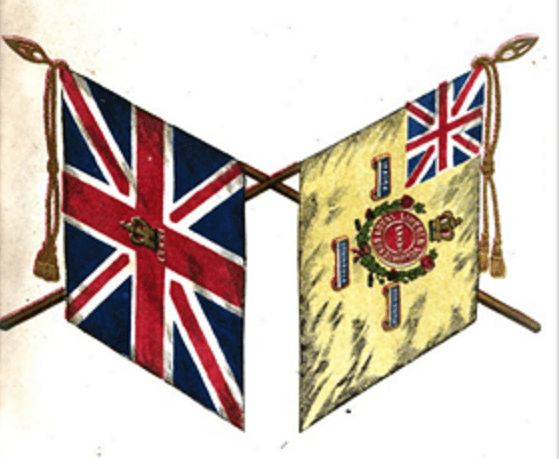
The place now known as a neighbourhood of the stately city of Lahore, Mian Mir – (today called Lahore Cantonment) – was, in 1857, a military station of its own. Stationed here were 850 men of Her Majesty’s 81st Regiment, two European troops of HEICo Horse Artillery, the 16th BNI – a famously decorated regiment that had won its battle honours for Mysore, Seringapatam, Ghazni, Kandahar, Kabul, Mudki, Ferozeshur, Subraon – their colours boasted the embroidered star for Seringapatam and the Royal Tiger under a Banyan Tree for Mysore. Raised in 1764 by Captain Alexander Dow, the Scottish orientalist whose renown was less for his fighting skills but for his translations, which consisted of two overwhelming works – “Tales translated from the Persian of Inatullah of Delhi” and the “History of Hindostan, translated from the Persian of Ferishta.” Although Dow had left them shortly afterwards, the 16th bravely fought their way through 93 years of history.
The 16th was joined by the 26th BNI, who had served distinction in Arracan, Kabul Mudki, Ferozeshur, and Subraon, the 49th, which had seen service in Arracan, Punjab, and Multan. To complete the picture, the 8th Regiment of Light Cavalry, whose fame ranged from Bharatpur, Puniar, Maharajpur, Ferozeshur, Punjab, Chillianwallah, and Gujerat. Of all the regiments in Mian Mir, the 16th was by far the oldest.
As for the officers in Mian Mir in May 1857, Brigadier Stuart Corbett had command of the station in the absence of General Gowan, Colonel Boileau commanding the artillery, and Colonel Smith, commanding the 81st.
On the 12th of May, while fugitives struggled through the countryside around Delhi and Hewitt cooled his heels in Meerut, in Mian Mir, on the night of the 12th, they were holding a ball. Not that they didn’t know what had happened – intelligence of the Meerut outbreak had reached Lahore on the 11th and on the following morning, a telegram brought the shocking news about Delhi. Unlike Delhi however, this was the Punjab.
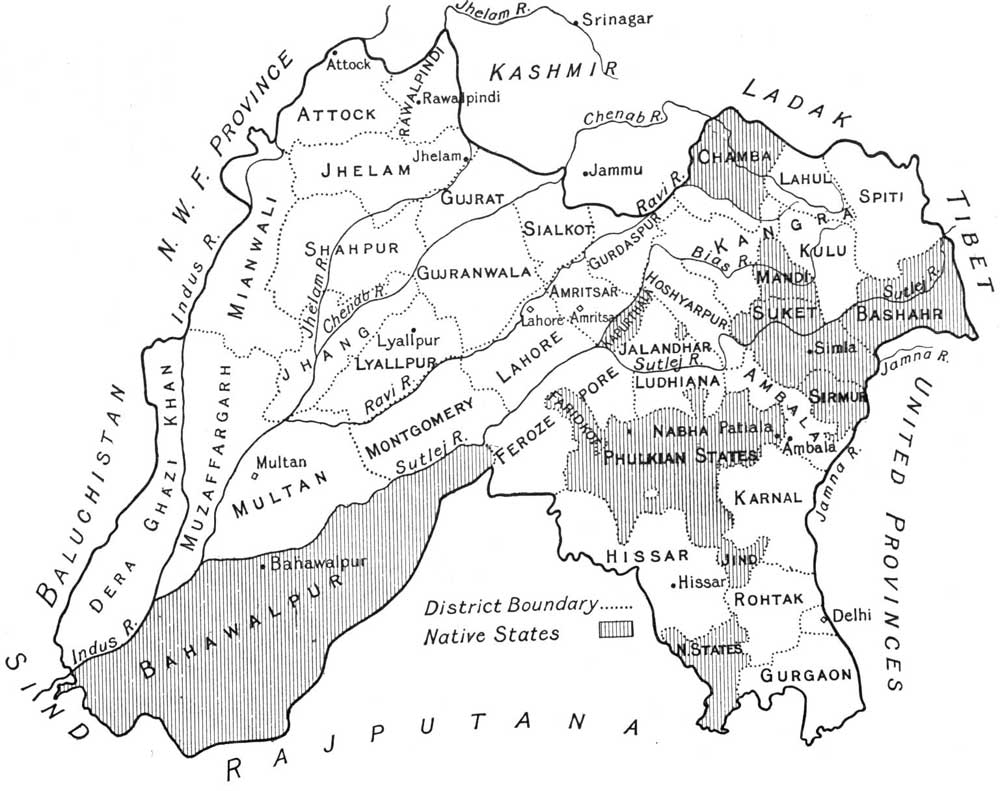
Following the news about Delhi, Robert Montogomery, Judicial Commissioner of the Punjab, wasted no time in ordering together seven senior civil and military officers to a hasty conference – their most pressing subject intelligence received by the station commander, Brigadier Corbett. He had been informed by a Sikh NCO of the Police Corps that the regiments in Mian Mir were ready to mutiny the next day. Their plan was to capture Lahore Fort, release the prisoners in the goal, and without a doubt, massacre every European they could find.
Where such a report might have been brushed off as a rumour and, at worst, ignored even a few weeks earlier, Brigadier Corbett did not wait for a confirmation. He did not speak to the native officers; he didn’t harangue his men with speeches about staying true to their salt. He acted – all native regiments were to be disarmed and confined to barracks. He met with very little opposition to what must have seemed like an audacious plan. One civilian official flatly refused to believe the Europeans would be massacred, but the military men remained firm – whether a conspiracy existed or not was beside the point; they would not be caught off guard as so obviously had happened in Meerut.
Ill in Rawalpindi and desperate to go to the hills to cure his damaged health was Chief Commissioner John Lawrence, the less approachable brother of the eminent Sir Henry, but in all ways as capable. He, too was not taking the situation lightly. His orders sent to Lahore were clear – every native regiment was to be disarmed and restrained in barracks, the only exception was to be the Sikh Cavalry and the Punjab Police. Like Corbett, Lawrence refused to take any chances. Once again, the civil officers were left ruffled – they trusted their men; if Corbett and Lawrence didn’t, then this really should not be their problem. It was Montogomery who had the final word,
“These men will take up arms if they see us as weak. If Lahore falls, the Empire falls. It is best to disarm them completely. As far as rebels go, no prisoners; we have no time or space for them.”
Grumbling aside, the civil officers agreed.
The Brigadier is going to Disarm the Native Troops
“Tonight, too, we all go to a Ball hardly one knowing the volcano we are here standing over, none perhaps but the Brigadier, Brigade Major, Wroughton, the Colonels and I, and poor Mrs. Brigadier Major, wild with fright…”
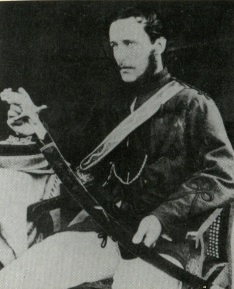
So wrote Second Lieutenant of the Bengal Engineers Arthur Moffatt Lang on 12 May. A young man of promise attached to the Public Works Department as Executive Engineer, Mian Mir Division. He was 25 years old, and although not looking for fame and glory, the next year of his life would see him involved in events he could never have imagined. For him, in 1857, Lahore was a pleasant station, his work was interesting, and he found himself in excellent company. The news of the mutiny in Meerut came to him in trickles of information, and it is not surprising that his opinion was initially one of disbelief.
“Were I Brigadier, I should draw them up, commend their fine state of discipline, point out the folly and wickedness of their brother sepoys, and confide entirely in their honour and loyalty to stand by their officers and Government. As it is, with this disarming, I expect they will rise. Where is this to end? I can’t believe the Anglo-Saxon is going to be turned out of India, but a feather’s weight more on the scale and down it will go.”
And so we come to the ball. All things told, it was ruse, but as ruses go, it was at least believable.
“The evening passed very pleasently – a perfect sham of smiles over tears. Half the Ladies were not present, and those who were there could barely disguise their anxiety while we, gentlemen, had to give the brightest picture of the case as possible…” The 81st Regiment of Foot (2nd North Lancashire) had only just arrived in Lahore; it was not unusual to hold a ball for the officers of a newly quartered regiment – and the orders were clear: don’t panic, act normally. Yet Lang and the other officers did manage to hold out until early in the morning, keeping up appearances.
Long before dawn on the 13th,
“Three Companies of H. M.’s 81st fell in and marched off to the fort at Lahore under Colonel Smith. Ten men per company had been also ordered to sleep in their barrack rooms with ‘their clothes on.’ At four o’clock in the morning, the remainder of the regiment fell in and were ordered to ‘loosen their ammunition’ – a proceeding which aroused the curiosity of the honest soldiers to the highest pitch…Leaving the barrack guards doubled, six companies, twenty-four files each, started for the parade ground, and were formed up in contiguous columns.”
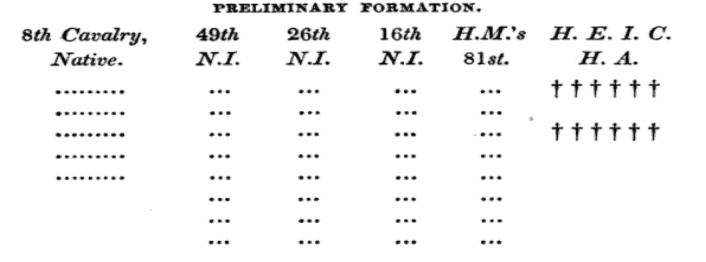
Brigadier Corbett then directed to be read out the Governor-General’s directive regarding the disbanding of the 34th at Barrackpore; as colonel of the 16th, Corbett started off by addressing his own men. He complimented them for their brave service, for their distinguished reputation and “intimated dimly the step which it was his painful duty not to adopt.” He then ordered the native regiments to change from front to rear, “by the wheel of sub-divisions round the centre” – in the meantime, the European artillery were loading as they moved, and the 81st formed a line facing the native regiments.
With the artillery port fires lighted and the guns loaded with grapeshot, the regiments were ordered to pile arms.
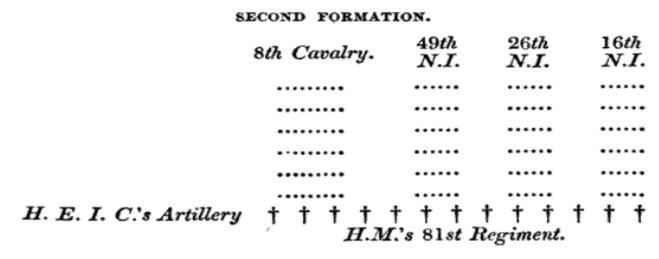
By early morning, all 2000 muskets and 500 swords of four regiments were piled into carts, and the men were marched back to their barracks. Not a single shot was fired.
While the parade was happening in Mian Mir, 3 companies of the 81st had moved in Lahore Fort itself, where they swiftly disarmed the sepoy garrison, which consisted of a half battalion – within 2 hours after dawn, Lahore was secure. With the help of the Sikhs, the 81st guarded, marched and skirmished across the Punjab until the end of 1857, covering an impossibly large territory which today covers parts of Pakistan as well as the state of Punjab in India.
Sources:
Blomfield, David, ed. Lahore to Lucknow: The Indian Mutiny Journal of Arthur Moffat Lang. London: Leo Cooper, 1992.
Chick, Noah Alfred. Annals of the Indian Rebellion. Calcutta: Sanders, Cones, and Co., 1859.
Cooper, Frederick. The Crisis in the Punjab: From the 10th of May until the Fall of Delhi. London: Smith, Elder and Co., 1858.
David, Saul. The Indian Mutiny: 1857. London: Viking, 2003.
Gajrani, Shiv. “The Sikhs: The Revolt of 1857 in Punjab.” Proceedings of the Indian History Congress 61 (2000): 679–85. jstor.org.
Hibbert, Christopher. The Great Mutiny: India 1857. London: Allen Lane, 1978.
Holmes, T. R. E. A History of the Indian Mutiny. 4th ed. London: W. H. Allen & Co., 1891.
Malleson, G. B. The Indian Mutiny of 1857. London: Seeley and Co., 1891.
Singh, Ganda. The Indian Mutiny of 1857 and the Sikhs. Delhi: Gurduara Management Committee, 1969.
 Mutiny Reflections
your stuff is truly so interesting.. having been in that part of the world, even so, i learn so much when i read, and re-read.. amazing..
LikeLike
Thank you! There is more to come, just getting my notes together for the next step. I hope I can continue!
LikeLike