The Boat Captured
Delafosse, Thomson and Murphy
Of the four men who survived, only three lived to tell the tale of what happened next, and the accounts are as varied as the individuals. We will start with Mowbray Thomson.
“…instead of waiting for them to attack us, eighteen or twenty of us attacked them, and few of their number escaped to tell the story. Their boat was well supplied with ammunition, and we appropriated to our own use, but there was no food, and death was now staring us in the face from that direction. That night we fell asleep faint and weary, and expecting never to see the morrow; but a hurricane came on in the night and set us free..” According to Thomson, the boat was now free and floating but had drifted into a side channel opposing Surajpur. The party was once again discovered and opened on them with musketry, and once again, the boat was held fast by a sandbank.
At 9am, Major Vibart directed Thomson, Lieutenant Delafosse, Sergeant Grady and eleven privates of the 32nd and 84th Regiments to “wade to the shore and drive off the sepoys” while he attempted, once again with the remaining men, to free the boat. “Maddened by desperation, we charged the crowds of sepoys and drove them back some distance, until we were thoroughly surrounded by mingled party of natives, armed and unarmed. We cut our way through these, bearing more wounds, but without the loss of a man, and reached the spot at which we had landed, but the boat was gone. Our first thought was that they had got loose again and were further down the stream, and we followed in that direction but never saw either the boat or our doomed companions any more.”
Lieutenant Delafosse, in “Annals of the Indian Rebellion” makes no mention of the first charge but writes of the second: “On the morning of the third day, the boat was no longer serviceable, we were aground on a sandbank, and had not strength sufficient to move her; directly any of us got into the water, we were fired on by thirty or forty men at a time; there was nothing left but for us to charge and drive them away, so fourteen of us were told to go on shore and do what we could. Directly we got on shore the insurgents retired, but having followed them up too far we got cut off from the river and had to retire ourselves, as we were being surrounded; we could not make for the river but had to go down parallel with it, and came at the river again a mile lower down, when we saw a large number of men right in front waiting for us, and another lot on the other bank should we try to get across the river.”
As for Private Murphy, his account appears to mingle the two incidents: “So at about 8 o’clock the same morning, our boat got stranded on account of all the water which got into it from the gunshots and no way of getting it out. So on the left bank of the river there was a large village about one mile and from there came a large party of men some in regimental and some in native costume and they came within about one hundred yards of our boat. They commenced firing at us. There was a civil officer in the boat by the name of Wilbert – he gave orders that there was two officers, twelve men to go and face the party. At the time we had no clothes. We got a piece of cloth and wound it round our waists and carried with us about 30 rounds of ammunition. We drove them back about 600 yards and returned to the boat to see if we could get her off the bank and at the same time everyone that could got into the river to see if we could get her off but it was impossible to do as she was half full of water. So they came so close two at a time that we were ordered to face them again. So we followed them so far that we were cut off from the boat altogether and we had to retire by the bank of the river for about seven miles and all the time the party after us firing at us. So they captured the boat and brought her back to Cawnpore..”
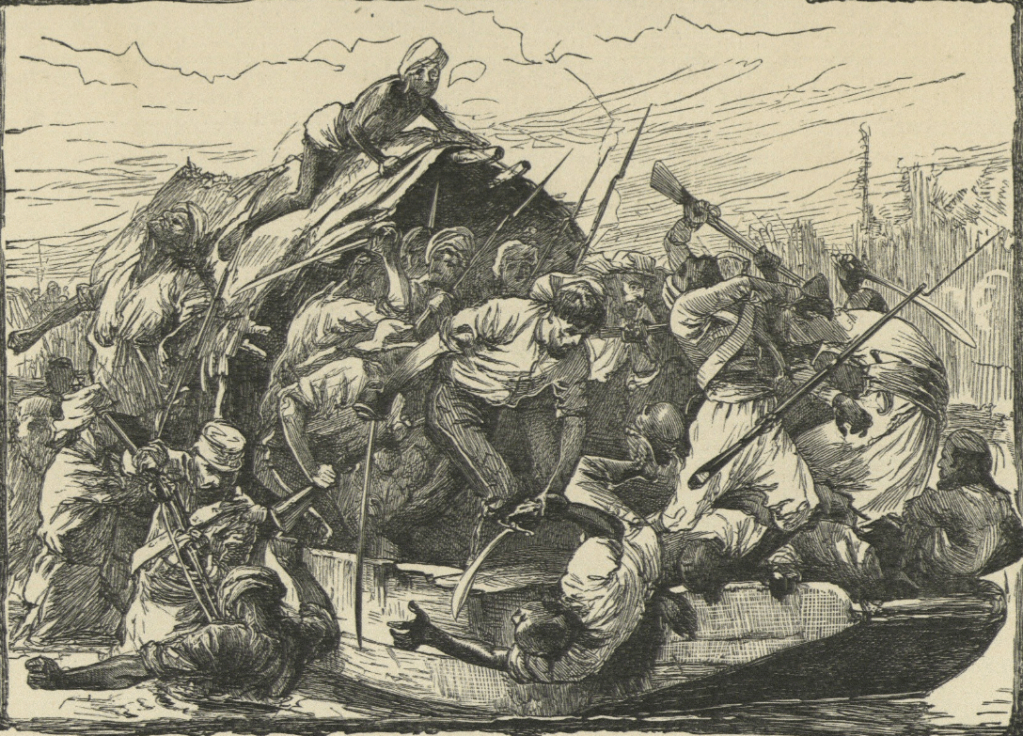
The fate of Major Vibart and the remaining survivors on the boat could only be ascertained many months later.
After Thomson and the others had left in their attempt to draw off the attackers, more sepoys arrived to take their place and opened fire on the battered boat. Lieutenants Battine, Satchwell, Balfour and Chalmers were killed while Daniell and young Master were wounded. Major Vibart decided that their plight, even if they could release the boat, was indeed hopeless.
Instructing the remaining men to throw their weapons overboard, Vibart ordered the surrender. As sepoys waded through the water to collect the guns, the survivors in the boat feebly helped their wounded companions to the shore. Assisted by a few villagers, they were carried to the shore. Hastily assembled carts were brought forward for the women, children and the wounded while the men were bound together by ropes – miraculously Lieutenant Fagan was still alive although his legs were smashed. It was an eighteen-mile journey from Sheorajpur to Cawnpore – along the way, Major Vibart would bleed to death from his wounds as would Lieutenant Master, whose father was fighting in Lucknow. He would receive his son’s final note from Cawnpore, but there would never be any word from Allahabad. Along with Vibart, Master’s body was thrown onto the roadside, a feast for the jackals and carrion birds.
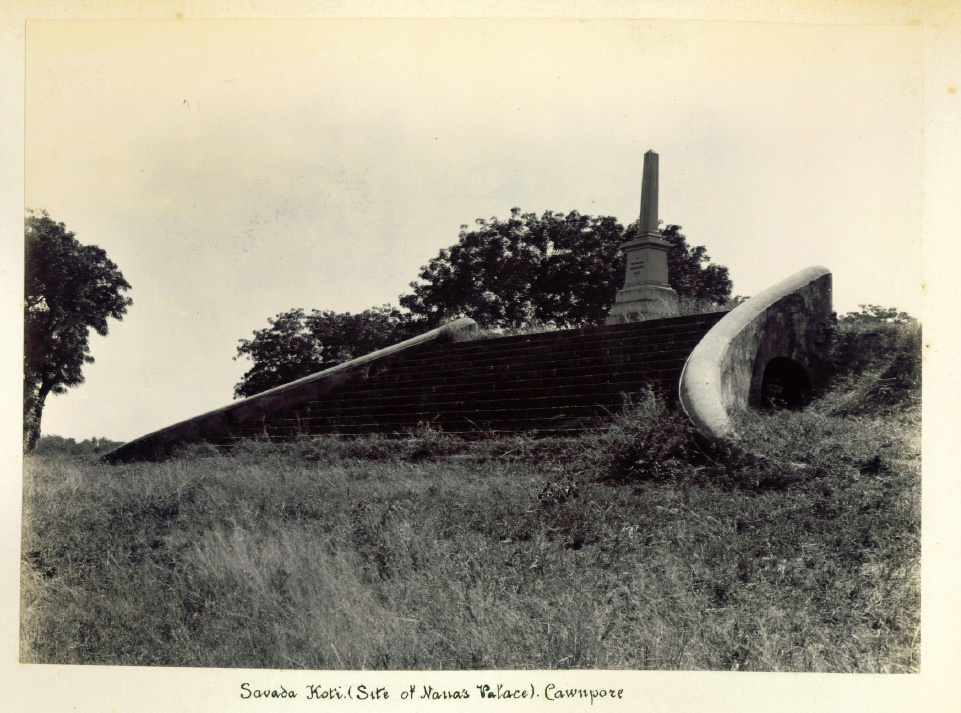
The party that reached Savada Koti on the 30th of June was quickly separated out – the four children and remaining women were placed to one side; among them was Ann Fraser, who had escaped from Delhi in May. The men were brought out into the plain in front of the house and shot. One woman was killed with them – the doctor’s wife refused to be parted from her husband, and clinging tightly to his waist, the sepoys were unable to detach her. The rest of the women and children were brought to the Bibighar to await their fate.
Sources:
Chick, Noah Alfred. Annals of the Indian Rebellion. Calcutta: Sanders, Cones and Co., 1859.
Kaye, John William. A History of the Sepoy Revolt. Vol. 2. London: Longmans, Green, and Co., 1896.
Mukherjee Rudrangshu. Satan Let Loose upon Earth”: The Kanpur Massacres in India in the Revolt of 1857. Past & Present, No. 128 (Aug., 1990), pp. 92-116.Published by: Oxford University Press on behalf of The Past and Present Society. Stable URL: http://www.jstor.org/stable/651010
Mukherjee Rudrangshu. Spectre of Violence. The 1857 Kanpur Massacres. Viking, by Penguin Books, 1998
Shepherd, W. J. A Personal Narrative of the Outbreak and Massacre at Cawnpore. Lucknow: Methodist Episcopal Church Press, 1879.
Thomson, Mowbray. The Story of Cawnpore. London: Richard Bentley, 1859.
Trevelyan, G. O. Cawnpore. London: Macmillan and Co., 1866.
Ward, Andrew. Our Bones Are Scattered: The Cawnpore Massacres and the Indian Mutiny of 1857. New York: Henry Holt and Co., 1996.
 Mutiny Reflections
👌👌
LikeLike
It is a tale that I know but reading your account and the testimonies of the survivors was harrowing! What stories would Miss Wheeler and Miss Horne have told?? And the sheer nerve of the Bradshaw party!! So much here to reflect on.
LikeLiked by 1 person
Amy Horne did leave behind her account but sadly she was not initially believed. As she as not and “English” girl (her family were Anglo-Indians and some of them were even of French descent) she did not fit the picture of the suffering English maiden. Ian Breckon’s thesis looks at her accounts in some detail – https://core.ac.uk/download/pdf/29422615.pdf
Andrew Ward does use her account to piece together the siege in the entrenchment – as the book, Our Bones are Scattered has been widely read, I did not include her descriptions in my writing this time around, though I may go back to Amy later.
LikeLiked by 1 person
Thank you for this!! Yes, I had imagined that many of the folks you mentioned that managed to somehow escape must have been Anglo-Indians. The sheer courage and nerve needed to survive that carnage is, to me, beyond humbling!
LikeLiked by 1 person
It is very humbling. I also find private Murphys account chilling. He wasn’t an author or an officer and even today many people think he didn’t survive. I found a letter he wrote and it is on my site.
The Anglo Indians were very marginalized. I would have like to have seen a full account by Mrs Bradshaw or Letts!
LikeLiked by 1 person
Thank you! I found the transcript on your site! :-)
Like you, I would love to know more of the Anglo-Indian experience during this time. Are you aware of any relatively contemporary accounts (seem to recall reading of Skinner’s daughter in print?) of normal folk? Given the numbers involved you would have expected some, even unpublished, accounts to have emerged or newspaper articles remembering the 25th anniversary etc. 🤔
LikeLiked by 1 person
Skinner’s daughter’s account was actually written by Florence Wagentreiber, who was a baby at the time of the mutiny. She wrote it using the accounts told to her by mother Elizabeth and father George. Her older sister was also there and she gave some input. However the account is none less riveting although written by someone who could have no recollection of the event. You can find it at https://archive.org/details/ase5555.0001.001.umich.edu/page/VI/mode/2up
Jonah Shepherd left his account of Cawnpore – he was an Anglo-Indian. It is sad that in his book he laments his family, so proud of their pale skin would now probably be murdered because of it, when they tried to pass themselves off as Indians. I always found that very sad. His book is available online at Google Books https://books.google.ch/books/about/A_Personal_Narrative_of_the_Outbreak_and.html?id=zlQOAAAAQAAJ&redir_esc=y
Normal folk as such did not leave many accounts. I have found a few by common soldiers but I think one of the most fascinating is by Kavanagh “Lucknow Kavanagh.” He was not a man to mince his words and it is refreshing to read.
https://archive.org/details/in.ernet.dli.2015.195720/page/n9/mode/2up He was accused of giving himself airs and graces but personally I think some his readers were just flat out offended by his opinions!
LikeLiked by 1 person
Thank you do much for your fullsome response and for these three links!! They all work for me, so, shall look forward to reading!! I have heard of Kavanagh and just read that Shepherd lost his entire extended family! Harrowing!
LikeLiked by 1 person
I have now read Breckon’s thesis! Some interesting reading and a lot of armchair speculation!
LikeLiked by 1 person
Excellent article on this desperate and tragic moment in the history of the British in India.
LikeLiked by 1 person