The Escape
Three boats out of an estimated 24 managed to set sail in some way or form – two drifted to the opposite shore and were immediately set upon by the waiting sepoys and villagers. Those who had not been killed were returned to Cawnpore. Another was sinking fast – it had been struck by roundshot beneath the waterline and was sinking. As she approached the third – Vibart’s boat – the survivors clambered onto the already overcrowded vessel, clinging to it in their last hope of survival. This ark, however, was bearly afloat. “Her rudder was shot away; we had no oars, for these had all been thrown overboard by the traitorous boatmen, and the only implements that could be brought into use were a spar or two and such pieces of wood as we could in safety tear away from the sides. Grape and round shot flew about us from either bank of the river, and shells burst constantly on the sand banks in our neighbourhood. Alternately stranding and drifting, we were often within a hundred yards of the guns on the Oude side of the river and saw them load, prime, and fire into -our midst. Shortly after mid-day, we got out of range of their great guns; the sandy bed on the riverbank had disabled their artillery bullocks, but they chased us the whole day, firing in volleys of musketry incessantly.”
The final boat was badly crippled but floated down the river into the main channel.
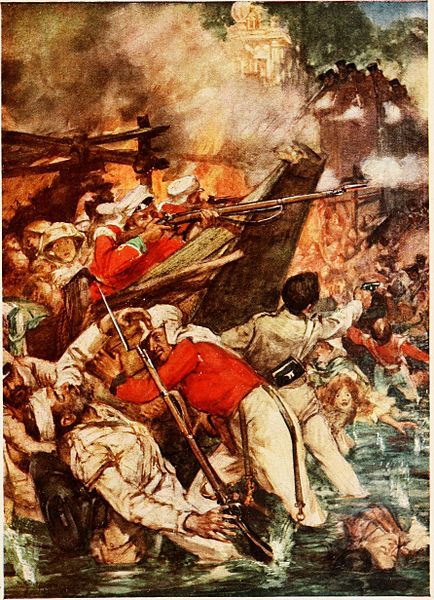
The Third Boat
A few men managed to swim away. Among them, Lieutenant Mowbray Thomson, who set his sights on the third boat.
“I threw into the Ganges my father’s Ghuznee medal, and my mother’s portrait, all the property I had left, determined that they should only have my life for a prey: and with one final shudder at the devilry enacting upon that bank, and which it was impossible to mitigate by remaining any longer in its reach, I struck out, swimming for the retreating boat. There were a dozen of us beating the water for life; close by my side, there were two brothers, Ensign Henderson (56th Native Infantry) and his brother, who had but recently come out to India. They both swam well for some distance when the younger became weak, and although we encouraged him to the utmost, he went down in our sight, though not within our reach; presently, his survivor, J. W. Henderson, was struck on the hand by a grapeshot. He put the disabled arm over my shoulder, and with one arm each, we swam to the boat, which by this time had stranded on a bank close to the Oude side of the river. We were terribly exhausted when Captain Whiting pulled us in, and had it not been for the sandbank, we must have perished. All of the other swimmers sank through exhaustion or were shot in the water, except Lieutenant Harrison, of the 2d Light Cavalry, and Private Murphy, 84th regiment. Harrison had left one of the boats in company with a number of passengers, and by wading they reached a small island, about two hundred yards from the shore…”
Thomson watched in horror as three sowars waded through the water and reached the islet, tulwars in hand. One mercilessly cut down a woman and then made for Harrison. Still armed with his revolver, Harrison shot his would-be assailant and then turned his attention to the second attacker, whom he likewise despatched. The third did not need a further invitation – he retreated back into the water, and Harrison set off swimming again.
The butchery was not over yet. From the shore, the insurgents fired mercilessly at the men in the water and at the people cowering in the boat. Thomson tried, in this hell and chaos, to offer a little comfort to a small boy, the son of Mrs. Swinton, who he found screaming in terror having just seen his mother fall overboard. “The little babe cried out, ‘Oh, why are they firing upon us? Did not they promise to leave off? ” I never saw the child after that and suspect that he soon shared his mother’s death.“
As the boat drifted on, it became increasingly difficult to manage – the dead and the wounded became entangled in its bottom, and it became imperative to lighten the load. The corpses were, with extreme difficulty, extricated and thrown overboard. Thomson nearly joined their number. Stunned by a bullet which struck him on the side of the head, he came to in time to be greeted by the words, “ We were just going to throw you overboard…”
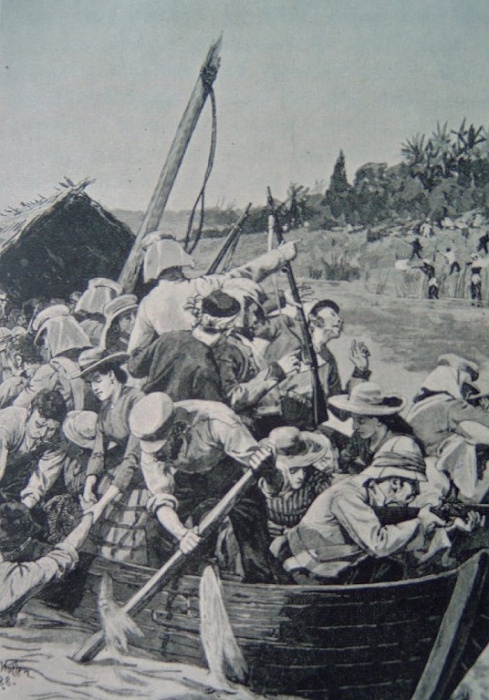
By nightfall, the boat had only floated six miles downriver before it was stranded on a sandbank.
Despite their efforts, the men could not move the keel, and it was finally decided to remain where they were, hoping the darkness would give them some shelter to at least offload the women for a moment and push the boat off into deeper water. Behind them, a burning boat floated downstream, sent by their would-be murderers – but it glided past the fugitives, missing them by a yard. Throughout the night, arrows with lighted charcoal attached to them flew through the sky from the short in an attempt to set the thatched roof on fire – the men quickly unfastened it and threw it in the river, effectively destroying their last means of shelter. Although they succeeded in pushing the boat off this sandbank using the cover of the moonless night as cover, it was only to flounder onto the next. Once again, the men jumped out of the boat, helped the women into the water, pushed off the boat, loaded the women and again floated for a moment only to end up on another sandbank. Thus, the night passed – around midnight, the firing from the shore finally ceased, and a little hope returned to the survivors.
When dawn broke, there was no sign of the pursuers. The boat had managed another four miles under cover of darkness, but it was becoming clear they could not continue without help. Spotting some men bathing in the river close to the shore, Major Vibart persuaded an Indian drummer who had escaped with them to speak to the bathers in the hope of getting some food. The drummer took with him the sum of 5 rupees, and after some discussion, one of the bathers agreed to not only bring food but to find some boatmen. He left behind is lotah as a guarantee of fidelity, but he never returned. Before leaving, he told the drummer that further downstream at Nazafgarh were waiting the men of the Babu Ram Baksh of Dhoniriakera, who had sworn not one Englishman would pass his territory alive. Their order was to capture the fugitives. In a final act of despair or hope, Captain Whiting hastily scribbled a note in pencil on a scrap of paper, stating, quite starkly, that hope had abandoned them. Securing it in a bottle, he tossed it in the river.
Their journey continued to its inevitable end.
At 2pm, the boat reached Nazafgarh. As they were stranded once again from the shore was heard the distinct rattle of musket fire. It was imperative to get the boat back into the stream – although shot through the arm the previous day, Major Vibart jumped out and lent his shoulder to the work – it cost him a shot through the other arm. Captain Athill Turner’s legs were both smashed, and Captain Whiting and Lieutenant Harrison were shot dead. Both Lieutenant Quin and Captain Seppings received shots to the arm while Mrs Seppings was injured in the thigh. Thomson quickly removed Harrison’s rings from his finger and gave them to Mrs Seppings in the quiet hope, should there be any survivors, she could use them as a bribe. Mr. Blenman, who had acted as a spy during the siege, was shot in the groin – a wound so severe he begged the other men to shoot him. There were no bullets left to spare. In the meantime, the attackers brought a gun into play, but a sudden torrential downpour put an end to their idea. In the rain, they could not make the gun discharge its lethal contents. There was no moving the boat – at sunset, the fugitives were still stranded. To their horror, another boat appeared, full of armed men whose intention it was to board their vessel. Their luck, however was in short measure as their boat too struck fast on a sandbank. For the British survivors, there was nothing for it but to charge.
 Mutiny Reflections
👌👌
LikeLike
It is a tale that I know but reading your account and the testimonies of the survivors was harrowing! What stories would Miss Wheeler and Miss Horne have told?? And the sheer nerve of the Bradshaw party!! So much here to reflect on.
LikeLiked by 1 person
Amy Horne did leave behind her account but sadly she was not initially believed. As she as not and “English” girl (her family were Anglo-Indians and some of them were even of French descent) she did not fit the picture of the suffering English maiden. Ian Breckon’s thesis looks at her accounts in some detail – https://core.ac.uk/download/pdf/29422615.pdf
Andrew Ward does use her account to piece together the siege in the entrenchment – as the book, Our Bones are Scattered has been widely read, I did not include her descriptions in my writing this time around, though I may go back to Amy later.
LikeLiked by 1 person
Thank you for this!! Yes, I had imagined that many of the folks you mentioned that managed to somehow escape must have been Anglo-Indians. The sheer courage and nerve needed to survive that carnage is, to me, beyond humbling!
LikeLiked by 1 person
It is very humbling. I also find private Murphys account chilling. He wasn’t an author or an officer and even today many people think he didn’t survive. I found a letter he wrote and it is on my site.
The Anglo Indians were very marginalized. I would have like to have seen a full account by Mrs Bradshaw or Letts!
LikeLiked by 1 person
Thank you! I found the transcript on your site! :-)
Like you, I would love to know more of the Anglo-Indian experience during this time. Are you aware of any relatively contemporary accounts (seem to recall reading of Skinner’s daughter in print?) of normal folk? Given the numbers involved you would have expected some, even unpublished, accounts to have emerged or newspaper articles remembering the 25th anniversary etc. 🤔
LikeLiked by 1 person
Skinner’s daughter’s account was actually written by Florence Wagentreiber, who was a baby at the time of the mutiny. She wrote it using the accounts told to her by mother Elizabeth and father George. Her older sister was also there and she gave some input. However the account is none less riveting although written by someone who could have no recollection of the event. You can find it at https://archive.org/details/ase5555.0001.001.umich.edu/page/VI/mode/2up
Jonah Shepherd left his account of Cawnpore – he was an Anglo-Indian. It is sad that in his book he laments his family, so proud of their pale skin would now probably be murdered because of it, when they tried to pass themselves off as Indians. I always found that very sad. His book is available online at Google Books https://books.google.ch/books/about/A_Personal_Narrative_of_the_Outbreak_and.html?id=zlQOAAAAQAAJ&redir_esc=y
Normal folk as such did not leave many accounts. I have found a few by common soldiers but I think one of the most fascinating is by Kavanagh “Lucknow Kavanagh.” He was not a man to mince his words and it is refreshing to read.
https://archive.org/details/in.ernet.dli.2015.195720/page/n9/mode/2up He was accused of giving himself airs and graces but personally I think some his readers were just flat out offended by his opinions!
LikeLiked by 1 person
Thank you do much for your fullsome response and for these three links!! They all work for me, so, shall look forward to reading!! I have heard of Kavanagh and just read that Shepherd lost his entire extended family! Harrowing!
LikeLiked by 1 person
I have now read Breckon’s thesis! Some interesting reading and a lot of armchair speculation!
LikeLiked by 1 person
Excellent article on this desperate and tragic moment in the history of the British in India.
LikeLiked by 1 person