Durand’s Three Weeks and What He Did Next
For details of Durand’s proceedings, readers can turn to The Malwa Field Force; however, we can also continue, in lesser detail, here.
“I have never approved of the assumption of the Agent’s powers by Captain Hungerford, Captain Elliot and Lieutenant Hutchinson when communication with myself at Sehore, Hoshungabad and Aseerghur was easy and rapid. What was necessary for the security and supply of the military post in the Fort at Mhow was the duty of Major Cooper of the 23rd Naive Infantry, the senior officer present, to perform. Why Captain Hungerford assumed the powers he did, I can neither understand nor approve; nor can I approve that men in the position of dependence upon Holkar, like Lieutenant Hutchinson and the occupants of the Mhow Fort, should assume the political functions of the Agent, and in utter ignorance of what had taken place at Indore, should take upon themselves, contrary to the express orders of the Governor-General in Council, to judge the conduct of Holkar and the Darbar.” (Durand’s dispatch from Mhow, No. 207, 18th August 1857 to the Government of India, paragraph 7)
What Durand appeared to have forgotten when writing this scathing letter was that for three weeks, no one knew where he was, and the letters Holkar, Hungerford and his own assistants had written to him, he never answered. He would further insist that Holkar was trying, by some means, to extricate himself from the slur of mutiny, by ingratiating himself with Hungerford and Elliot (Hutchinson was already a lost cause, being a relative of Lord Hamilton) and instead of giving him credit where credit was due, he claimed Holkar should have been able to not only forestall the mutiny but prevent it altogether. The European officers, in Durand’s arrogant opinion, had fallen into Holkar’s trap by assuming his innocence in the whole affair. He even went as far as accusing Lord Elphinstone of the same, leading Elphinstone to sharply rebuke Durand against holding any prejudices against Holkar.
Durand was not a man to admit his faults. His hasty retreat, though justified by the circumstances he was facing, was complicated by the fact that he did not proceed to Mhow. Had he done so, instead of retreating to Bhopal, he would have remained in contact with Holkar and Elphinstone; instead, by choosing the path he did, he left the European officers in Mhow with a responsibility he had forced on them by his actions, and consequently, was not present for any of the subsequent actions taken by Holkar or the officers. He effectively put a distance between himself and Indore and removed any possibility of influencing the outcome of any actions taken in good faith on his behalf. To so wilfully rebuke not just Hungerford but his own assistants shows the forceful nature of Durand’s character – he was not a man to be crossed, however lightly. Once he felt he had been unjustly treated, his capacity to carry grudges was beyond measure.
All we have, in Durand’s defence for the three weeks he spent “uselessly and sullenly aloof” (Dickinson) are filled up mainly by Durand’s son and by Sir John Kaye, in “securing the line of the Narbada”, of hurrying the troops up into Central India, and by completely disapproving of the actions of another civilian, Mr. Plowden, who to the best of his knowledge believed everyone at Mhow had been killed and it would be a waste of time sending forces to that station when they could be used elsewhere. While Sir John Kaye remains somewhat neutral regarding Durand’s actions, if history had been left to Durand’s son, who undoubtedly admired his father and, as a government official himself, was able to not only access but pick and choose his way through official papers as he saw fit in defence of his father, it would have cast aspersions on everyone else, including Lord Elphinstone.
Durand’s son surmises that Lord Elphinstone, instead of being the forward-thinking and active leader in the crisis, which he undoubtedly was, had contemplated abandoning the line at the Narbada River to secure the Bombay Presidency. Had Elphinstone considered this, he might have gone down in history as a fool – it is only Durand and, to some extent, Kaye who shovels the blame on Plowden instead, who make this supposition. Elphinstone, on the other hand, was doing everything in his power to push Woodburn forward and dispatch as many troops from his presidency to the succour of Central India as he could spare without sacrificing the security of Bombay. Instead, Durand harrassed Plowden, the Commissioner of the Central Provinces, wrote to General Woodburn and authorised the officers commanding the various military posts to disregard any order they might receive to abandon their positions on the Narbada. Durand remained in Sehore but one day – he then hurried onto Honsanghabad, from whence he harassed Mr. Plowden before travelling to Aurangabad himself to push Woodburn on. Durand had even, by way of an inferred threat, insisted he would travel to Bombay to present his argument directly in front of Elphinstone.
Woodburn, however, had already relinquished command to Brigadier Stuart, who was on his way to Mhow. Durand met up with Stuart at Asirgarh, and “by impressing his own energy on everyone present with the force.” entered Mhow on the 2nd of August. He would then presume to take control of subsequent military actions in Central India for the next months, instead of resuming his position as Agent to Holkar’s court. He appointed Major MacMullen, Magustrate of Mhow, to inquire into the facts of the 1st of July uprising. Durand further attempted to cast further aspersions not only on Holkar but on Maharaja Scindia of Gwalior, stating that, as Maharatas, they must, by default, be working together; their creed was enough to stamp them as traitors. Macpherson acted promptly from Agra, assuring Scinida his fidelity was never doubted, stating Durand was most likely unaware of the full circumstances of the current situation. While Scindia received a reassuring letter from Lord Canning at Macpherson’s behest, Holkar received nothing.
Major MacMullen, on the other hand, proved Holkar’s cavalry was not complicit in the Residency attack and acquitted them of all wrongdoing, disavowing Durand’s firm belief the cavalry had intended to cut off his retreat from the Residency. He promptly ignored MacMullen’s report, and as late as December 1857, long after MacMullen’s report, Lord Canning was still under the impression the cavalry “was conspicuous in their attack…“
When Durand was done traipsing Central India, he finally returned to Indore, as spiteful as ever. On the 14th of December, fully prepared to counter Holkar’s troops should they show any opposition to him entering the city, Durand met and disarmed Holkar’s regular cavalry and placed them under the care of the Sikh cavalry of the late Bhopal Contingent. He then sent a letter to Holkar’s chief minister demanding the remainder of Holkar’s troops, some 1600 infantrymen, be likewise disarmed. The order proceeded without as much as a murmur from Holkar, and the next day, Durand marched into Indore accompanied by a large body of the officers of the Mhow column. While the meeting between Durand and Holkar went off well, the very next day, Durand was relieved of his position by the return of Sir Robert Hamilton.
In all the preceding months, while Holkar was desperately trying to proclaim his innocence, Lord Canning did not once write to him; his letters to Calcutta remained unanswered. He had effectively been blocked by Durand, who had kept up a relentless correspondence with Calcutta, smearing Holkar’s name as effectively as he could. Holkar would not hear from Canning for more than a year after the mutiny, by which time Durand had done as much damage as possible. The simple fact remains, Durand had been humiliated by his retreat from Indore, but he was not willing to suffer his shame alone. The only person eager to implicate Holkar in the mutiny was Durand.
Lord Elphinstone, in a letter to Holkar on the 11th of July, wrote,
“I was highly delighted to receive your Highness’ letter, dated 1st instant. In reply to the same, I beg to inform your Highness that reinforcements have been ordered to proceed to Mhow, the strength of which will be suffice to protect the station and preserve the peace in your Highness’ territories. The endeavours which your Highness’ Government has made in suppressing rebellion and in punishing the mutinous troops will not be forgotten by the British Government…”
He was equally quick to write to Calcutta on the 13th.
“It seems clearly proved that Holkar was not implicated in the outbreak. He was unable to control his own troops, who were probably set on by the Bengal troops at Mhow and who attacked and plundered the Residency. Colonel Durand appears to be under the impression that Holkar had turned against us and that he was attacked by his orders. This, however, is certainly not the case. On the same evening, Holkar wrote to Colonel Durand and to me protesting his innocence and entreating that the march of General Woodburn’s force should be hastened as much as possible.”
Canning would eventually write to Holkar, but the letter, though friendly, was late in coming.
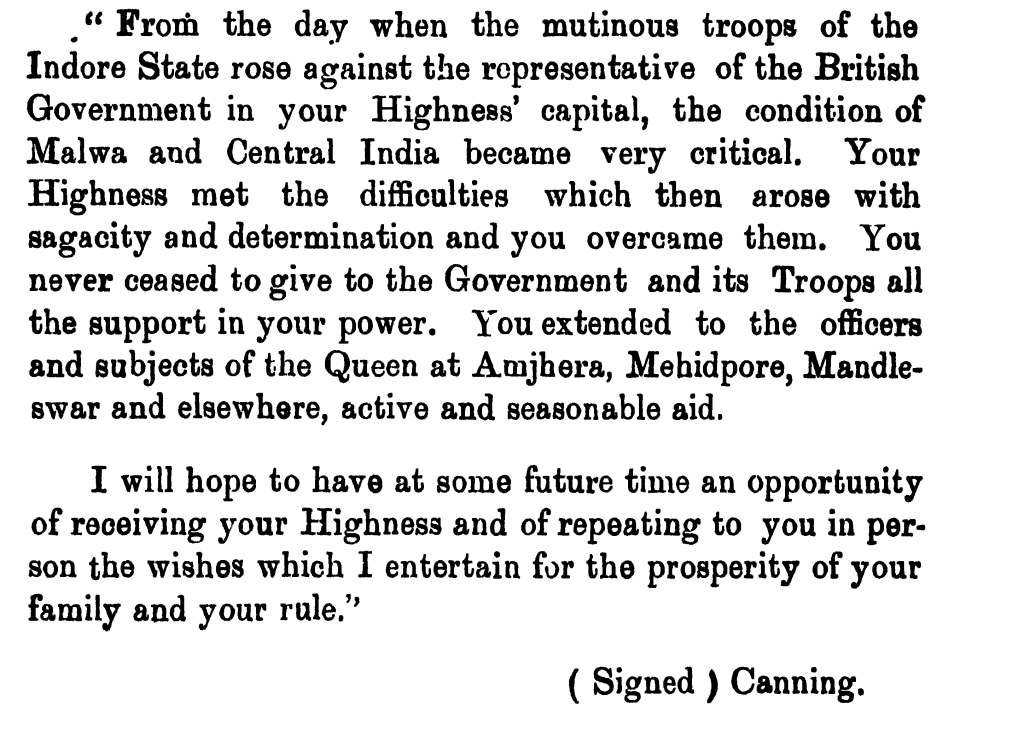
It was more than he would ever receive from Durand. In a reply to Canning, Holkar states,
“Here I cannot help asking, admitting that I failed to stop a Mutiny that exploded like a volcano, ‘How many British officers or Native Chiefs in that period of mutinies succeeded better than I did?’ ….I could not help asking, ‘could any Native Chief in such circumstances, prevent Mutiny?’ And did any other who saw his power prostrated…recover sufficient authority within five days as I did, to make his capital again centre of allegiance and order, to rescue British officers and subjects beyond his own territories as well as within them, to enable to the British Garrison to hold its ground in his neighbourhood, to give continuous military assistance to the British Government and employ all the resources of his State in its service?
Yet I had been doing this for months while neighbouring states of Gwalior and Bhopal were still helplessly in the power of Mutineers…with this strange conclusion, that the loyalty of the rulers of those States was acknowledged and liberally rewarded by augmentation of their territories. However, I certainly did ‘deserve the respect of the British Government’ and in the opinion of many Englishmen its ‘gratitude.’ Had I been unfriendly or disloyal, Captain Durand would not have survived to make representations against me…”
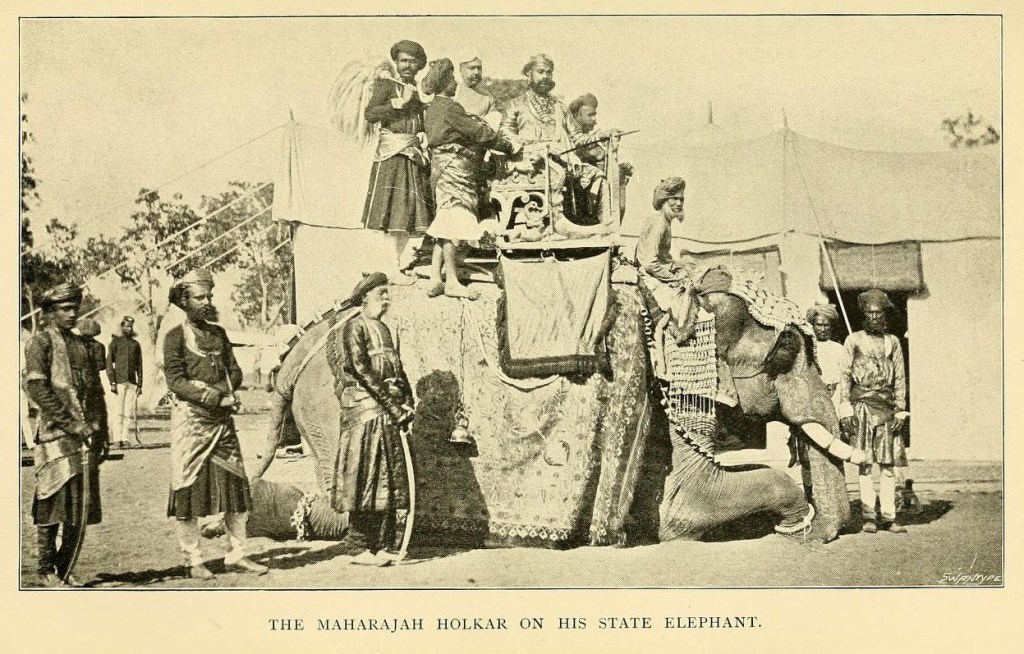
Holkar never received the thanks he deserved and remained, as Durand long as lived, under a cloud of suspicion. He would provide support to the Central India Field Force, under Hugh Rose, rendering them any assistance in his power – elephants, camels and escorts, he also extended his own network of spies and messengers, ensuring information about rebel movements was passed on swiftly and he even advanced at the head of his own troops to the cooperate with Brigadier Stuart’s forces at Mandasor. Unlike other rulers, Holkar never received the recognition he justly deserved.
Durand on the other hand, received more than he had cause to get. After sneering at Hungerford’s work at Mhow (Hungerford died in 1859, and by this unhappy circumstance, never fully rebuked Durand as he justly deserved), maligning Elphinstone, finding unpleasant things to say about Hutchinson and Elliot, and generally placing himself a head higher than he deserved, he deliberately did not furnish the government with a report explaining his conduct in the five months between July 1st and the 15th of December in regards to Holkar, simply stating he would write it “at leisure.” The report was never written – it would appear Durand did not find it his obligation to explain any of the statements he had made against Holkar, much less refute the baseless accusations he, Durand, was wont to throw about. On the other hand, by withholding such a report, he never found the “leisure” to make a distinct charge against Holkar and his court either.
“And thus, in the successive offices he filled, Colonel Durand felt it incumbent on him, whenever the occasion offered, to throw out vague imputations of misbehaviour against Holkar, which carried all the weight of his high position and reputation, and which, we may well suppose, were understood to refer to notorious and recorded facts.”
It would be Sir Robert Hamilton who would finally write the report to the government in regard to Holkar in which he would praise not only Holkar’s services but render him a “loyal, faithful and steadfast ally.” The report never met with much notice, and all Holkar received from it was the “cordial thanks” of the Government in January 1860.
Durand, however, would rise in Canning’s estimation – first to his aid, where he wielded enough power to persuade Canning to withhold the “complete and candid acknowledgement of Holkar’s good and faithful service” which the Governor-General had been prepared to issue in January 1858. Instead, in December 1859, Canning announced his condemnation of Holkar.
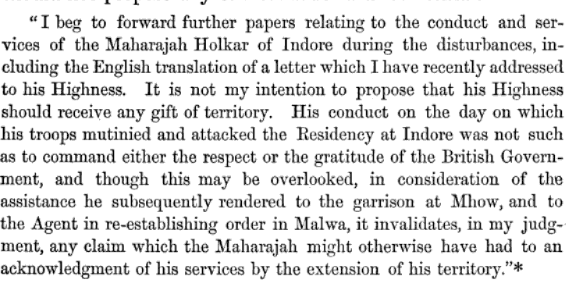
Holkar, for his pains, received the right of adoption and would be reimbursed for any expenses he incurred on account of troops “entertained in consequence of the mutiny of the Mahidpore Contingent towards the support of which the fixed annual contribution has been paid by the Indore Darbar.” Although he continued to appeal the right of territory, he never received the rewards he deserved.
In 1861, at a Jabalpur Darbar where Holkar met Canning in person, he was informed that the Queen included Holkar in her first creation of the Knights of the Star of India in acknowledgement of Holkar’s service. For a short time, Holkar felt his reputation was on the mend when the next blow came. Durand was appointed Foreign Secretary, a post from which he dominated all the States and Agencies of India, the very office any paper in regard to Holkar would have to pass first. He held the post until 1864 when he was made a Member of the Governor-General’s Council. He used his time, for nine long years, to ensure that any appeal made from Holkar or on his behalf remained hopeless as long as Durand had a stranglehold on the Calcutta Foreign Office or in the Viceregal Council in which Durand held a seat. Durand finally left the Calcutta government for his final position as the Lieutenant Governor of the Punjab. He would meet his end in 1871 by falling off an elephant that tried to enter a gateway too low to accommodate his personage. Thus died Henry Marion Durand, son of an officer of Waterloo.
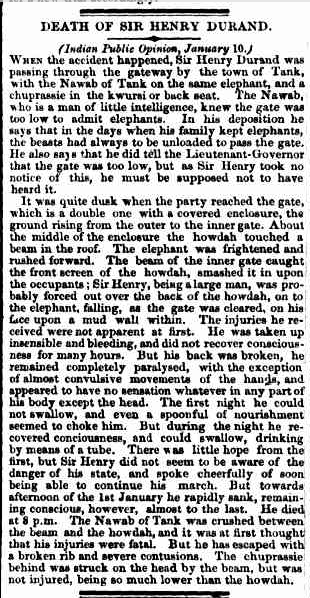
Source: The Trove
Holkar died in 1886 and was succeeded by his eldest son, Shivjirao Holkar. The line remained unbroken. On the 22nd of April, 1948, the Maharaja of Indore, Yashwant Rao Holkar II signed a covenant with the other neighbouring princely states to form the new state of Madhya Bharat, also known as the Malwa Union. In 1956, it was merged with the states of Vindhya Pradesh and Bhopal State to form today’s Madhya Pradesh.
We can surmise that the innocence of Holkar in 1857 has never been upheld with certainty. It, however, begs to question what would have happened in that fateful year had it not been for men like Holkar? That is a question even Durand was never forced to answer. Holkar was a victim of unfortunate circumstances, and he paid the price for unswerving loyalty with his honour.
Sources:
Ball, Charles. The History of the Indian Mutiny: Giving a Detailed Account of the Sepoy Insurrection in India. Vol. I. London: London Printing and Publishing Company, 1892.
Burway, Muntazim Bahadur M. W. The Life of His Highness Maharaja Tukoji Rao Holkar II, Ruler of Indore. Indore: Holkar State Press, 1925.
Durand, H. M. The Life of Major-General Sir Henry Marion Durand. London: W. H. Allen & Co., 1883.
Forrest, George W. A History of the Indian Mutiny. Vol. III. London & Edinburgh: William Blackwood & Sons, 1902.
Forrest, George W., ed. Selections of Letters, Despatches and other State Papers Preserved in the Military Department of the Government of India 1857-58. Vol. IV. Calcutta: Superintendent Government Printing India, 1912.
Intelligence Branch, comp. The Revolt in Central India 1857-59. Simla: Government Monotype Press, 1908.
Kaye, John William, and G. B. Malleson. Kaye’s and Malleson’s History of the Indian Mutiny of 1857-8. Edited by G. B. Malleson. Vols. III & V. London: W. H. Allen & Co. / Longmans, Green, & Co., 1889/1907.
Luard, C. E., comp. Indore State Gazetteer. Vol. II. Calcutta: Superintendent Government Printing, India, 1908.
Srivastava, Khushalilal. The Revolt in Central India – Malwa. Bombay: Allied Publishers, 1966.
 Mutiny Reflections