Agra in June and July
As soon as Mark Thornhill had relayed his adventures to his brother Cudbert, he was just as quickly shuffled off by his brother to tell his tale again to Mr. Colvin. With barely a rest and a bite to eat, Mark found himself on the steps of Government House. After waiting a few moments, “an attendant, with a dagger in his waistband and covered with a profusion of gold lace,” announced Mr. Colvin would see him now.
Mark found Mr. Colvin sitting in a large room at the end of a long table that was covered with a profusion of papers and books. The Lieutenant-Governor scarcely looked up when the magistrate entered, and even though he asked him to relate the events at Muttra, it was evident Colvin was not listening. He asked rambling questions, never once enquired if his son, Eliot Colvin, was alive or dead, and showed no interest or gave any remark when Mark finished. Colvin, just as abruptly dismissed him, and Mark returned to his family.
Later that evening, once dinner had been eaten and the ladies were safely ensconced in the parlour, Cudbert told his brother it was secretly, but generally, believed in Agra that the Lieutenant Governor was losing his mind. It was not a comforting thought and was almost as disconcerting as the panic he witnessed later that night.
As all Europeans had been told off to sleep at night at their designated rendezvous points, at eleven o’clock that night, he found himself in a house, situated on the summit of a high mound (possibly the same house that Mr. Muir calls The Lloyds) and had been thought as best suited for defence. There were two cannons on the terrace, and a party of English soldiers stood guard. It struck him as strange – at dinner, the company at the table had told him Agra had nothing to fear; the district officers, himself included, were considered as having wild imaginations. However, the alarm in the house was very real.
Several families had already arrived, and over the next hour, even more made their way to the house on the hill. Every available space was strewn with beds and bundles of clothes. Tired children screamed; servants scuttered in and out bringing this and that; the ladies fretted, and the gentlemen strutted about, too awake to sleep. When Mark finally dozed off at dawn, he was awakened and told it was time to leave – the same scene repeated itself, but in reverse, now everyone was scurrying back to their own houses.
On returning to the Thornhill house, he found a letter from the Seths waiting for him, informing him the Bharatpur and Ulwar forces had broken up and returned to their homes. The city, they added, was tolerably quiet, but there was no saying how long it would remain that way. Their recommendation was that he should return immediately and bring some cannons and English soldiers with him. Not waiting for breakfast, he drove quickly to Government House to tell Mr. Colvin.
He found him “very kind but more depressed,” holding a letter in his hand that General Anson had died of cholera. He added, “Nothing but ill news, each post announces some fresh misfortune.” He told Mark he could spare neither cannon nor soldiers but he could help himself to volunteers from the clerks in the offices. Most of them, however, were already spoken for as they had been sent away to other stations.
With much trouble, Mark Thornhill convinced eight men to come to Muttra with him. Cudbert lent him two elephants and at midnight, he set off back to Muttra. At Furrah, the town Mark had witnessed burning on his ride to Agra, he met up with Mr. Drummond.
Mr. Robert Drummond had ridden out of Agra, accompanied by his irregular cavalry, under the command of Saifullah Khan – they were making inquiries as to what had occurred at Furrah – they had with them 2 nine-pounder field guns, each gun accompanied by an English artilleryman. Mark met Drummond in his tent and stayed with him until late afternoon. Drummond would neither give Mark the guns nor enlarge his party – he returned to Agra while Mark Thornhill and his little band returned to Muttra.
Back at Agra, the nature of Colvin’s misery was only too obvious – he was both aware of what had happened and equally unable to prevent it.
“The country is in utter disorder, but bold men, holding together, should still make their way through. The real reason, I regret to say, why messages do not get delivered is that the belief in our power has been very deeply shaken and that men think there is a better chance for them to take to open plundering than to engage in special risks for our service…There are many good men, whose feelings are with us, but the vicious, the disappointed, and the desperate are the most bold in all such convulsions of order, and on the whole, there is (its police force being dispersed) no support to the Government …Aligurh and Etah, the two most important districts…are in a blaze of riot and revenge. It is melancholy to contemplate the fear calamities which, at but a short thirty or forty miles from me, are causing the misery of our poor subjects, for we have thought and toiled with so many anxious cares…Such is the state of things in extremely opulent districts, which but three months ago I prided myself on having done so much to improve…”
May had been but a foreshadowing of what was to come.
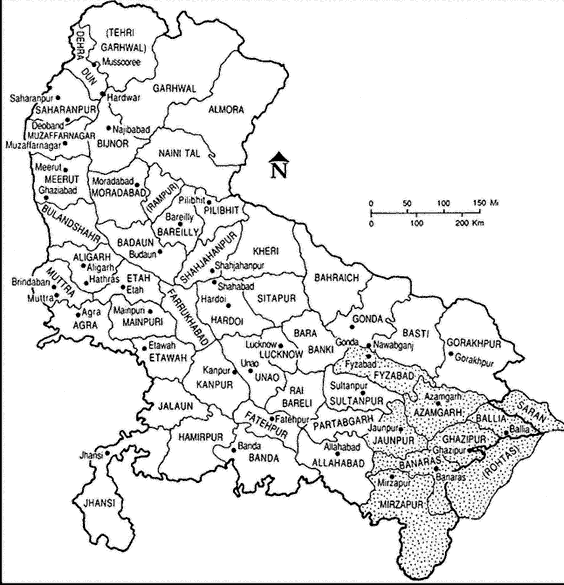
Mutinies had already occurred in 15 stations throughout upper India – if anyone, at the end of May, still thought this was a passing madness, June would finally prove them wrong, and for one man in particular, Charles Raikes, the Suddar Judge, it was about to become very personal. On the 30th of May, the last regular post left Lucknow – after this, there would be no letters for nearly a year; one of the messages was for Raikes from his friend, Sir Henry Lawrence.
“My dear Raikes, ” wrote Sir Henry,
“Kindly give me an occasional line until Delhi is taken. We are pretty jolly, but if the commander-in-chief delays much longer he may have to recover Cawnpore, Lucknow and Allahabad, indeed all down to Calcutta. We are in a funny position. While we are intrenching two posts in the city, we are virtually besieging four regiments (in a quiet way) with three hundred Europeans. Not a pleasant diversion from my civil duties. I am daily in the town four miles off for some hours but reside in cantonments, guarded by the gentlemen we are besieging! Send a copy of this to my brother George, at Ajmere; my health is very good for me! Christian is doing well and pluckily. What I most fear are risings in the districts and the Irregulars getting tainted. Daily, I have reports of conspiracies all around. Shows this Mr. Colvin and Reid.“
That very evening, Henry Lawrence, who had been warned an uprising was planned for 9 pm, would sardonically remark to the assembled officers, when the guns were heard in the cantonments shortly after, “Your friends are late.” The mutiny in Lucknow was as swiftly put down as it started, and Lawrence would hold the station for one more month.
Not so Mr. Christian. The son-in-law of Charles Raikes, George Jackson Christian, was Commissioner at Sitapur. He too, wrote to Raikes, what would be his last letter on the 30th of May.
“All quiet here; and throughout my division, the people seem well disposed, and the regular regiments, here the 41st, are very quiet. And I have in position 950 men so that if things go wrong elsewhere and they are tempted to rise, we could crush them in an hour. Our position here is strong, and our force so mixed that I am prepared to send, if required, reinforcements to the tune of 250 soldiers of the 9th Oudh Irregular Infantry in any direction and still retain enough to thrash the 41st Native Infantry. “Throughout the province, there is quiet, and at every station, preparations have been made.”
This optimistic civil servant was married to Raikes’ daughter from his first, very short marriage to Sophia Mary née Matthews. Sophia Carolina Anna Raikes was born a year after her parent’s marriage in 1834 and her mother survived her by one month – she died in April 1835. Although Raikes remarried in 1838, Sophia Carolina was his first-born daughter. She was also a mother – her little daughter Sophia and infant son, George, were with their parents in Sitapur. Christian, so determined to show the mutiny, not just a brave face but convinced he could “thrash” the 41st should they rise, had not sent any of the women and children away from Sitapur when there was still time. Although the story of Sitapur is told in “A Few Second Chances”, it is enough to say, Christian was wrong on all accounts. On the 3rd of June, his station burned, and he with his family, except his little daughter, lost their lives. It was a hard blow for Charles Raikes, made only worse when he learned, later in the year, that his little granddaughter had died in captivity in Lucknow.
Sitapur was but the beginning of bad news. On the same day, Azimgarh and Neemuch rebelled. Jhansi fell on the 5th, the same day the uprising in Cawnpore took place, while Benares, Allahabad and Fathegarh followed in quick succession with other uprisings occurring in Budaon, Jaunpore, Nowgong, Lalitpur, Sultanpur, Salon, Secrora, Gonda, Hamirpur and Banda. Every day, events were passing out of Colvin’s control and his power to initiate anything was quickly disappearing.
Europeans, forced to flee from their stations were making their way to Allahabad, Agra, Lucknow and even to Cawnpore. Some, like Mr. Edwards, who was forced to abandon Budaon on the 1st of June and the Probyns at Fatehgarh, who refused to go to Cawnpore, would go into hiding; others like Captain Scot and his party from Nowgong would be hunted through the countryside. The danger nearest Agra, only 70 miles distant, was the Gwalior Contingent – a considerable amount of whom, including men of the Maharaja’s own bodyguard, with their European officers, were in Agra, sent by Scindia for Colvin’s disposal. On the 15th of June, a day after the outbreak at Gwalior, Agra received the news that the Contingent had risen.
“Following it came likewise the information that the Maharajah, and his able minister, Dinkar Rao, still loyal and true, would use every means in their power to restrain the over-charged aspirations of their followers and their siphais. But graver events were at hand. Central India had risen; Rohilkhand had risen, and it was soon seen that the safety of Agra was imperilled from without.”
However, Agra continued as normal, or at least in their estimation as well as they could. The reports were distressing, but there appeared no need as yet to run to the safety of the fort. A permanent guard was set up at the Kandhari Bagh, and Charles Raikes set to work setting up his volunteer force, consisting of “Stout English clerks, sunburnt old soldiers on the pension list, Roman Catholic artillery men who had served under Scindia, East India sectioners, record keepers and tradesmen…” This impromptu garrison was well supplied with beer and biscuits, and a hundred large vessels, filled with water, were arranged around the outer verandahs, while sandbags were piled for defence. The 12-o’clock gun, which fired daily at noon, was dragged from its position and placed at the entrance to the Bagh. Grapeshot was improvised at a nearby coachmaker’s shop – the idea was to hold out at this makeshift fortress in case of a sudden attack from sepoys, mobs, prisoners or revolted regiments marching on Agra.
Raikes further organised a corps of Volunteer Horse. The men were to act as mounted police and patrols, while, if necessary providing escort to the women and children on the three-mile march from the Civil Lines through the city to the Fort, if necessary. Although initially under Raikes personal command he soon gave it over to Major Prendergast to act on his orders.
The first action Charles Raikes found himself on was to escort the fugitive women and children from Etawah who had been sent from that station and were in Fatehbad. On the 15th of June, Raikes led a small party, consisting of Mr. Phillipps, the Magistrate of Etah, Lieutenant Hugo James and a troop of thirty to forty Volunteer Horse twenty-five miles from Agra to Fatehbad, situated between the Chambal and Yamuna rivers.
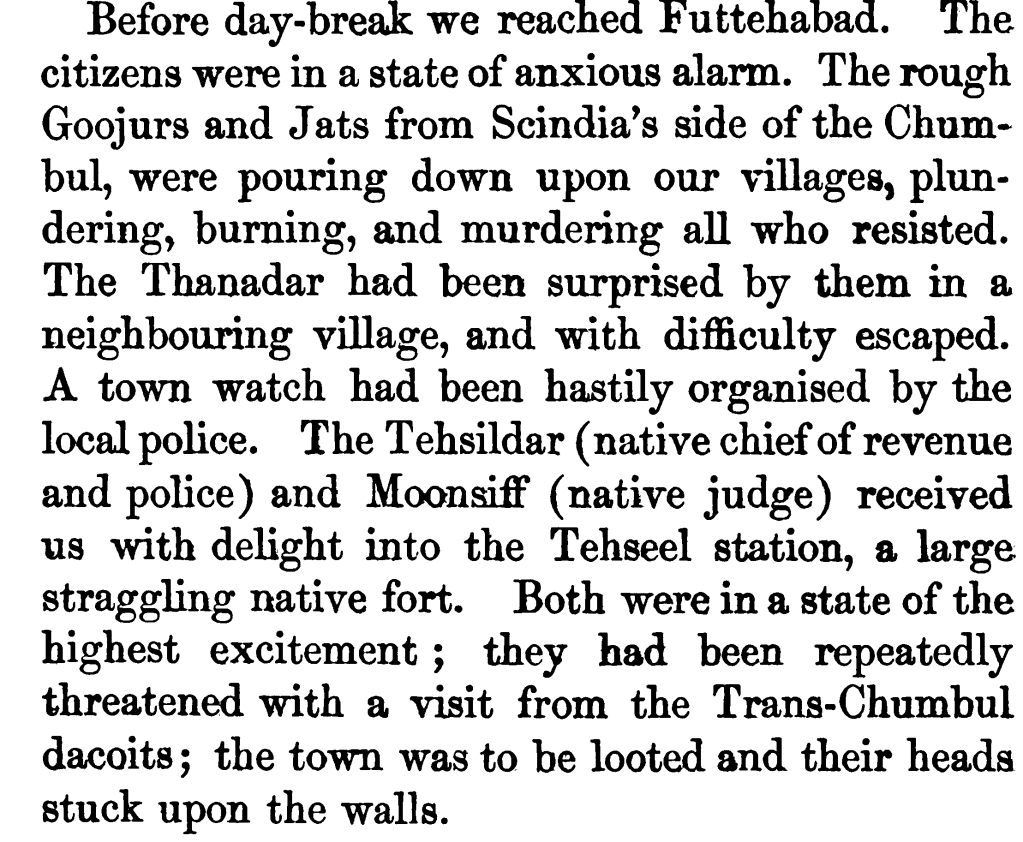
Shortly after their arrival, as Raikes was trying to get a little sleep, an alarm was sounded. Lights were seen in the distance, followed by the sound of men, horses and carriages. The Tehsildar, fearing the worst, put a cap on his gun and declared the enemy was on them – it turned out not to be marauders, but the fugitives from Etawah. The men and horses were their escorts – men of the Gwalior Contingent, Irregular Cavalry and some loyal matchlock men in the Raja’s personal service, all under the command of a very spirited young gentleman named W.H. Parker.
Raikes was loth to leave the Tehsildar without any support – his force had provided but temporary relief; however, he could not leave anyone in Fatehbad to keep the peace. Instead, he tried to drum up support from Luchman Singh, the chief of the Gujars and another taluqdar in the vicinity, imploring them to send a few hundred matchlock men and some cavalry to maintain the authority of the government in Fatehbad. It was an “unpleasant sign of the times” when the answer came,
“Luchman Singh was much afraid that his men would join the marauders in their mediated attack on the town and the Tehseel station.” In the past, such a request would have been complied with without hesitation but now, with the mutiny of the Gwalior Contingent, it appeared the EICo rule was well and truly over. They had decided, in self-defence, it was wiser to stay on the good side of Scindia’s subjects instead. As it was, the sepoy of the Gwalior guard very sulkily handed over the ladies, children and nurses over to Raikes, and his surly conduct confirmed that something terrible had happened. Raikes took charge and escorted the party without incident to Agra. On 16 June, when he arrived, he heard the Gwalior Contingent had mutinied – Agra had only heard the news the day before when he had been away, but the escort given to the ladies had known all along.
For Raikes, who had already lost his daughter, her husband and 2 grandchildren at Sitapur found the Gwalior situation particularly distressing – his friends, Major Macpherson and his sister, Mrs. Innes were in danger while his kinsman, Major Raikes had taken part of his regiment, the 1st Gwalior Cavalry to Mypoorie, leaving his wife and infant in Gwalior under the care of the Blakes. For all Raikes knew, they were probably all dead. To his relief, some of the Gwalior refugees, including Macpherson, had arrived in Agra, but his cousin was not amongst them. It would not be until the next day that she arrived in Agra with her child and the other ladies, including Ruth Coopland.
As for Charles Raikes, the pressure was beginning to tell. Surrounded as he was by personal tragedy and suffering from a low, intermittent fever, Mr. Harington came to him and said, “it was considered in the cantonments that be conducive to the public good,” if Raikes would give up the command of the Volunteer Horse and concentrate his efforts on the cantonments instead. Raikes himself admitted he had “no qualities left in me to compensate for my ignorance of military tactics.” He informed his force accordingly and focused his energies on the defences at the Kandahari Bagh.
Unfortunately, Agra was still besieged by one problem that was growing worse every day – the indefatigable, stubborn and overbearing Honorable Robert Drummond. In the latter half of June, Colonel Fraser, Mr. Harington, Charles Raikes and the other Suddar Court judges remonstrated with all earnestness with the very harassed Colvin regarding Drummond and his policy. The police at Agra were “more feared than respected by most men who wished well to the British Government” and lately every man who had “pretension to a uniform” and the armaments to match, was styling himself a sepoy. The Agra Police, so raised by Drummond in May, had been dressed, drilled and most worryingly armed. They had a large supply of balled ammunition, indulgently served out to them by Drummond, and he had the utmost confidence in his men. Nothing would or could shake his faith in his men. He also held sway over the Lieutenant-Governor, who, sick, tired and depressed, left everything entirely in Drummond’s hands. Drummond, even after the outbreaks in Gwalior, Neemuch and Nasirabad, felt the best policy was to show no fear; every sign of precaution was a sign of fear and must be rejected to keep, in his estimation, peace in Agra. However, it was at the invitation of the police that the Neemuch Brigade were now marching upon Agra. The same police cut off all communications, deliberately opposed the officers in their work of preparing the fort for siege and by their “insolent demeanour,” constantly proved where their hearts and minds lay. Colonel Fraser, Mr. Harington, Mr. Vansittart, Charles Raikes and his colleagues continued to badger Colvin to not continue his trust in Drummond’s advice. The fear was that when the Neemuch Brigade attacked, the police would cut off the retreat to the fort. They urged Colvin to allow at least their families, the schools, convents, the old and infirm and those civilians too poor to have access to any transportation besides their own feet to take up residence immediately in the Fort before such an attack became imminent. Colvin finally relented, but not before June was nearly at a close. However, the terms showed Drummond still influenced Colvin.
It was decided that no property was to be brought to the Fort beyond what could be termed a “sac de nuit” or basic necessities. This rule was relaxed slightly towards the end of June when some boxes would be admitted provided previously approved, in writing, by the officer in charge of the Fort. As such, when the crash finally came, hundreds of families were ruined as their property went up in flames in the first week of July. Besides private property, Agra would lose nearly all its archives, public and private records, books and libraries all because one man was too stubborn to admit there was a reason to fear. This was not the only problem facing Agra.
The Kotah Contingent, consisting of 600 men of all arms with 2 guns, had reached Agra in the early part of June. They were encamped for a time between the city and Muttra, then marched across the Yamuna to Sydabad, some 16 miles from Aligarh, to quiet the country, a mission they performed with much success, even ensuring that some of the long-due revenue collection resumed in the area. However, with the threat of the Neemuch Brigade looming ever closer, it was thought better to draw in the Kotah Contingent closer to Agra. The general feeling was, as they were sufficiently staunch, they could be held in check as long as European guns and bayonets were close at hand. However, it soon became evident, by their demeanour, that not all was well in the contingent. For the time being, they were held in check.
At Mynpoorie, Major Raikes and John Powel continued holding their own, as did the magistrates, including Mark Thornhill, in their various districts. In Agra, with all the destruction around them, Charles Raikes and the other civilians continued to sleep in the Kandahari Bagh, hoping above hope their families would remain safe in the Fort. The Neemuch Brigade, however, was but a short march from Agra.
Then came July.
Colonel Fraser was the first to consider the Kandahari Bagh a poor means of defence and repaired to a small house in the Fort. Residents in the Cantonments regarded those who remained in the Civil Lines as doomed men, and instead of Colvin being relieved of at least some of his responsibilities, he still had to give his approval for everything, no matter how trivial or how important. If anyone wanted a sword or pistol from the magazine, they could only receive it if Colvin countersigned the order – such minute management was too much for one man, and Colvin was visibly breaking under the strain.
Distressing news reached Agra from Fatehgarh – a plea for help from Vibart and Robert Thornhill, now besieged in the Fort, desperate notes written in French reached Colvin, begging him to send men for their succour. He could spare no one. The magistrate of Fatehgarh, George Probyn, his family and Mr. Edwards were hiding under the protection of Hardeo Buksh. Aligarh continued to hold out, but from Rohilkhand, Rajputana, Bundelkhand and Cawnpore, there came only silence. At Fathepur, the civilians had all left but one, Robert Tucker, to hold his ground for nearly a day before he was shot to death. Suddenly a small wave of magistrates and civilians flooded into Agra – Mynpoorie, Alligarh and Muttra were all forced to withdraw and flee to Agra.
On the 1st of July, a string of events was set in motion. Intelligence reached Agra that the Neemuch Brigade was in Fatehpur Sikri, 22 miles from the city – they had seized the officials, some of whom, willingly or otherwise, threw themselves into the brigade’s ranks. The tehsildar, after a short resistance, was carried off, beaten, and his arm broken. The Munsif was nominated the new Tehsildar by the brigade, while the Tannandars and Resaldar were allowed to remain at their posts. As such, a piquet of the Agra Voluntary Horse was posted at Pithoulie, four miles outside Agra, to keep an eye on the progress of the Neemuch Brigade.
On the 4th of July, the picquet sent word that the brigade was now halfway between them and Fatehpur Sikri, and an advanced guard of the brigade had been deployed towards Agra. It was decided to meet them in the field.
The Kotah Contingent, already rumbling with dissent, was to move out in the afternoon, and the European Regiment would follow them at eight in the evening. Drummond’s men, under Saif Ullah Keroli, were already in position on the road. As planned, the Kotah Contingent moved. They halted outside Agra and mutinied, the cavalry taking the lead while the artillery and infantry remained passive. They shot at their officers, killing one sergeant, and the entire contingent went off towards the Neemuch Brigade. The Agra Volunteer piquets led an attack – although there was little they could do besides cut up a few of the men of the retreating army, they saved the guns and all the ammunition. During the night, the two guns which had been placed with Saif Ullah’s levy were brought into Agra as a precaution, much to the dislike of Saif Ullah who, suspicious of this sudden distrust placed on him but equally suspicious of his men, asked for leave to return to the Karauli territory. On the morning of the 5th of July, his cavalry deserted Agra in a body, some of them to go and join the mutineers. His remaining matchlock men, whom Saif Ullah suspected of treachery, were sent away.
While some in Agra vainly hoped for reinforcements from the Bharatpur and Alwar Darbars, it soon became clear Agra would have to hold its own with the 3rd Europeans, a company of artillery and the volunteers. It was not a comforting prospect. They had to meet the reinforced Neemuch Brigade in open battle, come what may with the force they had at hand. On the 3rd of July, showing alarming signs of apoplexy, Colvin had no choice but to relinquish the Government for the next 24 hours to a Council, consisting of Mr. E.A. Reade, Brigadier Polwhele and Captain Macleod.
In Agra, almost all the civilians were now in the Fort, except a few individuals who chose to remain in the city. On the 4th of July, the Khandahri Bagh was finally abandoned, and even the Lieutenant Governor entered the Fort. Meanwhile, the Council of Administration met and decided on the following points:
“The information regarding the movements of the Neemuch mutineers received through the Police being ambiguous and contradictory, volunteers were called for from the officer,s who reported from personal observation the arrival of the camp within a distance of 15 miles from Agra. Brigadier Polwhele decided in the event of their advancing nearer, to meet and attack them.”
The Council was not quite finished.
Dr. Walker, superintendent of the Central Jail was instructed to release the short-term prisoners and pardon 70 Sikhs who would be detached as a guard for the defence of the jail, freeing up the European troops for Polwhele’s force. The pontoon bridge was broken and the boats were brought down to the fort and, on the 5th of July, all Native Christians were sent for protection to the Fort.
Once again, divided councils pervaded in Agra. The engineers Fraser and Weller beseeched Polewhele before sunrise on the 5th of July to give the European troops their breakfasts and send them off to find the enemy. Polwhele refused, saying the lives of the Europeans were too precious to be wasted on a needless manoeuvre, and the engineers were sent away, crestfallen but still hoping there might be a better result forthcoming. Ensign F. Oldfield brought the first tidings of the mutineers at 7 am, stating they were in Shahgunj, but only 2 hours later did Brigadier Polwhele determine to move out the troops. It took another hour to assemble them on parade. Colonel Fraser, hearing of the brigadier’s decision, rushed to offer his services as second-in-command, as the next senior officer in the station his request could not be denied, while Major Weller joined the Volunteers, on foot.
 Mutiny Reflections
My relative was Lieutenant James Graham and Frances Graham where their two daughters who died at the siege. Fortunately Fanny survived and her older daughter Sarah to return to England. I have all the correspondence. Malcolm Foster.
LikeLiked by 2 people
Thank you Malcolm! It is always fascinating to hear from relatives! Every history is unique and special. Do you know what happened to them? I would be honored to include your family history on my site.
LikeLike
Hello Malcolm. I was just wondering which regiment James Graham served with? I tried to trace him through the Agra Fort registry at Fibis but could not find him. I do have a Lietuenant James Graham at the Siege of Lucknow, who was died on the 5th of September. He was with the 4th Bengal Light Cavalry. I think I may even have a picture of his tombstone, but I don’t know if this is the same Lieutenant! He had 2 daughters who died during the siege of Lucknow – Fanny Jane, died 2nd of September and Georgiana M. Louisa who died on the 27th of September.
LikeLike
<
div dir=”ltr”>Hi Eva , yes this is the family member and he as I understand was
LikeLiked by 1 person
I do have a picture of his gravestone in Lucknow – it is not the best picture but I will going back in May so I can get a better one for you, as I will be doing some extensive photography at the residency, especially the cemetery.
LikeLiked by 1 person