The Hierarchy of Rule
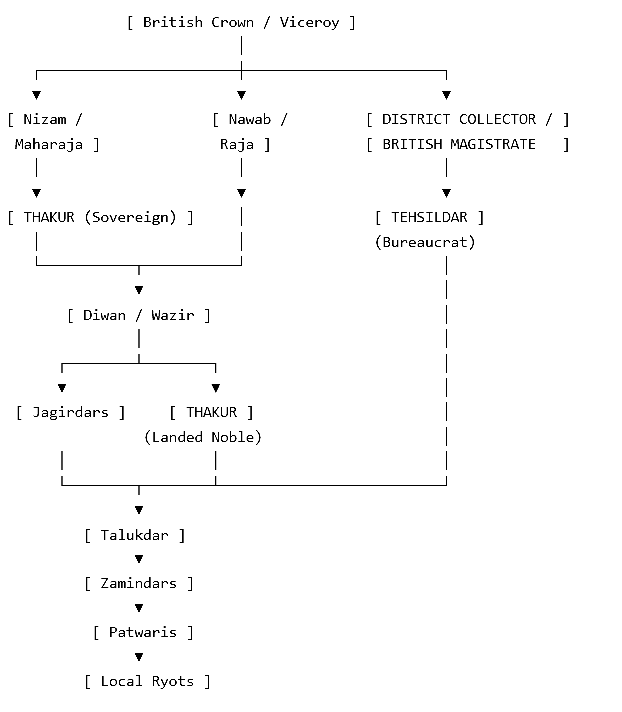
Those Rajas
and those Tehsildars, Thakurs, Talukdars and Zamindars…
Much of the work on a local, village level was still performed by Indians, without whom administering the districts would have been impossible. These explanations only scratch the surface of titles in the Indian ruling system:
Raja: This Sanskrit term translates to “ruler” or “king”. It was traditionally used to designate a monarch or a local feudal chieftain.
Maharaja: Derived from Sanskrit, it translates to “great king”. Originally denoting a sovereign over larger or multiple kingdoms (the equivalent of an emperor), over time, the title was also adopted by the rulers of various smaller princely states.
Nawab: Originating in the Mughal Empire, it means “viceroy” or “governor”. It was used to denote a semi-autonomous Muslim ruler of a province (such as the Nawabs of Bengal or Awadh) who answered to the emperor but governed their territories as independent monarchs.
Beneath any of these erstwhile nobles would be found:
The Diwan (or Wazir): The Prime Minister of the princely state. The Diwan managed day-to-day administration, treasury, and justice, answering directly to the Raja or Nawab.
Jagirdars: Feudal lords or nobles who were gifted large tracts of land (a jagir) by the ruler. They exercised restricted judicial and police powers over their territories and collected land revenues, keeping a portion for themselves and passing the rest to the ruler.
Zamindars: This was a hereditary, aristocratic title given to landowners. They would have held large swathes of land with the accompanying peasantry, whom they could tax at will on behalf of imperial courts or for the military. They were autonomous or semi-autonomous rulers who would give their allegiance to a higher power than themselves, such as a royal court or an emperor. A zamindar could be bestowed any of the following titles by the British, provided they proved their loyalty — Raja, Maharaja, Rai Saheb, Rai Bahadur, Rao, Nawab, Khan Bahadur. These titles were also bestowed upon princely state rulers.
Village Headmen / Lambardars: Local village elites who interacted directly with the peasants to enforce the tax demands passed down from the Zamindars.
Ryots: The bottom of the hierarchy, consisting of tenant farmers, peasants, and labourers who worked the land and bore the brunt of heavy taxation
The Talukdars, Thakurs and Tehsildars deserve their own explanations.
Talukdars could be compared more easily to the landed aristocracy. Instead of earning a government salary, a Talukdar owned or controlled a vast estate comprised of several villages, known as a Talukdari. In fact, the largest and wealthiest Talukdars in Oudh held so much power, fortresses, and private militias that the British referred to them as the “Barons of Oudh” and acted as a buffer between the state and the peasantry. They had actual power over their holdings and could hold the following positions depending on where in India they were located:
(1) A tax collector with administrative power over a district of several villages
(2) An official and civil servant, equivalent to a magistrate and tax collector — more common in Hyderabad State.
(3) A landholder with peculiar tenures
(4) Landholders dividing taxes for the Zamindars.
Simply put, a Thakur is the master of an estate. It is not a more modest title than rajah, and it has also been used to describe a “petty chief.” Of course, this does not mean he was necessarily petty in personage! They did not have a tremendous amount of power, but would have had influence in their areas. Powerful thakurs (like the Thakur Sahibs of Rajkot) bypass the larger kings entirely. They were recognised directly by the British Crown as rulers of independent, minor princely states.
Most Thakurs operated within larger kingdoms as elite Rajput warriors and land-grant holders (Jagirdars). They ruled their family estates (Thikanas) and answered directly to the Diwan or the state’s Maharaja.
The Tehsildar was a bureaucratic, salaried civil servant (a stipendiary officer) hired directly by either the British government or the administration of a Princely State. To manage vast territories, the British or local Maharajas divided “Districts” into smaller sub-districts called Tehsils (or Talukas). The Tehsildar was placed in command of this sub-district and ranked directly below the District Collector / Magistrate. The Tehsildar supervised land measurements, settled local land boundary disputes, ran the local sub-treasury, and strictly enforced revenue collection from landlords and peasants. They managed the Patwaris (village-level accountants who kept land records) and local tax collectors. Furthermore, the Tehsildar supervised land measurements, settled local land boundary disputes, ran the local sub-treasury, and strictly enforced revenue collection from landlords and peasants. Simply put, they were the tax collector for a tehsil or township.
When the mutiny did break out, the British put much store in their previous good relations with the men of the ruling classes but as they would find out, these relations could change on whim and depended very much on how much belief and trust these nobles still had in the EICo, as old grievances and strife took the centre stage.
Sources:
Bruce, J. (1810). Annals of the Honourable East-India Company: From their establishment by the charter of Queen Elizabeth, 1600, to the union of the London and English East-India Companies, 1707-8. Black, Parry, and Kingsbury.
Gilmour, D. (2007). The Ruling Caste: Imperial Lives in the Victorian Raj. Pimlico
Hunt, R., & Harrison, J. (1980). The district officer in India, 1930-1947. Scolar Press.
Kaye, J. W. (1853). The administration of the East India company; a history of Indian progress. London, R. Bentley. http://archive.org/details/administrationof00kayeuoft
Mathew C.K. Dr.(2020) The Historical Evolution of the District OfficerFrom early days to 1947. Azim Premji University
Trevelyan, G. (1895). The Competition Wallah. MacMillan and Company. http://archive.org/details/in.ernet.dli.2015.93629
Verelst, H., & Pre-1801 Imprint Collection (Library of Congress) DLC. (1772). A view of the rise, progress, and present state of the English government in Bengal: Including a reply to the misrepresentations of Mr. Bolts, and other writers. London, J. Nourse [etc.]. http://archive.org/details/aviewriseprogre00veregoog
Link:
https://rotarynewsonline.org/the-raj-and-its-civil-servants/
 Mutiny Reflections