Major Macpherson’s Journey to Agra
At daybreak on the 15th of June, with mixed feelings, Major Samuel Charters Macpherson turned his back on Gwalior and set off on the road to Agra. Macpherson and a small party of Europeans started their trek towards Agra, picking up on the way more fugitives who had managed to remain hidden through the long night. In all, 30 people, mainly women and children, were now facing the march under an unforgiving June sun.
We have already seen, in “The Contingent Speaks”, how, by the 15th of June, the rebels were no longer interested in killing fugitives – their leaders within the Contingent had tried their level best to stop the bloodshed in Gwalior – the death toll, though tragic, was compared to other stations, mercifully small. What they could not control completely were the roving bands of Ghazis who had been reinforced by men who had split off from the Contingent. However, when Macpherson met them at Hingonah, a village some 12 miles from the river, one of the leaders, Jahangir Khan, although dressed in all the accoutrements of a ghazni, protested he did not wish to harm any Europeans. Macpherson was not particularly confident that Khan was being completely honest, and Scindia’s bodyguard deserted the party, refusing to go any further – they had no wish to enter the territory of the Dholpur Rana on the other side of the river. Macpherson was forced to let them go, and the Europeans spent the night at the village, bedding down as best they could in their carriages or on the grass.
On the banks of the river, plunderers and men of Jahangir Khan’s ghazis had amassed and were quite obviously waiting for the fugitives to cross at Kaintri Ghat. Macpherson insisted they proceed at midnight – to make it somewhat easier, in case they needed speed, Macpherson transferred the women and children out of their carriages and onto horseback; he then took them along the bridle path towards Rajghat, lower down on the river. He was hoping they could escape those last 12 miles and ford the river under the cover of darkness.
“But deliverance was at hand. Soon after midnight the glitter of torches was seen in the distance, and a growing murmur of voices and the measured tread of an advancing force were heard. The hearts of many of the fugitives sank within them. But to their intense relief the advancing force proved to be the following of a friendly chief.”
What Macpherson seems to have forgotten was Dinkar Rao. The Dewan, anticipating there would be trouble at the river, had summoned the aid of Thakur Baldeo Singh, the chief of the Dandautia Brahmins. This rather robust and warlike tribe had been reminded by the Dewan that Macpherson had interceded on his behalf for certain tanks and wells for his people, a favour that the Thakur would be loath to forget. and “ The minister’s policy of dealing fairly with the subordinate races had thus borne fruit.” Proclaiming Macpherson’s life was in their hands and they would defend the Europeans to the death, the Thakur placed one body of his men to watch Jahnghir Khan while the rest surrounded Macpherson and his party.
On the far bank of the river, opposite one of the two paths that meet at the ghat, elephants and escort of the loyal Raja of Dholpur were waiting. A party of Jahagir Khan’s men had stealthily taken their posts during the night in the ravines over the path – but Buldeo Singh, cleverly, had sent out his spies earlier. Alerted of the presence of the ghaznis, he quickly changed their route. Macpherson and his party were able to cross the river safely, straight into Dholpur territory.
“The services of Baldeo Singh and those of the Dholpur chief were not forgotten. The former re- ceived a grant of land in British territory; and a jdgir or assignment of the revenues of certain villages from Sindhia; and 100 of his tribesmen, under the command of Gopal Singh,1 the chiefs brother, were selected to form a troop in a cavalry regiment, subsequently raised by Captain Meade, and known during the mutiny as Meade’s Horse. The latter received the honour of K.C.S.”
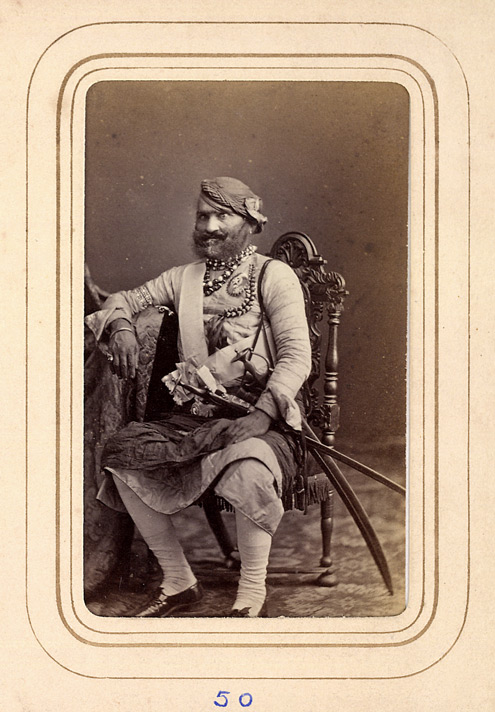
Dholpur [Dhaulpur], located in Rajasthan, was ruled by the Maharaj Ranas, who belonged to the Bamraolia Jat clan. Bhagwant Singh succeeded his father, Kirat Singh, the first Maharaj Rana of Dholpur. Like Scindia, Bhagwant Singh was a minor when his father died. He reigned under a Council of Regency until 1836, when he came of age, upon which he was invested with full powers of authority. In 1857, he raised a contingent of his own and sent 1,500 foot, some horse and artillery for service under the British at Agra. The rest of the journey proceeded without incident – after resting under the Rana’s protection for a few days, he provided the fugitives with carriages, elephants and a strong escort and saw them safely to Agra.
A few days later, he would do the same for Ruth Coopland, but her story was quite different from Macpherson’s.
 Mutiny Reflections