More Deaths
After a mile and a half, I came to the beginning of a long hill which the road skirted, and at that point of the road, there was an empty police station. I saw the, artillery sergeant ride up from the front to it, on my horse that I had put the wounded soobadar on, and get off and reel into the house. He said he wanted water for Mrs Smalley, who was dying ahead. The serjeant was a strong, active, healthy Scotchman, and the way he reeled off the horse and staggered into the house, to be down and await whatever might befall, told of awful exhaustion and of great disasters ahead. The vagabond been drunk in the morning and had galloped my horse backwards and forwards, in the wildest way, till he got sober and worn out…It was a disheartening sight.
There was no water at hand, so I pushed on and soon found Mrs Smalley by the roadside, lying dead or insensible, and her husband and baby beside her. All the rest had passed on. I had no water to offer. Mr Smalley said she had walked from the spot the carts were abandoned at, till she came to where I found them both, and there she had begun to stagger and reel about the road, and then lost speech and consciousness. A moan escaped Mrs Smalley as I looked at her, so I put down one child, and gave it, I think, to Mr Langdale, my writer, who came up on my horse, which the artillery Serjeant had left, and I took Mrs Smalley up before me, and carried her for some time. It was a difficult job to do so, as the poor woman (if alive) was unconscious, and the body was always slipping off, and most of the weight was thrown on my right arm. At last, I thought that death must have come, as the eyeballs were drying, and other symptoms appeared, and I had a consultation about it. It was settled that she was dead, so I took up a child and left the body by the roadside.
The Serjeant-Major’s death was an awful scene. He was a man of the Falstaff order; he had no hat on, only a thin cloth covered his head; he had got on thus far on foot, with the exception of a short ride on a horse, which I am told he was thrown from. I saw him all the way. He was terribly overcome by the heat, but he disgusted me by the spiritless way he behaved. He actually gave his sword to his little girl to carry and moaned and howled when I told him he should be ashamed of himself, so I took the sword. It would have done for Goliah.
At 2 pm, the exhausted party came to a village where once again, they were met with hostility but as no one attacked them, Scot felt it was safe enough to risk drinking water at the well.
We had just reached it, when we saw some of the villagers move towards the road, which passed very near the last-named village, and then came a bellow from the Serjeant -Major, who was hidden from sight by bushes, and screams from Mrs Laing and her two children, who were running away from the road towards us. No one was to be seen hurting them, and no one following. The Sergeant-Major soon emerged from the bushes in great distress and alarm. The woman and children said a villager had struck him. I got off my horse here, I now recollect, and put the bandmaster, and Mrs Tiernay and her daughter on him, and made Mr Langdale, the writer, take Mrs Smalley’s child and Mrs Tiernay’s boy, and we and others went on. Mr Smalley could walk no further. He had no shoes, and his feet were blistered. I had to leave here two little drummer children to some drummer’s care, to bring Mr Smalley and his little child on.
We had not been overtaken by the Serjeant-Major, and I had no intention of waiting for him, for there was no chance of saving him, and there was good hope of saving those about me. His little girl, whom he had made to carry the sword, wept and cried for him, poor thing, but we could not wait. Our pace was a slow walk, and not hurried, so that it gave a fair chance to all. We had not gone far ere I saw the poor man fall down an awful thump on the road. He rose and fell again, then rose, staggered, and fell several times. It struck me that blood to the head was the cause; then he could only get up on his knees, and when I last looked, he could only raise his head. Poor man, I hope he died soon. It was a horrible sight this, the more so that we could not even stay with him.”
Scot found a boot of Major Kirkes, big enough to fit on his injured right foot (he had been kicked by a horse days before when proceeding to the Lugasi Raja’s abode) and thus attired he began to walk, so he could give his horse to Mrs. Tierney (the mother of the wife of the sergeant-major) to ride.
Meeting with stragglers on the way, Scot would now learn of the next terrible news. Major Kirke was dead. He had collapsed of sunstroke on the road, and his men had buried him in a makeshift grave which they had scraped out of the hard ground with their bayonets.
His death terribly disheartened the men. Reward for recognition of their fidelity seemed bound up in his life, and when both had been much tested, it had passed away. My coming in sight cheered them greatly. I believe several ran out to meet me with water in their hands. Each Sepoy has a little lota of brass, and a string to draw water with. We rested awhile and then moved at a slow pace. We got the men to form two loose crowds, one in advance of and one behind the officers and women and children. As to falling in, I could not get them to do that; they were thoroughly disorganised, yet they were bent on protecting us. I assured them that I had as much power as Major Kirke to reward them, and they picked up their spirits as we went along. All the officers were kind and glad to see me, as they feared I was lost, and it was a pleasure indeed to be so kindly treated and to find all but the Major alive.
The sepoys now hatched a plan – they proposed that should they meet any rebels on the way, they would say that Scot and the party were actually prisoners on their way by order of the King of Delhi to be executed at Banda. Scot and the other officers agreed, handing over their swords to the men, making them hold their horses’ heads and surround them entirely. It was but a poor show at keeping prisoners, but it was enough to satisfy the villages they passed through.
The trials of Captain Scot and the fugitives from Nowgong weren’t over – they had barely begun.
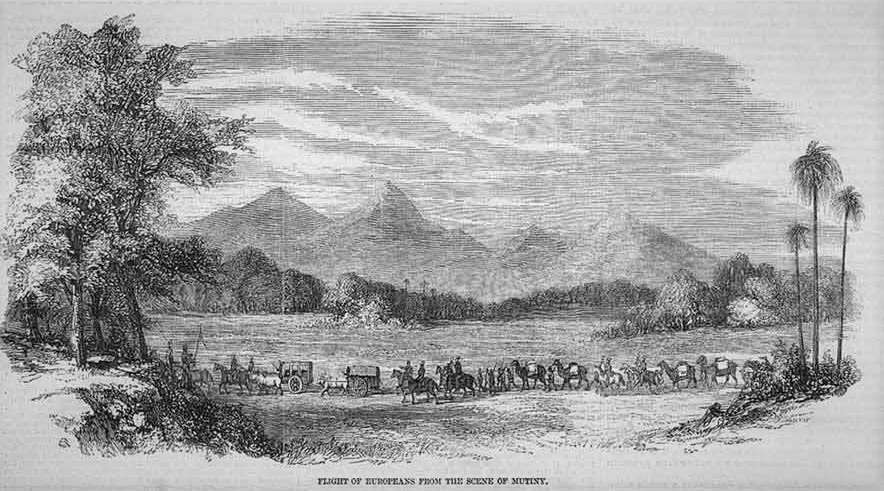
Sources:
Chick, Noah Alfred, comp. Annals of the Indian Rebellion, 1857-58. Calcutta: Sanders, Cones and Co., 1859.
Great Britain Parliament. Further Papers (No. 4) Relative to the Mutinies in the East Indies. London: Harrison and Sons, 1857.
Scot, P. G. Personal Narrative of the Escape from Nowgong to Banda and Nagode. Edinburgh: Thomas Constable, 1857.
Links:
Major Henry Kirke: https://www.wikitree.com/wiki/Kirke-100
Captain Scot: FIBIS: Families in British India Society https://fibis.ourarchives.online/bin/simplesearchsummarycat.php?mode=q
 Mutiny Reflections