The Captive Exile Hasteneth that He may be Loosed
The Rajah of Mitauli was undecided what to do. It would appear that everyone between his fort and Lucknow now knew he was harbouring fugitives. He had received a letter from Sir Henry Lawrence instructing him to escort the party to Lucknow. He had also received a notice from Begum Hazrat Mahal to send them to Lucknow. At least everyone wanted them alive. By October, Lone Singh had made up his mind. It no longer looked like the Company’s power was coming back, and what would be the consequences of misplaced loyalty now? Figuring his position would be vastly improved if he complied with the request of the Begum, and for a sum of 8000 rupees, he sold his guests.
Madelaine Jackson takes up the story.
“Men came and took Capt. Orr’s gun – said we were to go – would not let us take anything. We thought they would cut off our heads and send them into Lucknow – but at the edge of the forest they took us to, they had two native carts – drawn by two bullocks – in which they told us to get – and a lot of soldiers marched along – M. and I and Sophy and Sergeant Morton in the 1st – Capt. And Mrs. Orr and Louisa and Mr. Burnes in the other. They were big enough for 2 and had no springs. They had top covers and side curtains to keep the sun out. They stopped at a village and got a smith and brought out irons – Mrs. Orr and I begged them on our knees not to put them on – uselessly – they had some for Mrs. Orr and me – but Capt. Orr and M. said they would take 2 sets each – so after a talk, those were taken away. Those horrid irons were soldered round each ankle – and had two chains which they tied by a string round their waists – we tore our clothing in strips to wrap round them – but even then they made sore places. The poor serjeant (Morton) fainted when his were put on. All day we went on – and at every village stopped and crowds came to look at us.”
After a few more days, they arrived in Lucknow and were taken to the Kaiserbagh Palace. Their appearance so angered the rebels that it nearly caused a riot.
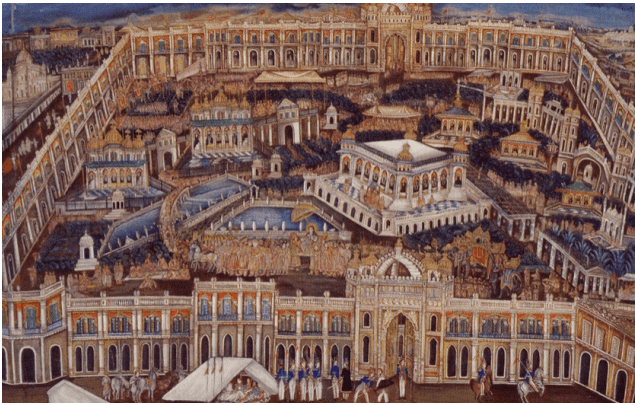
“When near the palace – the soldiers seemed afraid the people would kill us and made us get out of the carts, which could not stir for the crowd – we were first and I went to Mrs. Orr’ cart and saw a man with a big knife and made rush at her – the soldiers stopped him and made us walk between them – M. could hardly stand and had to be supported between 2 men – Mr. Burnes was out of his mind – Capt. Orr carried his little girl and helped his wife – I managed to lift up Sophy – tho I could hardly do it as she was a big child – and made the men keep off the press – the sepoys were doing their best to get us in safe…”
Within the palace, the group was treated to food and given “nice big rooms with English furniture”. The irons were removed from the men and their wounds were treated. It was comfortable prison, but a prison nonetheless and their future remained uncertain proving intolerable for the Sergeant Major and Mr. Burnes, who, as the days passed, “ were both half mad..”
The suspense came to an end on the 16th of November when the sound of English voices outside and “the natives yelling and groaning and all the horrid noises of fighting,” they received the news that Sir Colin Campbell was in Lucknow and his relief was a success.
“We just longed to be able to tell them to come at once and take the palace and the head people – they could have done it as there were no soldiers in it and they were all in dismay at the new army getting in so quickly – and they had no leader. Of course we should have all got killed first – and as it was, they were so infuriated, they came in saying the men must go with them. They would not take Mrs. Orr and I. They wanted to take little Sophy but left her hearing she was a girl. We were al stunned – M. kissed me and we all said goodbye. The last I saw – they were trying to tie their hands and M. refused and tried to shake them off – I rushed to help him but they pushed me back and pulled a curtain – I don’t know what happened – I suppose I fainted for I woke and found myself laid on a sofa and Mrs. Orr pouring water over me – and I told her I saw them shooting the men in the Court and were coming for us…”
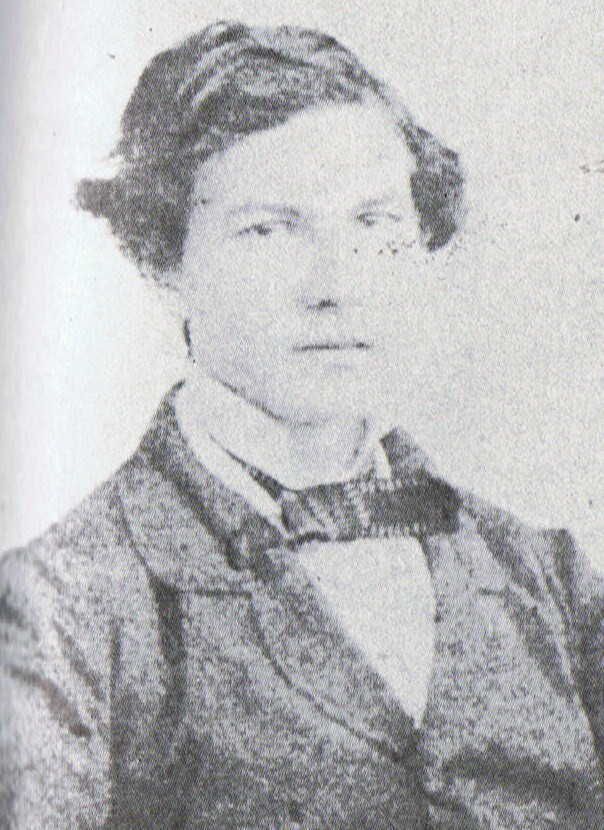
Madeline never saw her brother again. Mountstuart was shot by sepoys of the 71st BNI, along with Captain Orr, Quartermaster Sergeant Morton and Mr. Burnes – in a courtyard of the Kaiserbagh. A Christian camp follower named Songeness Madrasi, who had come to Lucknow with Havelock’s army, and (having been captured by the rebel sepoys in September and put to work as a sweeper) was witness to the execution. Tied arm to arm, they were shot; one man had a prayer book in his waistcoat pocket, another a hat. Songeness then related that the corpses of the men – after being untied – were piled one on top of the other in a nearby trench, some days after they had been shot (he being one of the burial party). Songeness put the hat and the book in with the dead.
Following the recapture of Lucknow, Songeness was taken back to Kaiserbagh to identify the burial place but he could not – a large defensive ditch had swallowed up the grave.
After the execution, the ladies were left in limbo.
“No one came near us or brought us food that day (16th of November) or the next. We had all had breakfast and the remains had not been taken away and luckily there were bits of chuppaties and rice which we gave the children…Mrs. Orr and I had none for about 36 hours – 2 days and a night – I got light headed very soon. I think we both hoped we were dying..” – Madeline Jackson
When Campbell’s army began shelling the Kaiserbagh, they were moved to a small room, in which there was barely any place to stand or lay down, and they could hear the people from the Residency filing past. But the guard on them was never let up and there was no chance of escape. Their time of waiting was far from over.
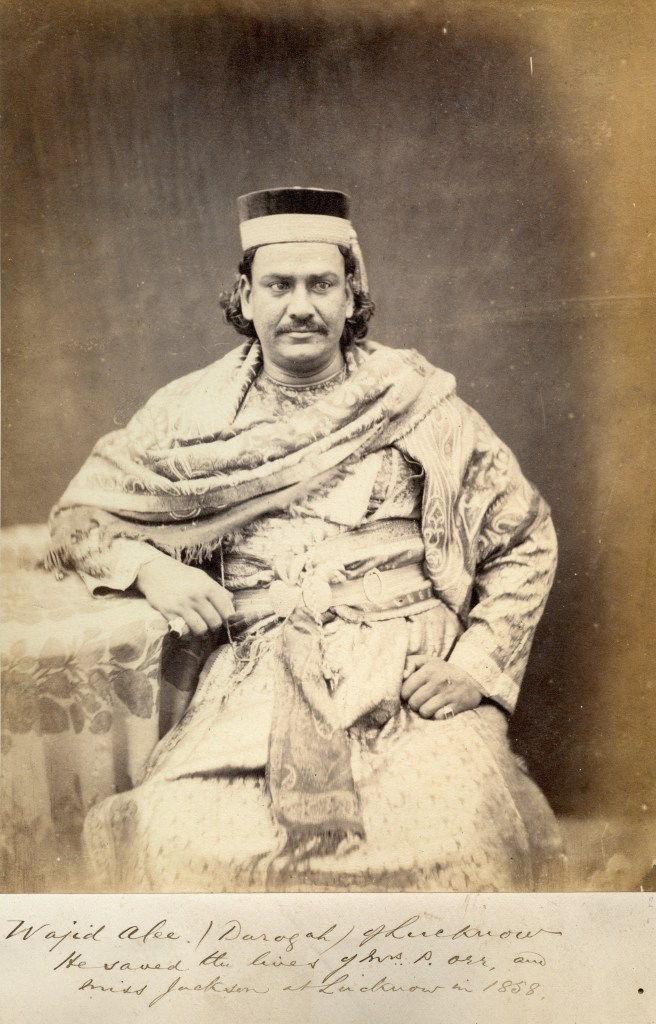
Sophie Christian died on the 22nd of November – dysentery had wreaked havoc on her poor little body and finally “ she breathed hard a little and then just went to sleep..” Mrs. Orr got word to their captor, Wajid Ali “the head man who took care of all the ladies in the palace” – and Sophie was buried that night.
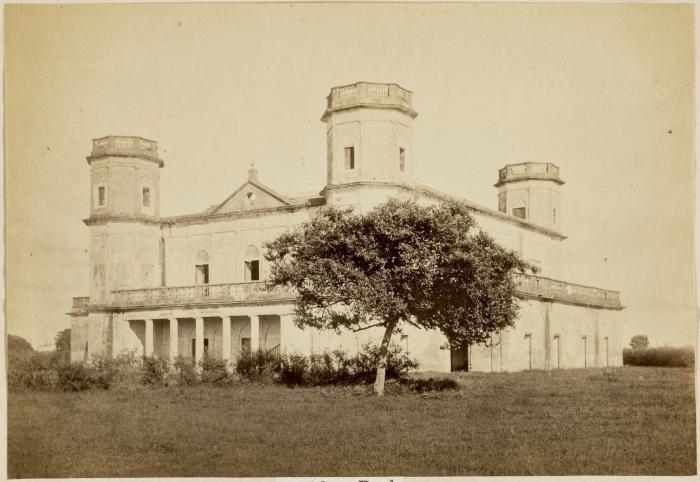
Shortly after, dressed in the clothes of the Lucknow ladies, they were moved to another house for their safety. Madeline heard that this had been her sister’s last home before her execution and she looked around the walls “to see if they had by chance written on them – but there was nothing.” It would not be until the beginning of March 1858, that Sir Colin Campbell would receive a surprising package at Alambagh – Louisa Orr.
“Wajid Ally to whom General Outram had offered a reward of 100,000 Rs. (sanctioned by the Government), should he succeed in effecting the release of the captives, made a solemn promise..and this promise made to the General and to Captain Orr’s brothers, was confirmed in the presence of the ladies, by a solemn oath, Wajid Ally swearing by the heads of his own children..”
Despairing about what to do, Wajid Ali hatched a daring plan. He would send Louisa Orr to the Alambagh.
“..dressed like a native her feet and hands stained, – and was carried out of the house like a bundle of clothes on the Ayah’s back – she was a very slight child – could speak the language perfectly and knew she was to pretend to be the Ayah’s child – then the Ayah was to say make her over to a Sowar who was to say she had smallpox – and he rode off with her to the English Camp..”
Mir Wajid Ali had tried to prevent the deaths of Georgiana Jackson and the others in her party. But having been placed in the hands of the Delhi mutineers, lately descended on Lucknow, he had been threatened with death had he attempted to intervene. He then did what he could to ensure the lives of the next group, but he was suspected of being too communicative with them and, subsequently, was prevented from visiting them. He was completely powerless to stop the 71st from executing the men who were under the command of Moulvie of Faizabad – a brilliant rebel leader but thoroughly ruthless in his hatred of the British. It was from this man that Wajid Ali was trying the protect the ladies.
Communicating now as openly as possible with the English, he wrote, “he felt the greatest anxiety regarding the safety of the ladies as well as his own family…” The Moulvie had discovered the ladies had been moved again and now there was no doubt in his mind that Wajid Ali was no longer a part of the rebel cause. “From his spies, Wajid Ally learnt that the Moulavy might every hour be expected: no time was therefore to be lost. In this difficulty, he begged of Mrs. Orr to write a note regarding the danger of the position she was placed, to the address of any British Officer…this note was immediately written and confided in the care of Wajid Ally’s brother-in-law, who, however, had hardly left the place when he encountered a party of Goorkas under the command of Captains MacNeill and Bogle…”
Quickly explaining the nature of his errand to the two officers, they now rushed to the house where the ladies were being kept. Without a moment to lose, the ladies were piled into a palanquin – with no bearers to be had, the Gurkhas bore the load, and escorted by Captain MacNeill, their ordeal was coming to an end. Captain Bogle, in the meantime, arranged for Wajid Ali and his family to be escorted away to General Macgregor’s camp – among his family, he had managed to secret away several clerks’ wives – nameless Eurasian women, who, but for his kindness, would most certainly have perished. In the camp, Mrs. Orr was reunited with her daughter and her husband’s brothers, Alexander and Adolphus; Madeline, when asked who she wanted to be sent to in India, she burst into tears, and said, “all mine were killed.”
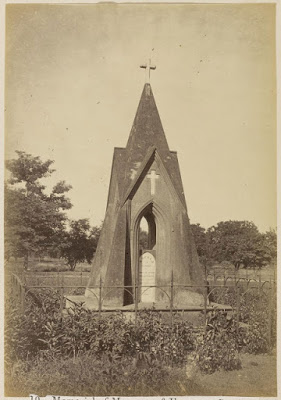
A tablet, dedicated to Montstuart Jackson and his sister Georgiana was erected at St. Paul’s Cathedral in Calcutta and reads thus:
To the memory of Sir MOUNTSTUART GOODRICKE JACKSON, Bart., of the Bengal Civil Service, Assistant Commissioner, at Sitapur, in Oude who, at the age of 21, after many months of privation and suffering, was murdered at Lucknow, on the 16th November 1857. Also of AMELIA GEORGIANA JACKSON, aged 20 years, sister of the above, who, in escaping from Sitapur, was separated from her brother, and after enduring for several months great suffering and exposure, perished at Lucknow in the massacre on the 24th September 1857. Eldest son and daughter of the late Sir Keith Alexander Jackson, Bart., of Ailsey, county Bedford.
Sources:
Chick, Noah Alfred. Annals of the Indian Rebellion. Calcutta: Sanders, Cones, and Co., 1859.
David, Saul. The Indian Mutiny. London: Viking, 2002.
Hearsey, John Bennett. “Account of Captain Hearsey in His Escape from Sitapur.” In Annals of the Indian Rebellion, edited by Noah Alfred Chick. Calcutta: Sanders, Cones, and Co., 1859.
Hibbert, Christopher. The Great Mutiny. London: Allen Lane, 1978.
Orr, Patrick. “The English Captives in Oudh.” Letter to Adolphus Orr, June 1857. In Annals of the Indian Rebellion, edited by Noah Alfred Chick. Calcutta: Sanders, Cones, and Co., 1859
O
 Mutiny Reflections