Indore Rises
On the 1st of July, the first news Durand received was a letter from the 20th of June from Agra. The report of the fall of Delhi was not just premature; it was false. He sat down at his writing desk to pen a telegraph to Lord Elphinstone. It was a quiet morning – there was no word from Mhow or from Holkar. Besides the news from Agra, it looked like at least today would pass by peaceably enough. Durand collected his thoughts and began to write. On the previous evening, one of his servants had warned him an uprising was to be expected – but Durand had ignored him. He was not a man who had time for rumours.
Suddenly, a messenger rushed into the room and, in a panic, reported the Durand there was a commotion in the nearby bazaar. Durand laid down his pen and went out onto the Residency steps. As he came out the door, three guns opened fire, and a shower of grapeshot flew into the lines of the Bhil Contingent.
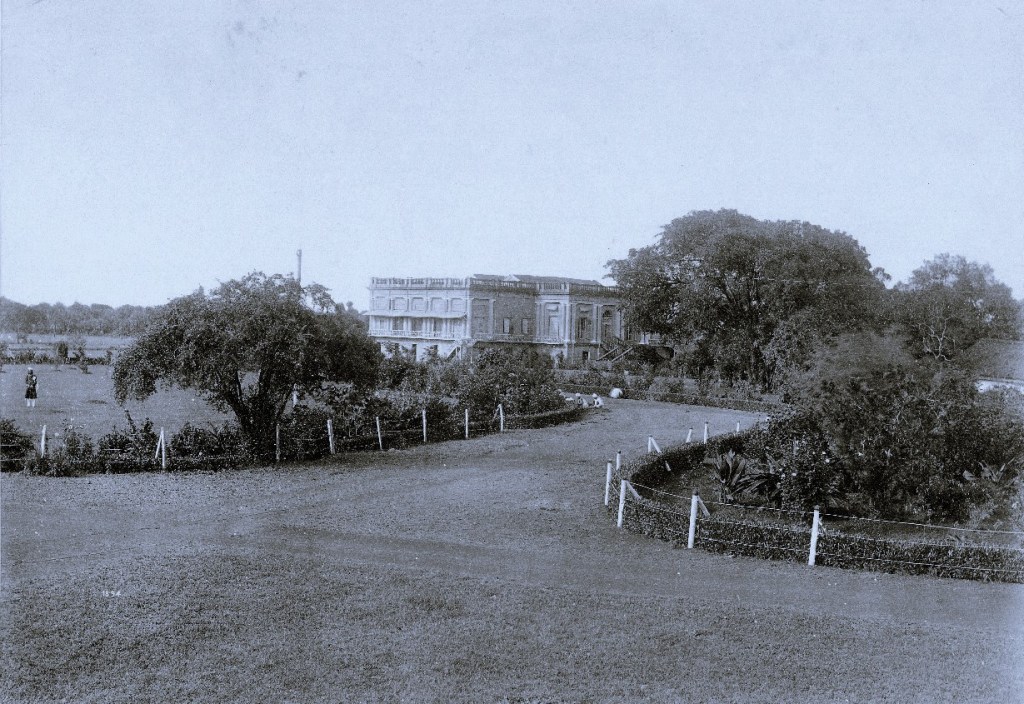
The 1st of July arrived, quietly for not just Durand but for Travers and the Shakespear family. Colonel Travers was outdoors, talking to the native officers of the Bhopal Contingent. Some men were cooking their morning meal, and others were bathing. The Shakespear family had finished their breakfast, and Shakespear, like Durand, was sitting at his desk, writing. And, like had happened to Durand, a servant suddenly rushed into the room, announcing there was a commotion in the bazaar.
Shakespear got up, calmly put on his hat and, choosing a stout cane, went outside. He could hear noise from the direction of the bazaar as he walked down the road. He could see men of the Bhil contingent congregating, talking excitedly, but he thought nothing of it. Shakespear walked on. He had not gone 100 yards when he was shocked to see the three 9-pounders, intended to protect the Residency, had been turned around and were now pointing directly at it. Shakespear turned around and ran back to his house. He told his wife to take the baby and then, with their neighbours, the Duttons, Shakespear hurried them all off to the Residency. It was not a moment too soon. The three guns opened fire. At the same time, the infantry made a rush at the neighbouring buildings, attempting to cut off the escape of anyone fleeing to the Residency.
The cavalry, at their picquets, had taken the brunt of the grapeshot and came rushing out, mounting their horses as quickly as they could, surprised and wild with alarm. Travers, who had been outside talking to some of his men, reacted quickly. He hastened to the piquet at the stables and ordered the men to turn out – his plan, if he could make it work, was to charge the enemy guns.
Meanwhile, Captain Cobbe and a European sergeant worked the two guns of the Bhopal Contingent and, with the aid of the Indian gunners, answered the enemy. At the same time. Captain F.L. Magniac, who had ridden straight up to the Bhopal and Malwa infantry to bring them to the residency’s defence, was soundly repulsed. He rode with some haste and reported to Durand that the men were mutinous.
Travers was not having it any easier.
“The men, surprised and half-stupefied by the suddenness of the attack, showed at first no hesitation. While they were turning out, Travers caused the men of the picket to mount and rapidly conducted them to a point whence they could most advantageously charge the enemy’s battery. He then attempted to form them up to charge. But here, likewise, treason had done its work. The native officer of the picket had been ” got at.” And though the picket was three times formed for attack, three times did this man break the formation from the rear. This action threw the men into confusion. Two opposite feelings seemed to contend in them for mastery. But to stand still was fatal. Travers felt this, and feeling it strongly, he gave, notwithstanding that success seemed hopeless, the order to charge.” Gallantly leading, Travers reached the guns with only seven men following him.
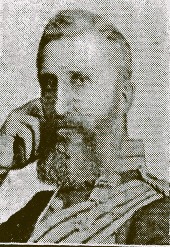
” As I cast my eye back and found only six or seven following me, and not in good order, much as I despise the Mahrattas as soldiers, I saw we could not by any possibility make an impression. Still, at it I went; to draw rein or turn after giving the order to charge was too much against the grain. I came in for a large share of the most polite attention. My horse was wounded in three places; I had to parry a sabre-cut with the back of my sword, but God, in his great mercy, protected me, and the dastardly gunners threw themselves under their guns. Had I had thirty or forty good sowars at the time, with their hearts in the right place, I would have captured their three guns and cut their 200 infantry to pieces, but what could half a dozen do against so many? The foe then moved into the plain in front…to blaze into the Residency. I instantly moved up with my two guns (the Subhedar Sewlale and the gunners behaving nobly)…the rest of my cavalry now came up, asking to be led to the charge, but I could find no bugler, nor could I get the men in proper order. They seemed uncertain who to trust – and to lead them on as they were then would have been destruction. They have been taken in flank by Holkar’s numerous cavalry and overthrown…so it was all up.”
Travers drove away the gunners and wounded their leader, Saadat Khan.“But not only was he not supported, but he and his five men were exposed to the fire supported of the enemy’s infantry, now drawn up in order. For a moment, indeed, that infantry seemed inclined to waver; but when they recognised the small number of the men who had followed Travers, they opened a musketry fire against the Residency.” Travers had no chance of holding the guns, and he quickly retreated. (Among the men who had attacked the guns with Travers, two, Nehal Singh and Harsa Singh, received the Order of Merit and would serve for many years to come with the Central India Horse. Harsa Singh would be killed in 1884 by a tiger in the Goona jungles. Sir M. Gerard would erect a monument in his memory, and the coinciding water reservoir was known by his name.
Travers’ charge had given Durand time to make hasty preparations to defend the Residency, had allowed the gunners to place their guns in position, and for the officers to turn out and form up their men. Durand had also had enough time to pen a hasty message to Colonel Platt at Mhow, telling him the Residency had been attacked, and Hungerford was to make haste to Indore with the artillery. He gave the note to Travers just as he arrived, with the order to forward it to Mhow. Travers gave it to one of his troopers whom he trusted, but he doubted if the note would ever reach Mhow.
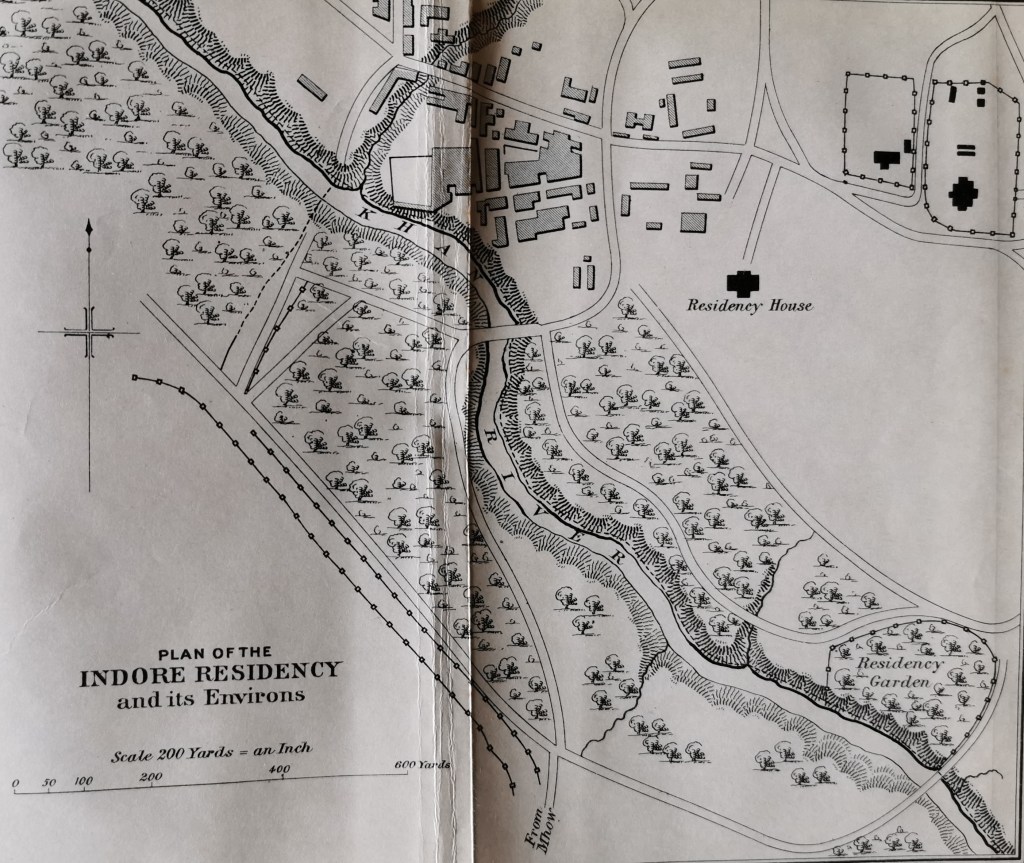
The mutineers had recovered from the shock of Travers’ charge and now moved their guns round to the left of the barracks, into the open ground, with the hope of taking up a position from which to attack the Residency from the front. Travers quickly countered by pushing his 2 guns forward by two hundred yards to the right front of the Residency and directed the gunners to concentrate their fire on the enemy’s gunners. The order was obeyed with such energy, one of the mutineers’ guns was disabled, and the infantry was forced to retreat. Durand now saw an opportunity to counterattack.
The cavalry came up in “excellent formation” but, despite the efforts of the officers and Durand’s haranguing, refused to charge. Instead, 30 of them turned around and galloped off towards Sehore, shouting that the Europeans were being massacred. The rest stood their ground, “helpless and panic-stricken, afraid of each other.” The Hindus and the Sikhs suspected the Muslims of treachery, while the Muslims proclaimed that if they turned their backs, the Hindus and Sikhs would murder them. Instead, they divided up into separate parties and scattered themselves around the residency grounds, each vying with the other for better shelter from the firing, and remained “passive spectators of an assault which with union and heartiness they might have prevented.”
Travers refused to give up. Furious at the behaviour of the Bhopal contingent, he ordered Captain Magniac to try, once again, to rally his men and attack the one battery that was lying defenceless in the open. Magniac obeyed, but his men did not. Repulsed once again, he returned to say he men would not follow him. Travers turned now to the infantry, convinced a bayonet charge would set things right. The 200 men of the Mehidpur contingent stared at him blankly and refused to fight. He turned back to the remnants of the Bhopal Contingent and found only 12 were willing to follow him. The rest “levelled their muskets and their officers” and told them to be off. Meanwhile, the Bhils, the only contingent that had not shown themselves mutinous but only terrified, allowed themselves to be formed up and brought under cover to the Residency.
“They were accordingly brought to discharge inside the Residency in the hope that they might be prevailed upon to discharge their pieces at the enemy when sheltered by stone walls. But. Meanwhile, the rebels, finding that no advantage had been taken of their first check and rightly conjecturing that the trained Sipahis had refused to fight them, had completed their artillery movement and were pouring in many directions a fire of round shot and grape. Under the influence of this fire, the Bhils were completely cowed, refused even to discharge their pieces, and, abandoning their posts at the outer windows, crowded into the centre rooms. The rebel infantry was forming up, evidently with the intention of taking advantage of the effect of the fire of their guns.”
After this final refusal, there were only 14 Indian gunners, eight officers, two doctors, two sergeants and four men of the telegraph department and one postmaster left to defend the Residency, but the 5 were useless. The state of their nerves was no better than the Bhils, and they were “unable, either from alarm or from being unnerved by the slaughter which they had escaped, to use their arms. They did not fire a single shot.” In their midst were eight women and three children. Thirty-nine civilians lay dead on the grounds, killed as they fled for safety.
Outside, the mutineers’ officers were calling on their men to charge assault, and their ranks were rapidly filling up. From the estimation of the men in the Residency, the odds were horrific – without any support, there were 31 men, the Indian gunners included, with two guns, facing a force of 600 trained sepoys of Holkar’s guard, the entire rabble of Indore and 500 mutinous troops within range of their defences. The insurgents had already taken up positions in the buildings around the Residency and were manning the roads – all said and done, the Residency would shortly be attacked from all four sides, and there was nothing Durand or anyone else could do.
To defend the Residency would have been valiant but impossible – maybe they could hold out until Hungerford arrived from Mhow if he ever received the note, but he could arrive at the earliest in two hours; besides this, the Residency was poorly provisioned, there was not even enough water to see them through the day. Durand could have formed up his remaining men and attempted to cut his way out of the Residency, but they would have had to leave the women and children behind, which was unheard of.
As for the mutineers, things could not have gone better.
Shortly after eight in the morning, Saadat Khan, an officer in Holkar’s cavalry, followed by eight troopers, had galloped to the lines of Holkar’s troops positioned between the city and Residency, shouting, “Get ready! Come on and kill the sahibs; it is the order of the Maharaja!” A rumour had already got about that Durand and treasury, some £150’000 in silver, were about the depart for Mhow. As it turned out, Durand had refused to remove the treasury, and if he had intended to, he could not have done so without the help of Major Travers – the treasury, on the 1st of July, was closed. Yet rumours do, as we have seen in other mutinies, serve their purpose.
Holkar’s troops immediately turned out, the gunners (whose guns had been turned the night before to face the Residency) ran to their positions and, at Saadat Khan’s orders, opened fire. The infantry, in the meantime, had been joined by various rabble-rousers from the city, and they attacked the outlying houses of the grounds, killing anyone they found. They mustered 1400 sabres and 2000 infantry and could, at a moment’s notice, bring another 29 guns to bear on the Residency. As for Holkar, he was powerless to stop them. Victory seemed close at hand – without the support of Hungerford, who, even if he arrived on time to prevent the inevitable slaughter at the Residency, would be unable to stop them. In Travers’ estimation, “…no field artillery could drive the enemy from such a position; infantry alone could do this.” But the infantry in the Residency enclosure was most disinclined to assist their officers and might, with a flash, turn on the Residency. Their next move was to move on the Residency with the guns and cavalry and cut off any retreat. Neither their commandant, Bans Gopal, nor any of the other officers made even the slightest attempt to stop them.
The situation for the besieged was hopeless, or so it seemed. Durand was not a man to give up without a fight; after all, he had blown open the gates at Ghazni, and the officers with him were not men to shirk in the face of impossible odds. But even for them, with all their years of experience in warfare, the situation was beyond their control. At this moment in the crisis, when everything seemed lost, a few of the cavalry that had remained huddled together at the back of the residency building, sent a message through Captain Magniac that they were contemplating consulting their own safety (i.e. leave) as any further defence was hopeless, and if they did not move immediately, their retreat would be cut off. They begged that this might be their last chance to save the women and children – and they would escort the besieged anywhere they wished to go.
Not everyone would be leaving Indore.
One of the first areas to be attacked was the Telegraph and Post Office. On hearing the approached tumult, Mr. Beauvais ordered his horse and carriage be brought from the stables to the back of his house and into it, he put his wife, daughter and grandchild. As they drove off, to Beauvais’ and his son-in-law’s horror, they were fired upon and killed. There was nothing for it – the two men ran with all their strength to the Residency, arriving, uninjured but in such a state of shock they were unable to even hold their rifles. The other casualties on that fateful morning were mostly from the telegraph department – they were either killed directly in their homes or as they tried to escape the onslaught of the mutineers. Some of their bodies were so severely mangled, identification was nigh impossible. The loss of life has been estimated to be as few as 25 and as high as 39. How this discrepancy came about is easily explained. Travers, in his account, mentions 39 Europeans, but there are only 22 mentioned on the memorial tablet at Indore – Mrs. Beauvais, along with her daughter and her granddaughter, were memorialised separately. Who the rest were, in Travers’ account, is somewhat mysterious. It must also be mentioned, only two, Macmahon and Brooks, were actually English; the rest of the dead were Anglo-Indians (Eurasians, in 1857), but this author refuses to make this distinction, nor did Travers. They were:
Mr. Alphonso, Bandmaster in Holkar’s employ – he was Portuguese, from Goa
Mr. Avery, superintendent Telegraph Office and his wife
Mrs. Mary Ella Beauvais, aged 36 , wife of E.T. Beauvais
Mr. Bone, assistant, Telegraph Office and his wife
Mr. Butler, assistant, Telegraph Office, wife and one child
Mr. Thomas Henry Brooks of the Telegraph Department
Mrs. Elizabeth Angelina Crawley, aged 23 and her daughter, Amelia Frances Mary, aged 3. Her husband was one Mr. T. Crawley, assistant agent to the Opium Department
Mr. Macbeth of the Veteran Establishment, his wife and five children
Mr. MacMahon, Civil Engineer
Mrs. Moran
Mr. Murray, clerk in the Opium Department.
Mr. W.W. Norris – clerk in the Residency office and wife
Two Parsis, unnamed
Mr. Payne
W. Norris, an engineer who had been supervising the construction of new barracks near the Residency when the firing started, watched as all the labourers dropped their tools and ran off towards the bazaar. He quickly mounted his horse and, with two others, Mr. Martin and Mr. Ross MacMahon, fled. The rebels pursued the three men, killing MacMahon, and captured Norris. He was taken prisoner and brought before Holkar. Holkar ordered him escorted to his palace and took him under his protection
James M. Knapp, the Central India Agency surgeon, was at the Residency hospital at the time the noise from the bazaar started. He left the hospital on foot. Near the gate, where the Bombay-Agra roads meet, he found two sowars of the Bhopal Contingent, idly sitting in front of their barracks. When he asked them what the commotion was, they replied it was nothing; the sepoys and bazaar people were having a row. He continued towards his bungalow and noticed many of the Bhopal sowars, resplendent in their red coats, gathered in groups of two or three over the parade ground. He reached his bungalow just as the 3 guns aimed at the Residency opened fire. He found his house empty – his faithful servant, on his own initiative, had already escorted his wife and two of his guests to the Residency. Knapp had enough time to grab his medicine chest and rush to the Residency to join them.
The Residency Abandoned
Much to his humiliation, Durand was forced the accept the offer of the escort. The mutiny had now lasted two hours, and it was only 10.30 in the morning. Hungerford, if he was coming from Mhow, would not arrive for at least another two hours, by which time the mutineers would be so positioned, it would be impossible for Hungerford to do anything if he could get through at all, there was no word from Holkar, who at this point Durand suspected of base treachery and staying was out of the question.
After consulting with the other officers, Durand and Travers organised the little garrison for evacuation. The mutineers had cut off all access to the horses and carriages in the stables, leaving no choice but to pile the ladies and children onto the artillery wagons drawn by bullocks. With the Bhils and the cavalry covering the rear, the little party moved slowly out of the Residency compound, under fire from Holkar’s guns. As they moved off, with a few parting shots from the guns, and “the pleasure of seeing their property burning before they got clear of the Residency” it was still not clear where they should go. On the retreat, only one man was killed, shot before they left the grounds, his head taken clean off by a cannonball. No one would have missed him if Travers had not seen his horse standing by the corpse.
The logical destination was Mhow, with the chance of meeting Hungerford on the way.
The road to Mhow from the Residency was completely under the control of the mutineers and they covered the bridge over the Khan River. There was the possibility of crossing another bridge, further up, but it would not have served their purpose as their retreat was impossibly slow (bullocks are not known for their speed) and the mutineers would have had ample time to cut them off. Besides, the remaining cavalry was most disinclined to go to Mhow. They wanted to go home, and home was in Sehore, where their families were. However, Durand resolved to push onto Mandelshwar with some idea of a rendezvous with the illusive column of General Woodburn.
As such, Durand and Travers sent notes to Hungerford, explaining they had left Indore and to prevent him from falling into an unfortunate predicament, they were now heading for Simrol. The troopers were dispatched cross country to find Hungerford and stop him from coming to Indore. At this point, Hungerford, who had received the message from Durand, had not even started – he would not leave until noon.
To cross to Mandelshwar they would have to traverse the Simrol pass, which, as Durand soon found out, was occupied by the very cavalry and artillery who he and Holkar had sent off before the mutiny for outstation duty, with the hope of being rid of them. This should have been reason enough to avoid Simrol and the Bhopal cavalry thought so too – they were willing to escort Durand and his party and protect them from an assault on the road but would not risk their lives for them at Simrol or anywhere else for that matter. They would escort them to Sehore and nowhere else. So Durand was forced, once again to change his route. What awaited them in Sehore, was anyone’s guess and it was still over 100 miles away.
The march was brutal.
The ladies were mounted on the gun wagons, sitting on the shot and powder boxes, dragged along at the inhumanly slow speed of three miles an hour by bullocks. When the sun was not blazing, they were drenched to the skin by the monsoon rain. Behind them came the officers and the few men of the cavalry who had not deserted them, further behind came the two guns they had managed to save. Stops were few and short; as determined as he had been to hold Indore, Durand was just as determined now to push on with all speed. His hope was his friend, Sikandra Begum, would not abandon him in his time of need.
Durand looked at the whole situation as a personal affront.
“I never witnessed such wretched treachery and cowardice as drove us from Indore…The Bhopal and Mehidpore Contingent Infantry would not fire a shot or obey an order and threatened to shoot their European officers. The Bhopal Contingent Cavalry never recovered from their surprise, were panic-stricken, and from the first, quite beyond the control of their officers. As for the Bhils, as fast as I put them behind pillars or bays of windows, undercover for the defence of the Residency, the moment my back was turned or that of their European officer, they used to collect together in the centre room. We could have repulsed the attack if we had had anything that could fight…It was the most painfully disgusting affair I ever underwent…
First came the humiliation of being forced to withdraw before an enemy that I despised, and who, could I have got anything to fight, would have been easily beaten back. As it was with only 14 Golundauze who would stand by their guns, we not only held out our own for about a couple of hours but beat back their guns and gained a temporary advantage…we retired unmolested in the face of superior masses, whose appetite for blood had been whetted by the murder of unarmed men, women and children. Of all the bitter, bitter days of my life, I thought this the worst, for I never had to retreat, still less to order a retreat myself, and though the game was up, and to have held on was to insure the slaughter of those I had not the right to expose to such a fate without an adequate hope of object, still my pride as a soldier was wounded beyond all expression, and I would have been thankful had anyone shot me.”
His wife, Annie, was no less displeased. Unlike her husband who bore his humiliation with some fortitude, the staunch daughter of the army (her father was a general and generations of her family had served in the army) was disgusted by the conduct of the troops, to be sure, but what truly infuriated this memsahib was the two officers who sorely provoked her as their “one idea seemed not to hold out to the last but to be off and save their wives and themselves with all possible speed…”
They had tried to convince Durand to retreat well before any attack had occurred and, when it finally did, wasted no time in looking for a way out. As for the redoubtable Annie, she was
“…more anxious to remain than go and really did not contemplate our being driven to retreat by the miserable cowardice of our own troops…” She also gives Captain Magniaic and his wife the what for, by stating, besides being terrible alarmists, “….bored me beyond expression with daily and hourly histories of what was going to happen…Mrs. M. was a perfect torment…(her) name should have been spelt without the ‘g’…” When the woman “rushed up from her own room below, when Holkar’s artillery opened fire on us…she half dressed, with her hair streaming about her face…the image of despair and terror. I cannot comprehend any woman with half a grain of sense exhibiting such desperate alarm… but she had been living for weeks in continual panic; consequentially, when danger came, she was unfit to bear it decently, and, really, she was quite a nuisance in the house.”
She further stated,
“One lady was furious with me because I expressed unqualified indignation at the cowardice that had forced us to retreat. She thought I ought to be grateful to the men for saving our lives…I would willingly have remained if Henry could have got rid of the other ladies, rather than have him exposed to the distress and mortification of retreating.”
It is a shame that none of the historians who describe the Indore mutiny bothered to add Annie Durand as one of the defenders of the Residency. She would have shouldered a gun, eight months pregnant as she was, if only her husband had let her. As it was, she was bundled into a wagon and carried away, whether she wanted to be saved or not.
They arrived in Ashta on the 3rd of July and were greeted, to their horror, by the guard drawn up along the river bank and across their road, with an accompanying crowd of townspeople. For the party, who had come so far, it looked like the end of the road – if they must make a last stand, it might as well be here. Before the swords could hit their necks, the ladies and children were hastily dismounted from the limbers and the guns were made ready for action. Before a shot could be fired, a messenger appeared – it was a guard of honour, he said, and they had come to escort them to Sehore.
On the 4th of July, they were finally in Sehore. The retreat had come to an end, but it was not over. From Bhopal, Sikandra Begum informed Durand she would do anything to protect him, but his presence in her territories was fraught with danger and an irritation to her forces. Her army was perilously close to mutiny, and Major William Henry Rickards, Political Agent to Bhopal but based in Sehore, had already been advised to flee to Hoshangabad. Fourteen sowars from Indore had arrived in Sehore before Durand – without the permission of the Begum – and they had been openly fraternising with her troops, instigating her men to rise. She was doing what she could to stop her territory from rising, but she could not protect Durand for more than a day. As for the cavalry that had escorted Durand from Indore, many were displeased with the snail’s pace of the party and had simply deserted on the way or rode far ahead of the party, proving themselves, once again, useless. As it was, no one molested Durand’s retreat, and for that, at least, he should have been grateful.
The next day, Durand pushed onto Hoshangabad, still determined to meet up with Woodburn’s column. It was here he heard of what had happened at Mhow, and for the next three weeks, no one would know what Durand was doing. He vanished. Holkar had said “Not one will stand by me,” when he was speaking to Durand about his troops – it begs to wonder if now perhaps he felt the same way about Durand.
 Mutiny Reflections