Nothing is simple in Lucknow and things get a little more complicated as officially the number for most VCs won in one day is cited as 24 and attributed to the 16th of November. However, this figure is erroneous and the problem appears to be with the citations themselves.
There were 2 VCs awarded for actions on the 12th and the 14th of November, belonging to Hugh Gough and John Watson. As these are clearly cited for those resepective dates, they cannot be included in the number 24.
16th of November, Sikandar Bagh
- John Smith 1st Madras European Fusiliers
- Alfred Ffrench 53rd Regiment of Foot
- Charles Irwin 53rd Regiment of Foot
- James Kenny 53rd Regiment of Foot
- Augustus Anson 84th Regiment of Foot
- John Dunlay 93rd Regiment of Foot
- Peter Grant 93rd Regiment of Foot
- James Munro 93rd Regiment of Foot
- David MacKay 93rd Regiment of Foot
16th of November, Shah Najaf
- John Harrison Naval Brigade
- William Hall Naval Brigade
- Nowell Salmon Naval Brigade
- Thomas Young Naval Brigade
- John Paton 93rd Regiment of Foot
Captain William George Drummond Stewart
Date of Act of Bravery, 16th November, 1857
For distinguished personal gallantry at Lucknow, on the 16th November, 1857, in leading an
attack upon and capturing two guns, by which the position of the mess house was secured.
Elected by the Officers of the Regiment.
This is wrong only in one respect:
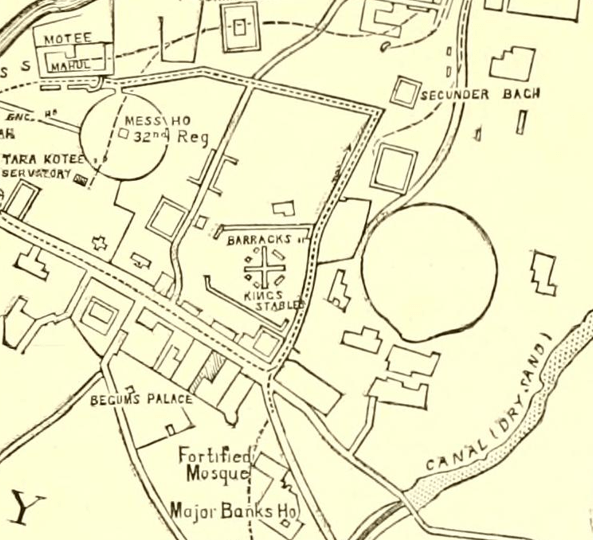
The Barracks were on the line of advance to the Sikandar Bagh and were secured by Stewart’s charge on the guns. The Mess House was not carried until the 17th.
““Stewart, perceiving the annoyance which these two guns were causing, and the injury that they might still
cause, called upon his company (No.2), and at the head of it, increased in weight and numbers by a few
men of the other companies, and of the 53rd, who had joined our men, dashed forward in the most gallant
style, captured the guns at the point of the bayonet, turned the guns on the flying rebels, and then, pushing
forward at the double, while Captain Cornwall, with his company (No.3) and the men of other companies, followed in support, assaulted the large pile of building called the barracks, situated in the left front of the
Sikanderbagh, drove the enemy out, and established themselves in it.” [“Historical Records of the 93rd Sutherland Highlanders” Roderick Hamilton Burgoyne, late 93rd Highlanders, London, 1883] .
When we include Anson, whose citation is for the 28th of September (Bulandshahr) and then of a more vague nature for the 16th of November –
“…At Lucknow, at the assault of the Secundra Bagh, on 16th November, 1857, he entered with the storming party on the gates being burst open. He had his horse killed, and was himself slightly wounded. He has shown the greatest gallantry on every occasion, and has slain many enemies in fight.”
we still only come to a tally of 15 that can be ascribed to the 16th of November. However, as an exercise in futility, we can try to make the number 24 work.
Undefined Actions between the 14th and 22nd of November by the Bengal Horse Artillery
“Elected respectively, under the 13th clause of the Royal Warrant of 29 January 1856, by the Officers and non-commissioned officers generally, and by the private soldiers of each troop or battery, for conspicuous gallantry at the relief of Lucknow, from the 14th to 22 November 1857.”
- Hastings Harington
- Edward Jennings
- Thomas Laughnan
- Hugh McInnes (Bengal Artillery)
- James Park (Bengal Artillery)
The citation spans 8 days.
The following VCs all belong to the 90th Regiment of Foot and as we shall see, their actions at the Sikandar Bagh were limited to outside the building itself.
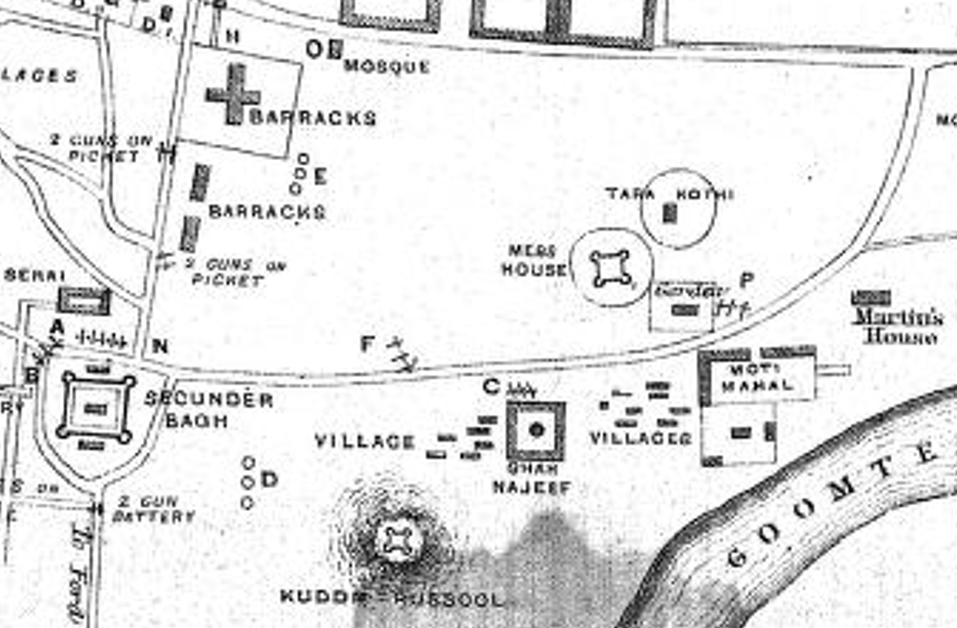
“However, my men lying down along the bank with their heads only exposed when they had loaded and were ready to fire, did much to keep down the enemy’s fire, for I don’t think we were over eighty yards from the corner tower of the place when we hauled the gun into action. The gun opened fire at once, sending great clouds of dust into the air when at each round its heavy shot struck the wall. Close behind me were the 93rd Highlanders, and as soon as the gun had made a sufficiently big hole in the wall, they went gallantly for it, whilst Wylde, with his magnificent regiment of Sikhs, went for the only gateway into the place and quickly burst it open...Blount’s troop of Bengal Horse Artillery now came up the lane of the village by which we had marched, and having struggled up its steep bank to the level of the ground surrounding the Sekunder Bagh, it galloped past that building, unlimbered, and came into action against the Shah Najif. I never saw anything prettier or more gallantly done in action...“As we looked from the Sekunder Bagh towards the Residency, this Shah Najif mosque, with its massive white dome, was to our right front, and not more than about six or seven hundred yards from us, whilst immediately in our front were the ruins of some mud-built sepoy lines. Our brigadier, Adrian Hope, now told me to advance my company at the double and occupy these ruined huts, as the enemy’s skirmishers had already begun to annoy the men of Blount’s battery from them. At that time my men were lying along the main road that led from the Sekunder Bagh to the barracks, and were thus covering the left of Blount’s battery, then engaged with the sepoys in front. I did as I was told, and we advanced at a qmck pace much faster than our regulation double… I soon had my men under cover amidst the walls and ruins of the old native lines.”
16th & 17th of November, Lucknow
- John Guise 90th Regiment of Foot
“For conspicuous gallantry in action on the 16th and 17th of November, 1857, at Lucknow.
Elected by the Officers of the Regiment.
Guise’s VC was of a “general character” and could not be pinned for any single action. It can be agreed that he was most conspicuous on the 17th in the taking of the 32nd Mess House where he led Barnston’s Detachments in lieu of the commander himself who had been shot the day before. He was elected by the officers of his regiment as the most worthy of them all. While this VC could be ascribed to the 16th, it equally belongs on the 17th. The next citation is detailed but very likely wrong when we consider the 90th was not a part of the storming of the Sikandar Bagh.
- Samuel Hill 90th Regiment of Foot
“For gallant conduct on the 16th and 17th of November, 1857, at the storming of the Secundra Bagh at Lucknow, in saving the life of Captain Irby, warding off with his firelock a tulwar cut made at his head by a sepoy, and in going out under a heavy fire to help two wounded men. Also for general gallant conduct throughout the operations for the relief of the Lucknow garrison. Elected by the non-commissioned officers of the Regiment.”
On the 17th of November, the Mess House was carried by the combined forces of Captain Garnet Wolseley of the 90th with a company of his regiment, Captain Hopkins and a detachment of 60 men of the 53rd, Captain Powlett leading ta few men of the 2nd Punjabis and Barnston’s Detachments under the command of Captain Guise. Wolseley then pushed onwards and we can place Irby on the 17th as Wolseley sent him off to carry the Tara Kothi. Wolseley simultaneously took the Moti Mahal. Considering the limited actions of the 90th on the 16th, Hill’s citation correctly belongs on the 17th.
This brings us to 22, but only if we ignore the 8 days for which the Bengal Artillery citation was given and include Guise and Hall so we can concentrate it all on the 16th.
The next citation ties in the actions of the 90th and the 53rd Regiment with the 17th of November:
- Patrick Graham, 90th Regiment of Foot
“Date of Act of Bravery, 17th November, 1857
For bringing in a wounded comrade under a very heavy fire, on the 17th of November, 1857, at Lucknow. Elected by the private soldiers of the Regiment.” - Charles Pye – 53rd Regiment of Foot
For steadiness and fearless conduct under fire at Lucknow, on the 17th of November, 1857, when bringing up ammunition to the Mess House, and on every occasion when the Regiment has been engaged. Elected by the non-commissioned officers of the Regiment.”
The Remaining VCs – 18th of November, 23rd Regiment of Foot
- Thomas Hackett
For daring gallantry at Secundra Bagh, Lucknow, on the 18th November, 1857, in having with others, rescued a Corporal of the 23rd Regiment, who was lying wounded and exposed to very heavy fire. Also, for conspicuous bravery, in having, under a heavy fire, ascended the roof, and cut down the thatch of a Bungalow, to prevent its being set on fire. This was a most important service at the time. - George Monger on the 18th of November, Sikandar Bagh
“For daring gallantry at Secundra Bagh, Lucknow, on the 18th of November, 1857, in having volunteered to accompany Lieutenant Hackett, whom he assisted in bringing in a Corporal of the 23rd Regiment, who was lying wounded in an exposed position.”
The number 24 remains illusive.
It is possible the actions of Hackett and Monger were misconstrued as the 16th due to the mention of the Sikandar Bagh in their citation. However, their actions are clearly on the 18th and did not take place directly in the Sikandar Bagh, but rather in the attack on the hospital grounds in which the 23rd took part and they were most likely the men who saved the corporal, an action for which Harington too is cited by George Bourchier. For a detailed explanation of this, I direct my readers to Courage in Chaos IV.
We shall now take this exercise to its conclusion and make a few adjustments:
The 16th of November = 15 (Sikandar Bagh + Shah Najaf+Stewart)
The 16th and 17th of November= 2 (Guise + Hall)
The 17th of November = 2 (Graham + Pye)
The 18th of November = 2 (Hackett + Monger)
The 14th to the 22nd of November = 5 (The Bengal Artillery)
If we then put the numbers together as quoted history would like us see it and lump everything together for the 16th:
The 16th of November = 15
With Guise and Hall = 17
The 14th to the 22nd of November = 5
We have a total of 22 which is still short of 24.
However, even 22 is a stretch.
17 is acceptable if we include Guise and Hall however, I do not draw that conclusion and believe Hall should be correctly set for the 17th of November.
For obvious reasons, the Bengal Artillery VCs are impossible to place on the 16th and require quite some imagination to be included.
To do justice it should be set at 15
or with a little arm-pulling, 16 (Guise)
which is far below our fabled number 24.
The other VC on the 16th of November was awarded for an action in Narnoul and cannot be included. Nor can the VC on the 22nd of November in Dacca.
In almost every account one reads, especially where Lucknow is concerned, one comes across names of men who did not receive the VC for their actions. Although there are no posthumous VCs between the Indian Mutiny and the beginning of the Second Boer War, the names of 6 officers and men were published in the London Gazette with the note they would have been awarded the VC had they survived. As it is, 18 VCs for the Indian Mutiny were sent to relatives, as the recipient had died before the presentation could be made.
Had it been left up to Mr. Rees at Lucknow, just about everyone he met he found gallant to some degree or the other but felt the civilians at Lucknow had been hard used. However, it had nothing to do with the Victoria Cross – they were simply being ignored.
“October 15th, — Sir James Outram had visited the various garrisons a few days ago. The volunteers of the uncovenanted service were called together and were told that, owing to the vigilance, gallantry, zeal, and valour they had displayed in the defence of the siege, they were to receive three months’ gratuity.
No general reward is without injustice. Men like Hill, who had made himself particularly useful in carrying out conservancy duties, Sinclair, Parry, Kight, Symes, Barsotelli, Greoffry, myself, and others, being in no Grovernment employ, of course, get nothing. I tried my best to obtain a few rupees, for, owing to Deprat’s death, and the absence of all communications with Calcutta, I had no means of replenishing my purse. Yet with all my endeavours, I succeeded in getting only seventy-five rupees. It is really unjust. Why I should have nothing, while others, who did as much or as little as myself, should receive from 150 to 1500 rupees, I do not see.”
As it is, there were precious few VCs for the Defence of Lucknow — only 6.
However, where the final relief of Lucknow is concerned, Clause 13 has practically become the rule.
Of the 28 VCs awarded between the 12th and 18th of November, only 9 were not elected by either the officers or the men of the regiment. This was looked on with some irritation by William Gordon Alexander, who noted,
“Colonel Ewart was twice wounded in capturing a colour from a rebel native officer, while Private Donald McKay, of the Light Company, captured the other colour, for which he received the Victoria Cross, where the Colonel got nothing, although Colonel Ewart was twice wounded, and the private not wounded at all. But Sir Colin Campbell never liked the Victoria Cross, and, instead of waiting for the recommendations of commanding officers, in accordance with the regulations for its distribution, had a rough-and-ready way of directing that so many and no more or no less were to be given to each rank of the battalions or corps which had pleased him, without any regard to the circumstances under which these different corps had worked…”
While Alexander would repeat that both Ewart and Burroughs should have received it but did not, he asserts quite clearly that Sergeant Paton was basically lucky to have received his.
“… Sergeant Paton, 93rd, received it for what, as described in the Gazette, he did not do… I have now to show how the Cross was sometimes received when there was not the shadow of a claim to having earned it !”
And in regard to Sikandar Bagh,
“As our small party was running up this walk, Lance -Corporal Dunlay of No. 6 (who afterwards received, by the votes of the whole of the privates of the regiment, one of the Victoria Crosses awarded by Sir Colin to the rank and file, for being the first man in the ranks of the 93rd who entered at the breach) was shot, and rolled over and over like a rabbit.”
This is quite unlike the citation for which Dunlay won his VC:
” For being the first man, now surviving, of the Regiment, who, on the 16th November 1857, entered one of the breaches in the Secundra Bagh, at Lucknow, with Captain Burroughs, whom he most gallantly supported against superior numbers. Elected by the private soldiers of the Regiment.”
While writing about Dunlay’s VC, it was a struggle for this writer to figure out what support Dunlay gave Burroughs – Burroughs was handling himself and he had, at his elbow, one William Gordon Alexander who hardly left his side at the Sikandar Bagh. One can only surmise what happened – Dunlay entered the breach after Burroughs and after doing something deemed valorous, was shot.
Being Alexander, he of course had a solution to what can be seen as a particular problem of the VCs at Lucknow:
“I believe that the institution of the Distinguished Service Order in November 1886, must have done much to remove the temptation from commanding officers to stretch the meaning of the Victoria Cross warrant, by recommending favourite, and perhaps deserving, commissioned subordinates for that decoration for services to which it was never intended to apply, in default of being able to reward them in any other manner. The institution of a similar order for the non-commissioned officers and men would, I believe, act as a check on the indiscriminate distribution of the Crosses to them also for services such as that rendered by Sergeant Paton … I never could understand how army doctors have been recommended for, and received, the Victoria Cross for dressing wounds under fire. If the doctor refused to dress men’s wounds under fire, he would deserve to be shot; then, why give him the Victoria Cross for simply doing his duty? Under certain peculiar circumstances, the doctor might be entitled to receive the Distinguished Service Order, but seldom, if ever, the Victoria Cross, for the simple performance of his medical duties under difficulties. Our surgeon, William Munro, and all his assistants in the 93rd attended the wounded under fire when necessary, as a matter of course, and would have imagined one was laughing at them if the Victoria Cross had been suggested! In 1857 no officer under field rank ever received a C.B., and there was no ‘ Distinguished Service Order,’ so it was the Victoria Cross or nothing.“
Of course, this might also be a jab at both the 78th and the 90th Regiment of Foot where in both cases, 2 doctors from each regiment were rewarded with the Victoria Cross for their actions during Havelock’s Advance. However, they did much more on those fateful days than tend to the wounded and change bandages while facing difficulties.
The situation was not lost on another man of the 93rd, the equally eloquent Forbes-Mitchell, one of the ranks.
“I may remark that I have known men get the Victoria Cross for incurring far less danger than Sergeant Findlay did in exposing himself to bring Captain Alison under shelter. The bullets were literally flying round him like hail; several passed through his clothes, and his feather bonnet was shot off his head. When he had finished putting on the bandages he coolly remarked: “ I must go out and get my bonnet for fear I get sun struck;” so out he went for his hat, and before he got back scores of bullets were fired at him from the walls of the Shah Nujeef.“
However, there was no VC for Sergeant Findlay who saved the life of Captain Alison nor did Captain Alison recommend him.
The same situation applies in kind to Private Grant and the service rendered to Lieutenant-Colonel Ewart. He too was elected by the men of the regiment, but, curiously, not one officer present at Sikandar Bagh who left an account of the 93rd mentions seeing Grant saving Ewart, nor indeed does Ewart himself. This might be an oversight, a heat-of-the-moment forgetfulness or even blindsiding a private – Ewart might not have seen him if Grant was behind him, but others should have. As to why Grant found it necessary to pick up a tulwar and attack 5 men with it, is anyone’s guess unless he had lost his own weapon. Understandably in a battle as ferocious as Sikandar Bagh anything could have happened, but an unarmed man, which Grant presumably was, would not have the leisure to pick up random tulwars. He would most likely be dead.
Sir Garnet Wolseley in his “Story of a Soldier’s Life” believed Sir Colin Campbell had a clear bias against his regiment, the 90th, before the attack on the Mess House. He felt as if Campbell, while bestowing the honour of the charge on him, wanted him to fail so he could send in the 93rd to clear up and Lucknow would be relieved by yet another Highland regiment! As it was, Wolseley would feel cheated – after the attack on the Mess House and the subsequent taking of the Moti Mahal, Sir Colin Campbell failed to mention Wolseley in despatches for that action. He had also promised him a VC before the attack, in what Wolseley calls a “pretty little speech,” – it therefore explains Wolseley’s next statement in regard to Ensign Haig at the Moti Mahal:
“I have seen many a reckless deed done in action, but I never knew of a more dare-devil exhibition of pluck than this was. In any other regiment this young ensign would have had the Victoria Cross, but to ask for that decoration was not the custom in the 90th Light Infantry.“
As it is, the citations for the VC during the 2nd Relief of Lucknow are often confused. It suddenly appears as if everyone was doing something, somewhere, all at once. Five men of the Bengal Artillery were recommended for actions between the 14th and the 22nd of November, but it is deliberately left vague; we have no less than 4 men entering breaches and gates the length and breadth of the Sikandar Bagh on the 16th, but no one can exactly say for absolutely sure who tumbled through first. Vague citations leave one with the feeling there is a much better story missing or that something is being deliberately left out.
However, this is not intended to throw a disparaging light on the memories of the men thus rewarded. They were elected according to the method of the times and justifiable, no matter how much Alexander grumbled, and as it is, Lucknow still presents a vast array of VC winners. These were indeed brave men in a chaotic jumble of equally brave men and undoubtedly it was a chore in and of itself to choose the most valiant of them all. However, we also need accounts by men like Alexander, Bourchier, Ewart, and Forbes-Mitchell to hold perspective in place.
As such, we should replace the number 24 – let us not look at Lucknow through the eyes of what appears to be a clerical error.
 Mutiny Reflections