On the morning of 22 March, the Major General and the First Brigade arrived opposite Kotah; the 13th Regiment Bombay Infantry had arrived the day before, having made forced marches to come up on time. Roberts set up his camp to the west, on the left bank of the Chambal. Towards evening, the 2nd Brigade under Brigadier Parke arrived with the siege train in tow.
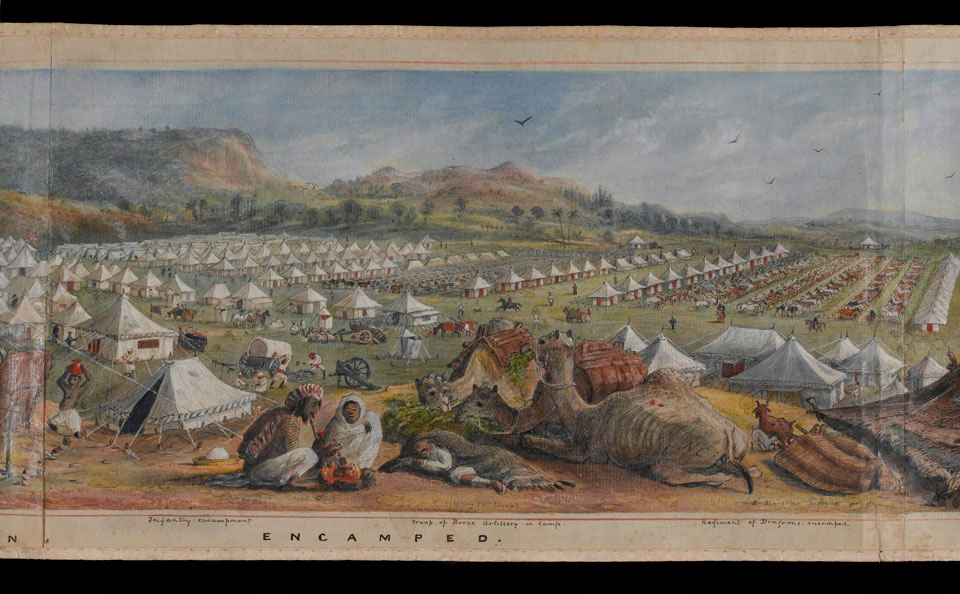
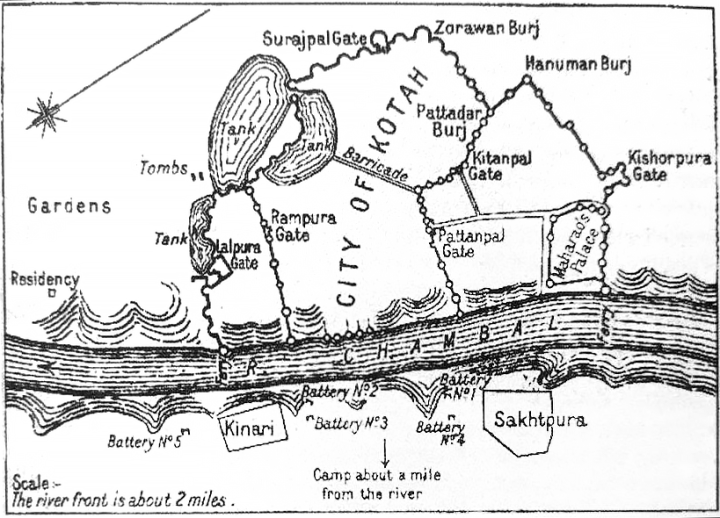
From across the river, the insurgents greeted their arrival with round shot, but without hitting anyone. With a reconnaissance having been made, the commanding engineer determined that two batteries would need to be erected on the left of the Chambal, one at Kinari (No.2), the other at Sakhtpura No.1). The objective was to keep down the firing from Kotah.
These enfiladed the ferry and, with the advantage of a higher elevation, they could throw round shot into Roberts’ camp. That very night, Captains Carmichael and Knatchbull broke ground for both the batteries, ensuring there would be some cover for the work parties by morning. At dawn, the first work party was relieved by another under Ensign Chapple – as soon as the insurgents realised what the British were up to, they brought two field pieces down to the riverbank directly opposite the work parties and opened fire. Roberts, however, had ordered no one was to fire back unless actually attacked but as “the guns were in the open without an escort and their fire began to get too warm for the working party,” a detachment of the 95th was sent down with their Enfields to give “them a few bullets.” Colour-Sergeant Brick and a few of the better shots of the regiment opened such a precise fire that eventually the insurgents collected their wounded gunners and for a moment, their guns fell quiet.
Kotah presented a few problems for Roberts. The fort consisted of a citadel built on high ground on the right bank of the deep river; the citadel was surrounded by formidably high and prodigiously loopholed walls, outside of which was the city of Kotah. This again was surrounded by stone walls, which not only enclosed the city but the citadel itself. The only opening was on the riverside side, which happened on this side to be unfordable. Nevertheless, this one gap was well protected by lighter walls with a bounty of gates. Bastions had been constructed at regular intervals all around the town, giving ample flank protection to the connecting curtains. These were “enormously high” with those near the river rising to nearly 70 feet above the water.
According to intelligence, the fort and the city were said to be occupied by some 7000 insurgents (although the number was actually closer to 6000), under their able leader, Hira Singh. They had some 90 heavy guns at their disposal, and these were engaged in besieging the Maharao in his palace. To take Kotah and relieve the Maharao, Roberts would have to take the city. However, things were not all that bleak, for in Kotah, they had friends: the Karauli troops had taken the south-western portion of the city nearest the palace and the fortified line of wall which separated it from the remainder of the town. The Maharao had, from the start, shown himself willing to allow Roberts’ troops into the part held by him and place the defence of the palace into their hands.
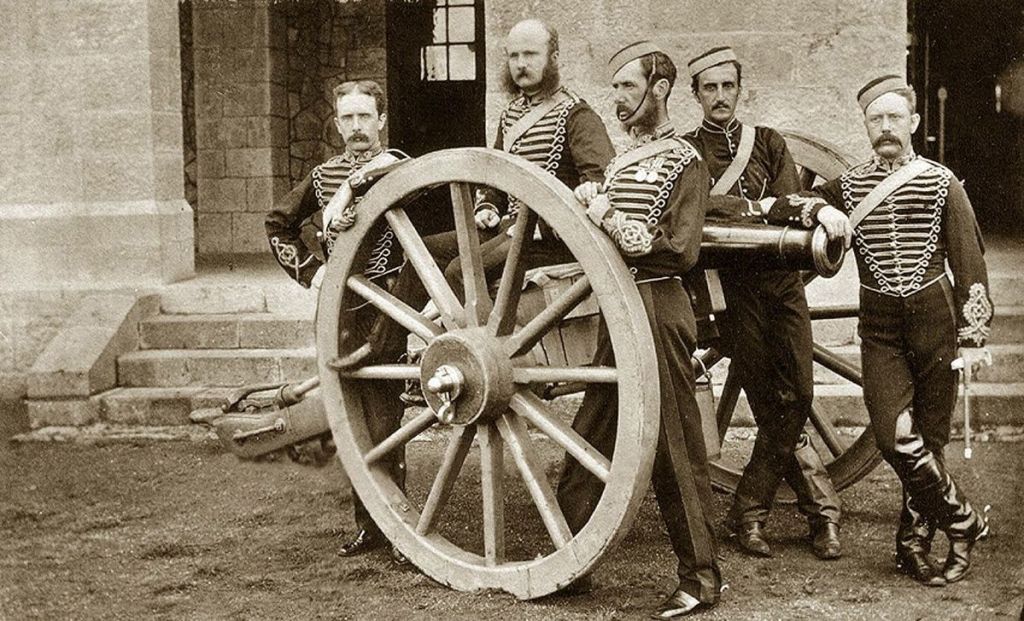
By the 24th, the batteries were complete and opened fire on Kotah. The work of the artillery Roberts would later describe in his official report as “having been almost beyond belief.” As there were no reserve artillerymen available, Roberts had needed to take men from the Horse Artillery and Field Batteries to work the siege guns: Lieutenant-Colonel Price of the Royal Artillery who arrived before Kotah on the 29th to take command of the batteries, would later report to Roberts the men had worked the siege guns without intermission for up to 48 hours at a time. By the 25th, the guns at Sakhtpura had nearly silenced the battery bearing on the ferry, but the Kinari battery was not having the desired effect on the town; nevertheless, the bombardment continued.
While the guns played at their hellish work, Roberts ordered 200 men of the 83rd, the Rifle Company of the 13th Bombay NI under Lieutenant Colonel Heatley, and a detachment of the 95th under Brigadier Macan to cross the Chambal by the ferry which was still being held by the Karauli troops. Their objective was to make their way into the portion of the town still held by the Maharao and reinforce his men. Although the insurgents were busy shooting at Roberts, they had not forgotten the Maharao – since Roberts’ arrival, they had doubled their assaults on the palace and had even attempted to carry it by an escalade. Major Trenemhere of the Bombay Engineers had made sure the men could cross but it would infantry only: “On an inspection of the river, which was at once made, it was ascertained that no difficulty would be experienced in crossing over any portion of the force opposite the palace, and that the boats in the Rajah’s possession were incapable of conveying heavy artillery.”
As Roberts was planning to take Kotah by storm on the 27th and 28th, he repositioned his guns. As the 12-pounders of the Sakhtpura Battery needed to be placed in the town and the troops for the assault would be sent over by ferry, it was now imperative to silence the irritating guns that were still taking shots at the ferry. A new battery was constructed containing two 18-pounders a little to the left of No.1 and in the evening, the 12-pounders and all the 8-inch mortars of Sakhtpura were withdrawn. The former were taken over the river during the night and the mortars moved to the artillery park in preparation of taking Kotah. As it was important to keep the isurgents distracted to the left, a new battery No. 5, was constructed for three guns on the north side of the village of Kinari, commanding the ghat at the Lalburj – it was completed on the morning of the 27th. Roberts certainly kept his engineers and artillery busy:
“In the Lallboorj, one 12-pounder heavy gun and one 24-pounder howitzer; below the rampart near the Lallboorj, three 8-inch mortars; near the Kittonpole Gate, two 5-inch mortars belonging to the mountain train ; on a bastion next to the Puttardar Bastion, and on the rampart below, two mountain train howitzers ; on the right below the Hooniman Bridge, three 8-inch mortars. Embrasures were made, and the parapets were strengthened, where necessary, by working parties of Royal Engineers and Sappers and Miners. Ramps were formed, and the terrepleins of the bastions enlarged to give more room for working the guns. The 12-pounder gim on the Lallboorj opened fire on the 28th upon some gims behind a stockade in its front, at the distance of 300 yards, and on the other side of the river slow firing was continued by the four 18-pounders in the batteries on the right and left.”
The same morning as No. 5 opened fire, the insurgents decided to try their hand against the 83rd – these took up the challenge and swiftly drove them away from the Maharao’s position. Meanwhile Roberts continued moving his guns. On the 27th and 28th, two 12-pounders and six 8-inch mortars, with the help of the infantry, were moved into the town under the insurgents’ noses. Heading this particular operation was Lieutenant Edward Wray (Field Commissary of Ordnance). At dawn the next morning he opened up a fearsome cannonade with cannister against insurgents’ formations, very much to their surprise.
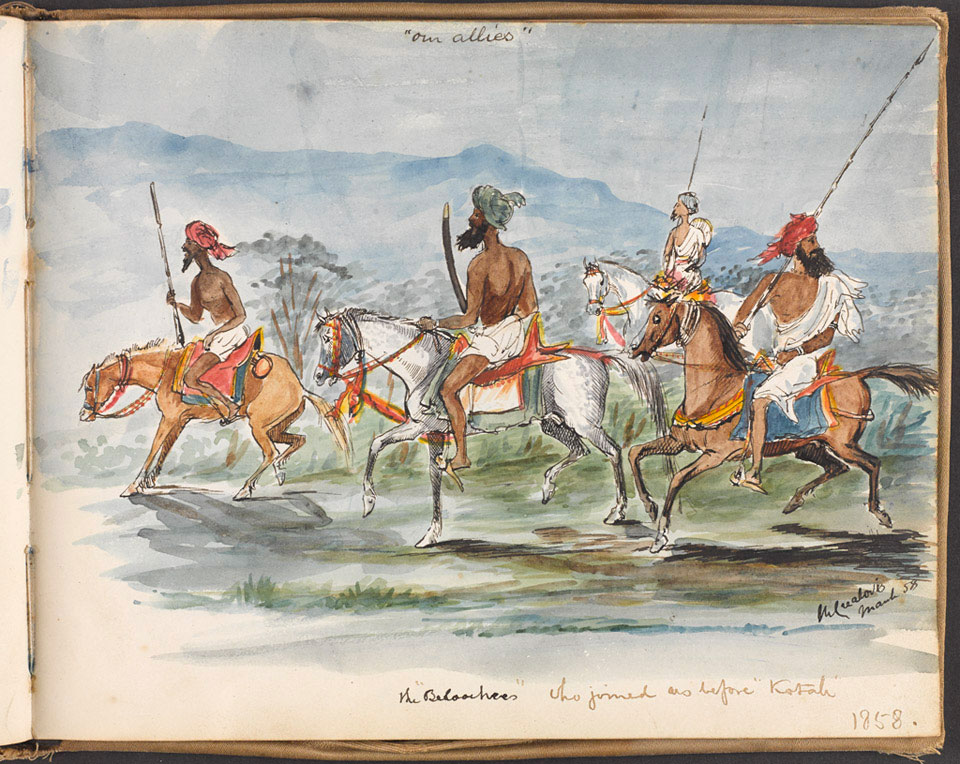
During the night of the 28th, the Beluchis arrived; they would followed the next evening by the 8th Hussars who would just miss the taking of Kotah.
By the 29 March all the guns were in place on and in the rear of the works in the town and opened fire at certain points in the city, namely the Magazine – around 5 pm it was clear that at least some of the bombardment had been successful as several explosions in quick succession were heard. The artillery duel however, had not stopped nor the constant labour. Working parties from the Royal Engineers and the Bombay Sappers busied themselves constructing rafts made of porter casks for the the passage of the infantry at the ferry as Roberts wrote out his final orders.
Kotah would be taken the next day – he also issued an order that the firing of the artillery was to continue through the night with “a slack fire” of two rounds per hour from each gun. By the afternoon, Wray would open up a ferocious artillery cannonade This was to continue through to the morning and throughout the day.
Troops for the assault were now organised in three columns :
Right (First) Column, under Lieutenant – Colonel Parke, H.M.’s 72nd Highlanders, consisted of —
H.M.’s 72nd Highlanders, under Major Thelluson – 250 men
12th Regiment Native Infantry, under Captain Adams 250 men
Second Column, under Lieutenant-Colonel Holmes, 12th Native Infantry, consisted of —
H.M.’s 83rd Regiment, under Major Steele – 250 men
12th Regiment Native Infantry, under Lieutenant Howinson ….. 250 men
Third Column, under Lieutenant-Colonel Raines, H.M.’s 95th, consisted of —
H.M.’s 95th Regiment, under Major the Hon. E. Massey – 250 men
10th Regiment Native Infantry, under Lieutenant Roome – 250 men
Reserve, under Brigadier Macan, consisted of —
H.M’s 83rd Regiment, under Lieutenant-Colonel Heatley – 250 men
13th Regiment Native Infantry, under Captain Stuart – 250 men
Two engineer officers with a party of the RE with tools and powder bags were attached to each assaulting column, while the Sappers would carry two scaling ladders for the the leading columns. The Third Column would be accompanied by two moutain train howitzers aunder Lieutenant Heathorn of the Artillery.
At one in the morning of the 30th the first column started crossing the Chambal to take their position in the town. As dawn approached, the guns on the walls opened fire and the mortars sent shot into the insurgents part of the town. By seven all the columns were over the river. Roberts had planned for the first two columns to pass through a breach in a wall which he intended to make with three mines while the third column were to blown in the Kittonpole Gate which had been blocked up with stones. The engineers however, had never seen the wall up close and quickly realised it was so old and so thick it would take days of concentrated battering to make an appreciable breach – Roberts was not put out though. Instead, he changed his plans and all three columns would enter Kotah through the gate. By 11 o’clock the columns assembled to enter through the gate. At half past eleven all the batteries suddenly fell silent and the assault began – the Engineers swiftly moved on the gate and by noon the powder bags were laid, the fuse lighted and the disappeared in cloud of smoke and debris.
” Out our men poured in quick succession, though with the utmost steadiness, each brigadier at the head of his column, sword in hand, the first and second leading to the right, the third to the left, whilst the fourth remained he reserve.”
Brigadier Parke quickly moved his men under a wall to the right to reach the Pattadar Bastion; he then wheeled to the left for his men to make their way under the ramparts to reach the Zorawan Bastion, “the broad ramp of which the 72nd Highlanders ascended as steadily as on parade.” The insurgents decided this was not really a good fight and fled, leaving behind three guns. Parke continued a rapid advance and, after some resistance, took the Surajpole Gate with its large bastions and three more guns. No sooner had the 72nd come up, they were greeted by the fire from the matchlockmen, holding a strong, stone house, facing the gateway. Lieutenant Cameron, with a small party, dashed up a narrow passage and staircase that led to the upper part of the building, but he was met with a very determined band of insurgents, headed by their commander-in-chief, a man named “The Lala.” Cameron was cut down and severely wounded. One man of the 72nd, one of the Royal Engineers, and another of the 83rd were all killed, and a private of the 72nd was wounded. Parke decided he would not risk any more men in the dark passageway and ordered the Royal Engineers to blow an entrance through the walls instead. While the blast had the desired effect, the men inside who had not been killed outright made their last valiant stand; not a single one was left alive.
With the taking of the gate, Parke had now outflanked the insurgents and taken their city position in reverse. “They had erected in nearly every street a double barricade and a gun in front of it in position to sweep it; and here and there by the guns infernal machines, with fifty barrels each, loaded half-way up and duly primed.” Unfortunately, the insurgents had refused to stand at their defences.
The Second Column reached the third bastion from the Pattadar Bastion and, likewise, turned to the left and made for the Surajpole Gate. The Third Column, meanwhile, after passing through the Kittonpole Gate, advanced directly to the left. The insurgents now realised the second column was coming on frighteningly quickly at the Surajpole Gate and tried to escape.
“Not knowing that the third column was to the left, crossed its front at 400 yards, when a great number were killed by the Enfield rifles of the 95th. Others, seeing that they would have to run the gauntlet, made for the bastions and effected their escape over the walls by the ropes which had apparently been in readiness for this purpose; and one man who was mounted, in a paroxysm of frenzy, spurred his horse to the rampart and jumped clear over, a fall of fifty feet. Both horse and rider I saw afterwards at the foot of it outside were killed.”
It was not a good day for the insurgents at Kotah. After occupying the bastions, the troops proceeded to clear the town, house by house. Meanwhile, Colonel Holmes of the Second Column, finding that Parke had taken Surajpole Gate, marched to the north end of the town only to find it had already been abandoned by the insurgents, and he quickly occupied the Rampura and Lalapura gateways. To cut off the insurgents in their flight, the Reserve column was directed to enter the Rampura quarter through the Kittonpole Gate and meet up with Holmes at the gateway. Hardby the Rampura Gate was one of the insurgent batteries, just opposite Kinari village – Holmes ordered Lieutenant Hancock with a party of the Royal Engineers to dismount the guns, but things did not go at all well.
“While so employed, the magazine in the battery blew up, and Lieutenant Hancock and ten men of the Royal Engineers and three of the 12th Regiment of Native Infantry were more or less severely injured, and that four of the Royal Engineers have since died of their wounds.”
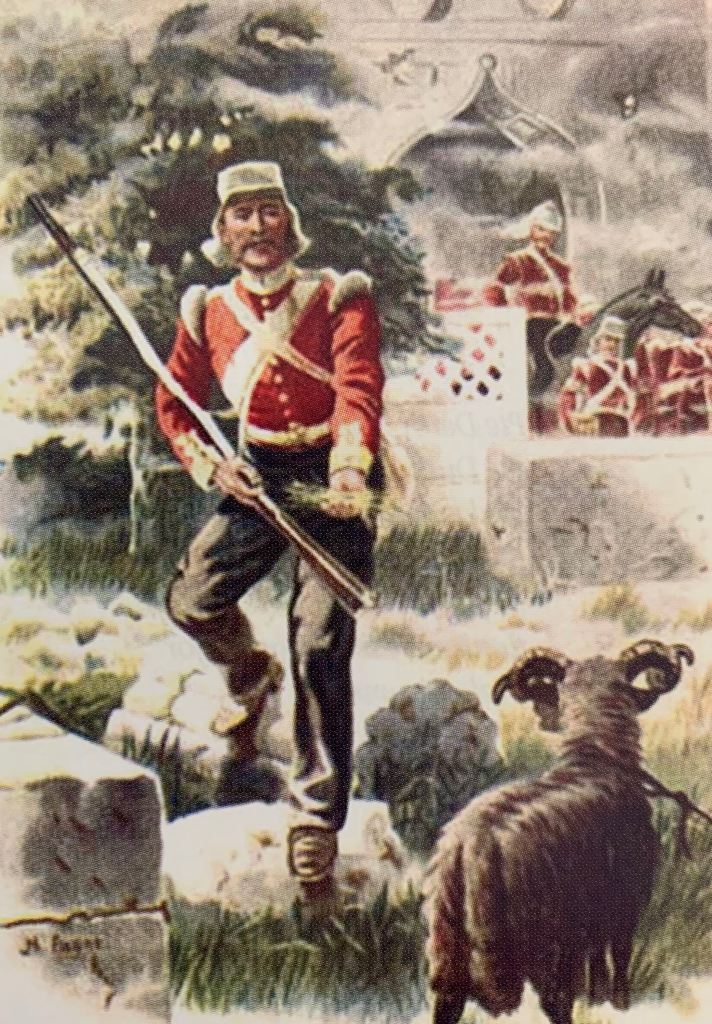
Amid the chaos, Private Sullivan of the Grenadier Company, 95th Regiment, took a startling prisoner. It was a particularly fine ram, with immense curved horns and by all means, a fighting animal, in the prime of its life. Sullivan called Colonel Raine’s attention to the ram, which was tethered to a pillar next to a temple. Raines, without any hesitation, told Sullivan to take the animal prisoner. Dubbed Private Derby, the ram, followed the 95th for the next 3000 miles of campaigning, and was wont to march at the head of the regiment. Derby was present at six actions in all and received, when on parade at Poona in 1862, his fair dues when he was presented with the India Mutiny Medal with a clasp for Central India. Unfortunately, this hard-won mascot died in 1863 when he tumbled into a well in Hyderabad in Scinde but the regimental tradition continues today.
By half past two in the afternoon, Roberts had taken Kotah and had captured 57 guns. The insurgents who had managed to avoid the British escaped through the east gate only to find themselves chased as far as the Parbati River, 60 miles away. In all, they had lost 400 killed in just a few short hours.
As For the Cavalry
The 8th Hussars under Colonel de Salis had been proceeding towards Kotah over the past few weeks from Bombay — on 26 March, de Salis received an urgent order to proceed with all haste and the despatch enclosed a route that contained six marches to Kotah, however, it was not indicated how quickly they needed to complete the stretch. So it was opted to take the leisurely option; however, fourteen miles down the road, another despatch was received, ordering de Salis to push on by forced march if he had to, and that night they marched 22 miles to Bundi. He halted his force for twelve hours to replenish their supplies, and at three in the afternoon, they were on the road again, to take on the last 21 miles to Kotah. During the last four miles, they could hear Roberts’ guns, and at 1.30 on the morning of the assault, the 8th Hussars arrived in the camp.
De Salis now read the brigade orders, which to his astonishment said the Hussars were to turn out at 7 am to take part in the action – they rode off at half past seven and joined the rest of the cavalry – the Bombay Lancers, Jacob’s Sindh Horse, the Beluchis and Blake’s Horse Artillery. What struck Mrs. Duberly, who rode with her husband, was that the firing was slack, compared to what she had heard at Sevastopol in the Crimean War. This was certainly a different kind of war.
The cavalry was to cross the river at a ford seven miles up from the Kotah to “intercept and destroy” any insurgents attempting to escape. They were not aware that by the time they arrived, Kotah had in fact already been taken, and the majority of the insurgents had already fled. The next day, they heard that while they had been watching the city, the remainder of the insurgents had escaped from the opposite gate. Mrs Duberly, somewhat indignantly, wrote,
“It will naturally be asked – ‘Where were the 1500 cavalry and artillery at this time, and what were they doing towards the destruction of the flying enemy?‘ The cavalry and artillery reached the ford at the appointed time, and had traversed half its width, in spite of the difficulties which it presented, when someone with keener eyes than the rest discovered what he declared to be a gun pointed at the wading force. On nearer and careful examination, it proved to be a black buffalo grazing. At last, after a good deal of delay and some little disorder, the ford was crossed. I hesitate to describe what followed. The cavalry and artillery were immediately halted on the river bank, and the men remained standing to the horses or lying under the trees until 2 o’clock, when the enemy, unable to endure the fierce assault of the infantry, fled across the plain, carrying with them their arms, ammunition and treasure! Surely, on receipt of this intelligence, the cavalry must have started in hot pursuit. No. Far from it. They remained where they halted all that day and all that night; and the next morning they marched into Kotah, and then returned to their original halting place by the ford!”
When the pursuit was finally ordered, it was not until the next day, and by then it was already four in the afternoon. Mrs. Duberly was nearly beside herself, writing, “It was hard upon the men to arouse them at midnight for a service they were not required to start until sixteen hours afterwards. And had the brigade had otherwise been commanded, there would have been no necessity for a pursuit at all, for few Acting Brigadiers would have halted their men for twenty-four hours with a flying enemy almost in sight. The fugitives, who had gained a fifty-two-hour start, were now to be pursued by our troopers in full marching order and on jaded horses!” She felt the 8th Hussars were not only disheartened but humiliated at not being part of the assault; they had not had the chance to add a fresh honour to the Crimean name. What Mrs. Duberly would soon find out, Kotah would not be their last ride.
Sources:
Behan, T. L. Bulletins and Other State Intelligence for the Year 1858. Vol. II. London: Harrison & Son, London Gazette Office, 1860.
Duberly, Mrs. Henry. Campaigning Experiences in Rajpootana and Central India during the Suppression of the Mutiny, 1857-58. London: Smith, Elder & Co., 1859.
Forrest, George W. A History of the Indian Mutiny. Vol. III. London & Edinburgh: William Blackwood & Sons, 1902.
Historical Records of the 72nd Highlanders, 1777-1886. Edinburgh: William Blackwood & Sons, 1886. Printed for private circulation.
Holmes, T. Rice. A History of the Indian Mutiny. London: Macmillan & Co., 1904.
Intelligence Branch, comp. The Revolt in Central India 1857-59. Simla: Government Monotype Press, 1908.
Jocelyn, Julian R. J. The History of the Royal and Indian Artillery in the Mutiny of 1857. London: John Murray, 1915.
Malleson, G. B. History of the Indian Mutiny, commencing from the close of the 2nd Volume of Sir John Kaye’s History of the Sepoy War. Vol. II. London: W.H. Allen & Co., 1888.
Raines, Julius. The 95th (The Derbyshire) Regiment in Central India. London: Swan Sonnenschein & Co., 1900.
Links:
https://mercianregiment.co.uk/the-regimental-mascot#:~:text=The%20ram%2C%20named%20’Private%20Derby,Medal%20in%201862%20at%20Poona.
 Mutiny Reflections