Mr. Charles Wingfield cannot really be called one of the heroes of the mutiny. He was a well-connected civil servant who served the interests of the government by whom he was employed, the doctrine set down by his mentor James Thomason and to a certain extent his own. His affectation throughout was guided by self-preservation; in other words, Mr. Wingfield rather believed he was worth more alive than dead. It was an astute decision, but it hardly deserved the accolades with which he would be heaped.
As we have already seen, he did not have much faith in the sepoys, regardless of which station he happened to be in. In Secrora, Mr. Wingfield had felt it was pointless to stay and, on the pretence of taking his evening ride, had simply ridden off to Gonda without telling anyone. At Gonda, after bringing in the news of the Secrora mutiny – which he did not have by any means as a first-hand account since the officers who left Secrora did so after him – Mr. Wingfield once again deemed the situation fruitless and after telling the civil officers they were at liberty to leave, he once again took to the road, this time for Balrampur.
There is no problem, essentially, with Mr. Wingfield’s actions. He was preserving his life and, in his estimation, the lives of others by allowing them to leave their stations without having to face censure from the government for abandoning their posts. Mr. Sherer was most insistent on finding a way to Allahabad to explain his conduct to the commissioner; Mr. Tucker at Fyzabad could not be convinced to leave under any circumstances; Mr. Thornhill fled under duress; Mr. Hume at Etawah risked his neck to stay. Duty and honour bound, many civilians remained in their districts long after any hope of escape had been extinguished – Cawnpore is just such an example. However, Mr. Wingfield does not appear to have shared their ideas. He acted by the letter – quite literally, as Sir Henry Lawrence, after the disaster at Sitapur had allowed civilians to abandon their post should mutiny be imminent, and he does not seem to have been struck by any particular sense of duty. No one would say Mr. Wingfield was a coward, but ultimately, his actions are nothing more than calculating.
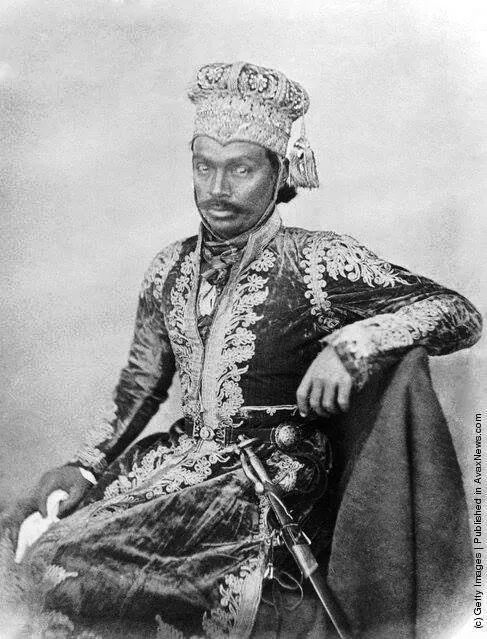
Raja Digbijai Singh of Balrampur
One of the men, Mr. Wingfield, who had done his best to befriend following the annexation of Oudh, was Raja Digvijay Singh of Balrampur. One of the most influential taluqdaris in Oudh it would have been a disaster had Balrampur joined the mutiny – Mr. Wingfield had done all he could to secure at least one friend in Oudh. It would appear he was successful – the Raja did not waver in his standing, and he remained staunch throughout the turbulent times to come.
On the 10th of June, after leaving Gonda with a little less stealth, Mr. Wingfield arrived in Balrampur, accompanied by Mr. Owen, Assistant Commissioner of Gonda and the officers of the 2nd Oudh Irregulars who had left Secrora shortly after him, Captains Hale and Boileau and Doctor Kendall.
Treated with all kindness and hospitality, Mr. Wingfield, for a moment at least, appeared he would stay at Balrampur. He did not have any pressing sense of duty; Balrampur would do quite nicely. If it wasn’t for the fact that on the 12th of June, a further 13 people arrived from Gonda.
Those Who Found Shelter in Balrampur
C.J. Wingfield, Esq., Commissioner of Gonda, Bairaich Division
C.B. Owen, Esq., Officiating Deputy Commissioner of Gonda
Lieutenant E.G. Clarke, Assistant Commissioner of Gonda – his wife and 2 children died during the Siege of Lucknow
Of the 2nd Irregular Infantry
Captain G. Boileau, Commanding – his young daughter died during the Siege of Lucknow
Lieutenant G. Hale, Adjutant – his wife and daughter would die in the Siege of Lucknow
B. Kendall, Assistant Surgeon – his wife and child survived the Siege of Lucknow
Of the 3rd Oudh Irregular Infantry
Captain C. Miles, Commanding
Lieutenant D. Campbell, Adjutant
F. Bartrum, Assistant Surgeon – killed at Havelock’s Relief of Lucknow; his wife and son survived the Siege of Lucknow
Lynch, Sergeant Major, wife and children
P. Carr, Quarter Master Sergeant
Civilians
Mr. C. Tucker, head clerk, Deputy Commissioner’s Office, Gonda, wife and family
Brother-in-law of Mr. Tucker
Mr. Yeoward, 2nd Clerk, Deputy Commissioner’s Office, Gonda, and family
Mr. Archer, head clerk, Deputy Commissioner’s Office, Baraich
Deputy clerk of Bareich whose name is unknown
Suddenly, Mr. Wingfield’s sense of comfort diminished considerably. The fort, he realised was not fortified; the rains had not set in so it would be but a night’s work for the Gonda mutineers to march on Balrampur, with the guns, and turn the fort to dust; the Raja was of course dependable, but his people were, according to Mr. Wingfield, certainly not. There might have been some truth in his estimations – it would undoubtedly have been impossible for the Raja to protect his position had the mutineers attacked, and there were certain elements among his people who were less than pleased with the Raja extending his hand in protection to the British. He had also been placed under considerable pressure by the mutineers. After boldly demanding he hand over the treasure in his tehsil to them, they were no less shy in reproaching him for hiding fugitives. Under the circumstances, and deeming the party, which now amounted to 19 people, too large for the Raja to protect, Mr. Wingfield, ever prudent, determined to leave.
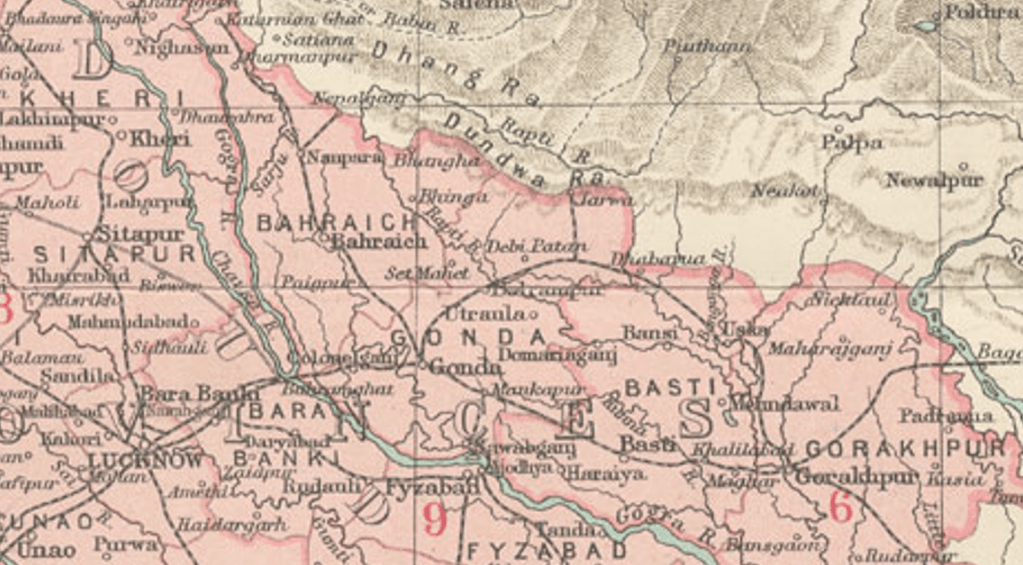
On the evening of the 12th of June, Mr. Wingfield left Balrampur and with him went everyone else. With an escort of 500 of the Raja’s men, the party of 19 adults and several children set out for Phulpur, a place belonging to the Raja and just within the borders of Gorakhpur District. Here they stayed until the 13th, taking a moment to consider what to do next.
The idea was to proceed to Bansi – the raja being a relative of the Raja of Balrampur – and from there, consider the options. As there was uncertainty, however, if Gorakhpur was still in British hands, Mr. Wingfield did not have many. They could make for the Gunduk River and attempt to sail down to Patna or, closer still, cross the border into Nepal. Neither option was appealing. Mr. Wingfield determined to wait for news from Gorakhpur instead.
When it came, it was somewhat heartening. The situation at Gorakhpur was certainly critical, but as long as the irregular cavalry held out, it was containable. The officers of the party, some seven in number, made their way without delay to that station. Mr. Wingfield once again had his doubts. His excuse this time is rather interesting.
“I resolved to wait for further news from my division, for none of the Taluqdars had yet shown any indication of revolt, and I thought it probable that the mutinous troops would all march towards Lucknow, when I might, with the aid of well-affected Rajas, return and re-establish the British authority. Besides, all communication from other parts had ceased since the 8th, and I was ignorant how far mutiny had spread in our older provinces, and they were equally so for the same reason at Gorakhpur…”
At this juncture, Mr. Wingfield received a letter from the Raja of Balrampur to the effect that returning to the district without a considerable force of British troops would be useless. Mr. Wingfield was left with one option – proceed to Gorakhpur. He arrived at the station on the 26th of June, and here he falls out of sight for a brief moment.
In Gorakhpur, we will meet a veritable man of action in the form of Mr. William Wynyard, who certainly deserves more words than Charles Wingfield and would have to do without as many honours. While Mr. Wingfield rose from strength to strength – he would take the post of Chief Commissioner of Oudh after the mutiny and then Commissioner of Gorakhpur, during which he was appointed Companion of the Order of the Bath on 18th May 1860. He then secured the position of Vice-Chairman of the East India Association’s Council, and on 24 May 1866, he was appointed Knight Commander of the Order of the Star of India. This, of course, was not the end of his career. Back in England, he served as a Member of Parliament for Gravesend. Although his actions were called into question after the mutiny, neither his reputation nor his career suffered. Martin Gubbins, on the other hand, who should have been Chief Commissioner of Oudh, was shunted sideways to the position of judge of the supreme court of Agra, an appointment which was guaranteed to give him little honour. Already ill, Gubbins would retire from his last post in 1863 and, in the same year, commit suicide at Leamington. Patronage in the East India Company went a very long way and for those who never strayed, went far. Despite his shortcomings and a rather unremarkable career up to this point, Mr. Wingfield understood how to play the game.
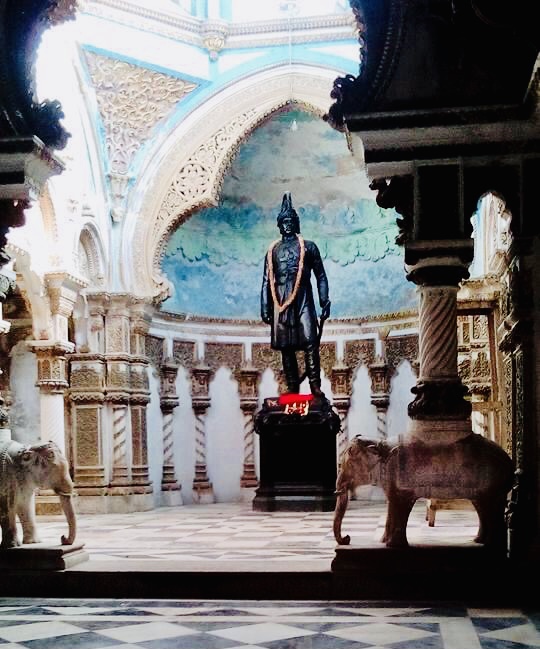
As for the Raja of Balrampur, he remained steadfast in his position, neither wavering nor capitulating as long as the mutiny lasted. His position was certainly not enviable, surrounded as he was by districts that were teeming with revolt. Yet there were rewards. In 1859, he was granted the title Maharaja Bahadur, in 1866 awarded a K.C.S.I. and in 1877 a personal 9-gun salute. He would also be a Member of the Governor General’s Legislative Council and President of the British Indian Association.
Following the mutiny, the Balrampur Estate became the largest taluqdari in Oudh, spanning 1300 square miles, after he was given large estates in Gonda and Bahraich. Charity and kindness marked his reign and were more than just a passing flight – he would build several charity houses to feed the poor free of charge, while the hospitals he established in Balrampur and Lucknow dispensed medicine to the needy for free. Honour is of the man.
To proceed to Gorakhpur and the events there, readers are kindly requested to go to
The Troubles of Mr. Wynyard, Esq.
Sources:
Chick, Noah Alfred. Annals of the Indian Rebellion. Calcutta: Sanders, Cones, and Co., 1859.
Bonham, John. Oude in 1857: Some Memories of the Indian Mutiny. London: Williams & Norgate, 1928.
Gubbins, Martin Richard. An Account of the Mutines in Oudh and of the Siege of the Lucknow Residency. London: Richard Bentley, 1858.
Malleson, G. B., ed. Kaye’s and Malleson’s History of the Indian Mutiny of 1857–58. Vol. 3, Cabinet Edition. London: W. H. Allen & Co., 1889.
Nevill, H. R. Bahraich: A District Gazetteer, Being Vol. XLV of the District Gazetteers of the United Provinces of Agra and Oudh. Allahabad: Government Press, 1903.
Rees, L. E. Ruutz. A Personal Narrative of the Siege of Lucknow. London: Longman, Brown, Green, Longmans, & Roberts, 1858.
Links:
https://www.indianrajputs.com/view/balrampur?tid=balrampur
 Mutiny Reflections