Bulandshahr and Secunderabad 12th May to 11th June, 1857
“If the Mutineers leave Delhi in force, it is plain that no wing of a corps, or even a single corps, could stay their march. Therefore, a move in strength to Bolundshuhur seems to be the right one.” (Lieut.Governor Mr Colvin to Brigadier Wilson, May 15th, 1857)
Not that anyone listened to Mr Colvin. Harassed as he was in Agra with the problems of the North-Western Province on his shoulders, he was looking too far towards a problem that had not as yet materialised. He was undoubtedly right, but Brigadier Wilson, for now at least, was content to concentrate his forces in Meerut and ultimately attack Delhi. He, of course, was right, too. Whereas Colvin was convinced the mutineers would break from Delhi and head south, Wilson, on the other hand, held that they were not leaving Delhi, and as for Bulandshahr, there was no contingency to reinforce the town as a second line of defence. So Colvin continued to fret.
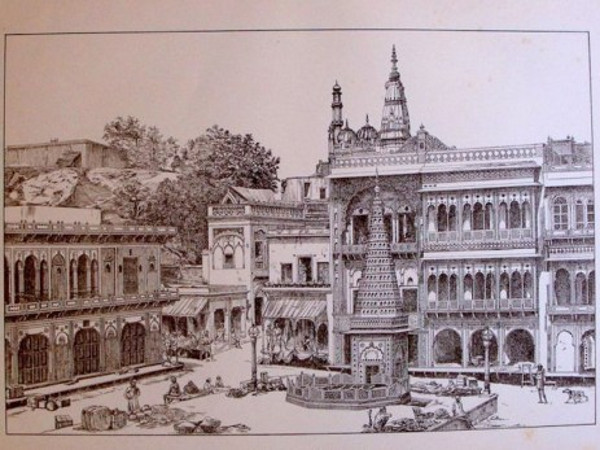
Situated between Delhi and Rohilkhand, bound on the south by Khurja and Aligarh, to the north-west by Delhi and the north-east by Rohilkhand, it was strategically situated on the Agra-Meerut road and thus on the direct line of communications, Colvin had every right to worry. The first anyone heard of the mutiny at Meerut was from a young officer who had been forced to return to Bulandshahr – instead of travelling to Meerut as planned, he had been attacked and robbed on the road. When trying to ascertain what to do next, he was told to go back to Bulandshahr; Meerut was in flames.
On the 12th of May, a determined band of Gujars attacked the area around Secunderabad. They indiscriminately pillaged villages along the roads, burned down rest houses and destroyed the telegraph wire. The retiring Magistrate, Mr. George Dundas Turnbull and Alfred Comyn Lyall, Assistant Magistrate who was new to the district, galloped over from Bulandshahr to restore some semblance of order. Aided by men of the 9th BNI, they arrested 46 Gujars and sent them to jail.
Historically, the Gujars were always socially diverse – from founders of kingdoms and dynasties to pastoral nomads, they were unfortunately already known by the early Mughals as a “turbulent people”. Divided into hundreds of exogamous clans, the names of which often derived from the early places where they had settled or from the clan founder, their origin as such is not known though it is generally accepted that they first arrived in India in the 5th and 6th centuries. Both Hindu and Muslim Gujars exist. Many had converted to Islam at various points throughout history, some as early as 1026 following the attack of Mahmud of Ghazni on Somnath. The Moguls continued the conversions – the Gujars of Himachal Pradesh were forcibly converted in 1700 by Aurangzeb. Not accepted as converts by the resident Pathans and Baluchis, the Muslim Gujars were forced to leave. Whereas the Hindu Gujars existed as a successful sedentary group, the Muslim Gujars derived a living from raising buffalos, an occupation which forced them into a semi-nomadic existence. They often augmented their livelihoods with petty thieving and cattle lifting. In 1857, as we have seen, they actively took part in sacking Delhi and harassing fugitives, even resorting to murder. Emboldened by events in Meerut and Delhi, the Gujars no longer saw British rule as a force to be reckoned with. By mid-May, most of the Gujars imprisoned in other districts had been released by the mutineers, and many were returning home. Turnbull and Sapte could only watch as the Gujars gathered in their district in alarming numbers.
Over the next few days, several other European travelers found themselves waylaid and unable to proceed past Bulandshahr, remained there. The Magistrate and Collector Mr. Brand Sapte, who had only just joined the station to replace Turnbull, found himself in a precarious position – with one company of the 9th BNI of doubtful loyalty under Mr. Ross, a few irregulars who happened to be on leave, and some 20 Europeans, he suddenly became very aware of his other problem. His district happened to be inhabited principally by Gujars. On the 21st of May, news of the mutiny at Aligarh reached Bulandshahr and the detachment of sepoys of the 9th BNI. The ladies were sent with a small escort to Meerut while Sapte determined to remain at his post despite the futility of the venture.
Forewarned that an attack was planned for 5pm the same day, Sapte, Turnbull and Mr. Melville first turned their attention to the treasury with a vain idea it could be escorted safely to Meerut by the guard of the 9th, the only men at their disposal. While thus engaged, the station was overrun by Gujars – for the last time, the 9th counterattacked and drove off the attackers, though not before the Gujars had opened the jail. Ordered to now march to Meerut, the 9th refused and distributed the packed treasure amongst themselves while simply dismissing Sapte and the other Europeans, advising them to go to Meerut instead. Sapte and Melville went off the Meerut, leaving Turnbull, Ross, and Alfred Lyall to hold the station on their own. The 9th marched off to Delhi, carrying the treasure with them.
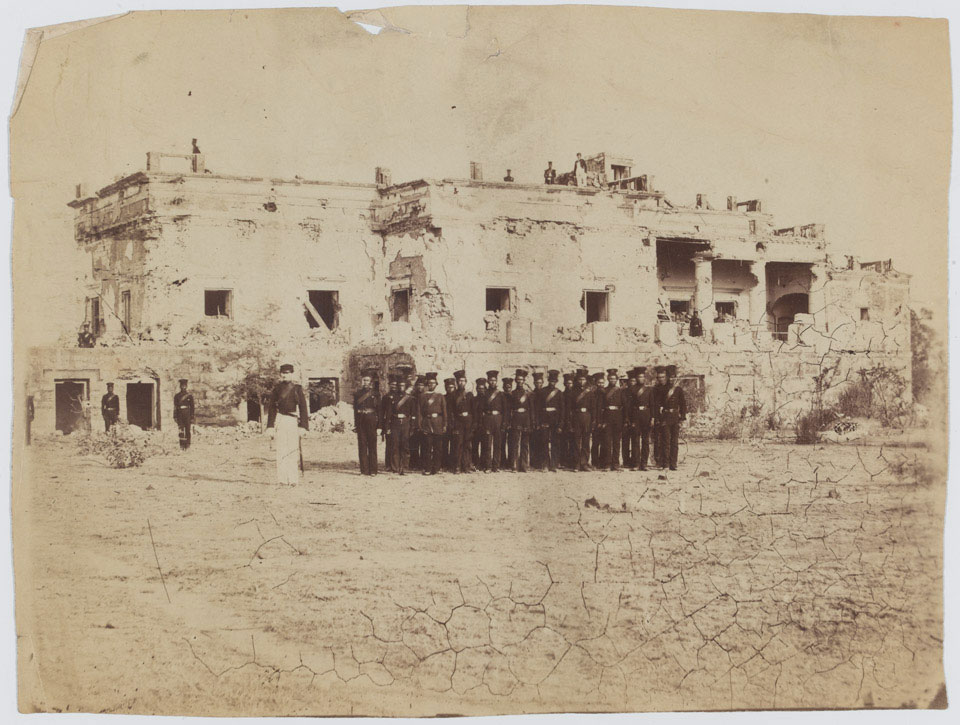
Mr. Sapte was not one to take his retreat lightly. He returned to Bulandshahr on the 25th of May with a few horsemen and Captain Tyrwhitt of the 14th Irregulars with some of his men, intending to recover the station. To his surprise, he found reinforcements had arrived before him, which included the Gurkha Sirmoor Batallion under Major Reid, on their way to Delhi who recaptured Bulandshahr on the 26th of May. They met with little opposition, but every house had been burnt and the station plundered. Major Reid and the Gurkhas did not stay very long – ordered to join Wilson’s forces at Ghaziabad, he marched his entire regiment out of the district on the 31st of May, leaving Captain Tyrwhit, Messrs. Sapte, Turnbull, Lyall, Clifford and Anderson with 14 sowars to keep the peace. It was a very tall order. Within a day, the cavalry rebelled and rode off to Delhi.
Secunderabad
Allow me to point out, dear readers, that the modern spelling is Sikandrabad and should thus not be confused with another Secunderabad, which is much farther away and does not come into our discussions. However, in 1857, Sikandrabad in the Bulandshahr district was known as Secunderabad.
Here onto the field enters Walidad Khan, Nawab of Malagarh. Having been in Delhi during the outbreak, he returned to his fort (some four miles from Bulandshahr) on the 26th of May. He was no longer just the nawab of his own four walls; the King of Delhi (a close relative of his) had entrusted him the position of Subedar of Bulandshahr and Aligarh. He admitted as much to Mr. Sapte, however, he excused himself, saying if had had not agreed to this promotion, he would never have been allowed to leave Delhi. As ruses go, it might not have been the most original, but it worked. Almost at once, Walidad Khan started plotting with the Gujars of Dadri and the district’s powerful Rajput zamindars. Their plan, besides ridding themselves of the British, was to destroy and plunder Secunderabad.
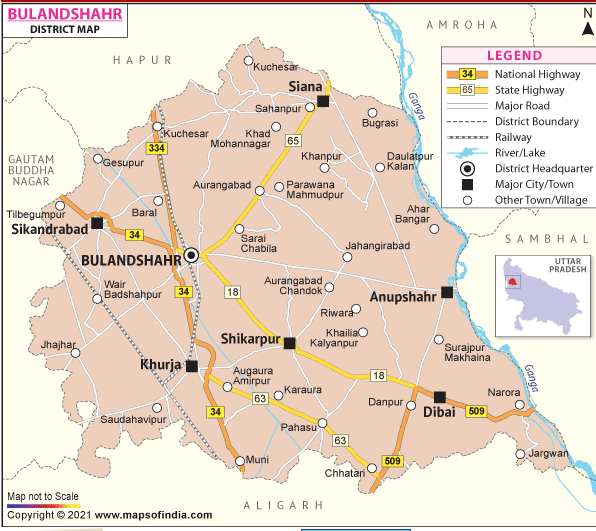
The combined forces under Walidad Khan took their chance and attacked the helpless town on the 31st of May, with Reid’s forces barely out of sight. In their thousands, they fell on Secunderabad, looting one area after the other over the next days until, by the 3rd of June, hundreds of townspeople were dead, and the town was reduced to ashes.
Those that could fled for protection to Bulandshahr and begged Sapte for help. Defenceless himself, Sapte could not risk sending his men out to meet Walidad’s forces, and the people had to resort to offering protection money to the self-same Gujars that had attacked them in the first place. This put a momentary halt to the plundering, but peace was short-lived.
Travellers were now being indiscriminately attacked on the roads, the ringleaders more often than not the zamindars through whose territory the travellers were passing. Squabbles broke out amongst the various clans and chieftains as they turned on each other, everyone trying their best to oust the other from his estates. Mutineers continued to gather in the district and, on their way, took their chances to plunder Secundrabad unhindered by anyone.
As for Sapte, he was still holding Bulandshahr – but he finally had to rescind power to Walidad Khan. With promises to hold the station for the EICo, Waldad Khan took possession on the 10th of June. The next day, Sapte and Tyrwhitt attempted to approach him again, but Walidad Khan’s men opened fire on them. Beating a hasty retreat, Sapte and the others left Bulandshahr in the hands of Khan.
With his district lost, Sapte threw in his civilian duties for a time and joined the volunteer horse levy and would be in the forefront when Balundshahr was retaken in September 1857. Alfred Lyall too put down his name as a volunteer and joined the Khaki Risala of Volunteers, an irregular European cavalry unit. He had only arrived in India in 1856, and one year later, at the age of 23, he was nearly killed when fleeing Bulandshahr; his horse was shot under him. He arrived in Meerut with just his clothes; all of his possessions had been burned along with his bungalow. In his later career, he would receive recognition as one of the most gifted civilian administrators of his generation.
Sources:
Chick, Noah Alfred. Annals of the Indian Rebellion. Calcutta: Sanders, Cones, and Co., 1859.
Kaye, John William, and G. B. Malleson. Kaye’s and Malleson’s History of the Indian Mutiny of 1857–8. Vol. 6. London: W. H. Allen & Co., 1897.
Mukherjee, Paresh Nath. “Bulandshahr in 1857 Rising.” Proceedings of the Indian History Congress 21 (1958): 496–500. http://www.jstor.org/stable/44145246.
Stokes, Eric. The Peasant and the Raj: Studies in Agrarian Society and Peasant Rebellion in Colonial India. Cambridge: Cambridge University Press, 1978.
” The Cornhill Magazine 18, no. 105 (September 1868): 364–67.
Tewari, J. P. “The Revolt of 1857 in Bulandshahr District.” Proceedings of the Indian History Congress 28 (1966): 365–76. http://www.jstor.org/stable/44140455.)
 Mutiny Reflections