“I beg you will assure his Excellency, that the exertions made by the force under my command, to ensure the success of our operations, have been of no ordinary kind; without tents, or anything but the clothes on their backs, they (one and all) have been exposed to the inclemency of the weather, in the several attempts to accomplish the object in view, viz., the destruction of the rebel force. No troops but the two seasoned regiments now with me could, I feel confident, have gone through all the fatigue and exposure to which they have been subjected; indeed the Casualty Return of Colonel Corfield’s Force, which simply operated for a few hours before sunset, will prove my assertion, seven (7) men having died of coup- de-soleil in that time; and further, that out of a party of 110 men of the 6th Foot, which left their camp with Lieutenant-Colonel Longden on the 13th instant, to meet the convoy already mentioned, as ordered from Jugdespore, full sixty (60) men fell out, most of whom had to be earned into their camp.” (Dispatch, Brigadier Edward Lugard, Camp, Jagdispur, May 14th, 1858)
6th Regiment of Foot
Killed by Coup-de-soleil
1 Corporal, 5 Privates
2 privates, wounded
Ill luck would continue to plague the regiment. They returned to Sasseram on 20 May, only to be beset by sickness, which carried off over 50 men. Their colonel, A.A. Barnes, had succumbed already on 5 May, 1858 and lies buried in Sasaram. In June, they were moved to Benares and five months later to Azamgarh, where they remained for the remainder of the year and into the next. The action under Colonel Corfield would be their only battle during the Indian Mutiny.
10th Regiment of Foot
Lieutenant-Colonel William Fenwick – coup de soleil, relieved from duty.
“Lieutenant-Colonel Fenwick, commanding 10th Foot, fell, I regret to say, from the effects of a sun-stroke, near Duleepore, and the immediate presence of the Doctor alone prevented a fatal result. This officer will not be able to resume his duties again without a change to Europe.” (Brigadier Lugard, 14 May)
Colonel William Fenwick would die of sunstroke at Bhosawrel when on his way to Mysore on 7 May 1870.
Lieutenant St. Andrew Beauchamp St. John – severe gunshot wound, with fracture of left arm, May 11.
“Lieut. St. John, 10th Foot, during a night attack between the 11th and 12th of May, 1858, was wounded by a musket bullet, which entered at the front of the left arm about its middle, passed directly through the humerus, fracturing and splintering it severely. The posterior opening was very large and torn; there was a second aperture, as if it had been produced by a spicula of fractured bone; and as the missile escaped, it struck the side, abrading the skin. The power and sensation of ring and little finger were gone; the others retained a little of both. The pulse beat naturally at the wrist. The arm was put up in splints; cold water applied. Suppuration attended by some fever followed. On the 19th, the discharge was very copious; there was a good deal of oedema of the forearm, but the wound looked healthy. The progress of this case was satisfactory; both the wounds healed, cold water having been the only application used, with the exception of poultices during a few days to encourage the commencement of suppuration. Union took place, but the hand remained powerless; the general health was good; he was sent on sick leave to England in July, and a year afterwards, on the return of the regiment, joined it at Plymouth, but with the hand permanently disabled.” (Gordon)
Corporal John McCoy – wounded 11 May
Privates
Cassidy, P. – killed in action
Deegan, -J. – killed in action
Fynne, Henry – wounded, 2 June
Higgins Patrick – killed in action, 11 May
Macartney – wounded, 12th May Penetrating the Intestine.—Macartney, 10th Foot, was, on 12th May, 1858, wounded in action at Chitowrah. The bullet made its entrance between the 10th and 11th ribs, in a line above the anterior spine of the ilium, and seems to have passed downwards and backwards, escaping an inch and a half to the left of the spinous processes of the first and second lumbar vertebrae, close to the crest of the ilium. At the same time he received a wound from a second bullet, which, entering on the outer aspect of the left arm about its middle, passed inwards completely through it. He was struck down insensible by these injuries, remained in that state some time, and when brought to hospital, was suffering from a considerable degree of ” shock.” On the following day, symptoms of peritonitis set in, attended by severe vomiting of bilious matter, and the contents of the large intestine were discovered to be escaping from the wound posteriorly. On the i4th, these symptoms had already begun to moderate, and some faeces were voided per anum. On the morning of the 15th, there was a very free faecal discharge from the posterior wound; considerable tympanitis; skin moist, and of natural temperature; face free from anxiety; pulse soft, small, and slow. He complained much of thirst, vomited much bile, but was not restless. Tongue coated with bilious coloured fur; bowels not moved naturally since the previous day, but very profuse faecal discharge from the wound, it being livid, dark, and offensive. He had, from the first occurrence of peritonitis, been treated with mercurials. The gums were now tender; he had, however, calomel in quarter-grain doses every three hours, the .diet being restricted to tea and bread. The notes of the case, taken at the time, state that it was remarkable how little he suffered. All the symptoms of peritonitis had disappeared by the 19th, but he still continued to vomit bilious matter. The greater part of the faeces were voided by the wound, but some also by the natural passage. The skin and pulse were natural. On the 21st, he was moved from the field to Arrah, where a temporary hospital had been established, and when again seen, eight days afterwards, the faeces had ceased to flow from the posterior opening, and the anterior was healing favourably. From this time till the 19th of June, the progress of the case was in all respects favourable. By that time, the anterior opening had completely healed; the posterior remained a granulating surface. He was then carried with the regiment towards Dinapore, a distance of about twenty-five miles, and which he reached on the 20th. Soon afterwards, he was attacked with slight pyrexia, which, however, was speedily subdued under treatment; the state of the bowels continued variable, but they were generally relaxed. On the 21st July, the posterior opening, which had for some days been healed, presented an ulcerated spot, and on the same afternoon, some faeces came away no pyrexia; no pain was complained of, and the state of the bowels was natural. He seems to have remained in much the same state till towards the end of September, when the mornings and evenings having begun to become slightly cool, his health began to improve. The posterior wound at times gave exit to the contents of the bowel, and he was at times troubled with pain in the abdomen. On the 1 1th October, he proceeded as an invalid en route to England.” (Gordon)
1 private died of heat exhaustion on the march, and another was admitted to the hospital suffering from apoplexy but made a full recovery.
13th Regiment
Sergeant Alexander Bevis – wounded
24th Regiment of Foot
1 Private killed by coup-de-soleil
84th Regiment of Foot
Private John Connell – wounded, 4 June
4th Madras Cavalry
5 troop horses killed
Sikh Battalion under Colonel Corfield
1 Private, wounded
Madras Artillery / “A” Company, 3rd Battalion
Serjeant Peter Murray – severely wounded, 11 May
1 havildar
5 rank and file wounded
1 troop horse killed
Royal Horse Artillery / E Troop
Serjeant Robert Campbell – slightly wounded, May 11
Lieutenant Stuart S. M. Maxwell – slight gunshot wound in the right knee, May 20
Serjeant Henry Robinson – slight gunshot wound in the back. May 20
1 rank and file wounded
1 Horse wounded
2nd Battalion, Military Train
Lieutenant William H. Dawson – killed, May 20
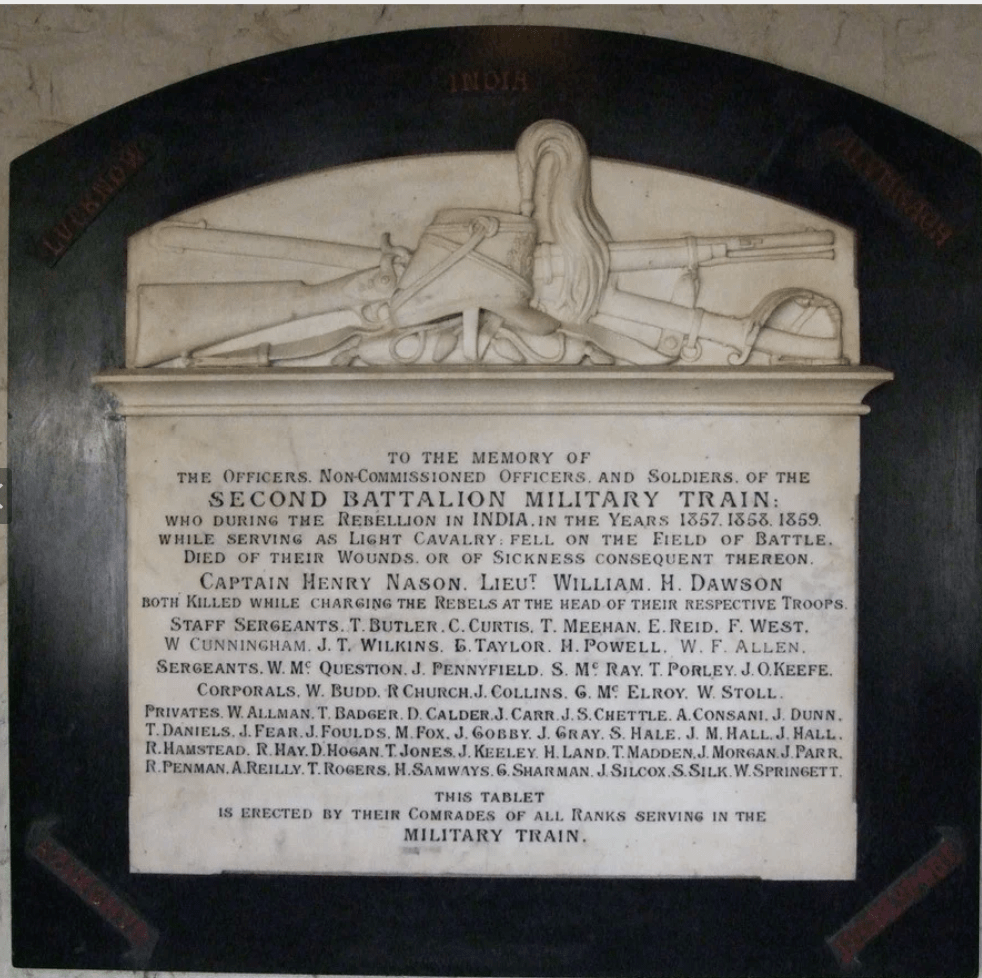
Sweet remembrance of the just who
Shall flourish when he sleeps in dust.
Sources:
Behan, T. L., ed. Bulletins and Other State Intelligence for the Year 1858. Part III. London: Harrison & Sons, 1860.
Caine, Caesar, ed. Barracks and Battlefields; or, The Experiences of a Soldier of the 10th Foot in the Sikh Wars and Sepoy Mutiny. London: C. H. Kelly, 1891.
Gordon, Charles Alexander. Experiences of an Army Surgeon in India. London: Bailliere, Tindall & Cox, 1872.
Greenwood, Hilary. Captain Thomas Fenwick, 1817-1859, Royal Engineer. Littlehampton Fort Project Research Series. November 2012. http://www.project.littlehamptonfort.co.uk/wp-content/uploads/2014/04/Captain-Thomas-Fenwick.pdf.
Kingsford, Charles Lethbridge. The Story of the Royal Warwickshire Regiment (Formerly the 6th Foot). London: “Country Life” Ltd., 1921.
Lee, Albert. The History of the Tenth Foot (The Lincolnshire Regiment). Vol. 2. Aldershot: Gale & Polden Ltd., 1911.
Malleson, G. B. History of the Indian Mutiny, 1857-1858. Vol. II. London: William H. Allen & Co., 1879.
Tavender, I. T., comp. Casualty Roll for the Indian Mutiny, 1857-59. Polstead, Suffolk: J. B. Hayward & Son, 1983.
 Mutiny Reflections