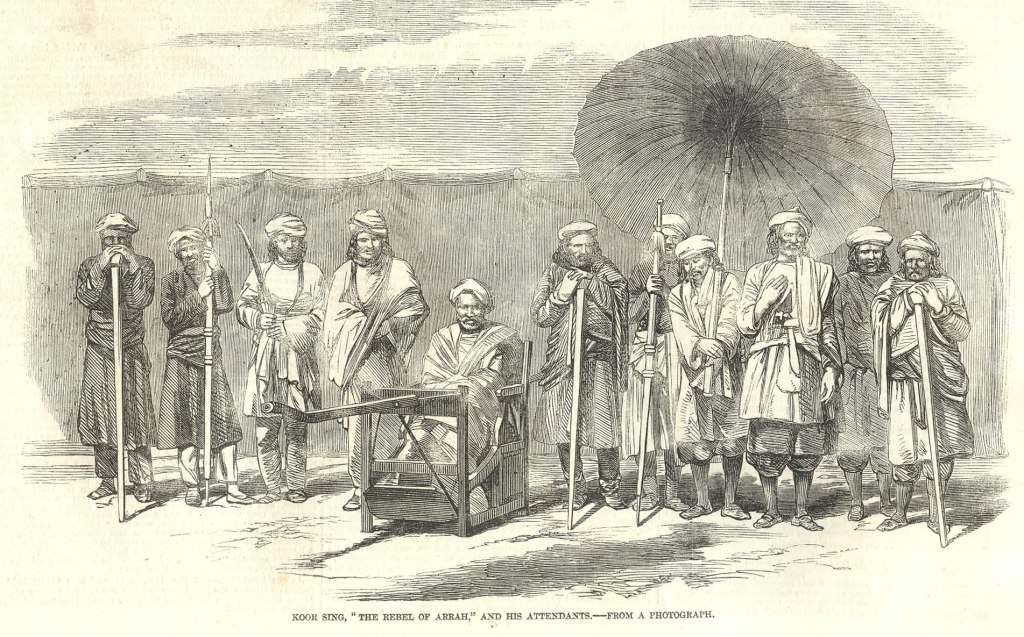
The day after the battle, Lugard marched to Didarganj, relieved the small Gurkha force at Jaunpore and buried Lieutenant Havelock. He then pushed onwards to Azamgarh. By the 14th of April, he was within seven miles of the town. By now, the forces of Kunwar Singh were said to be some 13’000 strong, but the British, still holding out in the jail, had been reinforced by troops from Ghazipur and Benares. Instead, a bulk of the garrison was moved out towards Mhow to cover Ghazipur, as that place was suddenly threatened by a large number of insurgents who had left Azamgarh the night before. This was indeed all Colonel Dames was prepared to do – his orders from Sir Colin were quite clear; he was to wait for Lugard before mounting any attacks.
Lugard marched 24 miles to Rani-ki-Sarai, just seven miles short of his objective; from there, he pushed forward a squadron of cavalry, 3 guns and four companies of the 10th under Lieutenant-Colonel Fenwick to reconnoitre a bridge of boats which had been thrown over the Tamsa (Tons) River and held by the insurgents. Lugard’s plan was to take the bridge; he could then cross it with a part of his force, not only turning to the insurgents’ position but also attacking it from the front and the rear simultaneously. Lugard had received plans of not only Azamgarh but the entrenchment ( which had been extended to include the judge’s house) from Lieutenant-Colonel Longden, who also happened to be one of the besieged, so on paper, it certainly looked like a workable plan. The same day, April 14, Fenwick moved his men over the Jaunpore bridge and soon came across the insurgents, who were in the process of attacking a picquet of the 37th stationed in the judge’s house. Surprised by Fenwick’s sudden appearance, they threw off a few shots in his general direction and made off towards the bridge of boats. As it was nearly dark and the ground was badly broken up, Fenwick halted his men and bivouacked for the night with the 37th.
Kunwar Singh still held the town and had been unremittingly harassing the entrenchment. However, he did have some doubts about his force. Sizeable as they were, they had failed not only to annihilate Milman but had not thwarted Kerr either, nor had they prevented further reinforcements from entering the entrenchment. What they would do when faced with Lugard’s brigade, Singh was not planning to find out. Instead, he decided subterfuge was indeed the best plan to follow. Instead of throwing his army at Lugard wholesale, he instructed his men to hold the bridge of boats while the bulk of the army was ordered to abandon Azamgarh and head for the Ganges. Once there, they should cross over and make for Jagdishpore. Had Lugard not arrived when he did, Singh had planned to attack the entrenchment in full force on the night of the 14th, but this was now out of the question. At daybreak on the 15th of April, everyone was on the move.
Lugard advanced his whole force towards Azamgarh while Kunwar Singh deployed a portion of his force along the left bank of the river and doubled his men by the bridge of boats. Fenwick, sent on his way by Mr Venables, who returned to Lugard, and guided by Lieutenant-Colonel Longden, proceeded towards the bridge of boats and, after a sharp skirmish, drove Singh’s men off the bridge. Then, pushing on up the left bank, Fenwick drove on towards a factory building from which the insurgents were keeping up a steady fire. Meanwhile, as the bridge had been partially destroyed in the fight, the Punjab Sappers and Lieutenant Keith of the Royal Engineers, who had accompanied Fenwick, set about repairing it with all rapidity, exposed the whole time to the persistent musketry fire from the insurgents on the left bank. Singh had cleverly sent “mostly old sipáhís, and on this occasion, they did credit to the training they had received. Forming up, on the approach of the British, like veterans, they repulsed, whilst still retreating, every attack, and finally forced the pursuers to cease their efforts.” As soon as it was passable, Lugard crossed over three RHA guns, a squadron of the Military Train and every man of the Sikh Cavalry in pursuit of the insurgents. These had now thought better of holding the left bank and began their somewhat disorganised retreat. At the fore of the attacking force was Mr Venables.
” ..Mr Venables charged the breaking enemy…and overtaking them, came into a sharp conflict. Lieutenant Hamilton was unhorsed and was only saved from being killed on the spot by a gunner in the Horse Artillery standing over him. Galloping on, Charles (Battye) noticed that Mr Venables was missing. He checked, found him severely wounded, dismounted, bandaged him up as best he could under fire, and ordered him to be taken to the rear; then remounted and continued the chase with his men.”
The rebel plan thus far had worked. The resistance at the bridge had ensured that most of their comrades had managed to leave Azamgarh well behind them before the pursuers caught sight of the main force.
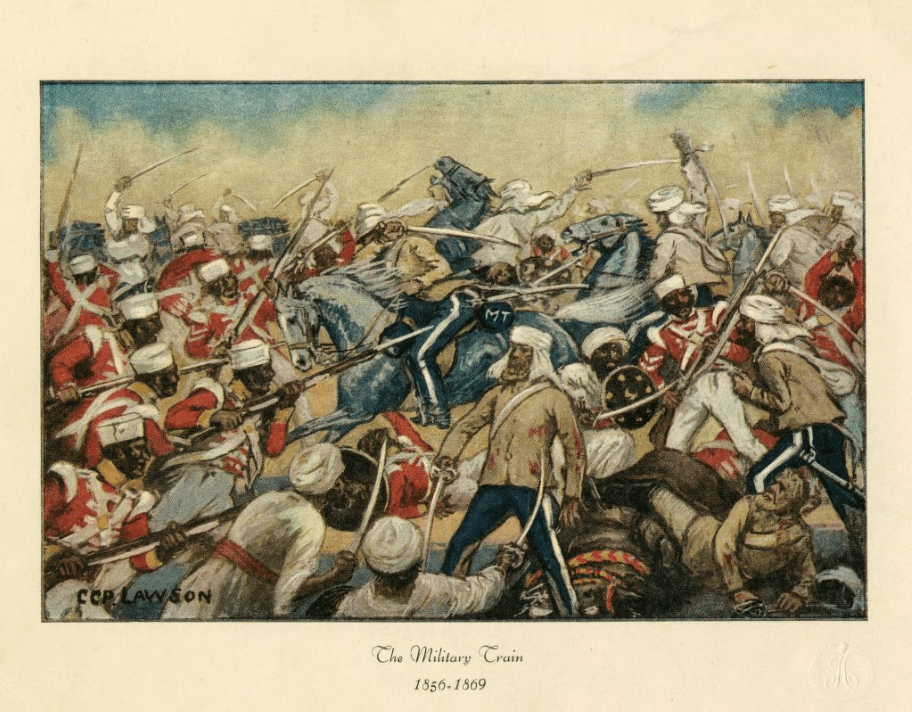
“And when they did see them, the sight was far from reassuring. Instead of a defeated and scattered host seeking safety in flight, they came upon a body of men retiring unbroken and in good order. They were the men of the old Danapur brigade, of the 7th, 8th, and 40th Native Infantry. But the pursuers did not hesitate. They charged — to make, however, no impression. ” It was all we could do,” wrote one of the officers engaged, “to hold our own against such odds. Immediately, our cavalry charged; they stood and formed square, and used to abuse and tell us to come on.”
Hamilton, who had managed to grab another horse, was badly wounded in the leg while charging one of the squares, and all the British achieved was to capture three of the rebel guns before realising that further pursuit was indeed pointless. They halted at Nathupur and watched as Kunwar Singh’s army vanished. They then sent their wounded back to Azamgarh and made a request for reinforcements. The insurgents had been moving in considerable hurry and left their baggage and several tumbrils of ammunition on the field, something for the British and their camp followers to pick over while waiting for news from Azamgarh. Scouts ascertained that while a considerable part of the rebel force had indeed crossed the Ganges, there was still a large portion in the vicinity of the village of Jewanpore, where they had thrown themselves into a small fort. In some dismay, the British watched as a strong body, with two Horse Artillery guns, purported to be from Neemuch, made their way into the fort to reinforce their comrades. They had left Azamgarh already on the 13th of April, leaving the British to wonder what exactly Kunwar Singh was up to.
For Lugard, there was little more he could do than call a halt. He ordered his force to make camp in Azamgarh and consolidated his plans. After some consideration, he decided the only way to proceed was to split his force. Two rajas, allies of Kunwar Singh, had been spotted making off in a northerly direction towards Oudh with their men, and Lugard also needed to keep an eye on the further movements of Ghulam Hussain, whom he had failed to stop at Tigra. With the message received from Nathupur, he now dispatched a force under Brigadier Douglas with the main wing of the 37th, the 84th, a company of Madras Rifles, Major Cotter with his four guns, and two 5 1/2 mortars as reinforcements. Marching through the night, Douglas arrived at Nathupur the following morning, on 16 April. In the meantime, Lugard sent an express to Colonel Cumberlege, then at Mhow (not the Mhow in Central India!), to continue patrolling towards Ghazipur as Lugard now expected he would soon have the company of insurgents from Azamgarh.
The question remained – what was Kunwar Singh doing and why, with so many men at his disposal, did he not attack Lugard outright? The answer, as the British would find out, was not as simple as they expected. For now, Lugard counted his dead and wounded.
——————————————————————————————————————–
Return of Casualties in the Azimgurh Field Force under Command of Brigadier-General Sir E. Lugard, K.C.B., at the passage of the Bridge over the Tonse River, at Azimgurh, and the subsequent pursuit of the Enemy to Azimgurh, on the 15th of April, 1868.
A Company 3rd Battalion Madras Artillery, with No. 2, Light Field Battery attached—1 rank and file, wounded.
Native Establishment attached to the above—1 rank and file, wounded.
24th Punjaub Pioneers—2 rank and file, wounded.
Her Majesty’s 10th Regiment—1 serjeant killed; 1 serjeant and 2 rank and file, wounded.
Her Majesty’s 2nd Battalion Military Train—1 serjeant, 3 rank and file, 2 troop horses, killed; 1 serjeant, 6 rank and file, 3 troop horses, wounded.
3rd Seikh Cavalry—1 subaltern, 1 native officer, 1 rank and file, 4 troop horses, killed; 2 native officers, 4 rank and file, 17 troop horses, wounded.
Total—1 subaltern, 1 native officer, 2 Serjeants, 4 rank and file, 6 troop horses, killed; 2 native officers, 2 serjeants, 16 rank and file, 20 troop horses, wounded.
E. LUGARD, Brigadier-General, Commanding Azimgurh Field Force
From the Nominal Return of Casualties in Azimgurh Field Force tender Sir Edward Lugard, K.C.B., at the passage of the Bridge over the Tonse River at Azimgurh, and the subsequent pursuit of the Enemy to Azimutgurh, on the 15th of April, 1858.
Serjeant George Wragg, Her Majesty’s 10th Foot, April 15, 1858, killed.
Colour-Serjeant William Hamell, Her Majesty’s 10th Foot, April 15, slightly wounded.
Private Thomas Collier, Her Majesty’s 10th Foot, April 15, wounded. (added by the author)
Serjeant John Foulds, 2nd Battalion Military Train, April 15, killed.
Serjeant James Tucker Wilkins, 2nd Battalion Military Train, April 15, killed.
Serjeant William McQuestion, 2nd Battalion Military Train, April 15, wounded.
Private Anthony Constant, 2nd Battalion Military Train, April 15, killed.
Lieutenant and Adjutant R. A. Hamilton, 3rd Sikh Cavalry, April 15, killed.
Total Casualties—7 killed, 21 wounded.
Mr Venables was wounded in the left arm by a musket shot; Lieutenant Hamilton, Adjutant 3rd Sikh Cavalry, was badly wounded and died during the night.
E. LUGARD, Brigadier-General, Commanding Azimgurh Field Force
Lieutenant Roger Adolphus Hamilton was attached to the Sikh Cavalry after his regiment, the 10th Bengal Light Cavalry, mutinied at Ferozepore in 1857. Born in 1835, he was the second son of Hans Henry Hamilton of Ballymacoll, Meath. He had been present at several actions during the mutiny and was severely wounded at Hissar in September. However, in November, he fought at the Battle of Narnaul and then proceeded to Lucknow for the final taking of the city.
During the fighting on April 15, Hamilton’s leg was shot off. As he lay on the ground, completely helpless, he was set upon by a few rebels who proceeded to slash at him with their tulwars. Lieutenant Middleton, Farrier Murphy and Private Samuel Morley rushed up and managed to fend off the rebels long enough to rescue what remained of Hamilton. He was still alive when they loaded him into a dhoolie, but besides the tattered leg, his wounds were so severe that there was no hope he would survive. As Lugard states, he died during the night. He was buried at Azamgarh, but there is no trace of his tomb. If there was a memorial to him, it has thus far not been traced.
Hamilton was not the only man Middleton saved – during the same fight, he rescued a man of the Military Train who had been wounded and dismounted. Middleton dashed forward, dismounted, drove the rebels away from the wounded man, and then, placing him on his horse, brought him to safety.
The Fighting Civilian – Mr Edward Frederick Venables
His injury was more serious than anticipated, and Edward Venables died three days later at Azamgarh. For the Battye brothers, who had been his steadfast companions since their days with the Jaunpore Field Force, the loss was personal, and they grieved his passing as did many others in India, even garnering a note from Colonel Malleson:
“He had rendered splendid and unpaid service to this country. In the earlier days of the mutiny, when all had been clouded and gloomy, he had bee noble example to everybody, and, when his station had been abandoned by the civilians, had shown the power of preserving order which even one resolute Englishman can wield in India.” – G.B. Malleson.
Born in 1818, the third son of barrister-at-law Lazarus Jones Venables of Bollington, co. Chester, and then to Woodhill, co. Salop, Edward Venables had decided, as a very young man, to try his fortunes in India as an indigo planter. It would appear that Venables prospered, and his factory was said to be one of the largest in the area and employed hundreds. Of course, the business of indigo was indeed a dirty one, and it is unlikely that Venables, although noted for his noble bearing and kindness of manner, was very different from other indigo planters. They were not in India for benevolence but to become wealthy.
The mutiny saw an end to his fortunes, for it is unlikely his factory or residence survived 1857 intact. Venables, realising that without an end to the fighting, there would be no returning to indigo, and effectively, his livelihood was in shambles. He instead volunteered his services to the government. Venables’ efforts to hold Azamgarh after the mutiny, his valiant endeavour to rescue the clerks that had been left behind and his marked ability as a cavalryman, led Mr Wynyard, in an official report regarding the battle of Mandauri to remark, “He was always where fighting was hardest; he was first up at the first gun taken, and killed three men with his own hand. ” However, after acting as a guide to Brigadier Franks, this hard life had taken a toll on Edward Venables. Broken in health, he had left Lucknow in March 1858 and travelled to Allahabad, with the idea of securing passage to England. However, Lord Canning saw him as the perfect instrument for the work ahead – not only Milman but Kerr and Lugard took advantage of Venables’ superb knowledge of the country in and around Azamgarh, and it is little wonder that everyone referred to his fine qualities. Perhaps that last fight on 16 April was, after all, the final culmination of a life that had been lived.
For four short years, between 1851 and 1855, Venables had been a married man. Tragedy, however, reared its ugly head, and his infant son died aged just 6 months on 9 April at Azamgarh. Barely seven months later, his young wife, 22-year-old Eliza Power ( the daughter of R.H. Kinchant, Esq., of Park Hall, Oswestry, formerly of the 69th Regiment of Infantry) died at sea, presumably on a voyage which should have restored her health. It was noted that Venables fought like a man with nothing to lose, and perhaps, in reality, he did not. In 1858, Edward Venables died on the 19th of April in Azamgarh. With both his older brothers dead and the youngest dying without issue, this branch of the Venables family eventually died out in the male line.
On his tomb at Azamgarh, the following inscription was added:
“Sacred to the Memory of Edward Frederick Venables, Esq., of Deoriaghat, near Azamgarh, who, though not in the service of the Government, upheld its authority during a time of trial and difficulty, with equal valour, ability and prudence, and after attaining the highest personal distinction, fell in the gallant discharge of his duty, leaving a name dear both to his own countrymen and to the loyal portion of the native community, by whose joint subscriptions, this monument is erected.”
The memorial tablet in Trinity Church, Azamgarh, bears the same inscription.
As for his injury and death, Surgeon C.A. Gordon, Regimental Surgeon of the 10th Regiment of Foot had this to say:
“Mr. Venables, a civilian, forty-five years of age, and twenty-seven years in India, was, on the 15th April, 1858, wounded during an attack on the Sepoys, near Azimghur. A bullet struck the outer aspect of the lower extremity of the left ulna, fractured the bone without entering the joint, ran up the side of the forearm, and was cut out near the elbow. There was at the time nothing in the injury to occasion anxiety, and the medical officer by whom he was attended therefore merely put the arm in a splint and loosely bandaged it. On the morning of the 17th Mr. Venables had a shivering fit, succeeded by the different stages of what seemed an ordinary attack of intermittent fever, to which for years he had at intervals been subject. While the pyrexia lasted, he was therefore treated by diaphoretics and effervescents. On the evening of that day, he complained of feeling that the rings which he wore on the fingers of the injured hand were tight; they were accordingly taken off. He also complained of diffused pain in the left shoulder, but somehow or other no further notice seems to have been taken of the state of the arm at the morning of the 18th, when it was discovered to be cold, black, and covered with phlyctenae; the arm, from the elbow-joint to the shoulder, was swollen, and presenting all the modifications of green, yellow, and blue; under the clavicle distinct emphysema was detected; the pulse was rapid and hard; face flushed; general manner excited, and he was generally delirious, although still capable at times of collecting his ideas. It was obviously too late to do anything effective in this case. Brandy and opium were given, and at three a.m. of 19th, he died. The heat of the weather was at the time very great, and although his body was interred the same afternoon, the state to which decomposition had advanced was horrible to look at. His habits had been free, but his general health was what in India is considered good, intermittent fever being held as of no account. With reference to this case, my object is not to remark upon the treatment pursued, but to bring it forward as illustrating a complication which, although by no means common, at times accompanies gunshot wounds in India.”
Sources:
Ball, Charles. The History of the Indian Mutiny. Vol. 2. London: The London Printing & Publishing Company, Ltd., n.d.
Battye, Evelyn Désirée. The Fighting Ten. London: BACSA, 1984.
Behan, T. L. Bulletins & Other State Intelligence for the Year 1858, Part III. London: Harrison & Sons, 1860.
Caine, Caesar, ed. Barracks & Battlefields or the Experiences of a Soldier of the 10th Foot in the Sikh Wars and Sepoy Mutiny. London: C.H. Kelly, 1891.
Dodd, George. The History of the Indian Revolt and the Expedition of Persia, China & Japan. London: W. & R. Chambers, 1859.
Forrest, G. W. A History of the Indian Mutiny. Vol. 3. Edinburgh: William Blackwood & Sons, 1902.
Führer, A. List of Christian Tombs and Monuments of Archaeological or Historical Interest & Their Inscriptions in the North-Western Provinces & Oudh. Allahabad: Government Press, 1896.
Gordon, C. A. Experiences of an Army Surgeon in India. London: Bailliere, Tindall & Cox, 1872.
Malleson, G. B. History of the Indian Mutiny 1857-1858. Vol. 2. London: William H. Allen & Co., 1879.
Links:
https://www.youwho.ie/hanshamilton.html
http://jccglass.me.uk/salop/kinchant-info4c.html
 Mutiny Reflections