The General, in his long grey coat, stirred the bivouac fire with his boot. Suddenly, he turned, and seeing the waiting officer, his grey eyes lit up with a comic twinkle, and there was a lift of one corner of the grizzled moustache that betrayed an inclination to smile.
‘The Artillery? Ah, yes! Tell the Colonel, with my compliments, to make his own disposition for the march — we are not likely to get near John Pandy today; he had enough of us yesterday. Good morning.’
The General nodded, and Jingo retired, immensely relieved. The General had evidently recognised his midnight assailant, but his manner was kind, and at the end of the campaign, he mentioned him favourably in despatches. Jingo kept his own counsel.” (Gunner Jingo)
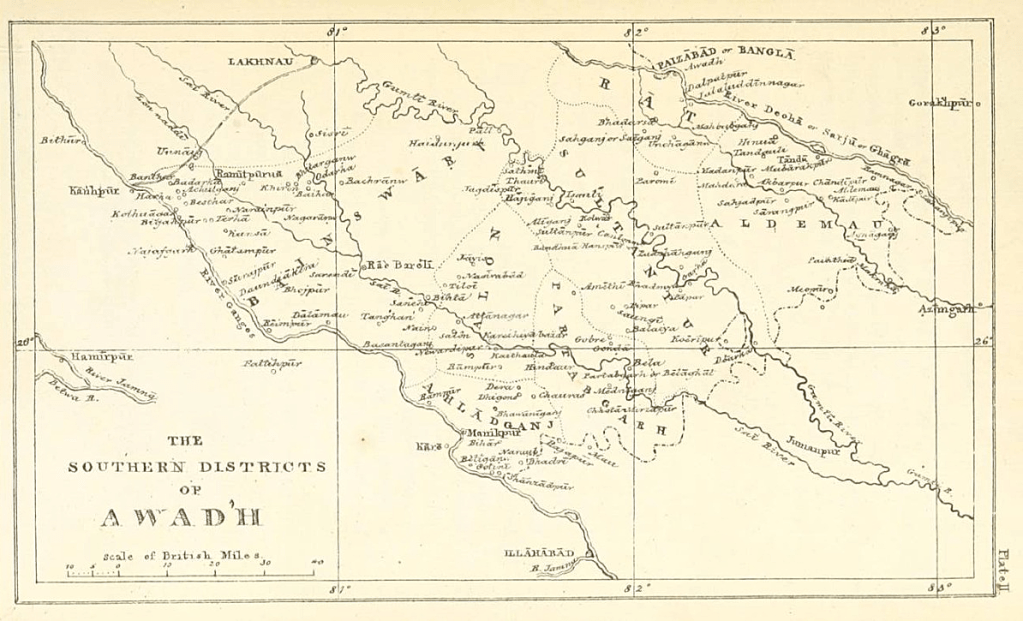
Franks halted his force the whole of 22 February at Bhadaiya, expecting cavalry reinforcements from the Punjab, in the form of the Lahore Light Horse and levy of Pathan irregulars under Captain J.H. Balmain (9th Bengal Cavalry). His spies informed him that the Nazim had taken his thumping at Chanda quite personally and was now encamped at Badshahganj, two miles past Sultanpore. He had set himself up in the old cavalry and police lines, where the fugitives of Chanda, the remaining sepoys and Oudh Irregulars, and what was left of the 7th BLC, the 12th and 15th Irregular Cavalry. Resaldar Shabudin Khan still led the 12th, as he had done ever since he had led the mutiny at Sultanpore in June 1857.
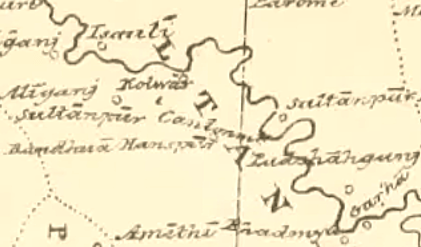
Once off the roads among the dew-laden fields (for the crops were green at that season), there was no dust. In the distance, catching the rising sun, glittered the golden minarets and domes of Sultanpoor, while a pale moon grew faint in a sky whose rose tints melted into zenith blue. Graceful groups of the rounded foliage of mango groves broke the level aspect. The scarlet of the long lines of British Infantry contrasted with nature’s green and the glint of burnished accoutrements. The sheen of dancing spears shone above the brilliant turbans of the Irregular Horse followed by the more sombre hue of the Artillery and the crawling columns of the Ghoorkas in rear, with white bullocks drawing their guns, while high above all loomed the broad foreheads- of the elephants as they trundled the heavy guns like baby carts behind their huge forms, walking with their peculiar slouchy gait and noiseless footstep. All made a picture framed in the memory. Put it face to wall! It is irresistibly recalled by a note of the bugle. A happy inspiration had seized the Bugle-Major (a Kelt of course). The mellow bugles of the Light Infantry rang out the lively march of—
The young May moon is beaming, love,
And the glow-worm’s lamp is gleaming, love,
How sweet to rove through Morna’s grove.
While the drowsy world is sleeping, love ! ‘
And so some marched to death, and all were lighthearted. (Gunner Jingo)
The rebel force totalled some 25’000 men, of whom 5000 were sepoys, 1100 cavalry and 25 guns. The infantry was commanded by Rajah Hassan Ali Khan of Hassanpore, assisted by his son and by Bhowain Singh, once an infantry subedar. Mirza Guffur Beg, an old artillery general who had served in the King of Oudh’s army, had been sent by the rebel court from Lucknow to take command of the force.
For his part, Franks obtained knowledge of the rebel position, furnished by Lieutenant Smith of the 58th BNI (now attached to the Gurkhas) and Lieutenant Tucker, 8th BLC, both of whom had been stationed at Sultanpore during the mutiny. The plans were drawn up by none other than Lieutenant McLeod Innes, one-time commander of Innes Post at the Lucknow Residency. Finding himself strapped for work after the fall of Lucknow, had attached himself to the Jaunpore Field Force as Assistant Field Engineer. Based on Innes’ plans, he prepared his operations.
 Mutiny Reflections