The Roorkee Field Force

By April 1858, it was clear that to end the Rohilkhand Campaign, Sir Colin Campbell would need to take Bareilly. His army was undoubtedly powerful enough for the task at hand, and he had taken great pains to secure the line of the Ganges and Jamuna, safeguarded by Allahabad, Fatehpur, Cawnpore and Fatehgarh. Although he was still convinced that taking Oudh should have been the priority, Lord Canning strenuously disagreed and he insisted Campbell march on Bareilly as soon as he was done taking Lucknow.
So, while still in Lucknow, Sir Colin Campbell gave the following orders:

Brigadier Sir Edward Lugard was to march to the Benares District and Bihar
The defences in Lucknow were to be improved
Major-General James Hope Grant would remain at Lucknow, in command of a force not only strong enough to garrison the position but also to act as moveable columns for operations in the surrounding district
And he himself prepared to take Rohilkhand.

As we have seen, Sir Colin Campbell ordered Brigadier Robert Walpole to advance from Lucknow, sweep the left bank of the Ganges directly to the Rohilkhand frontier – Walpole did so, but with rather abysmal consequences at Ruiya.
A force was to be assembled under Major-General Nicholas Penny at Meerut and march to Rohilkhand, and another, under Brigadier J. Jones (60th Rifles) would advance from Roorkee to Rohilkhand.
At the same time, a siege train would be assembled to march from Cawnpore via Fatehgarh and Aliganj.
If all went to plan, Sir Colin Campbell, at the head of any troops that could be spared from Lucknow and Cawnpore, would join Walpole at Aliganj; then, with the siege train and Penny’s force, they would take Bareilly from the south, while Jones would attack from the north.

The Roorkee Field Force

For his plan of attack on Rohilkhand to work, Sir Colin Campbell needed reinforcements, as he could not draw too heavily from either Lucknow or Cawnpore, without inviting disaster. So these would come in the form of two field forces, one advancing from Roorkee and the other from Meerut. Both were to converge for the attack on Bareilly; however, they first had to get there.

Major General Penny was ordered to march with his force, from Meerut through Badaon to Miranpore Kutra with the following troops from Meerut:

6th Dragoon Guards (Carabiniers) – 2 squads
HM’s 64th Foot
22nd Punjab Infantry, Baluchi Battalion
Multani Horse
No. 14 Field Battery 3/3 Bengal Artillery (Captain & Brev. Major, H. Hammond)
2/4 Bengal Artillery (two 18-pounders, two 8-inch howitzers under Lieutenant H.M. Cadell)

We shall return to the fortunes and misfortunes of Brigadier Penny shortly, but now let us take a look at Brigadier John Jones, 60th Rifles.

Meanwhile, the Roorkee Column, composed of troops stationed at Roorkee and Brigadier John Jones and a detachment of troops from Manglaur under Lieutenant-Colonel J.H. Smyth (Bengal Horse Artillery:

At Roorkee
6th Dragoon Guards (Carabiniers)
60th King’s Royal Rifles
1st Punjab Rifles
17th Punjab Infantry
Multani Horse
No. 7 Field Battery 1/1 Bengal Artillery (Captain A.G. Austen)
4/4 Bengal Artillery and detachments of the 1/4 and 3/4 Bengal Artillery with the following;
two 18-pounders
two 8-inch howitzers
two 8-inch mortars
two 5 1/2-inch mortars

At Manglaur
Detachments of 6th Dragoon Guards, 1st Punjab Cavalry, 1st Sikh Infantry, 5/1 Bengal Horse Artillery (Lieutenant G.A. Renny)

Cureton’s Multani Horse

Sir Charles Cureton

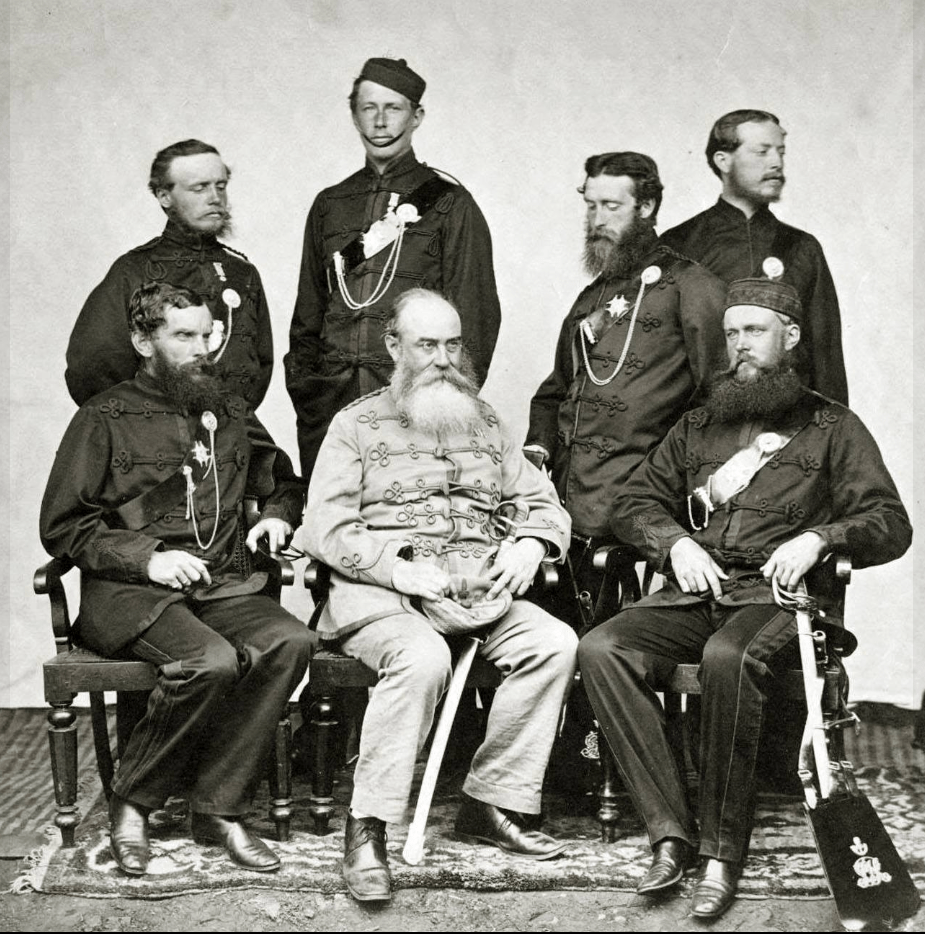
A little must be said, at this juncture, about Cureton’s Multani Horse, not to be confused with other Multani Horse regiments we have met throughout the mutiny.
At the outbreak of the mutiny, with Peshawar in danger, one Lieutenant-Colonel Herbert Edwardes, commissioner of Peshawar, remembered his comrades of the 2nd Sikh War and, without hesitation, summoned them to his aid. Edwardes knew them well; during the aforementioned war, risalas of Multanis had formed a portion of the force with which Edwardes had stemmed the progress of Mulraj. It was a different war and a different time, but Edwardes had not forgotten their gallantry. Now, when Edwardes needed them again, they came. On 20 May 1857, his letter reached Dera Ismael Khan, and on 1 June, Ghulam Hasan Khan, along with other chiefs and their followers, some 300 horsemen, arrived, armed to the teeth, in Peshawar. For the next months, they kept the frontier quiet and Peshawar in order, re-establishing order when the Bengal regiments mutinied. By January 1858, they were no longer needed in Peshawar, but the chiefs were not ready to leave — Khan requested Edwardes to be allowed to form up a regiment of 600 horse for service over the river in the Bengal Presidency. Jumping at the chance, John Lawrence approved the request, and at Lahore, in the same month, the regiment was raised. Captain Charles Cureton, an able officer with much irregular cavalry experience, was appointed commander, Lieutenant Dixon as second-in-command, Lieutenant Williams as adjutant, Lieutenant Frederick Campbell Gostling and B.M. Smith, doing duty, and Assistant Surgeon Bailie to take care of the medical needs. The native command fell to Ghulam Hasan Khan himself, and the other chiefs appointed under him. The regiment, at full strength, consisted of five troops of Multani Pathans, one of Multani Baluchis, each numbering 100 men. Many of the recruits had already served under the British on the frontier as police and had served as auxiliaries during the Second Sikh War, but with a distinct dislike of discipline and a repugnance to drill, Cureton had to turn them, in as short a time as possible, into a regular regiment.
Cureton himself was the most experienced man for the job. He had arrived in India in 1843 and by 1846, was posted as adjutant of the 12th regiment of irregular cavalry. He was present at Aliwal during the First Anglo-Sikh War; during the second war, he served as ADC to his father, General Charles Robert Cureton, KCB, until the latter’s death at Ramnagar on 22 November 1848, where Cureton himself was slightly wounded. However, he was at the passage of the Chenab, the Battle of Gujrat and in the pursuit of the Sikh Army under Sir Walter Gilbert, at the capture of Attock and the occupation of Peshawar. Cureton’s services were far from over. It was onwards to the north-west frontier campaigns of 1849 until 1852, and on 4 May 1852, he was appointed second-in-command of the 2nd Irregular Cavalry. A brief change of scenery brought him into the meshes of that disgraceful war, the Santhal Rebellion, but he was soon back in the Punjab. During the mutiny, Cureton took part in the destruction of the Sialkot mutineers at Trimu Ghat under Brigadier General John Nicholson and then against the Gogaira rebels. While Cureton may not have seen action at Delhi, as many of his fellows did, fate certainly had something more in store for him.
Cureton understood the men he was set to command. He knew he would have to acquire “influence with these wild soldiers of fortune” and stem their “impulsive natures”, but he had to experience to do it. He made no attempt to acquaint them with drill or discipline in the British fashion, but “limited his efforts to teaching a few elementary manoeuvres, so as to enable them to work together.” As to their uniform and arms, which they provided themselves and consisted of a sword, a matchlock or a lance, a pistol and a dagger, Cureton merely instructed their clothes to be dyed khaki, and he distributed a few English carbines. As for discipline, he “endeavoured to put himself in the position of their khan; he inflicted but few punishments, but when he did punish, it was done with great severity.” While all of this was acceptable to the men, the most elementary drill was still causing them great consternation. When ordered to form into two ranks, “their pride took alarm”, and no one wanted to be in the rear rank. Cureton’s solution was simple — they would sort it out themselves, in a most unmilitary fashion, with men, inferior in rank and family to others, to take up the rear. The arrangement proved satisfactory, and finally, the Multanis were ready to ride.
“After a march of 270 miles, the Mooltanis arrived in Roorkee…”
Cureton’s Multani Cavalry, seen here in their infancy, would become the 15th Lancers (Cureton’s Multanis), a single-class regiment, with all the men recruited exclusively from the Punjab; they would serve in the Second Afghan War and in the First World War, where they would become the first British cavalry regiment to land in France. In 1821, they were amalgamated with the 14th Murray’s Jat Lancers to form the 20th Lancers.

An officer of the 15th Lancers (Cureton’s Multanis). Watercolour by AC Lovett, 1910.

The Advance of Brigadier John Jones, 60th Rifles

Sir Colin Campbell had intended, initially, that the force marching from Roorkee would cross Rohilkhand and onto Bareilly would be a brigade force, and he appointed Colonel John Coke, of the 1st Punjab Infantry, to lead it. He was an obvious choice; Campbell would be hard-pressed to find a better-known or more distinguished officer than Coke. Not only was Coke a veteran of India, with an unsurpassed command of native languages, he had also seen extensive service — under Sir Charles Napier in Upper Sind, with Gough at Chillianwala and Gujerat, and with Gilbert when he was pursuing the Sikhs. Following the conclusion of the 2nd Sikh War, Coke turned his attention to the Northwest Frontier and, until the outbreak of the mutiny, was scarcely out of the saddle. “There, his name became a household word. Scarcely an expedition was undertaken against the wild border tribes, but Coke bore a part in it. Twice was he wounded; but his unflinching demeanour, his power of leadership, whilst it gained the supreme confidence of his men, extorted respect and admiration from his enemies. Wherever he might be, his presence was a power.” It was then no surprise that in August 1857, Coke was before the walls of Delhi, where he fought with distinction in the retaking of the city. He was now asked to take command of a troop of the 9th Lancers, Cureton’s Multani Cavalry, a wing of the 60th Rifles, the 1st Punjab Infantry, the 1st Sikhs, a detachment of the 17th Punjab Infantry, Austin’s Light Field Battery and two 18-pounders. He arrived in Roorkee on 22 February, but it would take two months, with the able assistance of Baird Smith of the engineers, before Coke was able to complete the barest of commissariat arrangements. There was nothing procurable, far and wide; the land had been destroyed, as if by locusts, so thorough had been the ravages of war that not even carriage was available.

“In this dilemma, Coke’s practical knowledge and fertility of resource came into play. He had read how, in His practical the olden clays of Indian warfare, the Brinjaris—dealers who carry their grain on pack cattle—had made themselves eminently serviceable. Calling to mind, then, that at the actual season these men were accustomed to pasture their cattle in the Terai, he sent thither, found them, and made such arrangements with their head men as enabled him to conquer a difficulty which many another man would have found insurmountable.”

With carriage arranged, provisions prepared and the force read to march, like a thunderbolt, Coke was superseded, for reasons known to Campbell but not to Coke, he had suddenly decided to make the command of a field force a divisional command. He ordered the other wing of the 60th Rifles to join up, and with that wing came Colonel John Jones, who, with the rank of Brigadier-General, was that step higher than Coke. Coke was relegated to act as brigadier and second-in-command under Jones. While this might have caused great consternation among other men, it was a “change in name only.” No one doubted Jones was a brave and valiant man, but he was “unwieldy in body” and “incapable of great activity.” He was, fortunately, blessed with enough common sense to know that if work needed to be done, it would be done by Coke. For his part, Coke was neither jealous nor resentful, and Jones, who would reap the credit for the subsequent campaign, never interfered with Coke’s arrangements.

On 13 April 1858, Jones arrived in Roorkee and took command of the Field Force. That very evening, he dispatched a party of artillery, 2 companies of the 60th and one wing of the 17th Punjab Infantry, under Major Churchill of the 60th Rifles, to Kunkhul to protect a bridge the engineers were still in the process of constructing over the Ganges. The next morning, the headquarters of the 60th Rifles arrived by forced marches and by the 15th, the entire column was encamped by the bridge of boats. Jones ordered the heavy guns and stores to be sent to the ford opposite the village of Nagul, and Major Smyth was instructed to “make a show of it” to divert the rebels’ attention by pretending to cross over. Jones himself and the remaining force crossed on the 17th and moved into a nearby forest in the following order (from dispatches):

Advance Guard.

One company 60th Rifles, in skirmishing order.
One company 60th Rifles, in support of two guns.
Sappers and Miners and a troop of Cavalry.

Main Body.
One troop Cavalry, Captain Austin’s Battery.
60th Rifles, Punjaub Infantry Brigade.
Ammunition and treasure, the Mooltanee Regiment of Cavalry.

Rear Guard
One Company Punjab Infantry, a troop of cavalry
On each flank of the main body was a patrol of a company of Native Infantry, and a half troop of Cavalry.

The Action at Bhogniwala — April 17th

Coke now pushed on rapidly with the advance, but had barely moved four miles when he and the advanced guard came upon the rebels. Surrounded by thick jungle, it was impossible to say how strong the force was, but it was, as they would soon find out, considerable. Coke reported the rebels had six guns; the main body was in the jungle itself, close to Bhogniwala, and their front was covered by a canal. Without waiting for an invitation, and having seen the British, the rebel artillery opened fire. In reply, Austin brought up his field battery, while the infantry, in skirmishing order, advanced. When they came up to the canal, which was nearly dry, they finally had a good look at the rebels. It was only for a moment, for now up galloped Lieutenant Gosling, commanding a troop of Multani Horse. He let his men loose, and the rebels fell back. Coke quickly brought up the main body of Multani Horse under Cureton and, with Austin’s battery, advanced rapidly, charging the rebels wherever they attempted to form up.

“The din of battle becomes louder and louder, and soon in the distance one or two wounded rebels break from the jungle, dragging themselves painfully along in the direction of the village. In a few minutes a score of fugitives follow, and shortly after a large body of the enemy’s artillery, cavalry and infantry, numbering some 1600 men, in order retreat, appear in the open space about half a mile from the British cavalry. On catching sight of the foe, the officers take post in front of the line, while the haughty Pathans they lead, with eyes flashing from excitement, raise their hangs towards heaven…the next instant the quiet-looking English officer, their leader, gives word to draw swords and charge. Onwards, like a torrent, rush the gallant band, officers, native and English, in front; while the six kettle-drummers beat their drums with energy. As the line approaches the enemy, some three or four Mooltanees, anxious to gain the approbation of their officers, rush to the front and plunge into the hostile ranks. A second after, their comrades are with them. The enemy, meanwhile, finding flight impossible, stand at bay, fire a scattered volley, draw their swords, and with sullen desperation, await the onset. For a few moments, nothing is to be made out but the surging, shifting crowd of mingled horsemen and infantry engaged in mortal combat…Swords, bayonets, and lance-heads gleam in the sun, groans and curses rise up to heave,, while here and there a figure sinking amidst the waves of this human sea, shows that some brave Mooltanee, some base rebel, has fought his last fight.”

The infantry, formed up in line, covered his flanks with skirmishers and commenced their advance; the rebels had left their attack too late; if it was a surprise they were intending, Coke was quicker to the mark. The relentless firing of his artillery, the advance of the infantry and a well-executed charge of the Multani Horse, Lieutenant Gostling ever in the fore, took the rebels in their left flank, forcing them to withdraw their guns and retreat. “He (the rebels) was charged by Captain Cureton, wherever he attempted to stand, and the guns, unlimbering as they came up, opened with shrapnel. The enemy, thus pushed over positions of great natural strength, and unable to show front even on the bank of stream where he had erected stockades, and behind which his camp was pitched, fell more and more into confusion.” The retreat turned into a rout, and abandoning their guns, the rebels dashed pell-mell through the jungle, some throwing down their arms as they ran, others “throwing off even their clothes to facilitate their escape.” They left behind four guns on the road, all their ammunition and camp equipment.
The Multanis drove the point home, chasing the rebels for several miles, with Gosling killing eight with his revolver. When the day was done, the British had lost one man killed and sixteen wounded, but the rebels left behind 200 dead. As late as 1863, local villagers claimed the ghosts of the mutineers haunted the scene, and their groans could still be heard.

Jones pitched his camp five miles from Nagul, and while the night would be peaceful, the morning brought new surprises. Captain Cureton was certain the rebels they had defeated the day before where most likely not as far away as thought and suspected they were hiding in the jungles just north of Najibabad. As such, he sent Jemadar Emam Baksh Khan with forty troopers to reconnoitre. While proceeding in the appointed direction, Khan was apprised by some villagers that some miles off was a small fort, complete with a rebel Nawab and five hundred followers. The Jemadar, without hesitation, marched to the fort and surrounded it. He then called on the garrison to surrender and send out their Nawab. His language must have had some persuasion, for he let the garrison know, with clear terms, if they did not do as ordered, he would put them to the sword and spare no one. Something in Khan’s bearing was convincing enough for the Nawab, for he came out and gave himself up. Khan disarmed him and took possession of the fort. He placed a guard over the gate and, before turning the garrison out, he took their arms and accoutrements. He then sent information back to the camp of his doings, and much to Jones’s satisfaction. Jemadar Emam Baksh Khan was awarded the Order of Merit.
The same day, Jones pushed on towards Najibabad and found the town abandoned; he then moved onto a nearby fort of Patthargarh, which likewise was empty, added eight guns to his arsenal and a welcome quantity of grain. However, things were about to change.

The Rebels of Bijnor

Patthargarh fort also called Najibabad Fort, water colour by Sita Ram, 1814

It begs the question here: who were the British actually fighting? In The Lay of the Land, we have explored some of the history of the district and events in Rohilkhand during the mutiny, and now turn our attention to Bijnor District. Brigadier Jones was now engaged in what the British were wont to call “pacification,” which would lead to some of the bitterest battles of the mutiny.

During the 1857 uprising, as district after district went up in flames, Najibabad came under the control of a local Rohilla leader, Nawab Mahmud Khan, who declared himself the governor of the district on behalf of the Mughal Emperor, Bahadur Shah, on 7 June 1857. He had been handed the keys, in just about every sense, by Magistrate Alexander Shakespear, who left Bijnor during the night of 6 June, handing over control to Khan.
Shakespear had tried to hold the district himself, but without British troops, and with an increasingly recalcitrant population, Shakespear decided his eventual death would serve no purpose, and he promptly left. Supported by his nephew, Ahmad Allah Khan (tehsildar of Najibabad), Khan was determined to take full control of Bijnor District. The Nawab did have support, but unfortunately, by announcing himself as governor under the banner of the Mughal Emperor, he alarmed the local landowner clans, the Chaudharies.

“…in the beginning of Nawab’s rule over the Bijnor District, Nawab Mahmud Khan and his nephew Ahmad Allah Khan, both, were eagerly waiting for the Hindu support, though the representative of the Hindus at Bijnor was there in the persons of Chaudhary Nain Singh and Chaudhary Jodh Singh. Both the Chaudharies were already suspicious of Nawab’s intention. To bring these Hindu representatives in Bijnor, out of suspicion, firstly, Ahmad Allah Khan went to the Chaudharies to make every assurance that the Nawab would remain unharmful to them. One more step ahead, Ahmad promised them to remain united against the British. He then got success in getting the Chaudharies’ assurance. The Chaudharies came into alliance by taking an oath on holy Ganga-water but they clearly refused to go to attend the Nawab at the Collectorate. Ahmad, then putting a seal on the Qur’an took the oath of fidelity and mutual alliance in the ensuing war against the East India Company’s rule. This worked in the right direction, and both the Chaudharies agreed to go to Nawab along with him. Again, both the Nawab and Ahmad Allah Khan putting a seal on the Qur’an, took an oath to never harm, but to support each other in the ensuing war of 1857 against the British forces.”

As it was, the Chaudharies were not buying it. The Nawab’s men (not the Nawab himself) engaged in looting several Hindu villages between Najibabad and Bijnor, and not long after, Khan himself began harassing the landlords themselves, mostly about money. So, the situation began to deteriorate. The Chaudharies started to gather up their forces to oppose the Nawab. Overtures by him to pacify the Chaudharies failed. Things were not improved when a Pathan, Munir Khan, arrived in Bijnor from Nagina, followed by 400 of his men who happened to be jihadis (religious fighters) and placed his allegiance with the Nawab. The Chaudharies did come to some kind of an agreement with the Nawab, with both sides swearing to leave each other alone, but unfortunately, the Nawab could not resist a little jihad himself as he attempted to take forceful control of the entire district, in which several Hindu villages were destroyed and their inhabitants killed. Looting and pillaging their way through the district, the Nawab finally declared a full jihad against the Hindus on 24 August 1857. What happened now was, in simple terms, a civil uprising and a localised war. The Chaudharies gave as good as they got and fought back. For a more detailed look into this, I recommend my readers to take a look at:

https://www.tajpurroyalfamily.in/bijnor-battle.php

The British were not fighting mutineers in the strictest sense of the words, but the men loyal to the Nawab, who, equal in his animosity against the Chaudharies, was only his dislike of British rule.

21 April 1858 — Nagina

With an added reinforcement of four heavy guns and a squadron of Carabiniers, Jones marched to Naghina, where he had been informed there were no less than 10’000 infantry, 2000 cavalry, 15 guns and a very strong position. While the numbers were worrying, Nagina was worse. The front of the town was covered by a canal, liberally guarded by ten guns; to the left was a bridge protected by a further battery of five guns and to the right, thick groves of trees. However, if the rebels thought the British were having second thoughts, they were wrong, for the British marched straight towards the canal. Austin’s guns opened fire on the bridge battery, while the 60th Rifle and the 1st Punjabis, with the Multanis on their left, swiftly crossed the canal and formed up on the right, while the 1st Sikhs cleared the canal banks. By the time the banks were cleared, the force had already crossed over. The order now was to turn the rebel right and capture the guns. The 1st Punjabis were ordered by Coke to advance and take the guns in the flank, while the 60th Rifles moved to the front. However, the rebel cavalry, with their heads about them, now tried to attack Jones’ left, and the Multani Cavalry was ordered to charge.
Just as Cureton received the order, he was suddenly faced by a young Englishman, no more than eighteen years old, who asked for permission to join the charge; Cureton acquiesced and ordered his men to advance, at a trot. The young man fell in next to him. They continued on, in this menacing fashion, until within 100 yards of the rebels, when Cureton pushed his men to a gallop and then the charge. The remaining rebel cavalry put up a short resistance and then turned to flee. Although they had every advantage, inexplicably, the rebel gunners now fled. In a panic, they did not try to defend their guns, much less use them, but fled in confusion. Some of the rebels tried to retreat into the city, but Jones quickly changed “front to the right, throwing the left forward at the double”, thus cutting off their line of retreat and driving them to the left of the town. With their flank completely turned, the rebels were now chased for nearly two miles by the artillery, the 60th Rifles and the 1st Punjab Infantry. Simultaneously, Coke ordered the 1st Sikhs on the right to move down both banks of the canal to flush out any remaining rebels. The 17th Punjabis, who had been held in reserve, were now ordered to clear out the city.
The remainder would have to face the cavalry. It was, however, a hard day for the Multanis.
In the charge against the rebel cavalry, Lieutenant Williams’ horse was shot, throwing the rider to the ground, and he was forced to fight his way on foot; the young volunteer, with only a few Multanis, attacked a “knot of the rebels, and though the swords of the gallant three did good execution, the brave boy received some very severe and dangerous wounds.” However, with the guns taken, Cureton now crossed a small ravine to attack a band of rebels who had decided, after all, to stand and fight. He quickly reformed his regiment and advanced to charge when Lieutenant Gostling was shot full in the chest, a death wound. The Multanis were not in the mood for discussion; their officer’s blood demanded vengeance, and Cureton knew better than to stand in their way.
“Nothing now remained in his immediate front, Cureton, confident of victory, and with that happy instinct that made him so excellent a leader of irregular cavalry, determined to ascertain the rebels’ line of retreat. Sweeping at a rapid pace across the plain, in rear of the enemy’s position, he cut up many scattered fugitives as he went…” But he was a little too confident. “On reaching a spot about five miles in the rear of the enemy’s extreme left, he perceived the foe in full retreat, while immediately in front was a party of chiefs, mounted on six elephants, and surrounded by cavalry and infantry. ” There really was nothing for it; with the battle still rushing in the veins, the Multani Cavalry charged again and this time they not only slew the chiefs, but captured the elephants, scattering the guard. Amid the carnage, they found an Englishman, a prisoner of the rebels, who had been brought to the field to witness a British defeat, only to find himself a free man.
While one might well say it was enough work for Cureton and his Multanis, the day was not over yet for the main body of the rebels, still numbering some 800 infantry and 500 cavalry, with a few remaining guns, which were still to be dealt with. Cureton decided a ruse was in order. Drawing up into a grove of trees on the side of the road, and with the captured elephants in full view and some of his men loitering about, he hoped the rebels would believe the Multanis were friends and not foes. What should not have worked, worked like a charm. The rebels, who must at this point been very short-sighted indeed, did not pay the Multanis any heed but set their sights on the elephants; as they approached the grove, a voice suddenly rang out, “Charge!” and from the trees came the rest of the Multanis, much to the horror of the rebels, who, not interested in another prolonged fight, turned and fled. The few that did stand and fight, did so to the death; valour was still well alive in the 100 men who lost their lives to the fiendish Multani swords.
As for the Multanis:
“They may well be proud of that day; for to defeat cavalry and artillery, then infantry, then again cavalry, artillery and infantry combined, in the latter case contending against enormous odds, were exploits which even a veteran corps might boast. How much more, then, a young regiment only three months raised and engaged in its second action!”
The Multani’s casualties were few, amounting to 31 killed, wounded (among whom Emam Baksh Khan received two sword cuts) and missing, along with 58 horses; for the rebels, Nagina was a singular defeat. They lost 700 dead and wounded, and lost 15 guns. It was found they had prepared the town for defence, and barricades had been built up across the streets. Those who did manage to find shelter in the city but it was nothing short of a massacre. “Bodies of the rebels sought shelter in walled enclosures, and were there • cut to pieces: in one of these nearly two hundred! were shot; and, the town being afterwards entered by the 17th Punjaub Regiment, numbers were there killed and many taken prisoners.” Among the prisoners was the Nawab
For the young volunteer, Mr Hanna by name, he was a student of the Roorkee Civil Engineer College who had followed the adventure in his spirit and had joined Jones’ force. Rather startled to find out that he was not an officer or indeed even a trooper, Coke recommended Hanna be given an unattached commission, something which Jones agreed to. Hanna would soon find himself doing duty with the 1st Punjab Irregular Cavalry and would, by 1863, be an adjutant in Fane’s Horse. It was just as well it was a cavalry regiment, for the wound he received at Naghina would leave him with a pronounced limp for the rest of his life.

Return of Killed and Wounded which took place in the Roorkee Field Force, in action with the Enemy, on the 21st of April, 1858, at Nagina.

Detachment of 6th Carabineers—1 rank and file, 6 horses, wounded; 2 horses, killed; 1 horse, missing.
Multani Horse—1 European commissioned officer, killed; 1 European commissioned officer, 4 native commissioned officers, 3 native non¬ commissioned officers, 23 rank and file, and 38 horses, wounded; 20 horses, missing.
Cavalry attached to 1st Punjab Infantry— 1 rank and file, killed; 1 rank and file, wounded; 2 rank and file, missing; 2 horses, tilled.
1st Battalion 60th Royal Rifles—4 rank and file, wounded.
1st Regiment Sikh Infantry—3 rank and file, wounded.
1st Regiment Punjab Infantry—1 native non-commissioned officer, missing.
Total1 European commissioned officer, killed; 1 European commissioned officer, 5 rank and file, wounded; 1 native rank and file, killed; 4 native commissioned officers, 3 non-commissioned officers, 27 rank and file, wounded; 1 non-commissioned officer, 2 rank and file, missing; 4

Names of Officers Killed or Wounded.
Lieutenant Frederick Campbell Gostling, 5th Bengal Native Cavalry, attached to Multani Regiment of Cavalry, killed. Aged 25. Son of W.F. Gostling, of Palace Gardens, London. Attended Harrow School (1847 – 1848)

Lieutenant Williams, Multani Regiment or Cavalry, contusion.

Multanis of Major Herbert Edwardes’ Cavalry during the Second Anglo-Sikh War

In the next post, we shall continue to follow Brigadier Jones and turn our attention, but briefly, to Major General Penny.

Sources:
Akhtar, Shamim. “SYED AHMAD KHAN AND THE REVOLT OF 1857.” Proceedings of the Indian History Congress 81 (2022): 755–61. https://www.jstor.org/stable/27388822.
Bhean, T.L. — Bulletins and Other State Intelligence for the Year 1858, Part III (Harrison & Sons, London Gazette Office, 1860)

Cornhill Magazine, v. VII January-June, 1863, “The Indian Cossacks”. (Hathi Trust)
Brodkin, E. I. “The Struggle for Succession: Rebels and Loyalists in the Indian Mutiny of 1857.” Modern Asian Studies 6, no. 3 (1972): 277–90. http://www.jstor.org/stable/311935.
Forrest, G. W. — A History of the Indian Mutiny, Vol III (London: William Blackwood & Sons, 1912)
Jocelyn, Col. Julian R.J.,— The History of the Royal and Indian Artillery in the Mutiny of 1857 (London: John Murray, 1915)
Malleson, Col. G.B. — History of the Indian Mutiny, Vol II (London: William H. Allen & Co., 1879)


Links:
https://josselin.org.uk/wp-content/uploads/2023/02/4.-Josselin-Society-Reference-Manual-2002_82-end.pdf

https://jndmeerut.org/wp-content/uploads/2024/01/2-3.pdf
https://franpritchett.com/00urdu/asbab/bijnor/index.html