Between 1857 and 1858 a total of 182 Victoria Crosses were awarded for actions during the Indian Mutiny of which only 64 would be given to men serving the Honourable East India Company, including that of Lucknow Kavanagh.
Thirty-two VCs were won between the 30th of June – the Battle of Chinhat – and the 2nd of October – the attack on the Phillips Garden Battery. Astonishingly few were given to men serving during the siege itself. This first post shall explore their exploits.
Lieutenant William Cubitt of the 13th Bengal Native Infantry
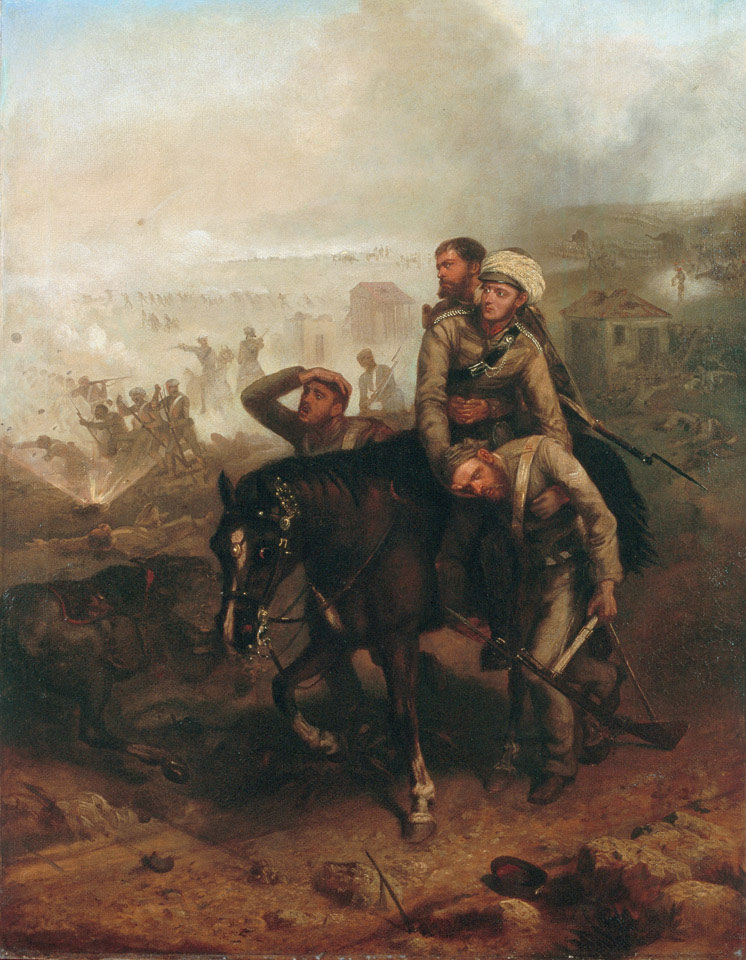
Oil on canvas, by Louis William Desanges, 1860
Born in Calcutta in 1835 to Captain William Cubitt, Assistant Secretary to the Government of India, Military Department and of the 18th Bengal Native Infantry. Captain Cubitt had entered the EICo services in 1805, at the age of 15, saw active service in the Nepal War and in the First Burma War. Promoted to major in 1839, he died scarcely a year later, leaving his widow and children to return to England. His widow remarried one William Archer Shee, the eldest son of the portraitist Sir Martin Archer Shee, in 1843.
Young William Cubitt was educated mostly by private tutors but he did attend school, firstly under Reverand John Buckland in Laleham. In June 1853, while residing in Manheim, Germany, his mother applied, on his behalf, for a cadetship in the Bengal Native Infantry. He passed his examination for a commission and on the 26th of July 1853, William entered the Honourable East India Company Army as an ensign on the 26th of July, 1853, to serve in the 13th Bengal Native Infantry and left directly for India. For the next four years, William trained his profession as a subaltern and gained his promotion to Lieutenant in November 1856. As for active service, he had seen some in the suppression of the Santhal Rebellion of 1855. 1857 found William and his regiment in Lucknow.
The intelligence received by Sir Henry Lawrence on the 29th of June should have been met with scepticism – the reconnoitring party reported the force gathered on the outskirts of Lucknow was minimal; his advisors who had not seen the field themselves insisted a victory would secure Lucknow for Lawrence through decisive and masterly force – in short, nothing could go wrong. The advisors believed the battle was won well before it was fought, and though not typical of a man so careful in his planning and thoughts, Lawrence gave way under pressure. He ordered a force of 700 men, consisting mostly of the 32nd Regiment of Foot, 230 of the remaining men of the mutinied regiments (13th, 48th and 71st), 40 Volunteer Cavalry, and 120 men, consisting of detachments of the once proud Oudh Irregular Cavalry – the 1st, 2nd and 3rd. Lawrence ordered 4 guns of the Horse Light Field Battery as artillery support, a further 4 of No. 2 Oudh Field Battery, and a prized 8-inch howitzer to take the field. Confidently, the force left Lucknow on the early morning of the 30th of June to meet, what they believed was a nominal force, hardly larger than Lawrence’s own.
On approaching Ismaelganj, they were suddenly fired upon by the rebels and the true nature of the battle quickly unfolded. Instead of the 700 Lawrence had been expecting, there were no less than 7000, well-armed and exceptionally well-led men waiting for him. They had taken up excellent positions behind stone walls and in the village of Chinhat – with little loss to themselves, they soon started wreaking havoc in the lines of the 32nd. The 13th Native Infantry managed to attack the village on its right flank, causing a momentary panic but the day was already lost as the 32nd, already exhausted under the merciless sun, without water and marching on empty stomachs, were unable to deploy with any rapidity. As their officers started to fall, the 32nd tried to return fire but some of the men found their muskets refused to fire. Loaded since dawn, the humidity had dampened their charges, forcing the men to draw the charges and reload. Trained by British officers and proving to have been very apt students, the rebels pinned down the 32nd with an onslaught of accurate musket fire.
“‘After an hour’s cannonade, the opposite artillery ceased its fire: in a few minutes rolling volleys of musketry from the village of Ishmaelgunge showed that Jack sepoy was there. The Volunteer Cavalry was ordered to move further to the right, and then, for the first time, I got a view of the plain between Ishmaelgunge and Chinhutt. It was one moving mass of men: regiment after regiment of the insurgents poured steadily towards us, the flanks covered with a foam of skirmishers, the light puffs of smoke from their muskets floating from every ravine and bunch of grass in our front. As to the mass of the troops, they came on in quarter-distance columns, the standards waving in their places, and everything performed as steadily as possible. A field day on parade could not have been better … Our artillery ceased its fire but beyond might be heard the crashing roll of musketry in Ishamaelgunge, where the 32nd, outnumbered by myriads, still maintained a struggle … a bustle in my rear attracted my attention: the rascally gunners were cutting their traces and were galloping away; the elephants for the howitzer gone … A few European gunners, the Volunteer Cavalry, and the 32nd remained; but now the enemy pressed on more closely – he unlimbered his guns and swept us with grape and canister; the deadly mitraille of musketry poured in one leaden shower from the swarming skirmishers. And now the valiant few of the 32nd are beaten near the village and come upon the road; their gallant Colonel (Case) falls dead as he approaches; some of our guns are spiked and abandoned (the howitzer among them), four are limbered, and gun carriages, covered with wounded men, gallop towards Lucknow. The 32nd also retreat; mixed up with them are some of the braves of the 13th Native Infantry – noble fellows, who were seen carrying wounded soldiers to the gun-carriages, abandoning their own wounded comrades on the ground. The Volunteer Cavalry form upon the left of the road; the rest of the handful of England’s army is in retreat. A cloud of insurgent cavalry is gathering on the far rear to the left of our retreating column. Do they mean to charge down among those staggering, half-dead heroes, who can scarcely walk along? The red and the blue flags thicken among them; when the tremendous voice of our leader (Captain Radcliffe of the 7th Light Cavalry), is heard, – ‘Three’s right!’ ‘Trot!’ and we sweep out of the trees and off the road, and we are within a quarter of a mile of our opponents. … now two light guns open on us, but the 9-pounder scarce whistled overhead when the stentorian ‘Charge!’ was heard; the notes of our trumpet sounded sharp above the din of the fight, and we rode straight at them; the cowards never bided the shock; they galloped like furies from the spot. Five hundred cavalry and two guns to be hunted by thirty-five sabres; it was a miserable fact … The battle of Chinhutt was done; the line of our retreat was marked by the bodies of the 32nd, their arms, their accoutrements; men were falling untouched by ball; the heat of a June sun was killing more than the enemy. Hard upon our heels they followed, and as we got into the Residency so did the round shot of the pursuing foe whistle in the air…” (John Lawrence, Volunteer Cavalry)
As they nobly fought, the Indian artillerymen swiftly switched sides, cut the traces on their horses, turned over their guns and joined the rebels. The Sikh Cavalry could not be induced to charge and at an opportune moment, fled. Chinhat was hardly a battle but an all-out slaughter. Officers screamed themselves hoarse as their men panicked and ran, even as the regimental surgeon, Dr. Darby called out in vain for the men “to stop for God’s sake and the remember Waterloo and Vimeira.” No one listened to him. The 32nd kept up a brisk fire, many of the men firing more than a hundred rounds of ammunition, but it was no use. Their commander, Colonel Case was shot and was last seen, lying with his eyes wide open and sword firmly grasped among the dead and dying. Captain Stevens was wounded in the leg but managed to limp on for another 5 miles but he finally fell, shot in the back.
The European Artillery too heeded the order to retreat but found themselves in a dilemma. The 8-inch howitzer would have to be left behind; Sergeant Miller was unable to get the elephants to drag the gun and he could not protect it – Lieutenant Bonham called out to Captain Ratcliffe for aid to spike the gun. They were just in time to disperse the enemy’s cavalry which boldly rode up to the muzzle of the gun. One of them fired his carbine at Lieutenant Bonham and hit him in the arm. Still standing, Bonham was as determined as ever to spike the gun. Unfortunately, with no spike at hand, quick-thinking Sergeant Suttle broke off the priming wire in the touch-hole instead. Private Johnson of the 32nd serving in the Volunteer Cavalry, however, saw a chance to save one gun at least, and he took it. Riding up to it, he quickly dismounted his horse and handing it over to a brother soldier, mounted one of the artillery horses and pulled the gun back to the Residency.
The rebel cavalry continued to outflank the retreating force and threatened to cut off Lawrence’s only retreat, a bridge over the Kukrai stream. Sir Henry, realising his defeat, now tried to turn the retreat into a victory -he ordered a battery of European artillery to occupy the bridgehead – a ruse – which paid off. The artillery had no ammunition left but their presence was enough to dissuade the rebels. To further break the momentum of the rebel pursuit, Lawrence ordered one company of the 32nd (who had not been at Chinhat, and were therefore, still fresh for a fight) to hold the last bridge before Lucknow over the Gomti River. Sir Henry was seen throughout the battle, riding to the most exposed parts of the field amidst a terrific fire of grape and round shot; at the bridge, Rees saw him again, this time wringing his hands in the “greatest agony of mind, and forgetful of himself, thought only of his poor soldiers. ‘My God, my God!’ he was heard to say, ‘and I have brought them to this!’ Fresh guns were ordered from the Residency and together with the remainder of the 32nd, Lawrence managed to keep the insurgents from crossing the Iron Bridge – however, their cavalry now tried to ford the river beneath it. Unable to prevent them, Sir Henry could only watch as they crossed over and occupied the south and eastern parts of the city. The most he could do was make their way there less pleasant. Ordering the guns from the Macchi Bhawan to open fire, they raked the road up to the next bridge and prevented them from taking not just the north but the west side of Lucknow. It also allowed a part of the retreating force to escape to the Macchi Bhawan instead of attempting the flight to the Residency.
The disaster at Chinhat cost Lawrence dearly - 118 Europeans, officers and men were killed and 182 native troops were killed or missing while fifty-four Europeans and 11 Indians returned to the Residency wounded. Three men were saved by 21-year-old Lieutenant Willam Cubitt and his citation in the London Gazette read
“For having on the retreat from Chinhut, on the 30th of June, 1857, saved the lives of three men of the 32nd Regiment, at the risk of his own.” (No. 22278, The London Gazette, 21 June 1859, p. 2420)
The citation tells us but little of Cubitt’s actions. During the battle, he was serving with the Volunteer Cavalry and had taken part in the charge described by John Lawrence. Active during the retreat, Cubitt first stopped to collect Lance-Corporal Kirby, whom he quickly sat behind him on his horse and then he swept up two privates of the 32nd, whom he dragged along as they grasped his stirrups. Kirby would later write,
“‘ … I have no doubt Sir, but you remember saving the lives of three men of Her Majesty’s 32nd Regiment. I am one of them, kind Sir, and this Irish man that you wanted to know his name, my name is Kirby, Sir, and the man that you brought in behind you on your horse. The names of the others are Joseph Deolin, 3rd Company 32nd Regiment, but the name of the 3rd man Sir I am sorry to say that I altogether forgot, for as you know I was struck with the gowling sun of the 30th June and for me Sir you know that you rode a grey charger and that you had to get one of the native Cavalry to get me on with your own assistance, the other two men you made them cling to your stirrups … I can call on Colonel E.W.D. Lowe that you took me to Hospital verandah and stoped there until you saw me, carried into the Hospital …“
Kirby would later testify, in 1858 during the process of securing Cubitt’s VC, that Cubitt had saved his life and great risk to his own.
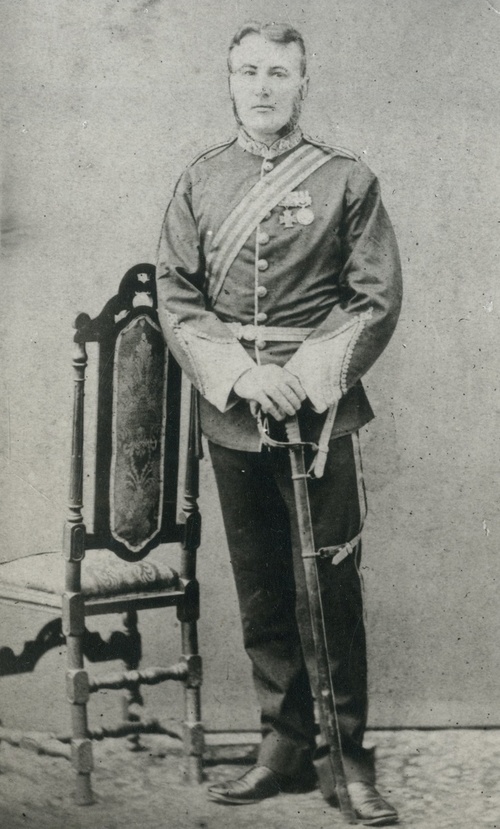
Wounded twice during the ensuing Siege of Lucknow, the last time severely, Cubitt returned to England in 1858 on sick certificate, sharing passage on the ship with one Mrs. Jenkins who recalled he as “modest and unassuming…He never talked of this deed as anything out of the common.” In the course of his VC recommendation, Colonel Aitken too would be asked about Cubitt; he steadfastly recounted that Cubitt even if he had not performed such a singular deed at Chinhat, “he richly deserved his reward for all his acts of self-denial in every way. In the time when rations were short, he would surreptitiously make over his share to someone who he thought required it more.” On the 15th of June Cubitt received his VC from Queen Victoria herself, at Windsor Castle.
By 1861, Cubitt had recovered enough to return to India and rejoin the 13th NI. What had remained of the 13th, 48th and 71st Regiments was formed into the “The Regiment of Lucknow” and the 13th was renumbered the 16th in 1861, and from 1864 carried the sub-title, “The Lucknow Regiment” in honour of their service during the siege. For Cubitt it was a time of tranquillity - he married Charlotte Isabelle Hills at St. Peter’s Church in Fort William, Calcutta, in 1863, thus gaining James Hills as his brother-in-law, the rather brash and daring officer who had won his VC at Delhi. His wife would eventually become the aunt of Brigadier Lewis Pugh Evans, another VC holder.
The marriage itself would produce 5 children.
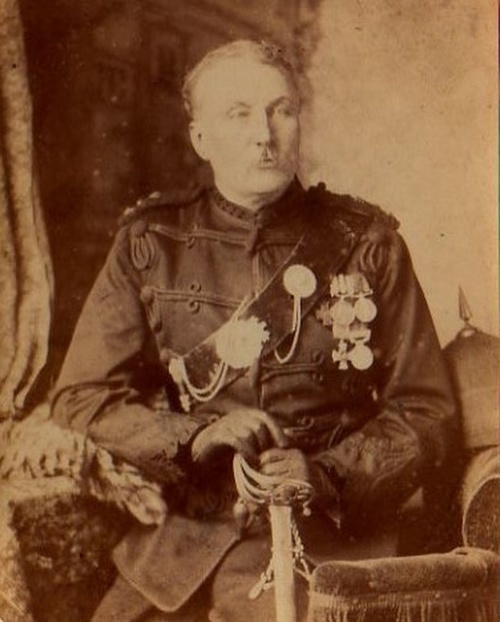
William served as adjutant to his regiment from 1863 to 1867, gaining his captaincy in 1865. He was promoted to Brigade Major in Benares in 1867, served as “wing-officer” in the 16th in 1872 and promoted to Major in 1873. His career continued – between 1873 and 1874 he served in Dacca as officiating station officer, took part in the expedition against Dufflas in the North-East Frontier and was finally promoted to Lieutenant-Colonel in 1879. Attached the Bengal Staff Corps from 1879, William served as second-in-command of the 16th (Lucknow) NI, as which he found himself commanding a fort at Ali Masjid in the Khyber Line Force during the Second Afghan War. The conflict nearly cost him his life for, when wounded, he nearly died of blood poisoning. He would not return to duty until 1881, when he was given command of the 43rd (Assam) NI, later known as the 43rd Goorkha Light Infantry – with whom he would serve until 1888. Promoted to colonel in 1883 he once again served on the North-Eastern Front then between 1883 and 1884 in operations against Akkas, where he would once again find himself mentioned in despatches.
War was never far behind William and between 1886 and 1888 he served during the Third Burmese War, becoming, as the result of his exceptional service, one of the first Companions of the new Distinguished Service Order, and more mentions in despatches. In 1889, William Cubitt retired and was placed on Unemployed Supernumerary in 1891. He died in 1903 and his wife would be buried beside him 13 years later upon her death in 1916. Cubitt’s medals, including his VC, are on display in the Lord Ashcroft Gallery at the Imperial War Museum in London.
Private William Dowling, of the 32nd Regiment ofFoot
“For distinguished gallantry on the 4th of July, 1857, in going out with two other men, since dead, and spiking two of the Enemy’s guns. He killed a Soubadar of the Enemy by one of the guns. Also, for distinguished gallantry on the 9th of the same month, in going out again with three men, since dead, to spike one of the Enemy’s guns. He had to retire, the spike being too small, but was exposed to the same danger. Also, for distinguished bravery, on the 27th of September, 1857, in spiking an 18-pounder gun during a Sortie, he being at the same time under a most heavy fire from the Enemy.” (No.22328. The London Gazette, 22 November 1859, p. 4193)
Thus, William Dowling received his VC.
Born in 1825, in Thomastown County Kilkenny, Ireland, little is known of Dowling’s early life. In 1845 he joined the army, and, posted to the 32nd Regiment of Foot, he was swiftly on his way to India, arriving in time to fight at Multan and Gujarat in the 2nd Sikh War.
In 1857, Dowling was still a private with the 32nd Regiment of Foot but Lucknow would show just how adventurous a man he was. Following Chinhat and the first furious days of bombardment against the Residency, three Irish privates of the 32nd and a handful of volunteers made a swift sortie. The objective of their sortie was to disable a 9-pounder the rebels had placed during the day behind a small mosque, on the road to the Iron Bridge. It was early afternoon on the 4th of July. Sir Henry Lawrence still lay dying at Dr. Fayrer’s House as William Dowling and the other men crept over the barricade at Innes Post. They were indeed unexpected guests, for at the post, they found some of the rebels asleep and others still at their dinner. Only the sentries were armed. Private William Cooney rushed the gun and drove home the spike with William Dowling killed the subadar and Private Michael Smith rapidly fired his musket at the others, and bayonetted two more. The volunteers acted on this occasion, as the covering party. Before the rebels realised what had happened, Dowling and the others were rushing back to Innes Post. They came through the ensuing heavy fusillade without a scratch.
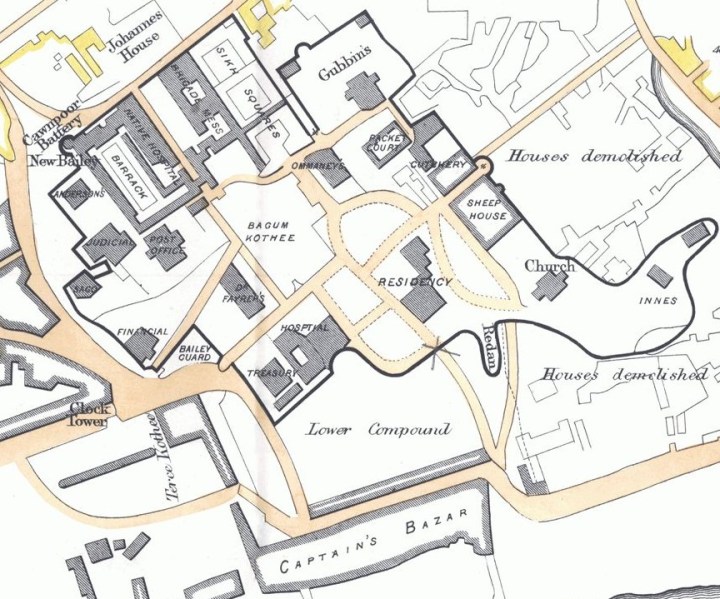
The next sortie, however, was not as successful. Once again, Dowling, this time with only 4 men, crept out of the garrison, making their way towards another gun, close to the defences. To his horror, Dowling found his spike was too short and would not completely block the touchhole. There was nothing for it but to retreat under a hail of bullets. It would be his last sortie until the 27th of September (after Havelock’s arrival) when on the ill-fated mission to capture the gun at the Phillip’s Garden Battery which cost the garrison dearly.
“We captured and spiked three guns after much firing, when, from want of confidence in the guide, and uncertainty as to where we were, the commander became confused — our men grew uneasy standing still — the enemy crowded forward, encouraged by yells and bugles — and we scrambled out of the battery, and followed our inclinations home... As we lingered in the battery a Sepoy of the 13th Native Infantry, who came out as a pioneer, advanced to a broad opening through which the enemy kept up a brisk fire, and, flourishing his pick-axe, called to the Europeans to follow him to another gun, till he was shot down. But the uproar and confusion at that, moment was such that nobody heeded him, and he would have been left behind had I not helped him out of the battery, and put him on the road, along which I was myself in full flight soon after.“
The sortie drew back under a murderous fire from the surrounding buildings which cost the lives of four men of the Madras Fusiliers, seven wounded of which two were mortally hit, and three men killed of the 32nd, among the Privates Cooney and Smith. The 32nd, which could ill-afford any losses, had one sergeant and four privates wounded, Lieutenant Huxham was severely injured and a young civilian named Crabbe was killed. However, Private William Dowling escaped unhurt, having spiked an 18-pounder.
However, there had been more than enough work for Private William Dowling to do between July and September. Like Lucknow Kavanagh, Dowling discovered he had a talent for that most hazardous occupation – mining. Towards the end of the siege, Captain Crommelin, who had arrived with Havelock’s force and would be in charge of much of the later mining operations would write in his report to the Governor General,
“I cannot close this report without noticing, in the most favourable manner, the important services performed by the undermentioned soldiers, as superintendents of the miners, Sergeants Cullimore, Bannetta and Farrer, and Corporal Dowling, all of the 32nd Regiment.”
Dowling would be promoted to sergeant before the end of the siege (on the 17th of November) and would be recommended for the VC.
“For distinguished gallantry on the 4th of July, 1857, in going out with two other men, since dead, and spiking two of the Enemy’s guns. He killed a Soubadar of the Enemy by one of the guns. Also, for distinguished gallantry on the 9th of the same month, in going out again with three men, since dead, to spike one of the Enemy’s guns. He had to retire, the spike being too small, but was exposed to the same danger. Also, for distinguished bravery, on the 27th of September, 1857, in spiking an 18-pounder gun during a Sortie, he being at the same time under a most heavy fire from the Enemy.” (No. 22328. The London Gazette. 22 November 1859. p. 4193)
He received his VC from Queen Victoria at Windsor Castle on the 4th of January, 1860. 1863 finds Dowling living at the Richmond Barracks in Dublin, celebrating the baptism of his son, Joseph Francis. When he exactly left soldiering is uncertain but he never rose past the rank of sergeant. Although he was drawing a pension, Dowling took employment with the Customs and Excise Office, a position he held until his death in February 1887, succumbing to bronchitis at the age of 60. He was buried at Ford Cemetery in Liverpool.
“Within this cemetery lies Serjeant William Dowling VC 32nd (Cornwall) Light Infantry; 1825-1887 of Thomastown, Co Kilkenny. Awarded the Victoria Cross for his; Gallantry at Lucknow on 4th and 9th July and 27th September 1857. William Dowling ended his days in this parish. This memorial plaque was moved from Ford Cemetery to here in 1991; Please pray for him.“
His Victoria Cross is currently in the possession of the Duke of Cornwall’s Light Infantry Museum in Bodmin in Cornwall, England.
Corporal William Oxenham, 32nd Regiment of Foot
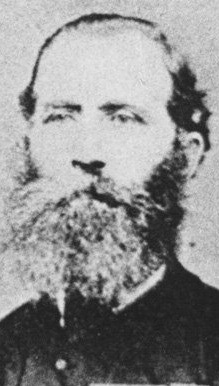
Born in October 1821 in Tiverton Devon, William Oxenham joined the army the 32nd Regiment in 1842 – it is likely poverty drove him to take the Queen’s shilling; he had married Hannah Harris in 1841 and had a little daughter, Charlotte, at the time of his enlistment. It is unlikely his family would have been allowed to follow him to India and during his 13-year absence from home, his wife died.
As his record tells, he served in the 2nd Sikh War. Oxenham was awarded the Punjab Medal with 2 clasps, Multan and Gujerat, but these were not the only medals he wore. Besides his VC, Oxenham wore the India General Service Medal with 1 clasp for North West Frontier, the Indian Mutiny Medal with 1 clasp, Defence of Lucknow and finally the Army Long Service and Good Conduct Medal.
Following the 2nd Sikh War, Oxenham was promoted to corporal and Oxenham would find himself, along with the rest of the 32nd, in 1857, doing duty in Lucknow.
“For distinguished gallantry in saving the life of Mr. Capper, of the Bengal Civil Service, by extricating him from the ruins of a Verandah which had fallen on him, Corporal Oxenham being for ten minutes exposed to a heavy fire, while doing so.” (“No. 22328”. The London Gazette. 22 November 1859. p. 4193)
His VC was awarded for an exceptional feat of bravery on the 30th of June, but unlike William Cubitt, it was not for Chinhat. It was for digging out a very unfortunate civilian, named Mr. Capper, from under the ruins of a veranda. It happened at the very badly battered Anderson’s Post, on the south face of the Lucknow Residency. Not wanting a golden opportunity like Chinhat to go to waste, the rebels lost no time in positioning their guns to face the newly formed posts, where men were still scrambling to get the defences in order, and while the injured men were still hobbling through the Bailey Guard Gate, the rebels opened fire on the Residency.
“So soon as our troops reached the Iron Bridge, one party went off to the Muchee Bawan, and the remainder came into the Residency: all the men were completely knocked up, and looked most miserable. The enemy kept up the pursuit, and we were now really and truly besieged at Lucknow. The gates were shut, and our guns opened. The mutineers soon filled the streets, and came howling up close to the outposts, where we were all ready for them; they also forthwith commenced getting guns into position.
At my garrison, a sharp fire was kept up from our loopholes, but the enemy brought a gun to bear on the pillars of our verandah, and soon brought it down with a terrible crash. Mr. Capper happened to be in the verandah and was firing out of a loophole, when a shot struck one of the pillars, and down it came. This gentleman was buried under some three or four feet of masonry, and, wonderful to say, he came out almost unhurt. There was, I fancy, no other such wonderful escape during the whole siege as this, and Mr. Capper has every reason to thank Providence for having his life spared in such an extraordinary manner. As the immense beams of the verandah were falling, they were suddenly checked by a single stout beam (which had been raised about two feet from the floor of the said verandah and formed a step for the volunteers to fire off), and in the interim Mr. Capper’s head, most fortunately, got under the space between this beam and the verandah floor, so that the other beams came down at a slant, instead of flat. When we heard that he was buried, we all rushed to his assistance, and heard only a low voice, saying, ” I’m alive! Get me out! Give me air, for God’s sake!” Someone remarked, ” It’s impossible to save him;” upon which Mr. Capper’s voice was heard to proceed, as if from a vault, saying, ” It is possible, if you try.”
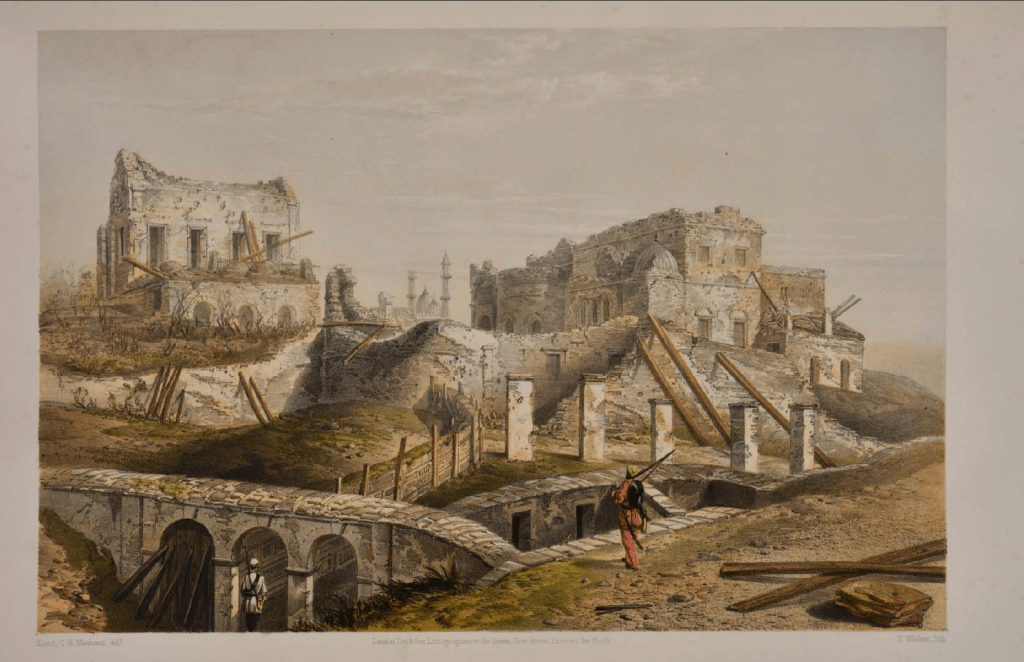
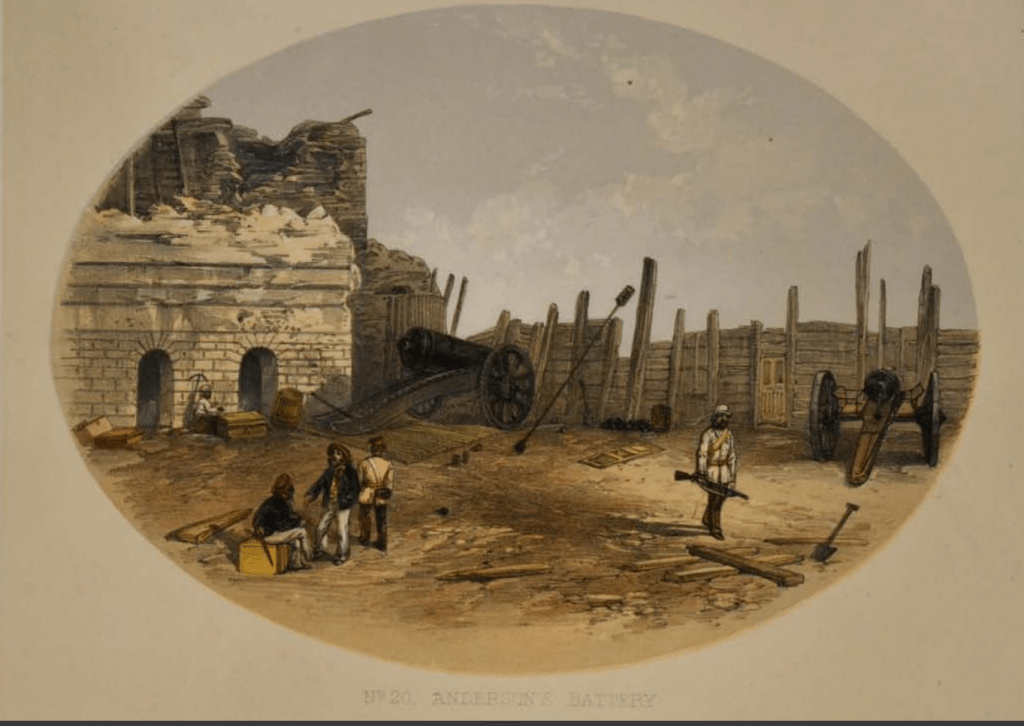
“We set to work at once, and a long and tedious affair it was. First, we had to displace huge pieces of masonry, and, as we did this, the broken bricks and lime kept filling up the little air holes, and poor Mr. Capper was constantly obliged to call out for “more air/’ During this time, be it remembered, the enemy kept up an incessant fire of round shot and musketry on the spot, knowing that we were working there; and all we had to protect us was about six inches of the wall, that just covered our bodies, as we lay flat on our stomachs, and worked away with both hands. After labouring for three-quarters of an hour, and when we were all quite exhausted, we managed to get the whole of Mr. Capper’s body pretty free; whereupon we set to work to get his legs out, and it was some little time before we could enable him to move his lower limbs. Throughout all this, a corporal, named Oxenham, of Her Majesty’s 32nd Regiment, behaved most nobly, and exposed himself considerably, so as to expedite the work of digging out our unfortunate volunteer, whose appearance amongst us seemed like as if one had risen from the grave; — we fully expected, at least, to have found that all his limbs had been broken; whereas, on the contrary, he had merely a few bruises, and felt faint.“
For this action, William Oxenham was rewarded with a Victoria Cross. However, had things gone Mr Capper’s way, who would spent years lobbying on behalf of Captain Anderson, he would have received his as well – but it would not be until 1868 when the recommendation was finally received by the War Office, by which time the fervour of Mutiny VCs was dying down. The application was turned down – over 10 years had passed since the action had taken place, and now it was simply too late to reward Captain Anderson.
It is hardly likely this was the only dangerous action in which Corporal Oxenham played a part. However, it was the only one cited for his VC. He would be desperately wounded in the arm in August, but unlike many others, he survived with his arm intact. He received his VC from Queen Victoria on the 4th of January, at Windsor Castle, in 1860. He remarried in 1862 and spent his final years in Exeter, with an annual pension of £10.- for his VC, and died of meningitis in December 1875. He was buried in High Cemetery, where he lies another VC holder, George Hollis.
His VC was sold in 1910 for a sum of £70.- but found its way to the Duke of Cornwall’s Light Infantry Museum in Bodmin where it rests today, together with his other medals.
Captain Henry Gore-Browne, 32nd Regiment of Foot
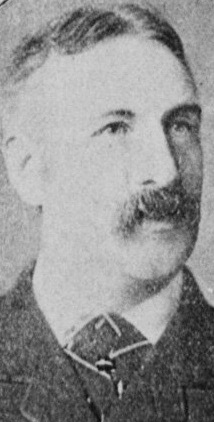
During the 87 days of the first siege of Lucknow, the garrison faced nearly constant bombardment from the guns outside their position and a galling fire from musketry, mostly directed from positions they could not reach but were frustratingly close to the parameter. One of these was Johannes House, formerly the home a merchant, Johannes. It was one of the houses Mr Gubbins had recommended blowing up well before the siege began, but Sir Henry had thought it imprudent to blast houses to pieces while Lucknow was still calm, for fear of terrorising the inhabitants of the city; after Chinhat, it was too late to begin any such extensive operations and the opportunity would be lost. Their mistake was a boon to the rebels. They quickly occupied the positions outside the walls, quickly loopholed the walls, set up batteries and started irritating the Residency, without pause.
On the 21st of August, after a failed attempt on the 7th of July to dislodge the rebels from Johannes House, another was planned and carried out, with a modicum of success. During the month, a mine was constructed, running from the compound and ending under Johannes House, while at the same time, two parties advanced from the Residency. One of these captured Johannes’ shop which adjoined the house, and the other party, led by Captain Gore-Browne, captured the nearby battery and with it, two guns. Unfortunately, the touchholes were so large that one could only be spiked most haphazardly and the other not at all. It scarcely took the rebels four hours to repair the damage and bring the guns back into service against the Residency.
“For conspicuous bravery in having, on the 21st of August, 1857, during the Siege of the Lucknow Residency, gallantly led a Sortie at great personal risk, for the purpose of spiking two heavy guns, which were doing considerable damage to the defences. It appears from the statements of the non-commissioned officers and men who accompanied Captain Browne on the occasion, that he was the first person who entered the Battery, which consisted of the two guns in question, protected by high palisades, the embrasures being closed with sliding shutters. On reaching the Battery, Captain Browne removed the shutters and jumped into the Battery. The result was, that the guns were spiked, and it is supposed that about one hundred of the enemy were killed.” (No. 22636, The London Gazette, 20 June 1862, p. 31)
Of course, nothing at Lucknow was quite that simple and a staff officer (T.F. Wilson) could not help adding a positive ring to the whole affair.
“At daybreak, all was well-prepared and ready for the blowing-up of our mine, and the simultaneous sortie of fifty Europeans under Captain McCabe and Lieutenant Browne (divided into two parties) for the purpose of spiking the enemy’s guns which fired into the mess house, and in order to hold Johannes’ House while the engineer officer blew it up. Precisely at 5 p.m. the mine, containing 400lbs of powder, was sprung, and as soon as the dust and smoke had in a measure subsided, the party ran out, drove the enemy (who were taken by surprise and made but a show of resistance) from their guns (two) and spiked them both and retained possession of Johannes’ House while the engineers made arrangements for blowing it up. These were soon completed, and the party withdrawn. A slow match was applied and the house laid in ruins. Our losses were one of the 84th killed, one sergeant (84th) dangerously wounded, one slightly wounded and a sergeant of the artillery killed. The operation was entirely successful and rid us of a house from which the enemy had, from the commencement of the siege, annoyed us greatly.” (T.F. Wilson)
In the confusion which followed the explosion, a detachment of 50 Europeans had filed out into the street, where they split into 2 parties. The first under Browne advanced the nearest battery where to his surprise, he found one of the artillerymen still asleep on his gun. Browne, who was the first to reach the battery, tried to shoot the man with his revolver but the gun misfired, the man woke up and ran off. As for the second party, under Captains Fulton and McCabe, they reached the shop behind Johannes’ House and found the door shut. The two officers, with their backs to the against the door and their feet on the veranda wall, heaved against the door until the frame broke and Fulton fell in, head of heels, to find himself tumbling into an eight-foot trench. McCabe and the others burst through the door after him, and as soon as the house was cleared, they brought in two barrels of powder. Fulton ordered the rest of the party back to the entrenchment and was about the light the hose when a cry went up there was still a wounded man in the lane. Fulton waited just long enough for the man to be carried back through the sally port before he fired the train and left the building, “happy to the last out and first in.”
This however leaves the question why did Gore-Browne win a VC when there were so many other men in the same sortie who would have deserved it?
It finally came down to a question of perspective.
Browne was the first man to enter the battery, which was protected by high palisades, with the embrasures closed off with sliding shutters. On his own, he had pulled open the shutters and leapt into the battery, where he found a napping gun crew. Four other officers certified that Browne had been the first to reach the battery and as such, it was enough to secure him a VC for which he was nominated by men of his regiment. Browne would subsequently be injured in three sorties, all ordered by Sir James Outram, which had Brigadier Inglis furious at the way Outram deliberately misused the men of the 32nd. Browne was slightly wounded on the 1st of October and again on the 8th of November, and barely recovered, he led another sortie on the 11th of November, which resulted in a serious wound in his leg. As he would survive the siege, Browne would wear his VC.
Born in Newtown, County Roscommon, Ireland, Henry George Gore-Browne was the son of Arthur Brown,, Esquire, and Anna Elizabeth Clements, the daughter of Captain Clements. He also happened to be the great-grandson of the 1st Earl of Altamont, MP and the great-grandson of the Right Honorable Arthur Browne, MP, of Leixip Castle in whose arms Wolfe had died at Quebec. Browne was educated at Trinity College in Dublin and only joined the 32nd Regiment of Foot at the late age of 25; he was commissioned into the regiment in 1855 and sent off to India. In 1856, he was promoted to lieutenant and barely 8 months later, to captain.
The mutiny was hardly the end of Browne’s soldiering days. As soon as he had recovered from his wound, he joined Maxwell’s Moveable Column and from August until October 1858 chased the rebels from one end of Oudh to the other end of Rohilkhand. In 1859, he returned with his regiment to England, and quickly transferred to the 100th Regiment (Prince of Wales’ Royal Canadian) which was stationed at Gibraltar. Although his VC recommendation was not submitted until 1862, almost too late, Browne still received his VC in a ceremony held in Gibraltar in the same year.
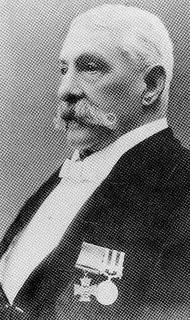
In 1867, now a major, Browne went on half-pay, and was made lieutenant-colonel in 1877, was unattached in 1881 (he married in 1882, to Jane Anne Seely, daughter of Charles Seely MP, and sister of Sir Charles Seely, 1st Baronet) and was finally received his discharge in 1888. He served as magistrate for Hampshire and as Deputy Governor of the Isle of Wight, where he died on the 15th of November in 1912, at Shanklin. He lies buried in St Mary the Virgin churchyard in Brook. His VC is held by the Duke of Cornwall’s Light Infantry Museum, The Keep, Bodmin, Cornwall.
Had Fulton and McCabe survived the siege, there would have undoubtedly been more redoubtable VCs for the Siege of Lucknow than that of Captain Henry Gore Browne.
Lieutenant Samuel Hill Lawrence, 32nd Regiment of Foot
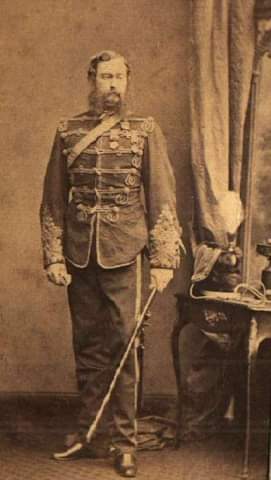
Born in 1831 in Cork, Ireland, Samuel Hill followed the footsteps of his father, also named Samuel Hill, into the 32nd Regiment. His father had seen service in the Napoleonic Wars and was wounded at Quatre Bas in 1815 – his son would proudly join the regiment in 1847 and immediately ship out to India, arriving in time to serve with his regiment in the 2nd Sikh War, with action at Multan and Gujarat.. It was a quick school for what was to come. His brother, Hector, born in 1833 and serving in the 34th Foot, would be killed at the Siege of Sebastopol in 1855.
On the 22nd of February, 1850, Lawrence was promoted to lieutenant and then just as rapidly promoted to field captain at Lucknow. He would be left in charge of Machchi Bawan, the fortress Sir Henry could not hold, and after organising its complete evacuation, on the night of the 1st of July, Captain Samuel Lawrence, with four other men of the 32nd, laid the charges and blew up the fort. 240 barrels of gunpowder and 594’000 rounds of ball and gun ammunition went up in such a tremendous blast, that the very walls of the Residency shook. Then Captain Lawrence rode, with all the calm a man could have, to the Residency.
“For distinguished bravery in a Sortie on the 7th of July, 1857, made, as reported by Major Wilson, late Deputy-Assistant Adjutant-General of the Lucknow Garrison, for the purpose of examining a house strongly held by the Enemy, in order to discover whether or not a mine was being driven from it. Major Wilson states that he saw the attack, and was an eye-witness to the great personal gallantry of Major Lawrence on the occasion, he being the first person to mount the ladder, and enter the window of the house, in effecting which he had his pistol knocked out of his hand by one of the Enemy:—also, for distinguished gallantry in a Sortie, on the 26 September 1857, in charging with two of his men, in advance of his Company, and capturing a 9-pounder gun.” ( “No. 22328”. The London Gazette. 22 November 1859. p. 4193)
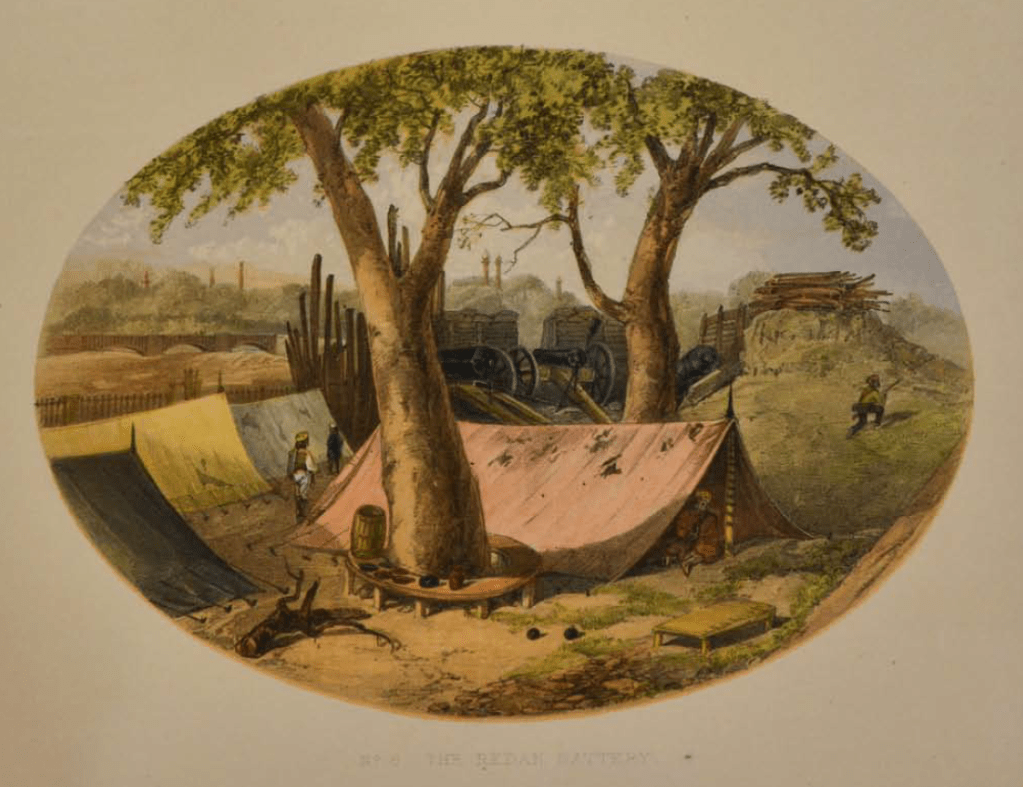
For the duration of the siege, Lawrence’s post was no other than the best battery the garrison had to offer, aptly named the Redan.
“This is the Redan Battery, and it is quite unnecessary for me to inform any member of the Lucknow garrison that that individual looking out of the tent, so thoroughly perforated with musket-bullets,—evidently on the watch to offer a passing friend the best of everything his scanty means may afford,—is its gallant commander, Sam Lawrence, of the 32nd Foot. It is impossible for me to call him “ Captain,” although he has since obtained that rank, which was never more hardly or more honourably earned. Strange to say, Sam, although commanding one of the most dangerous posts; a volunteer, too, upon every sortie; and one of the biggest men in the garrison, escaped throughout without a scratch. Some of his comrades aver that he principally exposed his burly personage upon these desperate sallies in the hope of obtaining the wherewithal to replenish a stomach which, he alleged, suffered sadly from the uncompromising diet furnished by the Commissariat. How far this may be true I cannot tell; but it is certain that he was ever foremost on these occasions. The bridge to the left is the celebrated iron bridge leading to cantonments, which was within the range of our guns, and consequently not much frequented by the enemy. The post was exposed to a very heavy musketry fire from the rebel sharpshooters stationed in the adjoining houses and mosques. Many men were hit in the battery by bullets that came through the loopholes. It was under that tree to the right that poor Mr. Ommanney, the Judicial Commissioner, received the wound which ended in his death. It was with the object of destroying this position that the enemy sprang their first mine on the memorable 20th of July. The attack, too, which they subsequently made upon the Redan was very determined. In fact, they evidently would have liked extremely to carry the battery; but Sam Lawrence and his band were in no mood to humour them, and their loss was always very heavy. (Mecham)
On the 7th of July, Lawrence showed just what kind of a soldier he was as he led the first sortie against Johannes’ House. Suspected a mine was being dug from that position towards the Residency position, 50 men of the 32nd and 20 Sikhs, led by Captains Mansfield and Lawrence, with Ensign Studdy of the 32nd, Ensign Green of the 15th NI, and accompanied by two engineers, Fulton and Anderson, were formed together for a sortie. They filed out swiftly through a sally port in the wall by the Martiniere Post at noon, covered by a brisk cannonade from the neighbouring batteries, while the officers on the roof of the Brigade Mess occupied the attention of a fearsome rebel sniper, who was watching, eagle-eyed as ever, from the tower of Johannes’ House. Occupied as he was, he did not perceive Captain Lawrence who was quick up the ladder and after a brief tussle in which Lawrene’s pistol was knocked out of his hand, dispatched the sniper. Below, the engineers were preparing charges of powder to blow up the house while Lawrence, Studdy and the others dealt with the rebels indoors. They bayonetted, according to some, 30, then continued, running out of the house and, in their fervour up the Cawnpore Road. At this juncture, Inglis curbed their enthusiasm, calling them back. He could see the rebels gathering in large numbers on the road, something the men could not see from their position on the road. They returned to the Residency, Lawrence sans a trouser leg, which was blown away. The affair had dampened the rebel attitudes for but a moment – as soon as the 32nd turned their backs, they deposited their dead and reoccupied Johannes’ House. Although it was not a victory by any means, the sight of Lawrence leading the charge had raised the spirits of the garrison, a sorely needed boost of morale.
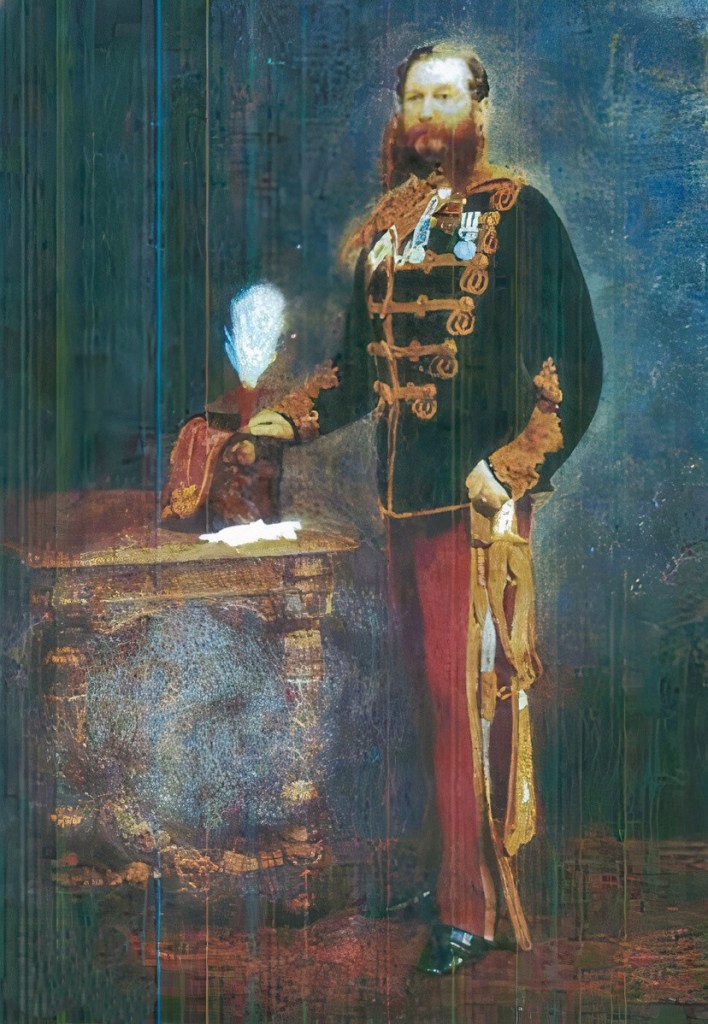
Described by Mcleod Innes as the “beau ideal of manly beauty, always genial and smiling, whether leading a sortie or waiting in quiet expectation of being blown up at the Redan,” Samuel Lawrence cheered everyone who came across him during the siege. His jovial nature bore the distress of the siege better than most; when he feared the rebels were digging a mine barely 40 yards from his battery, Lawrence joked with Inglis he “expected to shortly be among the little birds” and then roared with laughter. The engineers sallied out after dark to assure Lawrence that indeed no one was going to blow him up any time soon. His humour and bravery found an equal match in the formidable Captain McFarlan, who, during the attack on the Redan on the 20th of July watching his men dart out of the way of the falling shower of earth, called out to them, “Well, lads, when you are tired of running away, perhaps you’ll come back again.” Lawrence held the Redan and sortie after sortie, saw him sally out, always first.
On the 26th of September, with Havelock and Outram ensconced in the Residency, Samuel Hill Lawrence was called yet again to lead a sortie. By this time, Inglis’ patience with Outram was wearing thin and he protested against the ill-usage of the men of the 32nd. Outram ignored him and out went Lawrence, to secure the ground between the north of the Residency and the Gumti, including the capture of Captain’s Bazaar. Lawrence and his men left the compound by Innes’ Post at its north-western corner and pursued the rebels as far as the Iron Bridge before turning back to Captain’s Bazaar. Then, leading two of his men in the fore, Lawrence captured a 9-pound gun. It was the second citation for his VC.
After Lucknow, Lawrence returned home. Boarding the Ava in February 1858, in Calcutta with other survivors of the siege, the ship struck rocks off the east coast of Sri Lanka, close to Trincomalee. It was Lawrence whom Julia Inglis first saw, as he strode up to her, and seizing her hand, he said, “Don’t be afraid, Mrs. Inglis.” He then rushed up to the deck to ascertain how bad the damage was while Mrs. Inglis, fearing the worst woke her maid and children and prepared to abandon ship. Lawrence appeared again, this time less contained than before, “Don’t wait a minute,” he said, “Come up on deck at once!”
Together with Captain Forster, he persuaded Lady Inglis to board the first boat, she, the wife of their commander, however, put up a fuss, not wanting to leave the scene of danger. Lawrence and Forster swore to her they would follow in the next and she finally suffered herself to be rowed away. Meanwhile, Lawrence rushed down to her cabin and saved not only her cashbox and her writing desk, as the Ava slowly filled with water. Despite the best efforts of the crew, the Ava sank, but thankfully with no loss of life.
Lawrence arrived in England, not as planned on the Ava, but on the Himalaya, still together with Lady Inglis. He took his leave on shore and went home. He was awarded his brevet majority and received his VC on the 4th of January 1860 from Queen Victoria at Windsor Castle. Since VCs do seem to run in families, it was no exception for Samuel Hill Lawrence – his cousin, Lieutenant Thomas Cadell won his VC for actions at Delhi in June.
From here, the story of Samuel Hill Lawrence takes a strange turn. He had exchanged from the 32nd into the 25th Regiment of Foot in December 1859, but shortly after moved to the 8th Hussars in 1862. He returned to England for the last time in, on board the St Lawrence East Indiaman in April 1864. The 8th Hussars were proceeding to their station at York, but then, just as suddenly Lawrence exchanged into the 11th Hussars, stationed in Dublin, before retiring from the army altogether in 1865. The reason for all these moves is not known and besides being highly unusual, would have been very expensive. In 1868, he travelled the South America.
The United Services Gazette of the 15th of August 1868 reported that
“‘Major Samuel Hill Lawrence V.C., late of the 11th Hussars, died on 17 June at Estancia del Arazati, Monte Video, South America aged 37.’
The cause of death was never clearly ascertained but was put down to an illness he had contracted in India. What he was doing in South America, remains a mystery. According to some sources, he was buried initially in the Old British Cemetery at Montevideo but later disinterred and reburied at the British Cemetery, Avenue General Rivera in Montevideo. Unfortunately, even this is a matter of conjecture and no one can say for sure if he found his last resting place here after all.
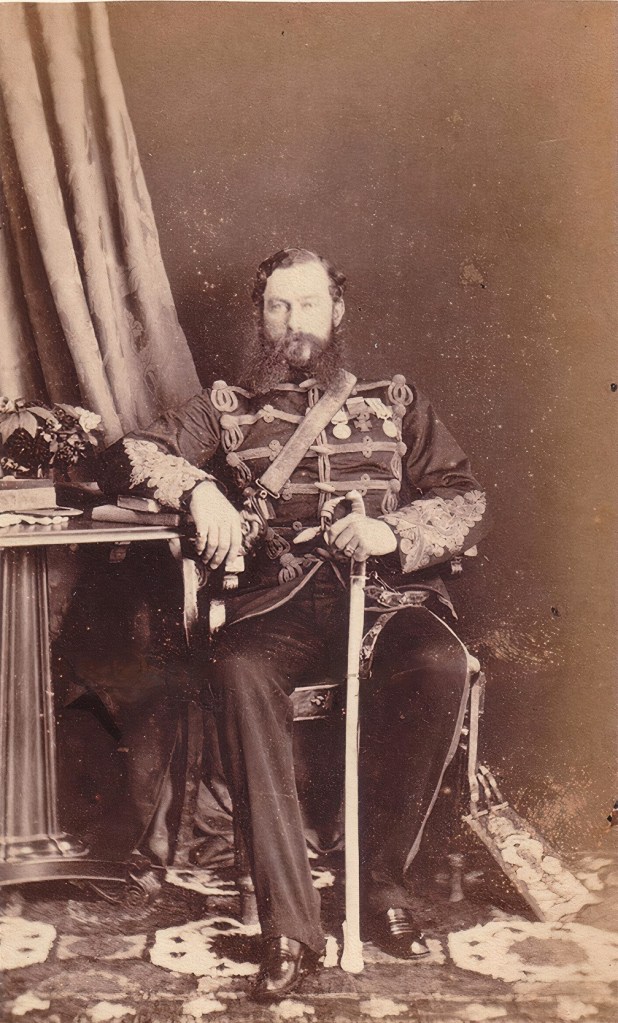
Captain Robert Hope Moncrieff Aitken, 13th Regiment, Bengal Native Infantry
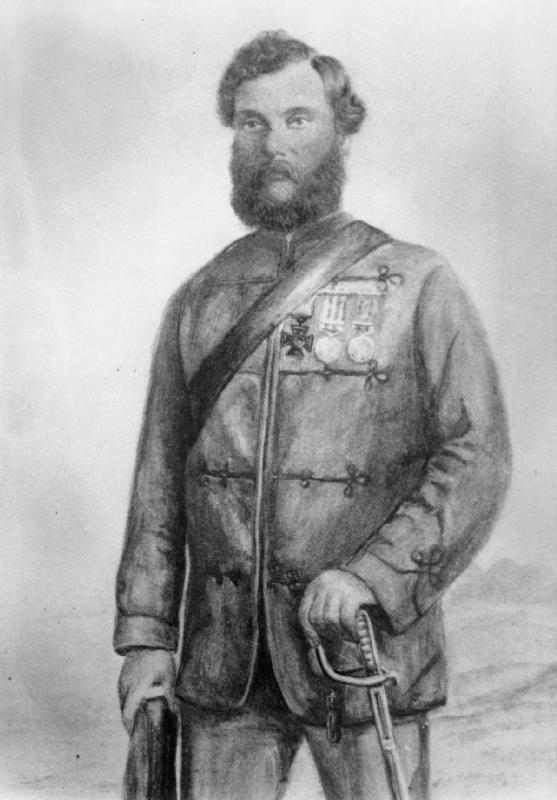
“For various acts of gallantry performed during the defence of the Residency of Lucknow, from the 30th of June to the 22nd of November, 1857.
1. On three different occasions, Lieutenant Aitken went into the garden under the enemy’s loopholes in the “Captain’s Bazaar”. On two of these occasions, he brought out a number of bullocks which had been left in the garden;— subsequently, on the 3rd of July, the enemy having set fire to the Bhoosa Stock in the garden, and it being apprehended that the fire would reach the Powder Magazine which had been left there, Lieutenant Aitken, accompanied by other Officers, went into the garden, and cut down all the tents which might have communicated the fire to the powder. This was done, close to the enemy’s loopholes. Under a bright light from the flames, it was a most dangerous service.
2. On the night of the 20 August, the Enemy, having set fire to the Baillie Guard Gate, Lieutenant Aitken was the first man in the gateway, and, assisted by some sepoys and a water-carrier of his Regiment, he partially opened the gate under a-heavy, fire of musketry, and, having removed the burning wood and straw, saved the gate.
3. On the evening of the 25 September, this Officer led on twelve sepoys of his Regiment, for the purpose of attacking two guns opposite the gate referred to, in order to prevent their being turned-on the late Major-General Havelock’s second column. Having captured them, he attacked and took the Teree Kotee, with a small force.
4. On the morning of 26 September, with a small party of his Regiment, he assaulted and captured the barricaded gateway of the Furreed Buksh Palace, and the Palace itself. On this occasion, he sprang up against a small wicket gate on the right and prevented the enemy from shutting it, until, with assistance, it was forced open, and the assaulting party were thus enabled to rush in. The complete success of the attack was solely owing to this Officer’s distinguished bravery.
5. In a subsequent sortie on 29 September, Lieutenant Aitken volunteered to take a gun which still continued firing, taking with him four soldiers through the houses and lanes to the gun. The enemy fired on this party from the houses, but they held their ground, until a stronger party coming up, the gun was upset from its carriage, and taken into the Residency. Another gun was subsequently taken. (No. 22727, The London Gazette of 17 April 1863, p. 2070)
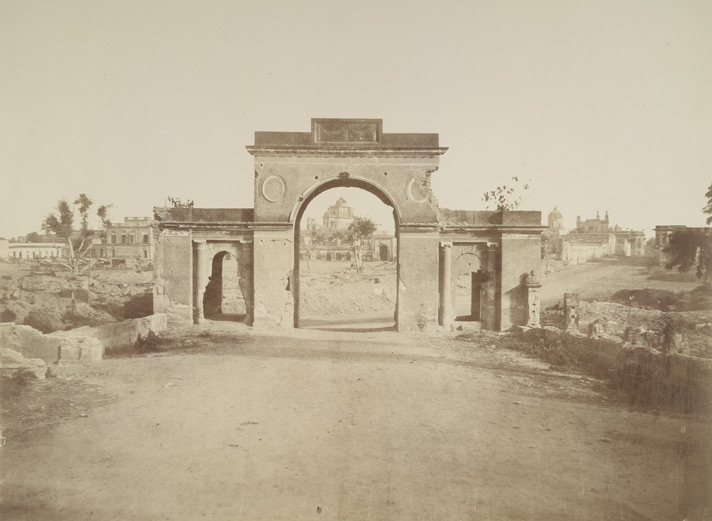
For all his gallantry, Aitken features little in the literature of the Siege of Lucknow. Everyone was aware of him, and obviously, he made sure he was everywhere but of his post the Bailey Guard Gate, hardly anything is said. Rees, Gubbins, Wilson and Joyce make fleeting mention of Aitken and fortunately, his VC citation is detailed enough without requiring much more enhancement. Whether there was still a latent prejudice against the men of the 13th NI that so gallantly fought at the Bailey Guard is a matter for discussion however Brigadier Inglis certainly was not painted with that brush, as his report shows.
“With respect to the native troops, I am of the opinion that their loyalty has never been surpassed. They were indifferently fed and worse housed. They were exposed— especially the 13th Regiment — under the gallant Lieutenant Aitken, to a most galling fire of round shot and musketry which materially decreased their numbers. They were so near the enemy that conversation could be carried on between them; and every effort, persuasion, promise, and threat was alternately resorted to, in vain, to seduce them from their allegiance to the handful of Europeans, who, in all probability, would have been sacrificed by their desertion. All the troops behaved nobly, and the names of those men of the native force who have particularly distinguished themselves, have been laid before Major-General Sir James Outram, G-.C.B., who has promised to promote them.”
However another possibility exists, and that is the very position of the Bailey Guard Gateway. During the siege, it was a most exposed position, and thus extremely dangerous to access. Rees appears never to have visited it, and unless someone had business there, it was a position to avoid at all costs. Besides being shadowed by snipers seated in the nearby clock tower, the rebels practically lived next to the men of the post. There was little Aitken could do to prevent this but he had one weapon the rebels did not – his men believed in him and he in turn, trusted them implicitly. If loyalty meant anything during the Siege of Lucknow, it was personified by the men of the 13th at the Bailey Guard Gate.
The dangers of his position were rapidly becoming clear when towards the end of of August, the rebels took to firing from a “very heavy piece of ordnance” possibly a 32-pounder, which they had managed to get into position at the Clock Tower, barely 100 yards distant from the Bailey Guard Gate. After several round shot had passed clean through the gates and destroyed 2 ammunition wagons with which they were barricaded, Aitken, assisted only by the men of the 13th and supported by the engineers, began to construct a sunken battery. The objective was to position an 18-pounder between the Treasury and the Bailey Guard Gate and supported by a 24-pounder howitzer. Before the month was up, the battery was completed, and the men of the 13th, after some initial assistance from three artillerymen, manned and worked the gun themselves, “with very good effect.” On the 5th of September, when a general assault began against most of the posts in the Residency, Aitken, with his new battery, quickly silenced the Clock Tower Battery, and much to the irritation of the rebels, he managed to tear down a portion of their defences.
For every trick of the rebels, Aitken had a reply. Just like the new battery, he answered their attempt to burn down the gate on the 20th of August with a rather simple solution. After a small body of insurgents had crept up to the gate and piled up wood and straw against it before setting alight, quite so under Aitken’s nose. Unperturbed, Aitken forced the gate open and then under a heavy fire, stood in the light of the flames, conducting the bheesties in their efforts to put out the flames. How the rebels managed to not shoot Aitken is a miracle and he managed to have the fire put out before any serious damage was done to the wooden structure. Then, without missing a moment, he ordered the walls flanking the gate to be loopholed, in case the rebels decided to try this trick again. They never did.
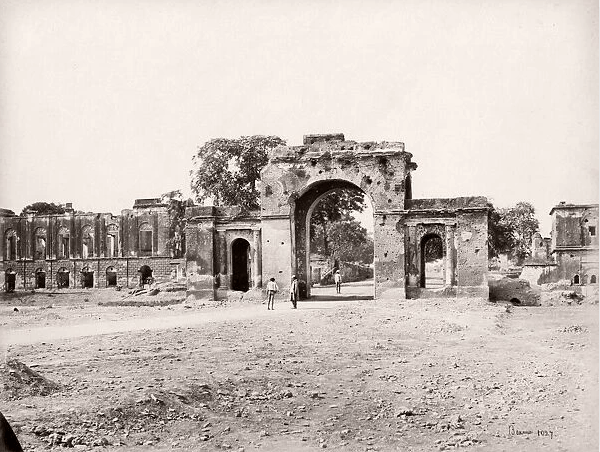
On the evening of the 25th of September, Aitken led out a party of his men, armed with pick axes and shovels to level a rebel battery outside the Bailey Guard Gate, which could have seriously hindered the advance of the oncoming troops. Aitken had heard their approach above the din of battle. Unfortunately, the 78th Highlanders, in the growing dusk, could not tell friend from foe and indeed, did not expect the men clearing the road could be anything but rebels. They attacked Aitken’s men.
The sepoys made no resistance as the Highlanders bore down on them with bayonets; they wounded three and one of them said, in the vernacular, as he fell, ” Never mind, it is fated. Victory to the Bailey Guard!” The others lay on the ground crying out, “Aitken sahib! Aitken sahib!” Hearing the commotion, Aitken threw himself between the Highlanders and his men, shouting most furiously, “For God’s sake, don’t harm these poor fellows! They have saved all our lives!” The Highlanders grounded their arms before any of the men were seriously injured – only three were wounded but none mortally.
Ultimately, Aitken’s VC belonged as much to him as it did to the men of the 13th NI. Without them, he would not have held the Bailey Guard, occupied the Tehri Kothi, taken the Farhat Baksh Palace or performed the deeds which led to his citation. However, it must also be mentioned that Aitken would be mentioned by Inglis in despatches 10 times – a feat almost as singular as winning a VC and perhaps a sign of a very brave man. Aitken was after all not alone at the Residency – his wife was with him and living in the relative safety of Ommanney’s House. Aitken had her life to fight for too.
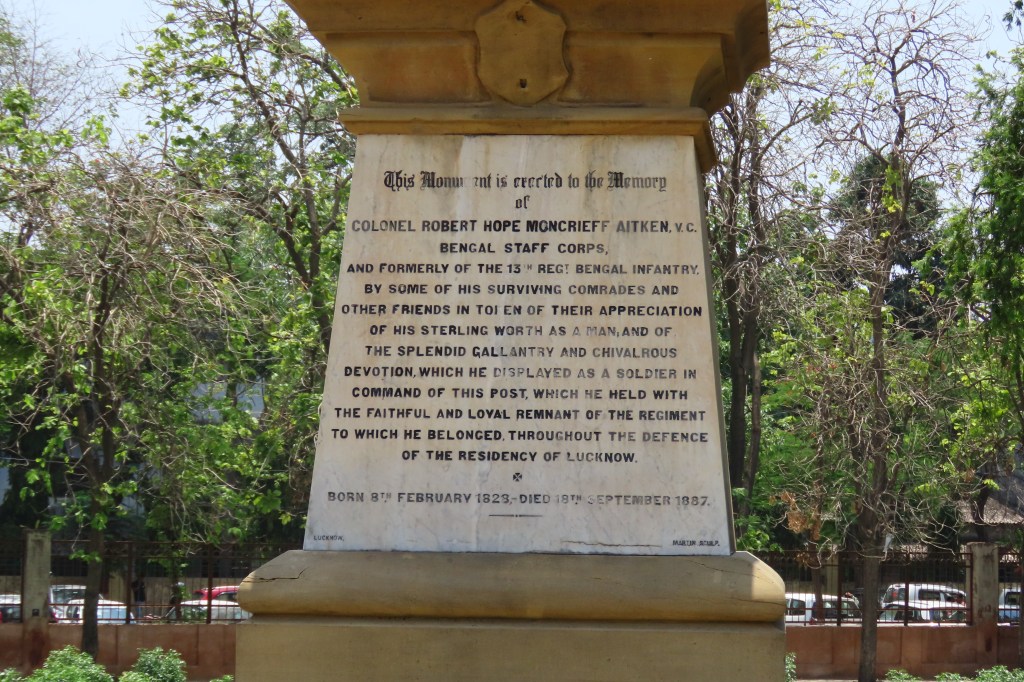
However, there was more than personal loyalty towards Aitken. The 13th NI were essentially, his family.
Born in 1826, the son of J. JAitken of Cupar, Fife, Scotland, Robert went to India in 1847 and entered the EICo’s army as an ensign in the 13th Regiment of the Bengal Native Infantry. He served through the Punjab Campaign, was present at Ramnagar, at the passage of the Chenab, at Gujerat and with the column, under Major-General Gilbert that chased the Sikh and Afghan army. The campaign won for Aitken a campaign medal and clasp.
He then served with the 13th in the Santhal Rebellion of 1855 and finally, as their lieutenant, brought his regiment through the Siege of Lucknow. Although they mutinied in part in 1857, it was one of the few regiments to save their colours and these were brought into the Residency. Here they remained until they were carried to Cawnpore after the final relief by Sir Colin Campbell. They were the only regiment to have saved their colours – those of the 48th were found in Cawnpore as late as 1906 in a very dilapidated condition but there is no evidence they were present at the siege. Those of the 71st Regiment would embarrassingly be captured by the 93rd Highlanders in November at the Secundrabagh. Perhaps the presence of the Colours at the Bailey Guard had the motivational effect the men so sorely needed, in the presence of such a formidable foe.
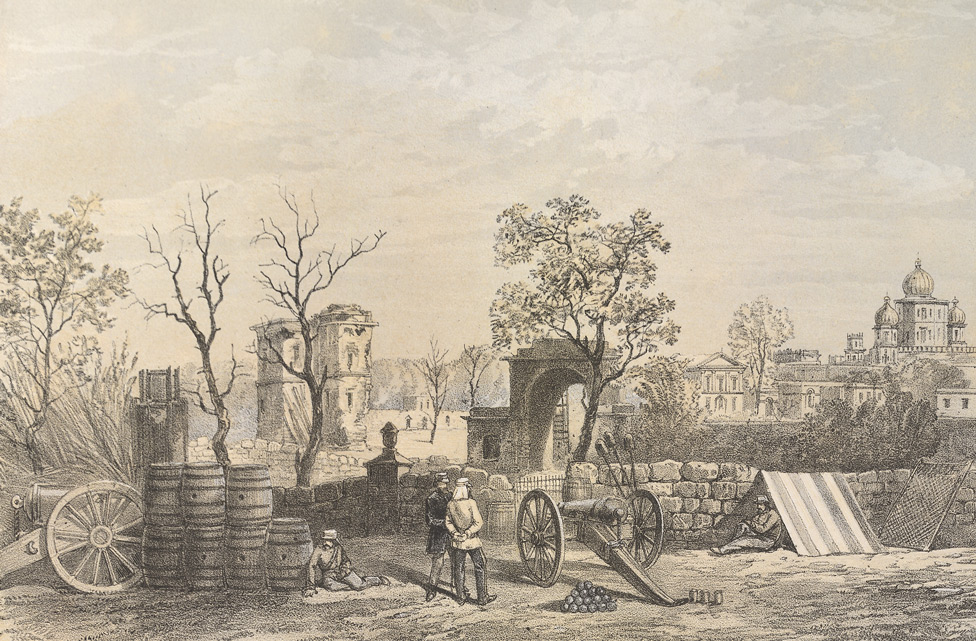
As for his VC, Aitken would not receive the medal itself until 1865. It should have been an honourable affair, carried out as it was at the Lucknow Residency and at the Bailey Guard itself. Aitken was by now a major in the 13th Regiment and the ceremony was much for him as for his men. Shortly before the general parade commenced, at which the Commander-in-Chief, Sir Hugh Rose was to present the medal, someone noticed the VC itself was missing. A flustered ADC suggested it had been left behind at Simla at which a frantic hunt was instituted to find another VC holder at the ceremony who might, perchance be willing to part with his medal for a moment, so it could be presented to Aitken. Unfortunately, of the 181 other VCs, not a single one was in Lucknow in May 1865. After Sir Hugh had calmed down enough to actually speak, he suggested Colonel Stewart lend Rose his CB as at a distance, the assembled company and troops would not be able to tell the difference. The parade went ahead following Rose’s suggestion, but at the ball that followed, Aitken had to wear a painted leather imitation VC.
As it turned out, the VC was not in Simla, it had in fact been lost and the War Office, of all things, billed Aitken for the replacement. However, as it could be proved the medal had been lost before Aitken even had a chance to wear it, the War Office rescinded their bill. The original medal did eventually show up in 1900 at an auction having been curiously bought in Simla in 1874. The War Office intervened with haste and the medal was surrendered as legal property of the Crown. Where it had been in the meantime, no one asked. As for Colonel Aitken, he never received the original medal – he died suddenly at the age of 61 at his home in St, Andrews, Scotland, in 1887, just six years after retiring.
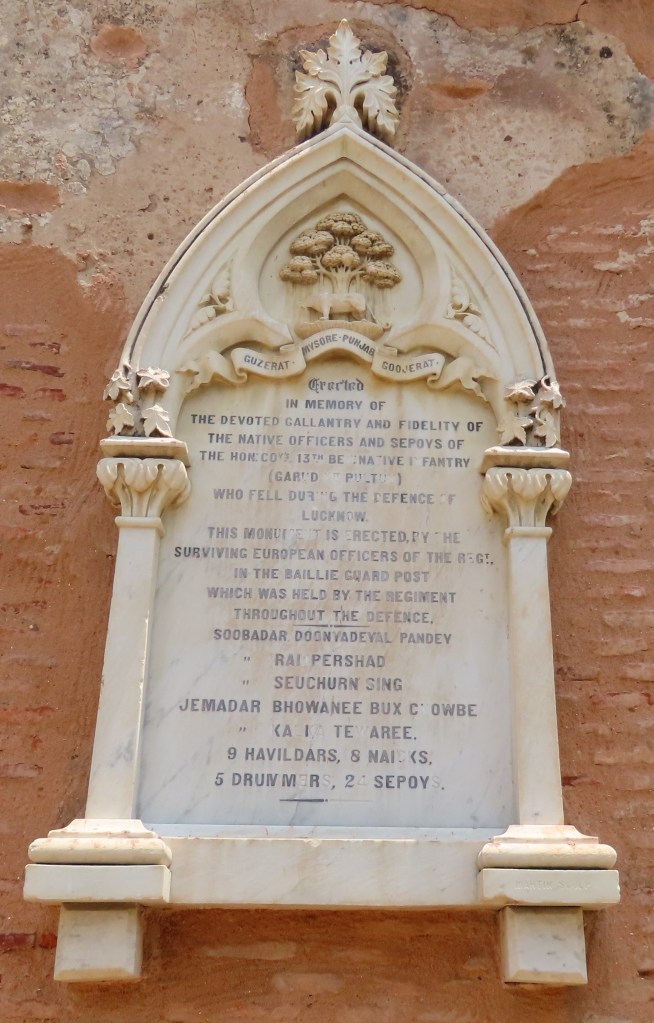
These are by far not the only VCs to be awarded to men at Lucknow, except Lucknow Kavanagh, who already has a whole post dedicated to him, but there would be none others rewarded to the men of the original garrison. In the first 87 days of the siege, these men represented everything noble and brave at the Residency and perhaps, because there are so few of them, their exploits can be better appreciated. As such, their VCs speak for the whole Lucknow Residency – the few who remain a voice in history for the many.
Sources:
A Personal Journal of the Siege of Lucknow – Captain R.P. Anderson (1858)
An Account of the Mutinies in Oudh – Martin Richard Gubbins (1858)
A Personal Narrative of the Siege of Lucknow – L.E.Ruutz Rees (1858)
The Siege of Lucknow – A Diary – The Honourable Lady Inglis (1892)
Lucknow and Oudh in the Mutiny – Lieut. Gen. Mcleod Innes ( 1895)
Ordeal at Lucknow – Michael Joyce (1938)
The Victoria Crosses that Saved an Empire – Brian Best (2016)
Online Sources:
COLOURS—INDIAN ARMY. BENGAL NATIVE INFANTRY – H. BULLOCK – Journal of the Society for Army Historical Research, Vol. 8, No. 34 (OCTOBER, 1929), pp. 258-261
https://www.jstor.org/stable/44232297
https://vcgca.org/
https://www.nam.ac.uk/
https://www.memorialstovalour.co.uk/
https://victoriacrossonline.co.uk/
https://www.thebluejackets.co.uk/
 Mutiny Reflections