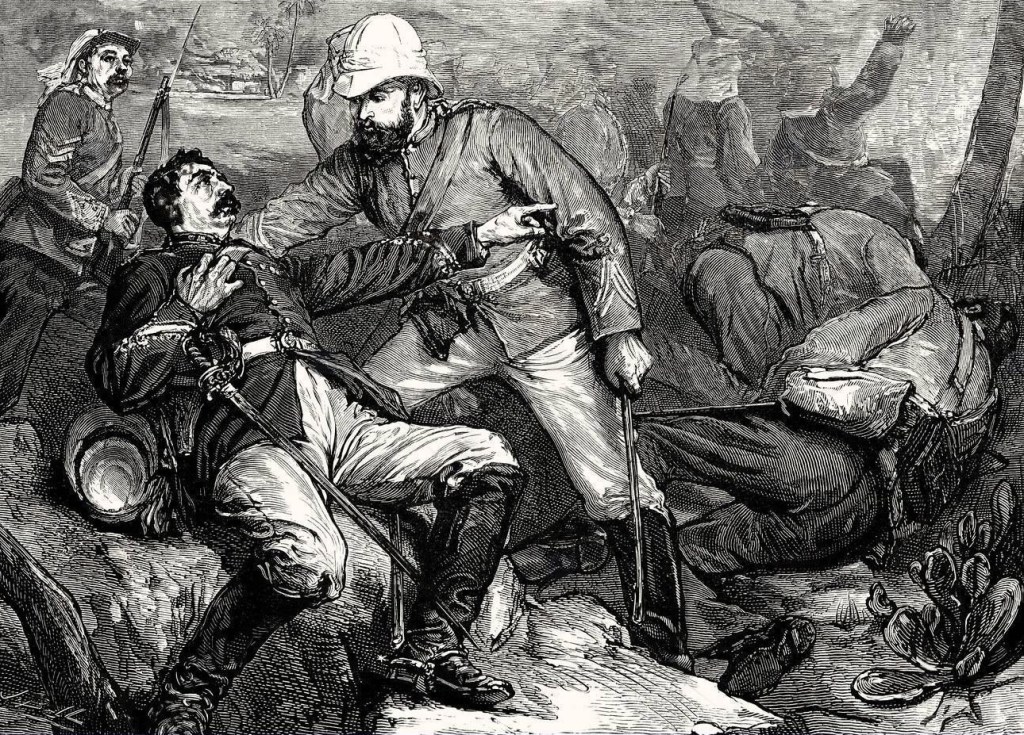
The Battle of Chinhat was a much-miscalculated effort by the British to show military might. Acting on intelligence received through native spies that a small force of insurgents was approaching Lucknow and assured it would be a quick way for the British to score a decisive victory, Sir Henry Lawrence bowed to the pressure exerted upon him by his advisers and ordered three companies of the 32nd Regiment of Foot, several companies of the 13th Bengal Native Infantry (BNI), a small force of Sikh and European volunteer cavalry, as well as Bengal and Native Artillery to proceed along the Faizabad road to intercept, what he had been led to believe was a force no more than several hundred strong. The Volunteer Cavalry left on the 29th of June to reconnoitre the area – there was no doubt the insurgents were in the vicinity, as they had thrown up piquets at some distance from the village of Chinhat. The village itself was occupied; however, no one ascertained how many rebels there were – when the cavalry returned to the Residency, their estimate was based on what they had seen; that more rebels would arrive during the night, they were woefully unaware.
As it turned out, Sir Henry Lawrence (and his advisers for that matter) had been sadly deceived. Acting under pressure, Lawrence ordered his force – 300 Europeans of the 32nd Regiment of Foot, 150 of the 13th NI, a small number of the 71st and 48th – no more than 100 – 125 of the Oudh Irregular Cavalry, and 30 of the Volunteer Cavalry, supported by one large howitzer drawn by an elephant, four guns of the Horse Light Field Battery and six further guns of the Oudh Field Batteries, to turn out and engage the rebels.
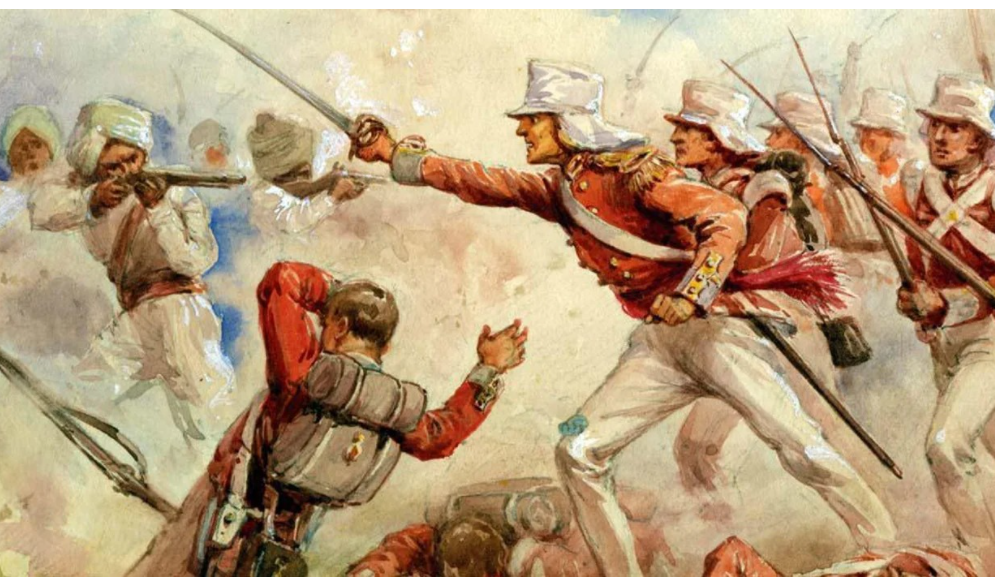
The insurgents outnumbered the British by approximately 6’000 to 600 – they fired on the British as they approached Ismaelganj close to the village of Chinhat- holding strong positions behind stone walls and within the village; they soon inflicted heavy casualties on the British forces, especially on the 32nd Foot. The 13th BNI attempted to attack to the right of the village, but the rebels were well entrenched and their leadership flawless. These insurgents were not a mindless rabble – consisting of retainers of local landowners and men of the East India Company Army they were led by Barkat Ahmad, a mutineer officer of the Company’s army – they were not only British trained but to some extent “British” led as a few renegade Europeans were seen leading the rebel forces. Lawrence’s Force, on the other hand, was exhausted before the battle had begun – the merciless June heat and the fact that the soldiers had been sent out into the field without food or adequate drink — many soldiers died of heat stroke before a single shot was fired and precious more were to die in the retreat from the same cause. What should have been a single success, quickly turned into a rout for the British and was one of the few victories the mutineers ever obtained against them throughout the Mutiny.
Besides being ignorant of the actual numbers facing him. Lawrence suddenly had to contend with dissension from within his ranks. Many of the Indian artillerymen switched sides during the battle, and the Sikh cavalrymen fled not from disloyalty but from a lack of decisive leadership. The British did the next best thing – they attempted to retreat. The 32nd kept up a brisk fire, many of the men firing more than a hundred rounds of ammunition, but it was no use. Colonel Case was shot and was last seen lying with his eyes wide open and sword firmly grasped among the dead and dying. Captain Stevens was wounded in the leg but managed to limp on for another five miles, but he finally fell, shot in the back.
“Dr. Darby in vain called out to the men to stop for God’s sake and to remember Waterloo and Vimiera. None heeded him; and Lieutenant Webb, his face black with gunpowder and the peak of his cap shot off, made himself hoarse with shouting to the men to halt….” (Rees)
The European Artillery too heeded the order to retreat but found themselves in a dilemma. The 8-inch howitzer had to be left behind; Sergeant Miller was unable to get the elephants to drag the gun, and he could not protect it. Lieutenant Bonham called out to Captain Ratcliffe to protect it. The four men who fell out were just in time to disperse the enemy’s cavalry, which boldly rode up to the muzzle of the gun. One of them fired his carbine at Lieutenant Bonham and hit him in the arm. Still standing, Bonham was as determined as ever to spike the gun. Unfortunately, with no spike at hand. Sergeant Suttle broke off the priming wire in the touch-hole instead. Private Johnson of the 32nd and now in the volunteer cavalry, however, saw a chance to save one gun at least, and he took it. Riding up to it, he quickly dismounted his horse and, handing it over to a brother soldier, mounted one of the artillery horses and pulled the gun back to the Residency.
The way back to Lucknow was fraught with danger, and it would only get worse. On their way back towards the bridge over the Kukrai stream, the rebel cavalry outflanked them, threatening to cut off their only route of escape. The volunteer cavalrymen, however, threw themselves against the rebels, causing momentary confusion in their ranks, and much of the British force was able to retreat over the bridge. Sir Henry, realising his defeat, now tried to turn the retreat into a victory – he ordered a battery of European artillery to occupy the bridgehead — a ruse — which paid off. The artillery had no ammunition left, but their presence was enough to dissuade the rebels. To further break the momentum of the rebel pursuit, Lawrence ordered one company of the 32nd (who had not been at Chinhat and were, therefore, still fresh for a fight) to hold the last bridge before Lucknow over the Gomti River. Sir Henry was seen throughout the battle, riding to the most exposed parts of the field amidst a terrific fire of grape and round shot; at the bridge, Rees saw him again, this time wringing his hands in the “greatest agony of mind, and forgetful of himself”, thought only of his poor soldiers. ‘My God, my God!’ he was heard to say, ‘ and I have brought them to this!’ Fresh guns were ordered from the Residency and together with the remainder of the 32nd, Lawrence managed to keep the insurgents from crossing the Iron Bridge – however, their cavalry now tried to ford the river beneath it. Unable to prevent them, Sir Henry could only watch as they crossed over and occupied the southern and eastern parts of the city. The most he could do was make their way there less pleasant. Ordering the guns from the Macchi Bhawan to open fire, they raked the road up to the next bridge and prevented them from taking not just the north by the west side of Lucknow. It also allowed a part of the retreating force to escape to the Macchi Bhawan instead of attempting the flight to the Residency. From 11 a.m. on the 30th of June, the siege of the Residency began. They had lost 118 Europeans and men, killed, and 182 native troops, killed and missing. Fifty-four Europeans and 11 natives returned to the Residency wounded.
The singular defeat at Chinhat proved to the rebels that the British were neither invincible nor as well-prepared as they had been led to believe. Following the battle, the rebels opened fire on the Residency. From the 30th of June 1857 until the 24th of September (when the first relief force was able to break through) the inmates of the Residency grounds were on their own. The disaster haunted Sir Henry until his death, and he never came to terms with the terrible losses. He placed the blame squarely upon himself, though it should have been equally carried by his rash advisers.
The rebels were now squarely at their door, and the population living in the vicinity of the Residency began to leave, trying to get as far from it as possible. Horses were seen galloping riderless up and down the streets, while mahouts tried to hurry away their elephants and at the river, the boatmen shoved off from the shore, securing their boats on the opposite side. By mid-afternoon, a strange stillness fell over Lucknow, it was as if all outside the entrenchments had turned into a city of the dead. The first shots hit the Residency building even as the wounded were being carried back through the Bailey Guard Gate. The ladies were quickly sent off to the underground cellars while the men prepared themselves for a battle. Towards evening, it was clear the rebels were not planning to attack the compound after all – they were entrenching themselves outside it – the Siege of Lucknow had now begun.
Sources
Kaye’s and Malleson’s History of the Indian Mutiny of 1857-58, Vol. i
Ruutz Rees, L. E. –A Personal Narrative of the Siege of Lucknow (London: Longman, Brown, Green, Longmans & Robert) 1858
 Mutiny Reflections