After the battle of Mahidpur not only the Peshwa’s but the real influence of the Mahratta States of Holkar and Shinde were dissolved and replaced by British supremacy.” (Durand)
On the 21st of December 1817, with the Third Maratha War raging, the British, under Sir Thomas Hislop, met the Indore State forces at the Battle of Mahidpur. The battle was brutal and long, lasting from midday until three in the morning – the British lost 800 men, and Holkar’s force was destroyed. His loss — 3000 men killed and wounded — broke the power of the Holkar dynasty and tossed them out of the war. The Treaty of Mandeswar (Mandsaur) was signed between Sir John Malcolm and Holkar in 1818 — Holkar was reduced to a ruler in name only — his affairs would, from now on, be guided by the British.
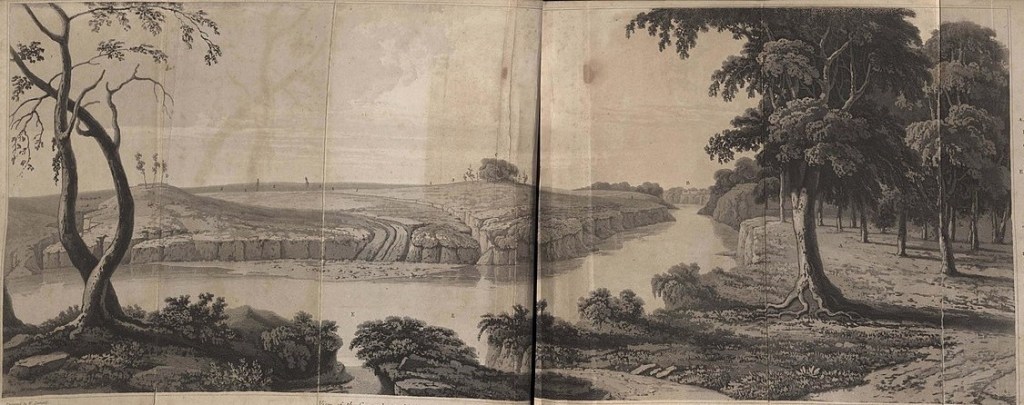
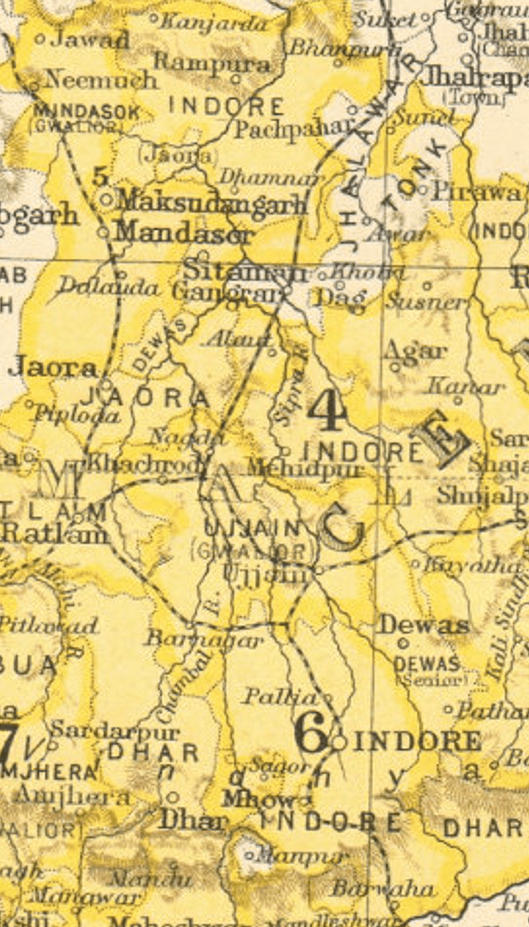
As for Mahidpur, 75 miles (ca. 121 km) from Indore, the British did not allow anything to chance — following the battle, they established a cantonment at Mahidpur. Tributaries of the river Kshirpa surrounded the fort and the town on three sides, creating a natural defence — and until the events of 1857, it was just another station in Central India.
The United Malwa Contingent
The United Malwa Contingent had its headquarters at Mahidpur under Major George Timins. He was hardly a newcomer to India; posted as an ensign to the 34th BNI in 1825, he had been with the United Malwa Contingent since 1838, firstly as the second-in-command and finally as their commander in 1841. The Contingent was a small force, consisting of a regiment of infantry, some cavalry, and an artillery battery. He was further supported at Mahidpur by a small cavalry detachment of the 2nd Gwalior Contingent.
After the mutinies at Nasirabad and Neemuch, Colonel Durand ordered four companies of the Malwa Contingent to assist in securing Neemuch. Under Lieutenants Francis Walter Brodie and Charles John Hunt, they were peaceable enough until they reached Malhargarh — only 14 miles (ca. 23 km) from Neemuch — where they mutinied and murdered their officers on the 6th of June. The companies then did not, as expected, march on Neemuch. Instead, they returned to Mahidpur, some 80 miles (ca. 129 km), which they covered in two days, intending to incite the artillery and infantry but ultimately joined hands with the mutinous Neemuch Brigade, then on the road to Deoli. They would fight Brigadier Polwhele at the Battle of Sassiah before Agra on the 5th of July.
Meanwhile, at Indore, the 200 sepoys and 100 sowars of the Malwa Contingent, detached to guard British interests there, bided their time. They had been ordered back to Mahidpur, but by this time, they were not inclined to follow orders. When the Indore Residency was attacked on the 1st of July, they withheld their support from Durand and eventually openly fraternised with the rebels. Then, with the mutineers from Mhow, they marched off to Gwalior, where they styled themselves the Indore Brigade, a largely rag-tag force with a collection of“miscellaneous rabble of badmashes” they recruited on their way. On their way, they attempted to coerce the Raja of Jaora, Ghaus Muhammad, who prudently refused. He would inform Durand of an understanding between Holkar’s troops and the mutineers outside Indore. When Durand took the field, he would be the only chieftain to join Durand in camp.
Timins is Beleaguered
When the news of the Malhargarh mutiny reached Timins, he left Mahidpur with the remaining British officers and sought protection at Lalgarh. The dewan, however, turned him away, worried the Amin of Mahidpur would incur the wrath of the Holkar Darbar for harbouring Europeans. It was a lame excuse, considering Holkar himself was not adverse to the EICo and would, in his turn, protect Europeans at Indore. Durand and Showers took a dim view of Timins, and he was ordered back to Mahidpur. While he was away, the Malhargarh mutineers had been looting the cantonment bungalows together with mercenary Walayatis, while the infantry, artillery and the 2nd Gwalior Contingent, Cavalry, under Rissaldar Mir Amjad Ali, were unable to act.
Timins came back to find his own bungalow in the possession of mercenaries. His guard had been helpless to prevent it – when they tried, they were rebuffed by the Walayatis with the words, “The bungalow belongs to His Highness, the Maharaja, ” implying Holkar. Iswariprasad, cantonment subedar, complained to the Amin of Mahidpur, who ordered the Walayatis to leave Timins’ bungalows, but not before Timins had sent a very harsh complaint to Durand and the Indore Darbar.
The Amin was pretty much out of anyone’s control — he assured the mutineers they would receive employment in Holkar’s name, although many of them chose to march off to Gwalior and a portion to Delhi. For Timins, it was a dreadful situation — everyone was just too busy to deal with the Amin, and he would have to hold his own for however long it would be. Following the mutiny at Indore, the Amin actively began recruiting mercenaries, which included not just Walayatis but also Sondhiyas and Makaranis, adding them to his own guard. The Walayatis, under the Amin’s orders, now patrolled the vicinity of the cantonment and Timins’ bungalow.
The Amin openly fermented trouble in the still passive remainders of the Malwa Contingent by sending messages not only to them but to servants in the employ of the British to throw off their loyalty. When this did not work, he impressed on Timins’ munshi that, “You should accept the service of the Maharaja Sahib and come to me. I shall send you to Indore with your papers. I shall recommend you for a dress of honour. Your status will be enhanced. You should put the infantry and artillery under my control. If you want to save the lives of the Europeans, you should ask them to escape from this place…” The munshi, for his part, was not impressed by all this talk of honour and prestige. He remained with Timins.
When nothing worked, the Amin attempted, by a hint of rumour, to incite rebellion among the people of Mahidpur – on the 4th of July, they were to rise up and simply murder the Europeans.
Nothing happened.
So he tried again two weeks later, and this time, he launched a surprise attack on the cantonment with the help of troops borrowed from neighbouring Dhulet. The cantonment guards and the still loyalty-professing remainder of the Malwa Contingent beat them off. He then tried to recall the rebellious contingent men from Indore, but they refused to listen and continued on their way.
Meanwhile, the Malwa Contingent at Mahidpur was receiving tempting offers from Shahzada Feroz Shah at Mandsaur — they were to desert their posts and rally under his standard, bringing with them guns, ammunition, and all accoutrements of war. The path to rebellion at Mahidpur was open.
It was the victory at Dhar that finally drove the remainder of the Malwa Contingent to show their hand. Mahidpur lay on the road to Mandsaur, and the retreating rebels from Dhar were making a beeline for the station. The Amin’s Walayatis, in the meantime, had come to an understanding with Timins’ infantry after having received news of the oncoming Dhar rebels and a force from Mandsaur who would arrive on the 8th of November.
That very morning, five shots rang out from the Amin’s Walayatis, signalling to the Malwa men to rise. Timins, for his part, was ready. He assembled his men — infantry and artillery – near the artillery lines, and with six guns, greeted the oncoming rebels. They withstood the first onslaught from the artillery and quickly surrounded Timins’ guns and infantry. After this, things could not have gone worse for Timins. The infantry refused to charge, standing still as their officers rushed forward. The six guns of the artillery did fire, but when the Waliyatis joined the fracas, they professed they would not man the guns and quickly went over to their side. The 2nd Gwalior Contingent (Cavalry) mercifully stood their ground and helped Lieutenant Drysart work the guns while the remainder of them, with Lieutenant Mills leading them, charged the rebels. It was a gallant but ineffectual effort.
Meanwhile, Timins could only watch as the subedar major of the Malwa Contingent opened his jacket, revealing a green flag that he now joyously waved about his head, a sign he had thrown in his lot with Feroz Shah, much to the delight of the rebels. In the meantime, with Lieutenant Mills severely wounded and Dr Carey dead, the only officers left were Timins, Drysart and Risaldar Mir Amjad Ali, who staunchly continued to lead the 2nd Gwalior Contingent. By noon, however, the situation was by no means improved — with the rebels from Dhar and the Amin’s mercenaries, the force attacking Timins had swelled to 1500 — in short order they captured the guns, forcing Timins and the others back.
Urged now by the Rissaldar to flee, Timins and Drysart abandoned all hope of saving Mahidpur. The Rissaldar and two sowars, Imayat Ali and Mir Ali Rasul, were badly wounded, but they managed to rally the remaining 32 men of the Gwalior Cavalry. Forming a guard around the British officers, they left Mahidpur. Mrs Timins, who had been preparing for flight from her bungalow, had also mounted her horse, but, at this very inopportune moment, it was shot dead. Her servants ran out to her aid and quickly bundled her off before the rebels could catch up. Mahidpur was subsequently plundered and burned to the ground. Meanwhile, the escaped party managed to ride to Durand’s camp at Noyla and, still surrounded by the faithful cavalry, arrived the next day.
Killed at Mahidpur:
Lieutenant G. Mills, United Malwa Contingent
Dr Carey, United Malwa Contingent
Serjeant-Major Manson, United Malwa Contingent
Serjeant-Major O’Connor, United Malwa Contingent
Mahidpur would be retaken, not by a British force, but by the Hyderabad Contingent Field Force, whose conduct and exemplary discipline under their enigmatic leader would be second to none.
Sources:
Burton, Reginald George. A History of the Hyderabad Contingent. Calcutta: Government of India Central Printing Office, 1905.
Durand, H. M. The Life of Major-General Sir Henry Marion Durand. Vol. I. London: W. H. Allen & Co., 1883.
Great Britain Parliament. Further Papers (No. 6) Relative to the Mutinies in the East Indies. London: Harrison and Sons, 1858.
Intelligence Branch, comp. The Revolt in Central India 1857-59. Simla: Government Monotype Press, 1908.
Luniya, B. N. “MAHIDPUR IN 1857.” Proceedings of the Indian History Congress 20 (1957): 281–85. http://www.jstor.org/stable/44304478.
Malleson, G. B. History of the Indian Mutiny, commencing from the close of the 2nd Volume of Sir John Kaye’s History of the Sepoy War. Vol. III. London: W.H. Allen & Co., 1888.
Watson, W. A. King George’s Own Central India Horse: The Story of a Local Corps. London: William Blackwood & Sons Ltd., 1930. Reprinted Uckfield: Naval and Military Press, 2005
 Mutiny Reflections