Firoz Shah Shahzada
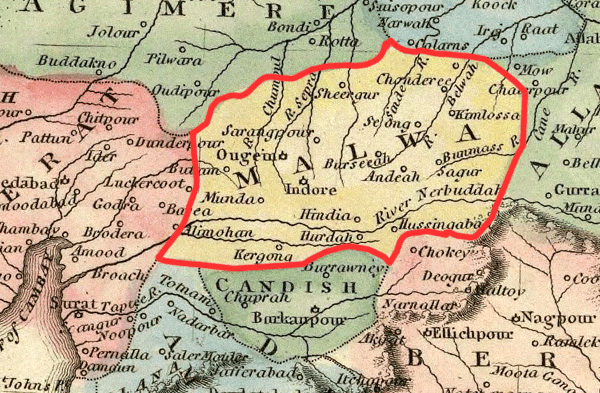
It would take the skill of one exceptional young man to turn the uprising in Malwa into something far more serious than factions of disappointed rajas and nawabs, each with their own agenda in mind.
Firoz Shah Shahzada was born in Delhi in 1832 as a descendant of Bahadur Shah Zafar, the last Mughal emperor. In 1855, he embarked on a pilgrimage to Mecca and arrived back in India in 1857, alighting in Bombay. He then hurried northwards.
He first comes to light in August 1857 in a letter that states he had arrived at Nahargarh, accompanied by 20 others. As he progressed onwards, he continued to gather followers. At Jaora, the Nawab gave him an audience, taking pity on the young man, who claimed he had been robbed on the road. The nawab gave him Rs. 50 and a few swords before sending him on his way.
By the time he arrived in Khachrod, 200 people formed his entourage. Scindia of Gwalior was hardly impressed. The Shahzada put up at the Jama Masjid and, on account of the rains, started an open campaign of preaching – “all who desired to aid the faith” were to come with him. The 30 people who heeded his call were expelled by Scinida, who then requested the Shahzada himself to leave, which he did. The Shahzada finally came to a halt at Mandsaur and was greeted by jubilant, unemployed Mewatis who erected the standard of Islam, and with beating drums, received him into the town.
The local officials and Doodan Sayad at Mandsaur were not delighted by this sudden arrival and tried everything in their power to evict him, but the Shahzada was determined to stay. By now, his gathering had grown considerably, and no one was powerful enough, from among the local tahsildars and taluqdars, to oppose him. He effectively took control of Mandsaur and declared himself the government. Anyone who did not agree was either killed, confined or forced to flee. It did not take long for him to build up an army of 15’000 men, many of whom were recruited to his standard and paid for their services like mercenaries of old. He issued a proclamation, stating that he, Firoz Shah Shahzada, grandson of Bahadur Shah Jafar of Delhi, had taken his seat on the throne of Mandsaur, and anyone who did not rise to his standard and pledge allegiance would be punished. Not everyone was impressed by his lineage, and others would go so far as to say he was an imposter; whatever the truth is, Firoz Shah Shahzada’s claim to the lineage of the Delhi house is undisputed. The question remains, however, how he was related, and this has never been fully established.
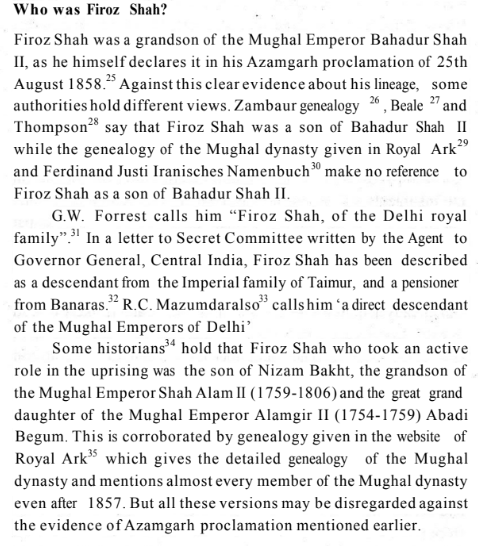
Who he was, or wasn’t, is of little importance to the actual uprising in Malwa. He was charismatic, well-educated and above all, the people believed he was a Prince of Delhi. With his abilities as a leader and an administrator, it was enough for the much-neglected and quarrelsome population to rise in his support. His gathering power was certainly a cause for concern and one which did not just affect the British but the other rulers in Malwa. It was the Nawab of Jaora who first set the alarm bells ringing when he sent a letter to Durand, describing the Shahzada’s coup at Mandsaur and that his intention, as the Nawab had learned, was to drive the British out of Neemuch, Mahidpur and Mhow, and then, finish them off completely in all of Malwa. The Shahzada further claimed, he said, that he had been sent by the Delhi Court to deal with the British. The Nawab of Jaora could report the Shahzada’s army was singularly “not fit for one fire of any company of artillery,” but men continued to flock to Mandsaur because he continued, as promised, to pay them.
Upon the death of the Ratlam ruler, Balwant Singh, Jaora Nawab went to pay his condolences – as soon as his back was turned, his nephew and some followers went to Mandsaur to join Firoz Shah. The nephew, Abdul Sattar Khan, was welcomed with a five-gun salute, presented an honorary robe and placed at the head of the army, much to the disappointment of the Mewatis who had hoped he would be declared their nawab and not a servant of Firoz Shah. It gave the Mewati leaders a moment of reflection, with many suddenly realising that perhaps going against the British was really not such a very good idea. The leaders wrote to the Jaora Nawab that if they could expect a pardon from the British, they would make their way to the court of Gwalior and pledge their allegiance ( and apologise) to Scindia. Firoz Shah attempted to apprehend them, but they had already fled as soon as Jaora Nawab gave them his approval.
Meanwhile, many of the Malwa rulers, cowed by the threats of the Shahzada and by the daily departure of their men, continued to provide money and gifts to his new court – whether they approved of him or not was another question; preservation of their own territories was first and foremost in their minds and if they had to pay the man for peace, they would do so. Things had deteriorated so far that the Nawab of Khachrod was forced to flee after his own army plotted to kill him. He fled to Mhow, where he met Durand, but Durand was unable to help him. He was advised to proceed to Gwalior and seek refuge under Scindia. At Kachrod, the troops unfurled the Shahzada’s flag, looted the town and took the place for themselves. Jawad, Ratangarh, and Singoli all rose in open rebellion and declared themselves for the Shahzada. Ratlam was plundered, and until October, when the Malwa Field Force could finally be brought into action, his influence continued to grow.
Sources:
Durand, H. M. The Life of Major-General Sir Henry Marion Durand. Vol. I. London: W. H. Allen & Co., 1883.
Intelligence Branch, comp. The Revolt in Central India 1857-59. Simla: Government Monotype Press, 1908.
Malcolm, John. A Memoir of Central India, Including Malwa, and Adjoining Provinces: With the History, and Copious Illustrations, of the Past and Present Condition of That Country. 2 vols. London: Kingsbury, Parbury, & Allen, 1823.
Malwa Bhil Corps. A Short History of the Malwa Bhil Corps. Indore: Holkar State Press, 1890.
Mishra, Suresh. Shahzada Firoz Shah: A Forgotten Hero of 1857. New Delhi: Sage Publications, 2018.
Simcox, A. H. A. A Memoir of the Khandesh Bhil Corps, 1825–1891: Compiled from Original Records. Bombay: Thacker and Company, Limited, 1912.
Srivastava, Khushalilal. The Revolt of 1857 in Central India – Malwa. Bombay: Allied Publishers, 1966.
Trotter, L. J. The Bayard of India: A Life of General Sir James Outram. Edinburgh: William Blackwood and Sons, 1909.
 Mutiny Reflections