“On the morning of the 20th, Lieutenant Rose, 25th Bombay native infantry, was in command
with a detachment of his regiment of the kotwali, or police station, not far from the main gateway
of the rock fort. As the guns from its ramparts continued to fire, Rose proposed to a brother officer, Lieutenant Waller, who commanded a small party of the same regiment near him, that they should attempt to capture the fortress with their joint parties, urging that if the risk was great, the honour would be still greater. Waller cheerfully assented, and the two officers set off with their men and a blacksmith, whom, not unwilling, they had engaged for the service. They crept up to the first gateway unseen. Then the blacksmith, a powerful man, forced it open, and so with the other five gates that opposed their progress. By the time the sixth gate had been forced, the alarm was given, and when the assailants reached the archway beyond the last gate, they were met by the fire of a gun which had been brought to bear on them. Dashing onwards, unscathed by the fire, they were speedily engaged in a hand-to-hand contest with the garrison. The fight was desperate, and many men fell on both sides. The gallantry of Rose and Waller, and their men, carried all before them. Rose especially distinguished himself. Just in the hour of victory, however, as he was inciting his men to make the final charge, which proved successful, a musket was fired at him from behind the wall. The man who had fired the shot, a mutineer from Bareilly, then rushed out and cut him across the knee and wrist with a sword. Waller came up and despatched the rebel; too late, however, to save his friend.” (Malleson)
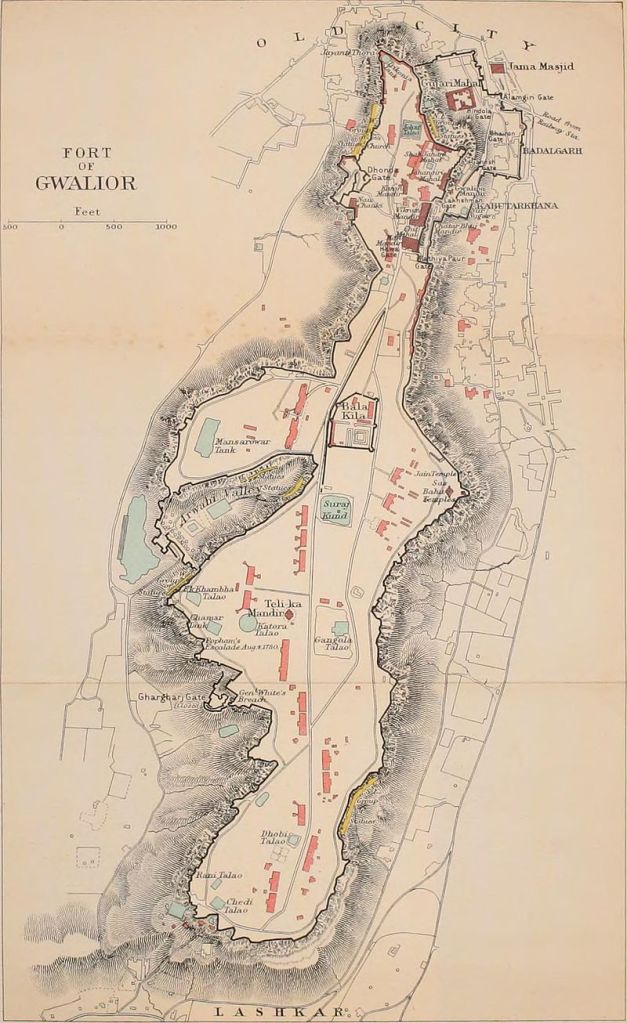
“For great gallantry at the capture by storm of the fortress of Gwalior, on the 20th June 1858. He and Lieutenant Rose, who was killed, were the only Europeans present, and, with a mere handful of men, they attacked the fortress, climbed on the roof of a house, shot the gunners opposed to them, carried all before them, and took the fort, killing every man in it.” (London Gazette, 25 February 1862. 20 June 1858, Lieutenant William Francis Frederick Waller, 25th Bombay Native Infantry.)
Two men of the 25th Bombay Native Infantry had, on 20 June 1858, come up with something of a madcap plan. They would take Gwalior Fort, accompanied by a handful of men from their regiment and put an end to the last rebels holed up inside, who were still firing the guns from the walls of the fort. Little did they know, when they embarked on this particular feat, they faced a small but determined group of men, of which two were gunners of the Gwalior Contingent, who had decided, mid-march, to return to Gwalior to meet their fates. What their motivations were for returning to Gwalior when their compatriots were already marching off, either following Tantia Tope or breaking out on their own, is anyone’s guess. While the Gwalior men were from the Contingent itself, the remainder were Walayatis – men who had previously given their allegiance to the Rani of Jhansi and Bengal sepoys, some purported to have mutinied at Bareilly. They had single-handedly manned the guns that had so irritated Sir Hugh Rose on the morning of the 20th, and when the final fight came, each man died, fighting to the last.
Lieutenant William Francis Frederick Waller, 25th Bombay Native Infantry
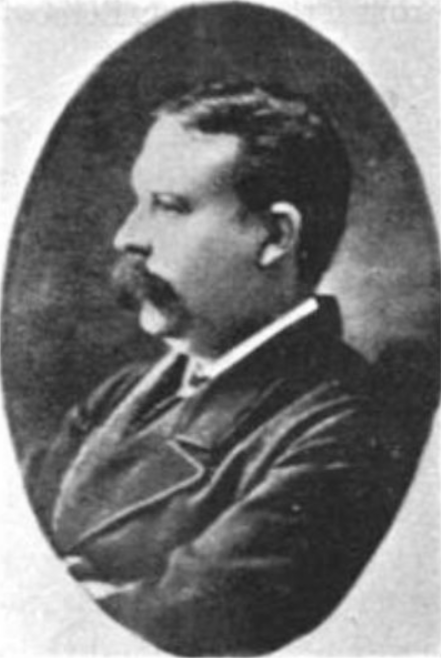
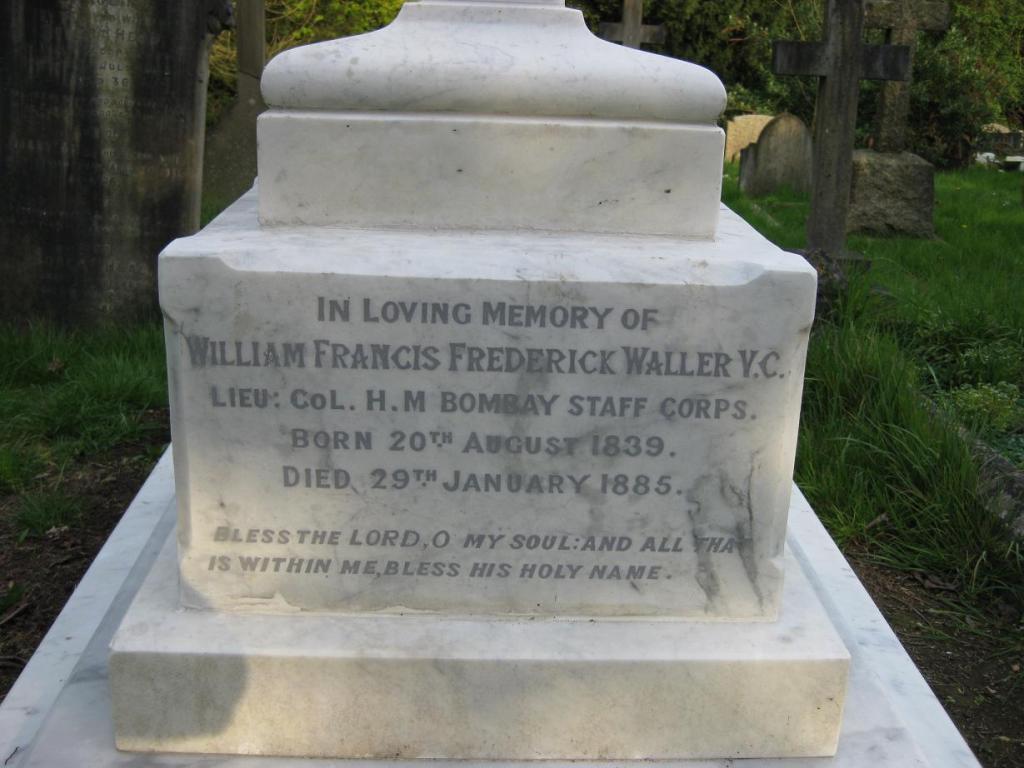
William Francis Frederic Waller was born on 20 August 1839 in the Bombay Presidency. His parents were married on 2 February 1835 in Belgaum – Thomas Waller is listed as Assistant Surgeon, in charge 6th Regt. Native Infantry, and his mother, Alicia, as the fourth daughter of Joseph Gilbert, Esq., of Lymington, Hants. He would have spent his formative years in India and was most likely sent to England for his education; however, in February 1857, Waller was commissioned into the East India Company army, six months short of his 18th birthday.
The 25th Bombay Native Infantry and Waller saw service at Chanderi, Jhansi, Betwa and Kalpi; on 4 June 1858, he was promoted to lieutenant. He received his Victoria Cross from Lieutenant General Sir William Mansfield at a ceremony held in Bombay in 1862. Promotion was not particularly quick for Waller – he attained the rank of captain in 1869, the same year he took up work in the Political Department.
In 1864, he married Mary Anne, daughter of the late Dr.D. Grierson, in Sholapore when he was serving as Adjutant to the Kolapore Infantry. Together, they would have eleven children. Two died in infancy, including their only daughter. While some of their sons would serve in India in various positions, including the army and civil service, two emigrated to Canada.
Waller never left the 25th Bombay Native Infantry per se, but in 1869 took over command of the Sawunt Warre Local Corps. Waller attained his majority in 1880 as 2nd in command of the Sawunt Warre Local Corps. Two years later, he served as political agent to the Southern Maratha Country and later served as assistant to the political agent of Kathiawar and as Joint Administrator of Sangli. In 1884, he finally sailed for England on leave, but his untimely death on 29 January 1885 at Lansdowne Terrace, Bath, cut his career short at the age of 45. His medals are held by the Lord Ashcroft Collection. Sadly, his youngest brother, Arthur Murray Waller, died in March 1885 in Hobart, Tasmania, after “a long and painful illness,” at the age of 35.
The Barons of Kilravock
Hugh Rose, 20th Baron of Kilravock, was the father of several sons from two marriages; his youngest son, from his second marriage, Alexander, was born in 1828, after his death. This particular branch of the Rose family had been sending their sons to India and to the army for some time, and they paid the price.
Hugh Rose, 21st Baron of Kilravock, had a very short career – he obtained an appointment in the civil service of the East India Company, and went to Bengal immediately after his father’s death, and died in 1847, of the effects of fever, at Banda, on his way to the coast. His brother, John Baillie Rose, succeeded him as the twenty-second baron.
John Baillie Rose joined HM’s 55th Regiment in April 1826 and might have fared better had it not been for the Crimean War. Previously, he had served in the Chinese War at Chun Kaing Foo. In 1851, he was a Brevet Major. In Crimea, his regiment was in the second division at the Battle of the Alma:
“Major John Baillie Rose, 55th Regiment, was ‘slain in the battle of the Alma’. He received a severe wound about three o’clock in the afternoon and was carried to the rear. Surgeon Blake found that a bullet had penetrated his chest. Kilravock was fully aware of his danger, and awakening after a short sleep, he desired the Surgeon to send word home that the last name on his lips was that of his dear wife. Major Rose died on September 20, 1854, and the regiment lamented him. He was interred side by side with Captain Shaw, another officer of the regiment, who fell the same day. Of Kilravoch Castle, Nairnshire. [Gentleman’s Magazine Nov. 1854, p.533]. He was said to be “A chivalrous soldier as gentle as he was brave.”
Things would have come to an end with the barons of Kilravock, had Hugh not been married a second time; however, his sons from this marriage continued to leave their lives in India.
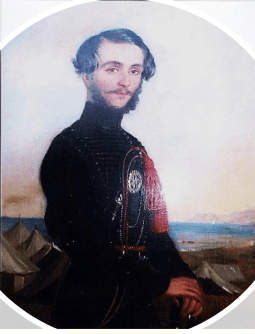
The first to die was William, born in 1824, who was serving as an assistant surgeon at Combaconum, in the Madras Presidency, a post he hardly held a year, in 1846.
Lieutenant Wellington Rose, had he lived, would have likewise been invested with the Victoria Cross; however, at the time, there was no provision for a posthumous VC, but his name would live on in family legend.
“Wellington Rose was the first to scale the walls of Gwalior Fort and to plant the British flag on its ramparts. The feat was warmly cheered, and his kinsman, Sir Hugh Rose, (afterwards Lord Strathnairn), used to relate that he had mentally resolved to recommend the plucky lad for the Victoria Cross for what he had done, when a moment later a fakir was observed stealing up behind him, who levelled his pistol at him, although by this time the fort had capitulated. Poor Wellington Rose was mortally wounded, and he died on June 19, 1858. His brother Arthur died from the effects of excessive fatigue a fortnight later.”
However, as things go, no one had thought to take a flag with them on that day, so the story represented above is more lore than reality. Wellington Rose had just turned 32 on the 18th of June; he was killed two days later; his brother Arthur had been killed at Kaira, Lakhisarai, Bihar, India, nine days earlier, on the 11th.
Major James Rose, the eldest brother of Wellington and Arthur, succeeded to the title of 23rd Baron of Kilravock and fortunately left India before anything untimely could happen. He too served in the Bombay Army following his time at Addiscombe. After the death of his elder half-brother, John Baillie Rose, 22nd of Kilravock, on 20 September 1854, Rose inherited Kilravock Castle and the title, which convinced him to leave the army, while he was still intact. It was hardly the end of the deaths – his youngest brother, Alexander, died in New South Wales in 1891, leaving Major James Rose as the last surviving son of Hugh Rose and with the title, 23rd Baron of Kilravock. It was undoubtedly a legacy to be proud of: the Roses have continuously owned Kilravock Castle ever since they were created Baron of Kilravock by John Balliol in 1293. The legacy continues today.
Sources:
A Genealogical and Heraldic History of the Landed Gentry of Great Britain and Ireland – Sir Bernard Burke (London: Harrison and Sons, 1894)
FIBIS
https://www.familysearch.org/en/tree/pedigree/landscape/9VLW-TLR
https://vcgca.org/our-people/profile/1151/william-francis-frederick-waller
https://www.victoriacross.org.uk/bbwallew.htm
https://fineart.hallsgb.com/auction/lot/lot-77—crimean-war-major-john-bailie-rose-55th-westmoreland-regiment-als/?lot=165755&sd=1
https://www.familysearch.org/en/tree/person/details/9SFJ-V51
https://www.findagrave.com/memorial/7827991/william-francis_frederick-waller
https://thirdwatchprotection.com/wp-content/uploads/2020/11/FAMILY-MEMBERS-THAT-SERVED-IN-THE-MILITARY-CLAN-ROSE-EDITION-2.pdf
 Mutiny Reflections