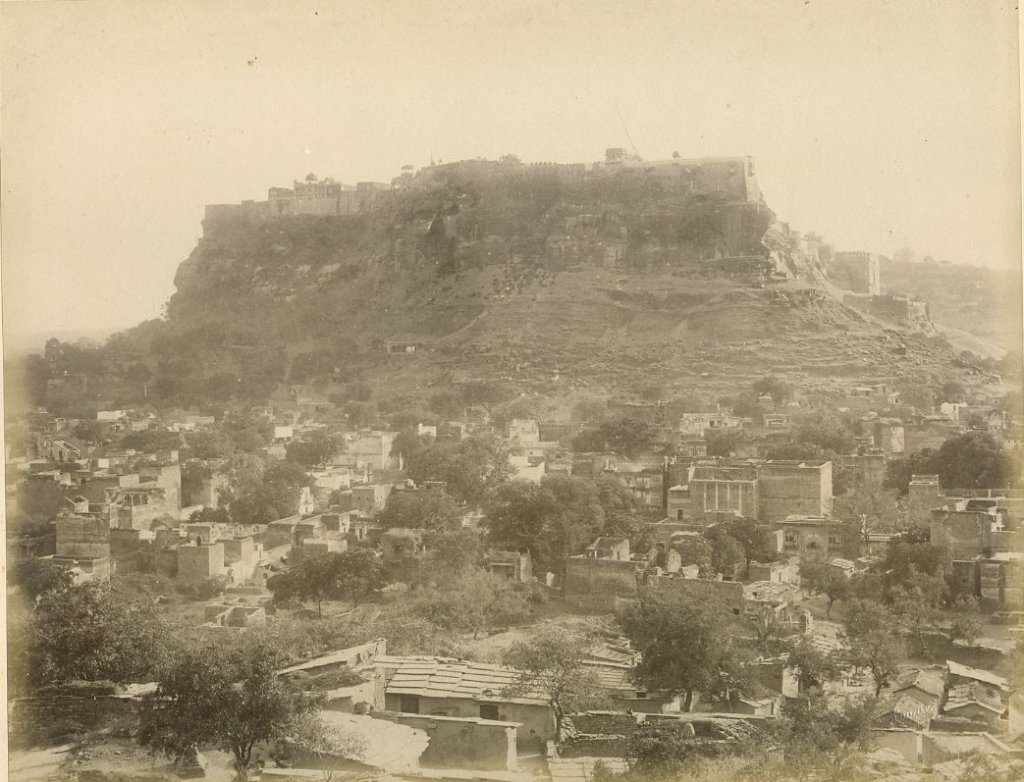
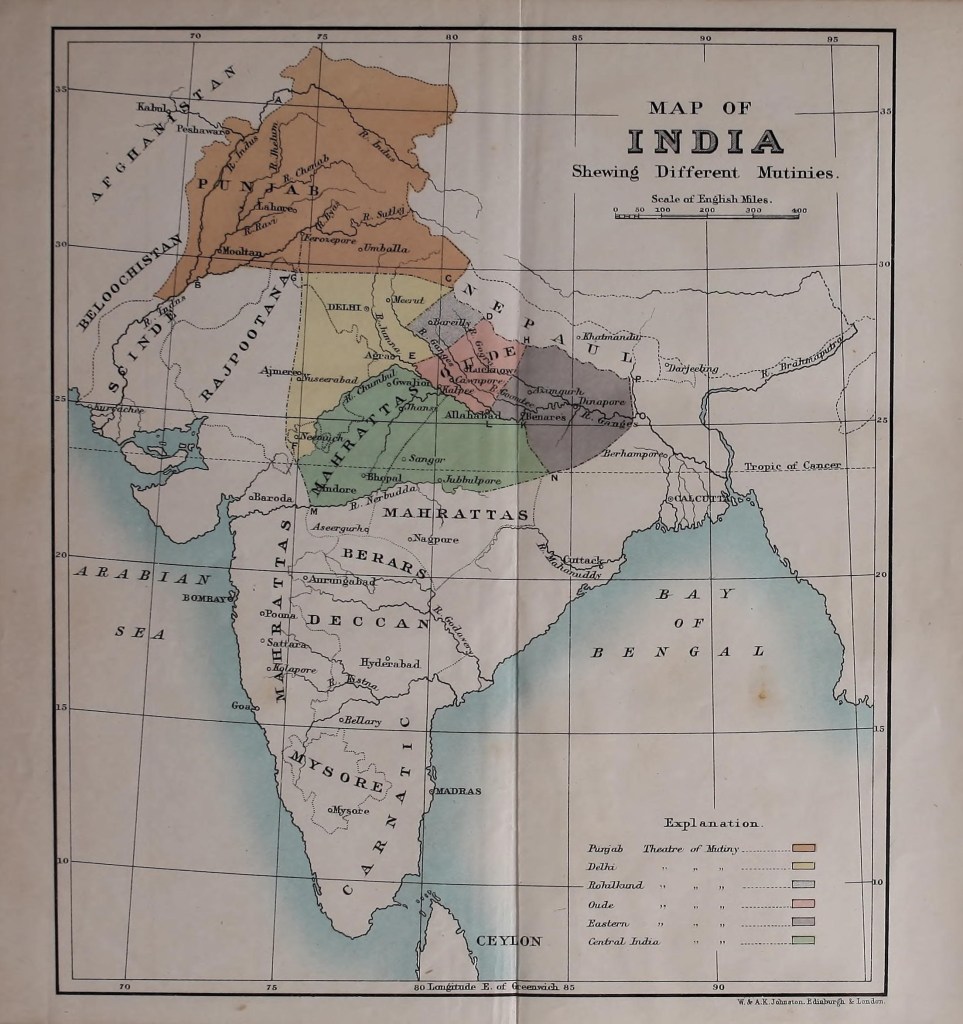
Not for nothing had Lord Canning remarked in one of his dispatches to the Court of Directors, “If Scindia joins the Rebellion, I shall have to pack off tomorrow.” His worries, where Scindia was concerned, were not unfounded. Machinations in his own court, the continued dissatisfaction within his personal troops and bodyguard were issues Scindia would now have to address. However, Dinkar Rao held only so much sway over Scindia, while Major Macpherson still could not leave Agra.
Scindia Loses Control
Scindia had managed for months to ignore not just the threats and flattery of the Contingent before they finally left, and until 1858, the desires of his own troops. He had also disregarded the poor advice from some of his most intimate friends and had stood firm in the eyes of nearly all the chieftains of Gwalior, allowing himself to be guided by Dewan Dinkar Rao and two faithful military chiefs (Mohurgar and Bulwant Rao) while relying much on his own tact and spirit. He had, at great personal risk, succeeded in keeping the Contingent out of the field until September 1857 – but what he still had to face was his own troops. The disbandment of a portion of them would have been advisable, but on this point, Scindia refused.
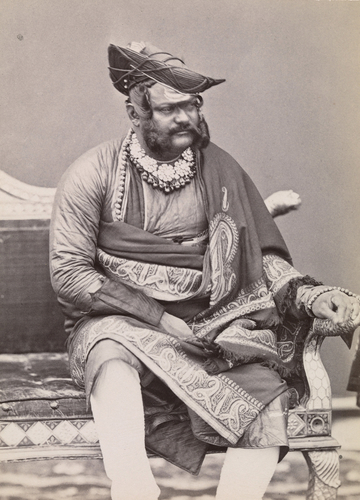
One portion consisted of sepoys from Oudh and other British territories, while the rest were Marathas and men of Gwalior. The former had been cajoled masterfully by both the Dewan and Bulwant Rao to check and baffle not just the Contingent but the rest of Scindia’s troops to prevent them from rising in mutiny. Unfortunately, once the Contingent was gone, Scindia suddenly showed a great reluctance to move against the disloyal men in his own force. He withdrew his confidence from not only his military chiefs but for a moment, stopped listening to Dinkar Rao. Scindia lost hold of his faithful soldiers and transferred his support to some “unworthy favourites,” men whose only desire was to restore the Maratha Empire. Unwittingly, he had become a tool of the rebels.
“At the same time, contemplating the eventual dismissal of his Poorbeahs, he was so unwise as to make his intention known to them, thus withdrawing from them any inducement to adhere to his cause. He completed the list of mistakes by massing his whole force at the capital, where the emissaries and the contagion of the revolt were strongest.”
These new developments drove Macpherson, Political Resident to Gwalior, frantic. Still shut in Agra, there was little he could do but send off letters, imploring anyone who would listen to send a force to Gwalior. In March 1858, he wrote, “‘I have had to write a long letter to Lord C., to try and make him station the European troops of the new Contingent at Gwalior. Our principle should be to place commanding forces at the capital: the districts will take care of themselves. Then I am at my wits’ end for a Gwalior force, I mean one for the Rajah. His force mainly now consists of men from our provinces, who are all, he says, hostile to us, like our own late army. I proposed to supersede them by Mahrattas, not more friendly, but who will wait on Scindia’s will; and Lord Elphinstone objects strongly to this, believing, I presume, that the Mahrattas want only the Nana Saheb anybody but us: the sign whereof is the offer of a lac of rupees for his capture. I am considerably anxious as to the effect of Nana coming to Gwalior. Till Jhansi and Calpee shall fall, it must be highly disturbed. The people there don’t at all believe that Lucknow is fallen or that we have a big army; or why do we leave Calpee so long alone? They believe that we are hard pressed, though victorious, and say it is their own policy to fly and renew the fight so as to wear us out in the hot weather and rains.’
The tone of the letter is unmistakable – Macpherson knew Scindia would not hold out much longer without British help. When Macpherson was able to finally leave Agra, he hastened to meet Sir Robert Hamilton in Sir Hugh Rose’s camp after Kalpi fell. Scindia sincerely felt he could not receive Macpherson, he said, unless he came with an escort of Europeans. Sir Hugh Rose was willing to listen to what Macpherson had to say about Gwalior and perceived the necessity to send troops hither without delay, but the efforts were for nought. The following letter is written from Kalpi on the 1st of June 1858:
“The rebels have next invaded Gwalior, while the force to go there in support of Scindia is still here, for want of orders from the Governor-General; but Sir Hugh Rose has ordered it off tomorrow, at our request. I am in deep anxiety. A rebel mass from Bareilly and Calpee is twenty-four miles from Gwalior, and Scindia has sent out two regiments and eighteen guns and a thousand horse to meet them. If they beat that force, Gwalior is theirs, there being infinite treachery within it. We have, it is true, a small pursuing force within five marches of their rear, quite enough, I think, to meet them separately, or to co-operate with Scindia’s, but not to command both the enemy and Scindia’s men, which we desire to do. …
The monsoon threatens to overtake and paralyse us, and for want of an order to march a week ago, all my Gwalior work may be ruined. About Amaen were posted, when the rebels crossed, 400 of Scindia’s foot, 150 horse, and 4 guns. Scindia’s civil officer told the Rao Saheb, ‘ It is the order of the Maharajah and the Dewan that you retire.’ ‘ And who,’ replied the Rao Saheb, ‘are you? A ten-rupee underling of a Soobah, drunk with bhang, and who are the Maharajah and Dinkur Rao? Christians! We are the Rao and Peishwa. Scindia is our slipper-bearer. We gave him his kingdom. His army has joined us. We have letters from the Baiza Bai. Scindia himself encourages us. Tantea Tope has visited Gwalior and ascertained all. He having completed everything, I am for the Lushkur. Would you fight with us? All is mine.’ Scindia’s detachment did not attempt resistance. Advancing with such boastful words, and affecting to send letters to Scindia requiring his submission, the Rao Saheb paraded his troops, under 5,000 in all, and marched to Burragaon, eight miles from Gwalior.”
Although all of Scindia’s forces had been brought, more or less, to sympathise with the rebels, there was still a portion that had sufficient motivation to strike against them in Scindia’s name. Dinkar Rao remained confident – with the small force detached by Hugh Rose behind them, the rebels might be divided by bribery to turn on each other; while a select body of Scandia’s Gwalior and Mahrati men if posted far enough in the advance while holding the others back, would be able to check the rebels for a few days, while the British caught up.
On the morning of 31 May, Scindia was convinced by his bodyguard and household officers, all of whom were rebel sympathisers, to move 8000 men and 24 guns to Morar to supposedly disperse the rebels. However, by evening, Dinkar Rao had managed to persuade Scindia to go home, leaving only a token portion of his troops in Morar. Yet by midnight, Scindia was at it again. Dinkar Rao had left his side for a moment, and Scindia decided to move his troops out. A short, mock fight followed, and Scindia could only watch as his supposedly loyal troops now openly fraternised with the rebels. He was left with only one choice – flee to Dholpur.
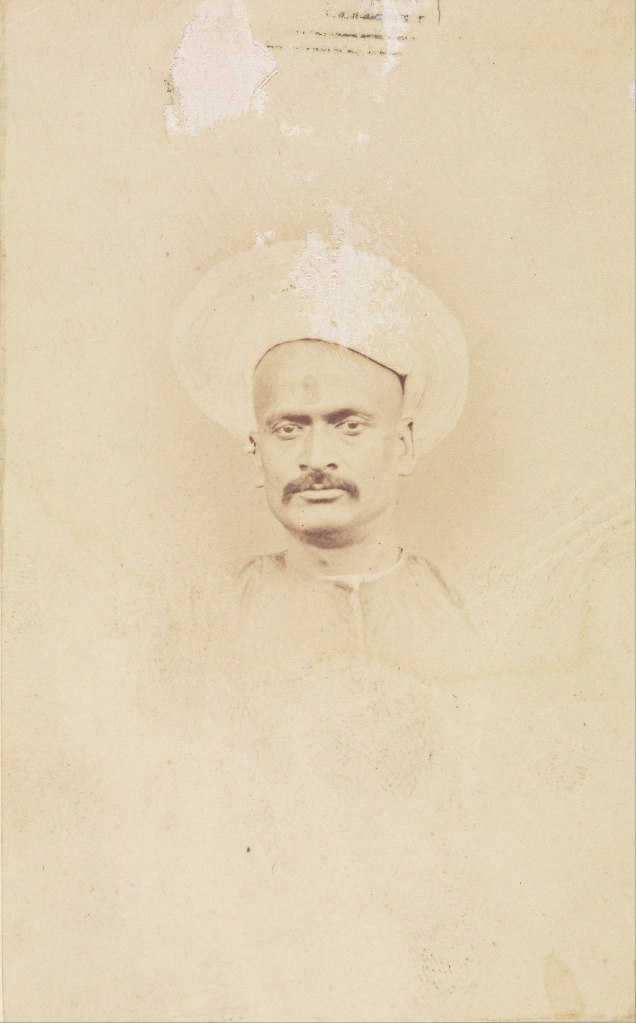
Dinkar Rao, another gentleman and some troopers attended Scindia in his flight, and he was joined by a few others shortly before he began his journey to Agra. His wife and female relatives – the Ranis – accompanied by some officers of the household and a few cavalry troopers, went to the fort in Narwar, three miles away. One of them, the mother of the Maharani, the formidable Bazia Bai, believing Scindia was beleaguered in the Phool Bagh palace and gardens, seized a sword, mounted her horse and rode to the palace, summoning all to her aid to save Scindia. When she arrived, she found he had gone, but she stayed another three days before finally joining the other ladies.
None of Scindia’s new, pampered favourites followed him on his flight and nor did they join the Ranis. They had truly been bought by the devices of Tantia Tope and gladly accepted not just pay from the rebels but various other gratuities, ranks and offices. Scindia had been duped out of his own throne, and with a few exceptions, the population of Gwalior appeared to agree with the new regime. Of course, it would have been better if Scindia had stayed.
A newly appointed Dewan styled Scindia was quickly described as” a deeply-fixed root of the Nazerenes and strong striver of their cause…” nothing more than a base traitor to his people. Nana Sahib (Rao Saheb) was now the new ruler of Gwalior, but the appointment did not make him very happy. It would have been so much better if Scindia had been won over to the cause instead of now languishing in exile in Agra, neither vanquished nor bought. Nana Sahib tried to convince Bazia Bai (the third wife of the deceased Daulat Rao) to take the throne, but she refused and sent his letters to Sir Robert Hamilton instead to inform him. Nana Sahib did manage to prevent the sacking of Gwalior by the troops; he confiscated the houses of Dinkar Rao, Bulwant Rao and Mohurghar; he confined any remaining officials who were loyal to Scindia and disbursed to Scindia’s troops and to his own a mass of treasure, buying for a time their loyalty. The Fort fell without any resistance, and Scindia’s palace and Macpherson’s house were destroyed. The rebel army under Tantia Tope and Rani of Jhansi had not only taken Gwalior, but they now had access to not only Scindia’s armoury, and above all, his nearly limitless treasury. As such, feeling secure in their new position, the rebels started to form their new government. The Nana Sahib was declared Peshwa, and his nephew, Rao Sahib, was appointed the governor of Gwalior. Four Maratha chiefs, who had been imprisoned by Scindia, were released, given honorary titles and fancy clothes before being sent off into the district to raise troops to prevent the British from crossing the Chambal. At Gwalior, the bulk of the force remained encamped outside the city and was placed under the command of the Rani, while those in the town obeyed Tantia Tope. Letters were quickly sent off to the rajas of Banpur and Shahgarh, to pull themselves together and make their way to Gwalior. With all of Scindia’s property now confiscated, the Gwalior Contingent troops received hefty rewards for their services, as did the troops who had escaped Kalpi.
They had added Scindia’s personal force to their army, and now that the monsoons were starting, they knew the British would find marching in the relentless heat and torrential rain extremely unpleasant.
The News Spreads
The disbanding of the Central India Field Force had been the doing of Sir Colin Campbell, Commander-in-Chief in India. Without any knowledge of what Scindia was up to, this seemed the most logical option – the force could be used to garrison Jhansi, a portion would be sent off to Neemuch and Nasirabad, and the Hyderabad Contingent Field Force would be sent home to the Deccan. Sir Hugh Rose had met all of his objectives and received well-deserved thanks from the Government. No one expected, at this juncture, their staunchest ally, Scindia of Gwalior, would go ahead and embarrass himself.
The news of the fall of Gwalior reached Kalpi on 3 June. Sir Hugh Rose had been vigilant, and as we have seen, after Kalpi was taken, he had sent out parties in different directions to track the rebel movements. Information reached him swiftly that whilst a few had indeed crossed the Yamuna and were headed into the Doab, and a few more had been checked in their attempt by Colonel Riddell, who had been moving down the north bank of the river with a Bengal Column escorting siege guns from Agra to Gwalior. With the 3rd Bengal Europeans, Alexander’s Horse and 300 Sikh Infantry and two guns, he caught up with them a few miles out of Kalpi on 25 May. The 3rd Europeans crossed the river, but as the rebels fled in their wake, they simply captured their camp. Colonel Riddell had had a few minor skirmishes with the detached parties of insurgents already – a small party of his troops had been on their way to Kalpi in boats when they were attacked by large parties near Bhijalpur. Lieutenant Sherriff, who commanded the party, did not wait for ceremony. He immediately landed 150 men who not only defeated the insurgents but took four of their guns to boot.
The main body of rebels was heading to Gopalpur, towards the southwest, and these were tracked by Colonel Robertson with the 25th Bombay NI, the 3rd Bombay Light Cavalry and 150 men of the Hyderabad Contingent Cavalry.
“Robertson set out from Kalpi on the 25th of May, the rain falling heavily. This rain continued throughout that day and the day following, much impeded his progress. He pushed on, however, as fast as possible, and traversing Mahona and Indurki, found that the rebels were but little in advance of him. At Irawan, reached on the 29th, supplies ran short, and as none were procurable in the district, the column had to wait till they could be sent up from Kalpi. On the 2nd of June, Robertson received these and was joined by two squadrons of the 14th light dragoons, a wing of the 86th foot, and four 9-pounders. The following day, he reached Moharar, fifty-five miles from Gwalior. Here he was startled by information of the attack made by the rebels on Gwalior and of its result.” His first despatch on 1 June to Rose intimated that the rebels were in fact headed for Gwalior. With a moment to lose, Rose sent General Stuart and the remainder of his brigade, consisting of the other wing of the 86th, a wing of the 71st Highlanders, four companies of the 25th Bombay NI, one squadron of the 14th Light Dragoons, No. 4 Light Field Battery, two 18-pounders, one 8-inch howitzer and some sappers to join Robertson. They were to march on Gwalior. Stuart reached Attakona on 3 June, the same day Robertson reached Moharar, and here he was apprised that Gwalior had fallen.
“The order which had sent Stuart to Gwalior was dictated by a sound military instinct. But no one, not even Sir Hugh Rose, had imagined the height of daring to which the Rani of Jhansi would carry her audacious plans. The rebels might march on Gwalior, but no one believed they would carry it by a coup-de-main. It seemed more likely that they were marching into a trap, to be kept there till Stuart’s force should fall on their rear.”
And now, Sir Hugh Rose would be forced to act to prevent a calamity, but it was 4 June, he had his medical certificate in hand, and had just resigned his command of the Central India Field Force.
Sir Hugh Rose Re-Enters the Fray
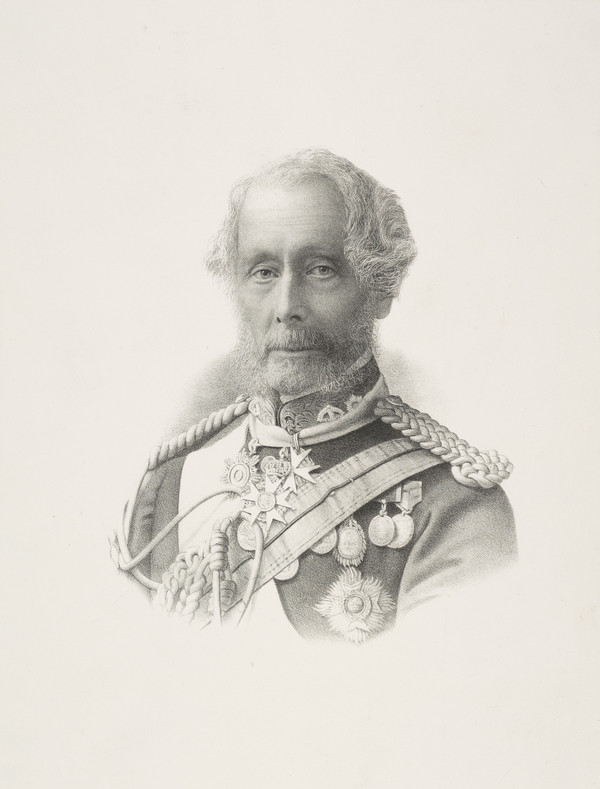
Sir Hugh Rose desperately needed to rest. The campaign had tired his already frail constitution to near breaking point, but he understood the implications of the loss of Gwalior to rebel hands. The time of year could not have been worse – within a week, the monsoon would start in earnest, replacing parched ground and low rivers with impassable mud and raging torrents. Without pontoons, transporting siege guns would become well nigh impossible – but this was far from his only worry. Transport could be managed, but any delay in advancing on Gwalior would mean the rebels were one step closer to provoking a Maratha uprising. They could, in all likelihood, with their Gwalior reinforcements and, with cash at hand, march with ease to the Southern Maratha Territory, which had been all but emptied of troops. It was feared that Tope had enough clout to persuade the Deccan to follow if he showed up at their doors with a large enough army, and the inhabitants of Indore would most likely have followed the example set by him at Gwalior and sent Holkar packing. With the Peshwa’s banner unfurled before them, who was to say the local population of the Deccan and their chieftains would not follow Tantia Tope piecemeal and begin another Maratha War.
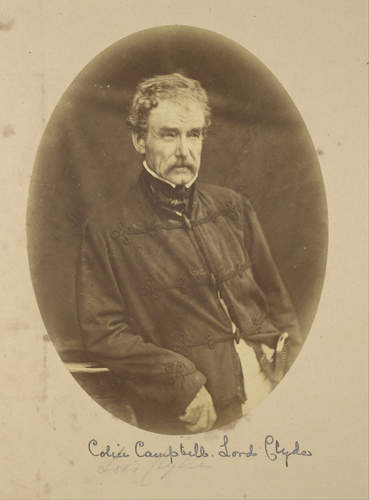
With this in mind, Sir Hugh Rose put aside his medical certificate and volunteered his services. He was the only commander in the area with the experience needed to take on the rebels of Central India, and considering he had been fighting them for six months, it made little sense to send anyone in his place. The decision was hailed as the right one, both from the government and the Governor-General, Lord Canning; however, Sir Colin Campbell, who had just completed his Rohilkhand Campaign, was beside himself with fury. Sir Hugh Rose had not asked Campbell’s opinion or indeed his permission; as C-in-C of India, it would have been Campbell’s decision as to who would lead the new field force. It was further rumoured that Sir Colin, though not displeased with Rose’s work, was jealous of all he had achieved in such a short time. In future events, he deliberately throttled the force’s prize money, including what should have gone to Sir Hugh Rose, while securing himself a hefty payout for a campaign he did not fight and supposedly quashing VC nominations for the Central India Field Force. What was well known was that Sir Colin was prejudiced towards Highland regiments, particularly the 93rd, whom he sought to put in the forefront at every opportunity. They had played no part in the Central India Campaign, which, to some extent, did not allow Sir Colin to appreciate the outstanding qualities of the Central India Field Force. He also felt Rose, by being so forward in volunteering, undermined Sir Colin Campbell as C-in-C. As such, he sent Sir Hugh Rose a fire and brimstone reprimand, before concurring, as any good commander would, that Sir Hugh was right and he would support him as best as he could. There was some reason behind his rancour: on hearing of Rose’s intent to proceed home on sick leave, he had already promised his position to someone else – Robert Napier, who had entered the mutiny at the behest of Sir James Outram back in 1857. Napier was considered not only the finest engineer in India, but the bravest of men – and now, Sir Colin Campbell detached him from his work at Lucknow and sent him to Central India.
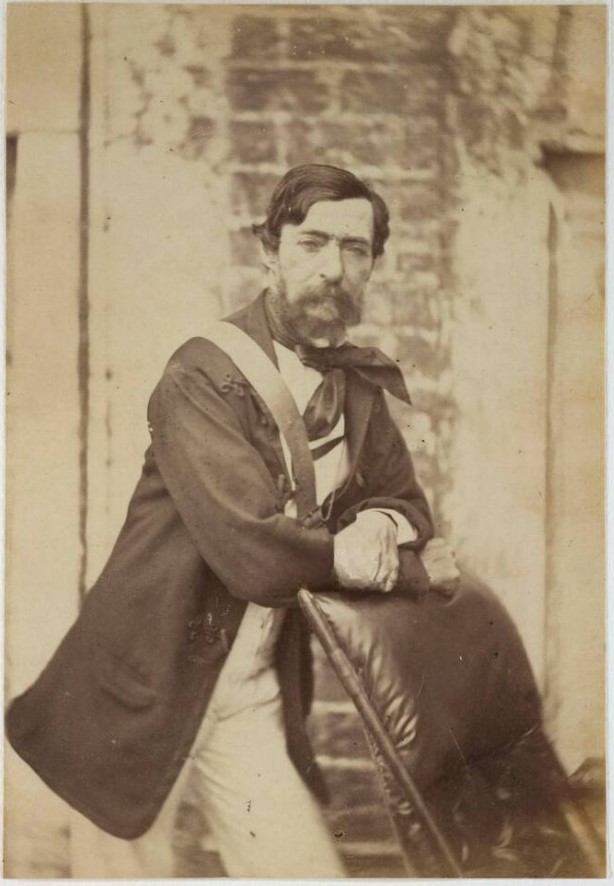
However, Sir Hugh Rose had nobly taken back his command, and Campbell was now sending Napier where he had intended, but without the command of the field force, somewhat to Campbell’s embarrassment.
The orders somewhat surprised Napier, who was still busy improving the defensive capabilities of Lucknow. He had already refused Campbell’s offer of the position of Quartermaster General for India, but what came now he could rightly turn his back on, since it came from the government itself, at Campbell’s behest.
“Colonel Napier will proceed with the utmost expedition to assume the command of the Troops marching upon Gwalior. He will have the rank of Brigadier-General. These troops are advancing in two bodies from Culpee and will, it is hoped, be joined by a Brigade detached from General Roberts ‘ late Rajputana Field Force, from the side of Sipree.
Colonel Napier will learn the latest details of their movements as he passes through Culpee. The object which he has before him is to recover Gwalior from the mutinous troops of Sindia, who, by the last accounts, are in possession of the City and Fort. He will bear in mind that the interests of the British Government and of the Maharajah are in every respect identical. It is most important that a blow should be struck speedily and before the mutineers are able to establish themselves in the Fort in strength and to collect supplies which may enable them to make a protracted resistance. Brigadier Napier will find the Governor-General’s Agent Sir R. Hamilton and the Political Agent of Gwalior, Major Macpherson, attached to the Force which is moving forward. …The Divisional Staff of Sir Hugh Rose has received orders from the Commander-in-Chief to remain with the Force.” (Secretary to the Government of India, Military Department, at Allahabad, 5th June, 1858)<
Instead of being put out by this sudden loss of command, Napier, a generous and honourable soldier, professed himself to Lord Canning as delighted to serve as Rose’s second in command, and for his part, Rose was most pleased to accept the services of such an able officer.
The Advance on Gwalior
As we have seen, with the taking of Kalpi, the Central India Field Force had, in effect, ceased to exist. However, with this new and unexpected development, it was called back to life.
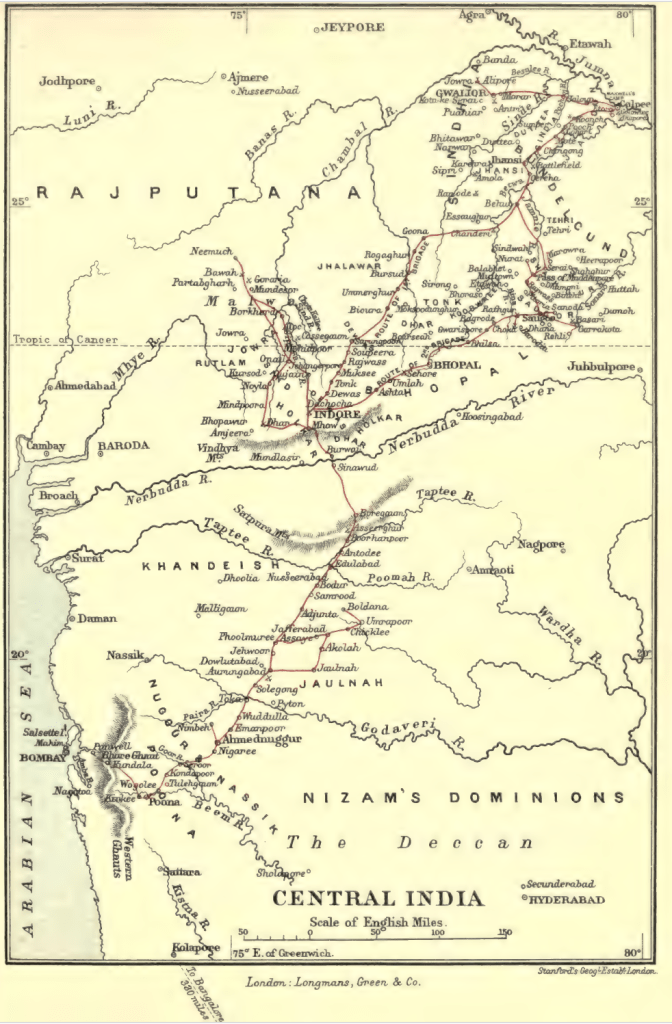
As it would have been foolhardy, at this juncture, to remove troops from Jhansi or to leave Kalpi undefended, the force Sir Hugh Rose now organised was but a sliver of the original field force. He marched on 6 June towards Gwalior with:
1st Troop, Bombay Horse Artillery
1 Squadron, 14th Light Dragoons
1 Squadron, 3rd Bombay Light Cavalry
Madras Sappers and Miners.
The remainder, consisting of Captain Ommaney’s Royal Artillery battery of 9-pounders, one troop 3rd Bombay Cavalry, 21st Company Royal Engineers, one wing, 3rd Europeans, and 400 men of the 24th Bombay Infantry, were to remain at Kalpi until relieved by Bengal troops. He also sent word to Major Orr of the Hyderabad Contingent Field Force, requesting a renewal of their services. Orr put the proposal to his men – they were under no obligation to turn from their road home, as they were, essentially on loan from the Hyderabad State; however, one and all they “expressed their earnest desire to take part in the operations of the old commander.”
Sir Hugh Rose sent out despatches to Orr, Stuart and Riddell – his plan was as follows:
Major Orr was to move to Paniar, on the road between Sipri and Gwalior, to cut off any rebels who might be heading south; Brigadier Smith and the Rajputana Field Brigade were to march on to Kotah-ki-Serai, five miles south-east of Gwalior, and Colonel Riddell was to proceed with his siege guns along the Agra-Gwalior Road. He expected they would all be in place no later than the 19th of June.
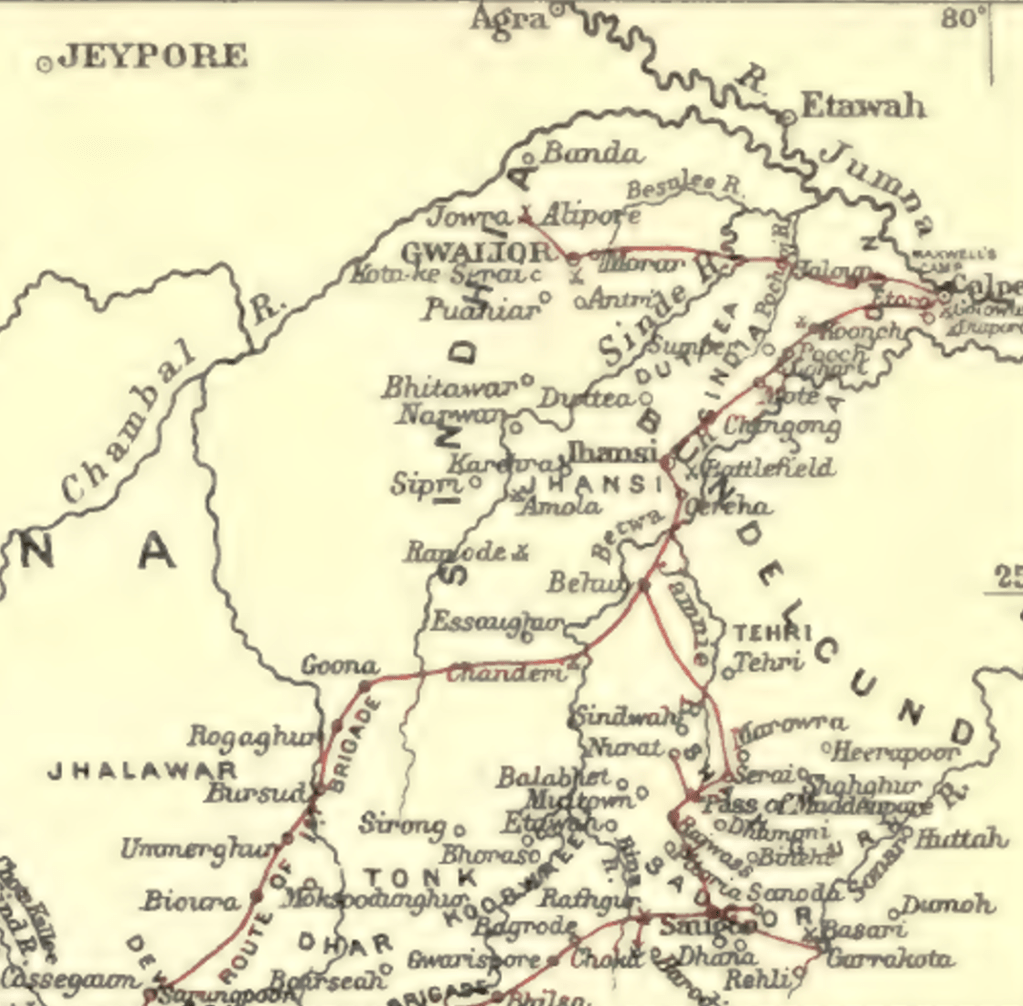
Another troop would also be on the march, but they were coming from Agra, and they would leave the marble fort on 13 June – Meade’s Horse, who, in later life, would form the nucleus of the Central India Horse. Their duty was no less warlike, but it was essentially to serve as an escort to Scindia of Gwalior, who would be summoned to return to his state. It was a curious homecoming for Richard Meade – he had been chased out of Gwalior nearly a year to the day, where, until the outbreak of the mutiny there on 14 June, he had been serving as Brigade Major of the Gwalior Contingent.
Making good his escape to Agra with the other Gwalior fugitives, Meade found life in the fort, with the bickering civilians and panicked population, onerous, to say the least. He had been relegated to the position of “doing duty officer,” available for any kind of service required, but with no definite military duties. It would not be until the end of November 1857 that Meade received instructions from the Government of India to raise a regiment of native cavalry for general service. One of the men helping him in his task was Sergeant Henry Hartigan, VC, of the 9th Lancers, famed for his actions at Badli-ki-Serai and Agra.
“He set to work at once con amore, but the task was somewhat arduous, for trustworthy recruits were not to be had in the vicinity, while those whose loyalty was satisfactory were, as a rule, entirely innocent of the art of riding. However, by dint of incessant labour and his personal popularity with native races, he was able, in a little more than two months’ time, to get together and prepare for service a cavalry regiment nearly 600 strong. It was what is technically known as a “class” regiment, that is, a regiment in which each troop is composed of men of distinctive castes or nationalities. Thus, of the six troops composing Meade’s regiment, one troop consisted of Sikhs, another of Punjabi Muhammadans, another of Jats, another of native Christians; the fifth was a troop of Gwalior men under the command of Gopal Singh, brother of the loyal Thakor Baldeo Singh, who had befriended the fugitives at the river Chambal, and the sixth a troop of mixed races. The regiment was under the command of Captain Meade with six English officers selected by himself, and when inspected by Brigadier-General Showers in March 1858, was declared to be “as fine a body of native cavalry as he had ever seen.“
Between January and June 1858, Meade’s Horse was constantly employed in maintaining order in the Agra district, and now, they too, were on their way to Gwalior.
Sir Hugh Rose was anxious, due to the heat, to avoid a siege; he was further hampered by having no valid information about Gwalior itself. It was rumoured the cantonments were brimming with insurgents, some 17’000 in number, how many were in the fort or the city was a matter of speculation. As things were, he was hoping that when he arrived at Gwalior, he would still have enough left of his force to fight with.
To meet the rendezvous, Rose, like Stuart and Orr, was proceeding by forced marches. Although Rose insisted the night hours were taken full advantage of to cover the distance, he could do nothing against the heat during the day. The closer Gwalior came, the worse the temperatures, undoubtedly solidifying its name as the hottest place in India. On one day, the temperature rose to an unbearable 130° F in the shade, and by the night of the third day’s marching, the Dragoons at an outlying picket fell from the saddles from exhaustion, needing to be relieved by the Hyderabad Contingent. It was hard going for everyone, but Mrs Duberly was determined to complain as much as a lady was wont to do as she rode with Smith’s Column – “my strength is gone”, she wrote morosely when the temperature in her tent went up to 108°F, “I am unequal to any effort or fatigue, and look with absolute dread upon the horses, knowing I shall be compelled to ride them, however unfit I may be.” Her husband had sprained his ankle, and the doctor, obviously less enlightened than the specimens of Lowe and Sylvester, was treating the sprain with an abundance of leeches, adding substantially to the man’s already weakened state. For some reason unknown, the 8th Hussars were not dressed for India – they were in stable jackets, cloth overalls and forage caps, and still had sheepskins on their saddles; the 95th were dressed just as badly, and if things could not get any worse, the 14th Dragoons were told off for wanting to remove their buttoned up, in thick woollen tunics as their commander believed leaving his men “stifling, sweltering, gasping and not half so effective,” in front of the enemy, was still better than appearing unsoldierly. Many deaths from sunstroke could undeniably have been prevented if anyone had considered what the men were wearing, but amid the campaign, no one was looking for tailors.
Others bore their labours with no complaints at all.
“I cannot help avoid giving a word of praise to two classes of hard-worked followers, without whose assistance we should have been awkwardly placed, and who faithfully served us during the whole of the arduous campaign. These were the bheestie-wallahs and the dhoolie-bearers. The former, whether on the line of march, or in front of the enemy, were sure to be in attendance, and contributed greatly to our comfort, by moistening our parched lips with a timely drink of water, or pouring the cooling liquid over our burning heads and down our bosoms; the hot winds blowing through our wet clothes, giving such a sense of coolness and exquisite pleasure—even if only temporary—impossible to describe. If water was to be had, there the bheesties were with it, no matter what the risk. The dhoolie bearers, too, were always close up to the column, ready to bear off a wounded or sun-struck man, and often running the risk of being shot in doing so. These two classes of men must have had pretty hard times of it, as the hotter the weather, or the more sick and wounded there were, the harder became their work—in fact, their work was never done; and they ran almost as much danger of being killed as we did, as they were often under fire, and never shrank from their work. I think these poor fellows got medals; if they did not, they ought to have got them, for they richly deserved them.” (Stent)
If the heat was not bad enough, the transport carts provided to Rose’s force, as that of Stuart, were of bad make and were increasingly finding it hard to keep up. They routinely threw their wheels, and when things could not possibly get worse, became mired down in a deep nullah. While the force marched on, the 25th Bombay Infantry, guarding the baggage, was thus deprived of food for three days. Horrified, Stuart ordered the men to be allowed to bathe in the river and take a rest: they procured enough flour for their chapatis and, after eating this very sparse meal, were ready to march again.
It took ten days of hard marching for Sir Hugh Rose to reach Bahadurpur, where Scindia had recently met his defeat, for the final chapter of Gwalior to begin.
Sources:
The Revolt in Central India 1857-59, Compiled in the Intelligence Branch (Simla: Government Monotype Press, 1908)
Bulletins and Other State Intelligence for the Year 1858, Vol II – T.L. Behan (Harrison & Son, London Gazette Office, 1860)
Rulers of India – Clyde and Strathnairn – Maj.Gen. Sir Owen Tudor Burne KCSI (Oxford: Clarendon Press, 1892)
A History of the Hyderabad Contingent – Major Reginald George Burton (Calcutta: The Office of the Superintendent of Government Printing, India, 1905)
Campaigning Experiences in Rajpootana and Central India during the Suppression of the Mutiny, 1857-58 – Mrs. Henry Duberly (London: Smith, Elder & Co., 1859)
A History of the Indian Mutiny, Vol III – G.W. Forrest (London: William Blackwood and Sons, 1912)
Selections of Letters, Despatches and other State Papers Preserved in the Military Department of the Government of India 1857-58, Vol IV – edited by George W. Forrest (Calcutta: Superintendent Government Printing India, 1912)
Historical Record of the 14th (King’s) Hussars from 1715 to 1900 – Col. Henry Blackburne Hamilton (London: Longmans, Green & Co., 1901)
A History of the Indian Mutiny – T. Rice Holmes (London: Macmillan & Co., 1904)
Central India during the Rebellion of 1857-1858 – Thomas Lowe (London: Longman, Green, Longman & Roberts, 1860)
History of the Royal Irish Rifles – Lt. Col. George Brenton Laurie (London: Gale & Polden, 1914)
History of the Indian Mutiny, commencing from the close of the 2nd Volume of Sir John Kaye’s History of the Sepoy War, Vol. III – Col. G.B. Malleson (London: W.H. Allen & Co., 1888)
Field-Marshal Lord Napier of Magdala, GCB, GCSI; A Memoir – Lt.Col. Hon. H.D. Napier (London: Edward Arnold, 1927)
The 95th (The Derbyshire) Regiment in Central India – General Sir Julius Raines, KCB (London: Swan Sonnenschein & Co., 1900)
The Rebellious Rani – Brigadier Sir John Smyth (London: Frederick Muller Ltd, 1966)
Scraps from My Sabretasche, Being Personal Adventures While in the 14th (King’s Light) Dragoons – George Carter Stent (London: W.H. Allen &Co., 1882)
Recollections of the Campaign in Malwa and Central India under Major General Sir Hugh Rose – Asst. Surgeon John Henry Sylvester (Bombay: Smith, Taylor & Co., 1860)
King George’s Own Central India Horse: The Story of a Local Corps – Maj.Gen. W.A. Watson (London: William Blackwood & Sons Ltd., 1930)
 Mutiny Reflections