Leaving the Entrenchment
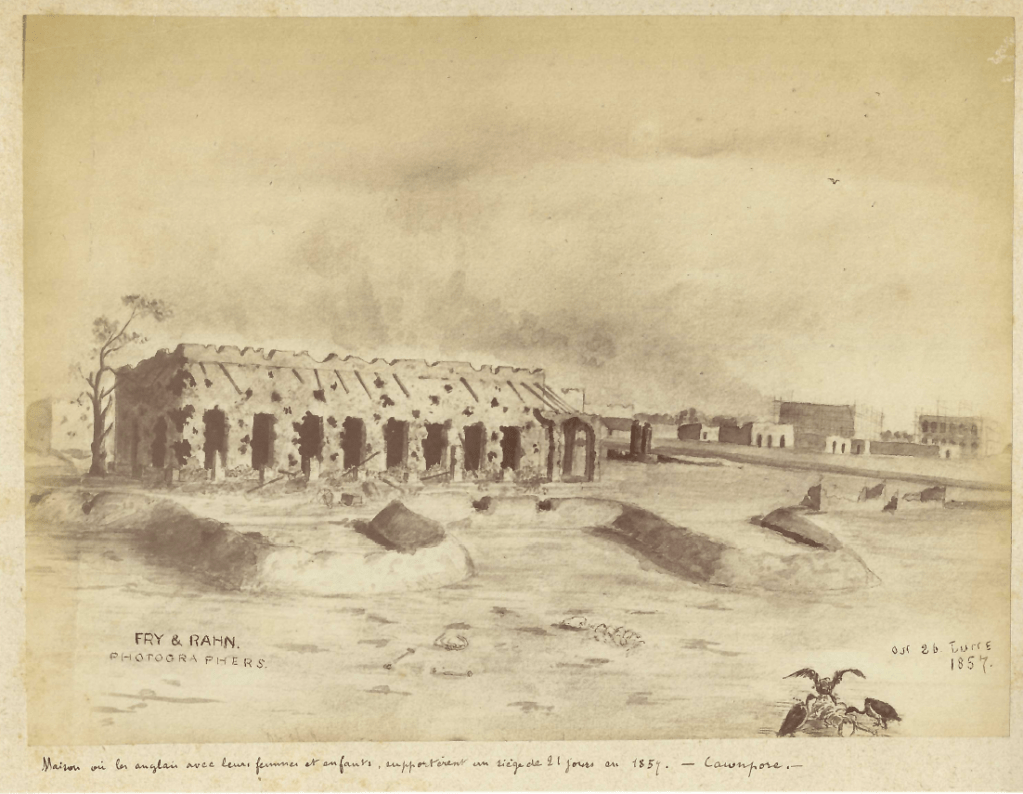
“It was a truly strange spectacle which the opening morning of the 27th of June brought within the intrenchment. All the activities of departure were manifest on every side. Men and women were loading themselves with what each thought most precious. Hurried words of sympathy were uttered to the wounded, and many a hearty declaration given that, at all hazards, they should not be left behind. Some had much that they wished to carry away, some had nothing. The time for deliberation was short, and the power to carry waslimited indeed. Little relics of jewellery were secreted by some in the tattered fragments of their dress. A few were busily occupied in digging up boxes from the ruins of the building, the said boxes containing plate and other valuables. Some cherished a Bible or a Prayer-book; others bestowed all their care upon the heirlooms which the dead had entrusted to their keeping, to be transferred to survivors at home. The able-bodied men packed them¬ selves with all the ammunition which they could carry, till they were walking magazines.“
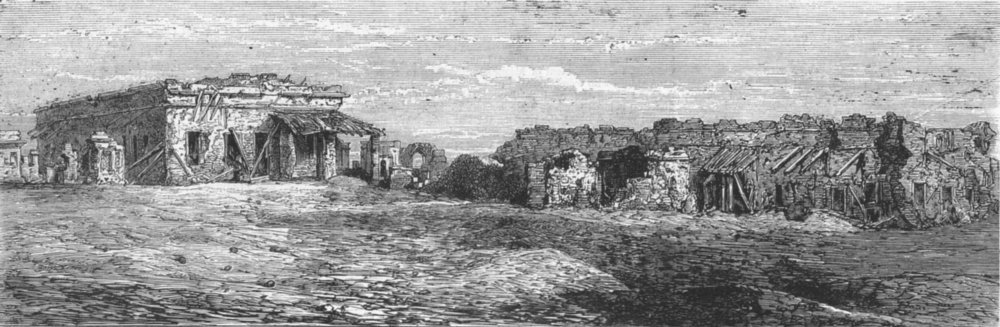
“Not a few looked down that well, and thought of the treasures consigned to its keeping. Some would have fain been amongst them even there. Here a party paced the outside of the barrack-wall, and gazed at the brickwork, all honeycombed with shot. There a little group lent kindly aid to bind up and secure the clothing that could scarcely be made to hold together.“
“After an hour or two of this busy traffic, the elephants and palanquins made their appearance at Ashe’s battery. Water was the only cordial we could give to the wounded, but this they eagerly and copiously drank. No rations were served out before starting, nor was any ceremony or religious service of any kind observed. Sixteen elephants and between seventy and eighty palanquins composed the van of the mournful procession, and more than two hundred sufferers had thus to be conveyed down to the river. The advance-guard, consisting of some men of the 32d Regiment, led by Captain Moore, had to return for a second instalment of those who were unable to walk the single mile to the ghaut. Not a sepoy accompanied us; we loaded and unloaded the burdens ourselves, and the most cautious handling caused much agony to our disabled ones.”
“The women and children were put on the elephants, and into bullock carts; the able-bodied walked down indiscriminately, after the advance had gone. Immediately after the exit of the first detachment, the place was thronged with sepoys. One of them said to one of our men, “ Give me that musket,” placing his hand upon the weapon, as if about to take it. “ You shall have its contents, if you please, but not the gun,” was the reply; the proposal not having been accepted, the insulted Briton walked off: it was the only semblance of an interruption to our departure.”
As they walked, sepoys came up to the men, and loudly expressed their surprise that the British had held out so long; Thomson informed one had the food not given out, they would have carried on fighting. A sepoy who had once served in his regiment, the 53rd, quietly told him their losses had been terrible and claimed the British had killed 800 of their number, something Thomson disbelieved. All along the road, sepoys approached the men; some inquired about the fates of their officers and were visibly distressed when they were told their officers were dead. Thomson asked if it was true they were to be allowed to go to Allahabad unmolested; the sepoy nodded, and Thomson believed him. In hindsight, he would write, “He affirmed that such was his firm belief; and I do not suppose that the contemplated massacre had been divulged beyond the councils of its brutal projectors.”
But the Nana Sahib had no intention of allowing the garrison to leave Cawnpore. Whether the decision to murder them was his alone or if he had been unduly influenced by others is disputed, depending on which account one reads. That discussion is left to others and has no place in this writing. Ultimately, he was the leader of the rebels, and it was his voice they listened to, so the burden of the killings can be placed squarely on his shoulders.
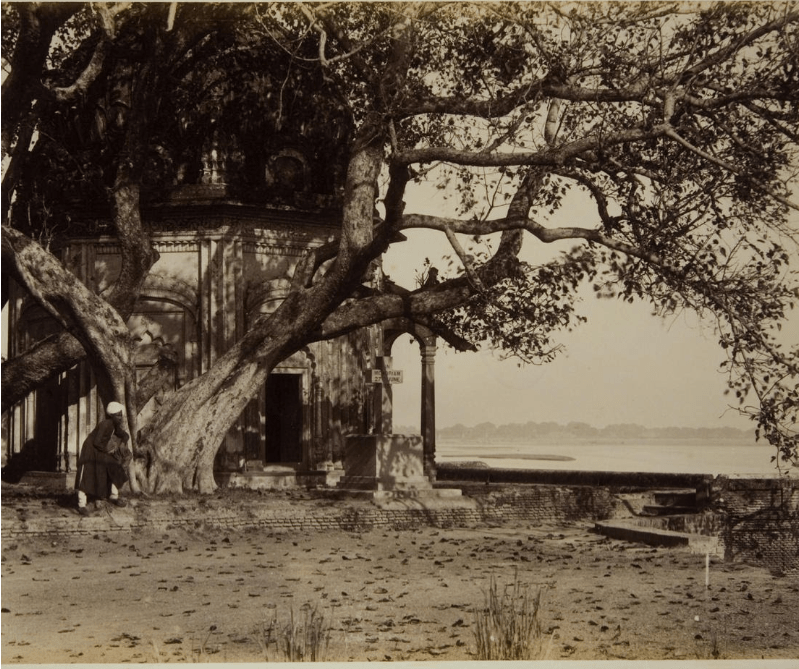
Before long, the men, women and children arrived at Satichaura Ghat. The shores were lined with thousands of people, curiously watching the spectacle; and from his viewing pedestal, specially constructed for the occasion, sat the Nana Sahib, Tantya Tope, Azimullah Khan and Jawad Prashad.
Satichaura Ghat
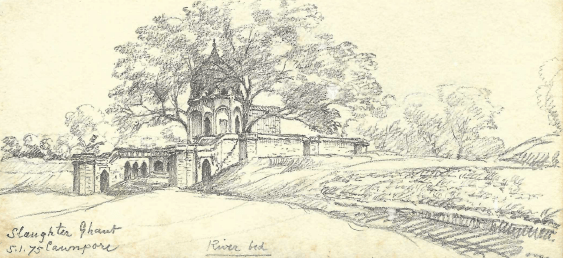
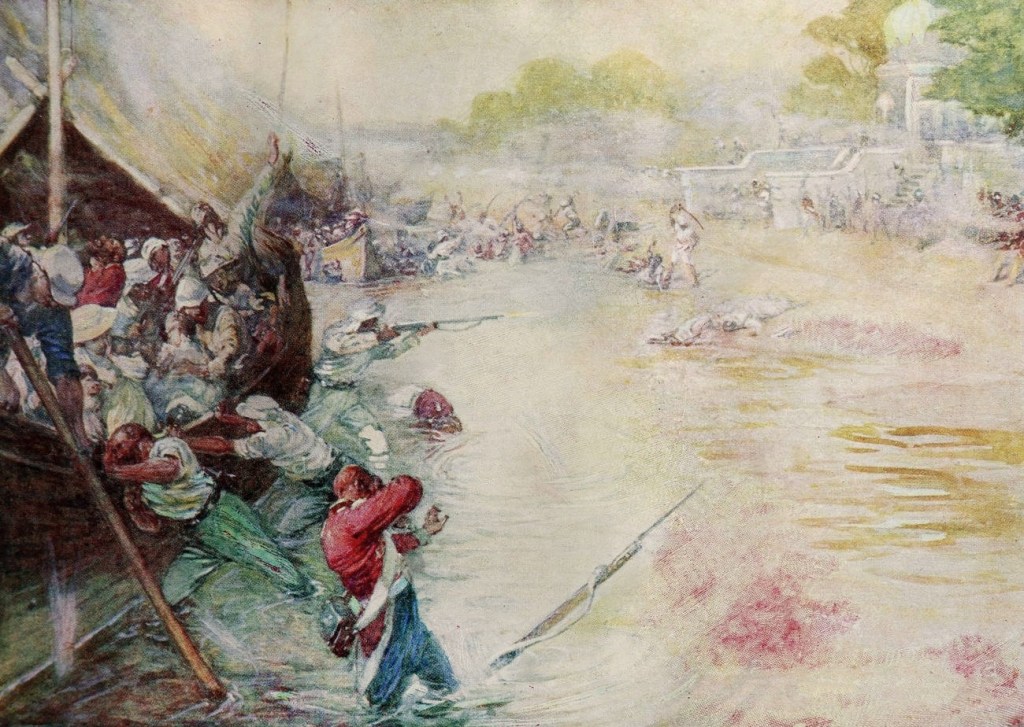
The boats, as promised, were waiting just off the shore at the Satichaura Ghat. The garrison embarked in silence, with no help from the boatman or the hundreds of onlookers who stood on the shore. The boats were moored in the shallows, but as this was before the rains, the river was low, and many of them were stuck fast in the sand.
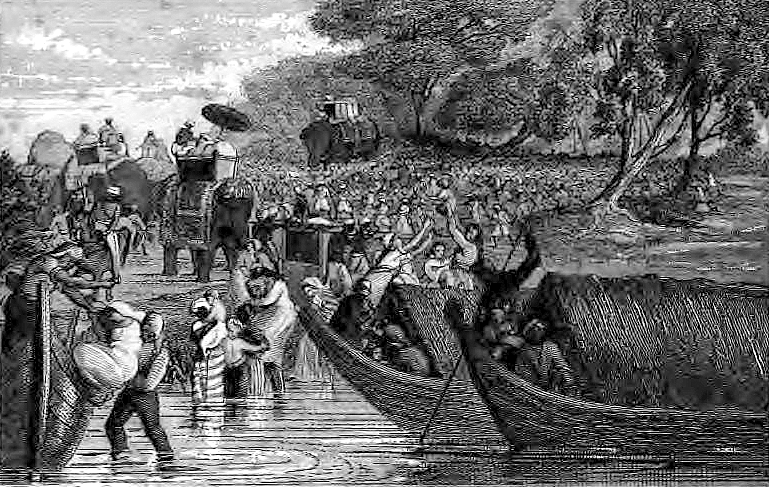
“As soon as Major Vibart had stepped into his boat, ‘“‘Off‘“‘ was the word, but a signal from the shore, the native boatmen, who numbered eight and a coxswain to each boat, all jumped over and waded to the shore…” The men on the boats opened fire on the fleeing boatmen.
Private Murphy, who was with the rear guard, recalled:
“ Certainly, we were supplied with all sorts of conveyances to the wharf. We were allowed to get in the river and some on board of the boats when they opened fire from all the Batteries at both banks of the river. I happened to be one of the rear guard, myself with the General and his family, and partly in the water when the firing commenced. The General did not get to any of the boats. He was seized and brought out of the water, and what became of him after I cannot say.“
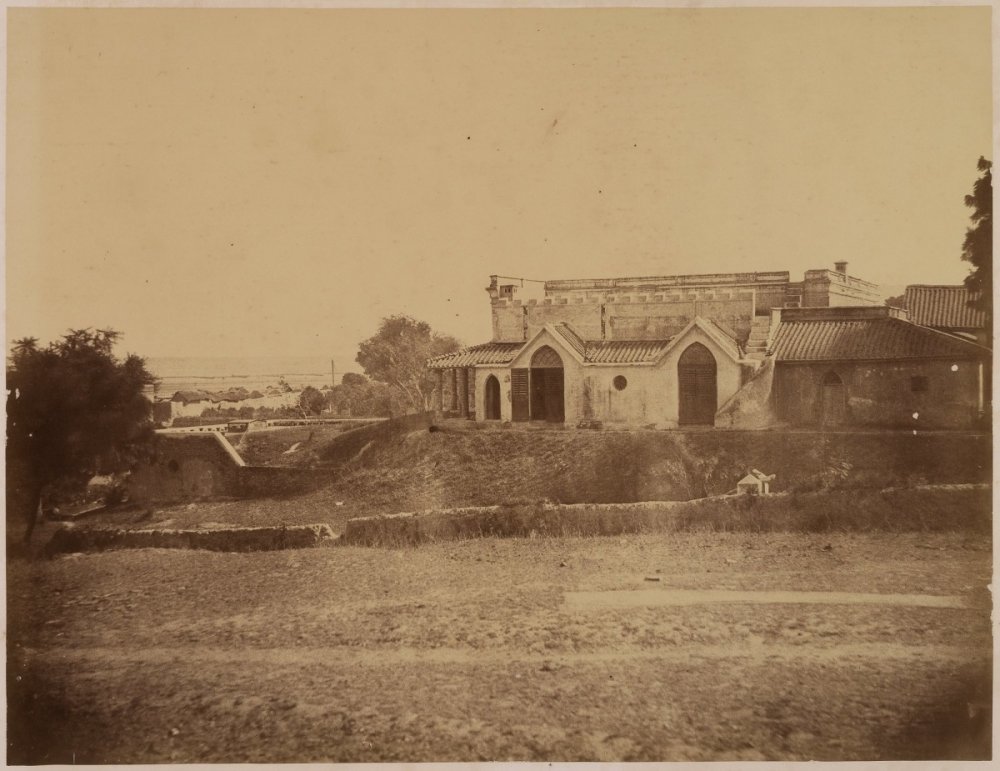
It has been argued that the British were the ones who started the massacre at Satichaura Ghat by firing at the boatmen. However, it was at a designated signal from the shore that the boatmen jumped overboard and not before, and the British were at this point ready to accept the worst. The boatmen had concealed burning embers in the thatched roofs in some of the boats – these now began to burn. While the occupants jumped into the river, there was no hope for the wounded – they would choke to death in the smoke or be burned alive.
Simultaneously with the departure of the boatmen, the gravity of the treachery was now revealed: hundreds of muskets opened fire on the boats, and four nine-pound cannons were brought out into play from their hiding places along the shore. In the confusion, some men jumped out of the boats and tried to push them into deeper water, but many were stuck fast in the sand and completely immovable. As Thomson writes:
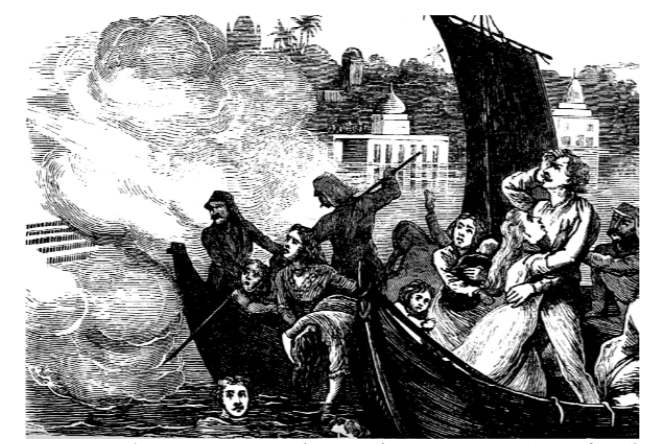
“The scene which followed this manifestation of the infernal treachery of assassins is one that beggars all description, Some of the boats presented a broadside to the guns, others were raked from stem to stern by the shot. Volumes of smoke from the thatch somewhat veiled the full extent of the horrors of that morning. All who could move were speedily expelled from the boats by the heat of the flames. Alas! The wounded burnt to death, one mitigation only there was to their horrible fate – the flames were terrifically fierce, and their intense sufferings were not protracted. Wretched multitudes of women and children waded out in the deeper water and stood up to their chins in the river to lessen the probability of being shot…” (The Story of Cawnpore, Thomson, p.168)
For Private Murphy, who did not make it into any boat at all, the only option was to swim.
“I threw any clothes off me, and I began swimming to the next boat, which was about one hundred yards from me. I was attacked by several of the Cavalry and they came quite close to me. So when they came within about 10 yards of me I dived and got on the bottom and commenced crawling on the bottom as long as I could remain underwater. When I rose again to the surface, I was about two hundred yards away from them when they gave whip and spur to their horse and after me again. All this time their horses were swimming, and the carbines and ammunitions got wet, which providence sent at the time and all this time I had a pair of drawers on me, and I could not get time to take them off. I was thinking at the time that it was all over with me. Still, I trusted to my Maker, and it did not fail. And after a long struggle, I got my drawers off, and after that, I had good hopes. After this, I had a chance. Still, at the same time, in about half a mile from here, the river was crammed with dead and red with blood, both cavalry and infantry cutting down both men, women and children. At length, their horse and themselves got tired, and they returned to where the slaughter was going on. This gave me a chance of a start.“
Some familiar names, men who had fought so valiantly in the Entrenchment and had never given up hope, gave their lives at the last in the boats. “Captain Moore, Lieutenants Ashe, Bolton, Burney, and Glanville, besides many others, whose names I did not know. Captain Moore was killed while attempting to push off the boat — a ball pierced him in the region of the heart; Ashe and Bolton died in the same manner. Burney and Glanville were carried off by one round-shot, which also shattered Lieutenant Fagan’s leg to such an extent that from the knee downwards it was only held together by sinews…”
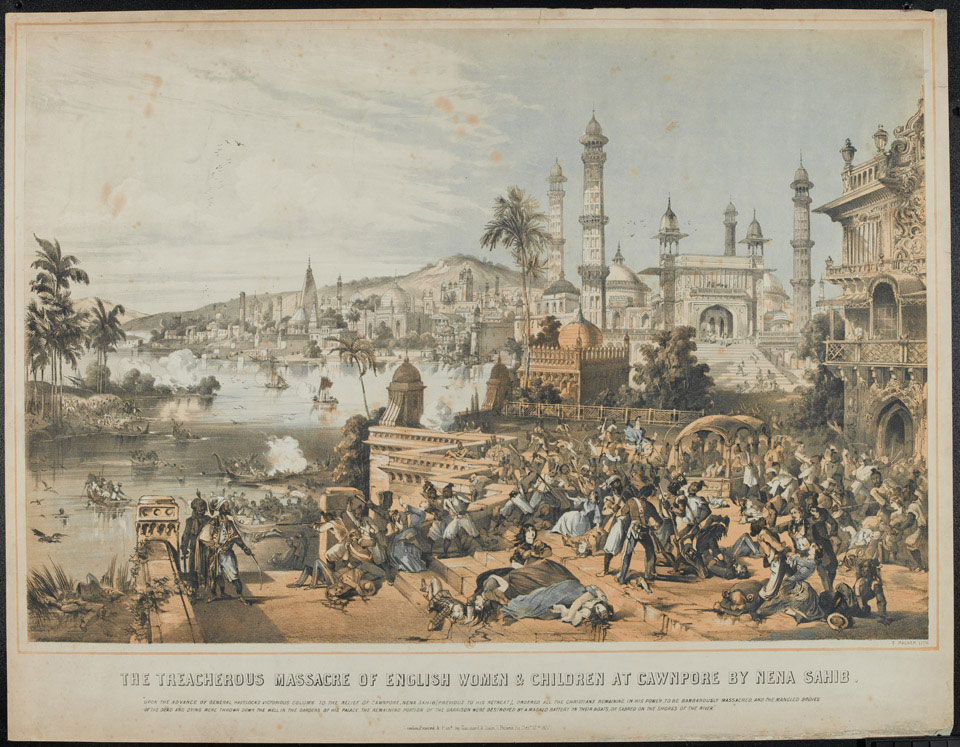
At Satichaura Ghat, after twenty minutes, the number of dead had begun to outnumber the living, the firing slackened, and the cavalry entered the water, armed with swords and pistols to kill whoever was left. Some young girls, most likely including Margaret Wheeler and a daughter of Bandsman Spiers, were hiding in the tall grass around the river, and were taken away by sowars; Amy Horne had been grabbed from a boat, thrown in the water and then hoisted up by a sowar who rode off with her. She had watched with horror as her little sister, her leg broken, lay on the floor of a burning boat, screaming, “Amy, don’t leave me!” It was the last time Amy would see anyone from her family. One man was dragged out of the grass and beaten to death with cudgels by badmashes. Some 125 women and children who had escaped the fire and the shooting were herded to the shore and taken prisoner. Among these was Ellen Probett and her children. From the boats came some more women and children, swelling the number to around 146. The survivors were taken to Savada Koti, where they joined another group of 60 Christian women and children who were the final survivors from the Fatehgarh flotilla.
When the last shot was fired at the Satichaura Ghat, it became clear the massacre had been, in the eyes of the Nana Sahib and his compatriots, a success. No boat would ever reach Allahabad. It would have been in the power of the Nana to spare the women and children of Fatehgarh and Cawnpore. He could have kept them prisoner and, at an opportune moment, traded them for his own neck. But he chose murder.
 Mutiny Reflections