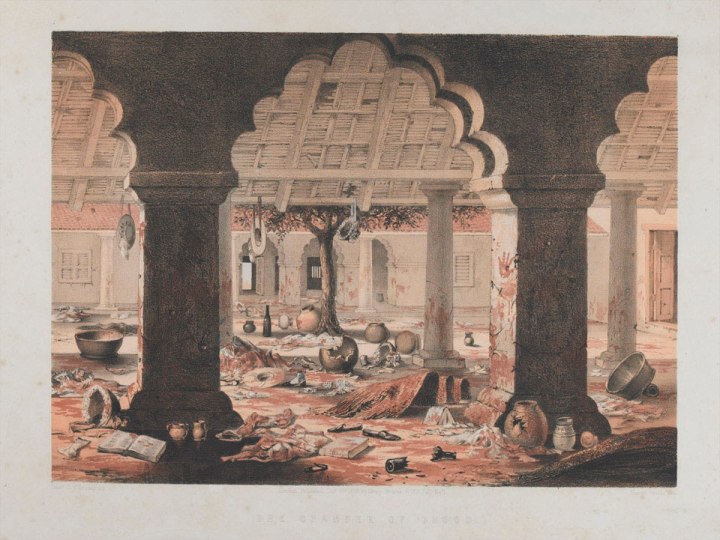
“…the floors of the room were still covered in congealed blood, littered with trampled, torn dresses of women and children, shoes, slippers, and locks of long hair, many of which had evidently been severed from the living scalps by sword cuts…”
It was September 1857 when William Forbes-Mitchell of HM’s 93rd Regiment arrived in Cawnpore. His regiment had been detailed for duty in China but was diverted, arriving in Calcutta in August. Too late to save the garrison, too late to rescue the women and children in the Bibighar. Although the massacre had been perpetrated in June, the remains of horror were still evident 3 months later.
“The first place my party reached was General Wheeler’s so-called entrenchment, the ramparts of which at the highest place did not exceed four feet and were so thin that at the top they could never have been bullet-proof! The entrenchment and the barracks inside of it were complete ruins, and the only wonder about it was how the small force could have held out so long. In the rooms of the buildings were still lying strewn about the remains of articles of women’s and children’s clothing, broken toys, torn pictures, books, pieces of music..”
As a memento, Forbes-Mitchell picked up a New Testament written in Gaelic, without a name in it. All the blank pages had been torn out, most probably used as gun wadding during the most desperate days of the siege. Unlike Lucknow, where there was always a chance of rescue and eventual relief, where supplies, though monotonous, were still available, drinking water was procurable, and shelter was provided for, Cawnpore had nothing. Over 1000 people entered the entrenchment in early June 1857 – only 450 walked out again 3 weeks later, and barely a handful survived at all.
Page 1/5
 Mutiny Reflections