Haldwani, 1 January 1858
Lieutenant Gepp had been spending his time between Brokerie Fort and Kallah Dungee and was hoping, after weeks of duty, to be allowed to enjoy Christmas in Naini Tal. Captain Ross had already given his agreement to the young man’s plans when Captain Crossman, who had liberally given leave to everyone but Gepp, instructed Gepp to remain at Kalah Dungee with the second in command of the cavalry irregulars, Crossman was trying to raise into something of a force. After a disconsolate and, above all, dull Christmas, Gepp was hoping New Year’s Day would present a little more excitement. He was invited, along with Captain Crossman, to a dinner that evening in Naini Tal, where he had but lately arrived.
“The Fates, however, were adverse; for about 5 o’clock p.m. I received a short note from Crossman telling me to come to him immediately. I went to him; he told me that our force stationed at a place called Huldwanee (about four miles from the foot of the hills and fifteen from Naini Tal, and consisting of about six hundred men) had been surprised by the enemy and obliged to retire and that it was very possible that the road to Naini Tal might be open and undefended. He ordered me, therefore, to go down as quickly as possible to Kalah Dungee and bring up my company. I had not a pony to ride, so was obliged to walk down all the way, and lost my dinner into the bargain.”
After five hours of walking, Gepp arrived in Kalah Dungee and immediately organised his men. Just as they were ready to march, a letter arrived: “Instead of being obliged to retire, our troops had gained
a victory and driven the mutineers off the field, and therefore we were to stand fast and wait for further orders.” He later found out what had happened.
Around 8.30 in the morning, some villagers had brought word that they had sighted some rebel cavalry. As the senior-most officer at Haldwani, Captain Baugh of the Nepal Contingent ordered the men to stand to their arms while he and another officer went out to reconnoitre. They quickly came on the sowars, but these, upon seeing Baugh and his companion, turned about and slowly began to retire.“Baugh then came back into camp, pooh-poohing the idea of there being any force belonging to the enemy anywhere near (he must have been infatuated) and dismissed the men to their breakfasts.”
The officers were not ten minutes into their breakfast when they were startled from their repast by the sound of heavy guns. Rushing outside, they saw the elusive rebels, drawn up in strong force and, at less than 100 yards, peppering the camp with grape and round shot. Baugh shouted for the men of the Nepal Contingent (300 strong) and those of the 66th, a further 300, to be brought under arms – in their eagerness to engage, the Nepalese Gurkhas dashed forward without waiting for orders, and Baugh ordered the 66th to attack in their wake. Fortunately, the sight of Gurkhas, kukris drawn and mad for a fight, was enough to panic the rebel forward, who turned tail and ran. Their artillery was horsed, making it impossible to capture their guns, much to the disappointment of the 66th. “The rest of the brave army, on seeing their guns bolting, were struck with the advisability of doing likewise, and ran…” Baugh let the Gurkhas give chase; over the next four miles, they killed around 100 insurgents, and the action was over as quickly as it began. With no cavalry to speak of, the British once again could not pursue with any further effect.
Gepp, who was on outpost duty at Kalah Dungee, found the whole affair astonishing.
“The enemy amounted to two or three thousand men, a large proportion of which was “sowars” If they had only had the pluck to charge our men, in their disorganised state, the result might have been very different. Baugh must have been perfectly mad not to have been warned by the appearance of those four “sowars “early in the morning. Any man with a grain of sense must have known that four “sowars” would never have approached our force alone. The only rational construction which could, I should think, be put upon their appearance so near us was that they were the advance guard of a strong force, and this, in truth, was the case. Baugh also, at the second alarm, had ordered down four guns, which had been placed in an entrenched position at the foot of the hills, to Huldwanee.” The authorities at Naini Tal took a dim view of Baugh’s handling of the affair; they ordered the guns returned and removed him from command.
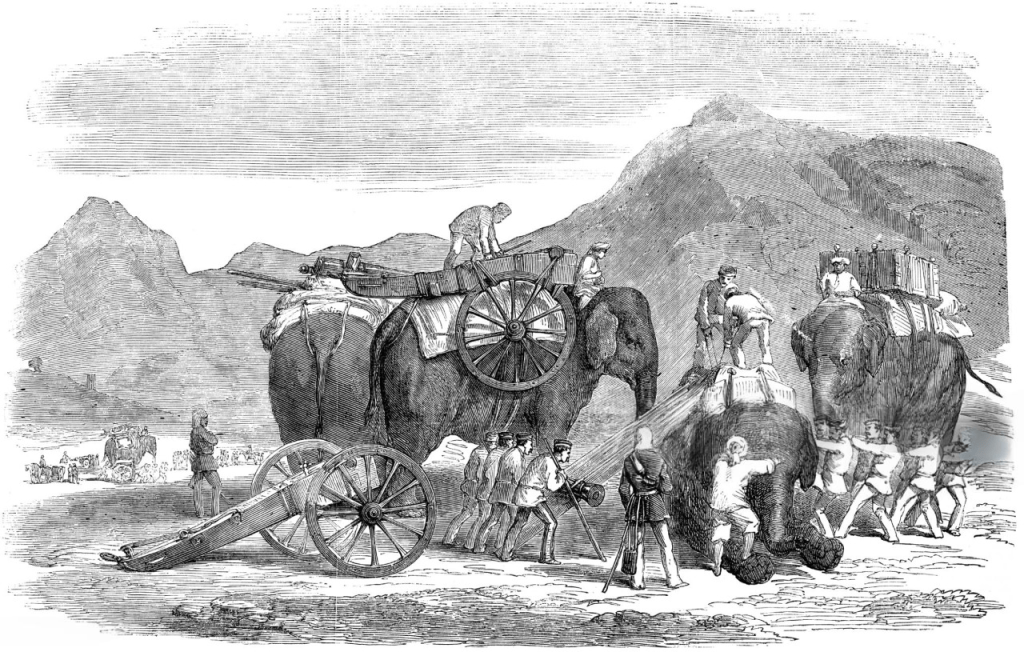
The next day, 2 January, Captain Crossman rode back down to Kalah Dungee. He had a curious mission that had nothing to do with rebels but instead, with 24 government elephants.
The Nawab of Rampur had been holding the pachyderms in his care for several months at Rampur. It had been determined by the government that the elephants were too valuable to be sent to the hills, where food in the already strapped forts and stations would have been difficult to procure and expending manpower on their care was an expense they could currently do without. So the elephants remained in Rampur, housed in comfortable stables and cared for by the mahouts and the attendees in the Rampur Nawab’s extensive employ. However, they also presented a problem. As one of their staunchest allies, the Nawab had been putting himself at considerable risk for months, establishing communications between Kumaon and the plains, providing supplies for Naini Tal, thwarting marauders roaming through his dominion, and keeping as much peace as he could among his people. Unfortunately, he could not trust his troops or, for that matter, any of the local subordinate chieftains in his borders; he had been facing an uphill battle for the continued loyalty of his troops, who had most assiduously kept out of the way of the British. The elephants were proving to be a thorn in his side, and his men were beginning to mutter that their usefulness could be turned to their advantage. What he needed was for the British to collect their property. Ramsay and the government, for their part, were not willing to allow the elephants to be used to arm a rebel army, and after some deliberation, it was decided to move them to Kalah Dungee, well out of the temptation of the Nawab’s men and return them under the watchful eyes of the British.
On 3 January at 3 in the afternoon, Crossman, along with Gepp and 150 men of the 66th and 50 of the newly raised cavalry, marched out of Kalah Dungee to a rendezvous point, some 13 miles from the station. They arrived 5 hours later and found, as promised, the Nawab’s chief minister and his staunchest escort waiting, with 24 well-fed elephants. The minister ushered the officers into a tent where they were regaled with a fine dinner of curries, the first meal they had had since morning, while the minister informed them of the doings in Rampur and beyond. Disturbingly, he also told the officers he had, just before their arrival, been informed the rebels, aware that Kalah Dungee was this evening somewhat undermanned, had expressed their interest in overrunning the place. Instead of the rest of the men so sorely needed, Crossman and Gepp finished their dinner, loaded the Gurkhas on the elephants and determined to return to Kalah Dungee that night. In addition to the elephants, Rampur generously provided twelve yoke of “magnificent oxen” to draw the guns anticipated to be arriving with Tytler and the 1000 Nepalese Gurkhas, expected any day at Kalah Dungee. Retracing their steps, Crossman and Gepp pushed on through the night, arriving back in camp at 4 in the morning to find they were “not, however, molested by the way, neither did we find that the enemy had tumbled into our beds or carried off all our property.” Elephants and oxen were safe, and the officers could finally sleep.
For Lieutenant Thomas Sydney Gepp, who had just celebrated his 22nd birthday on 12 October, time had nearly run out.
Charpura, 10th February 1858
Kumaon, in the meantime, had become stronger. The contingent of Nepalese troops had arrived, and MacIntyre’s new Gurkha regiment had made such good progress that they could now take over duties in Almora. As such, the headquarters of the 66th left Almora for Haldwani on 1 February, with only one company remaining behind under Captain Strachy. Colonel McCausland now had a force of 1000 infantry, 250 cavalry, 2 six-pounders, and 2 mountain guns, and he gathered his little army at Haldwani.
The rebels, for their part, were not going to make things easy. They presented two forces: Fazl Haq was marching from Pilibhit with 4500 men and four guns, while Kale Khan was proceeding from Bareilly with another 4500 infantry, over 1000 cavalry, and four guns. They intended to form a junction on the Bareilly road and then take on McCausland together.
McCausland would ensure this would never happen, and he was determined to fall on Khan before he could combine his force with that of Fazl Haq. On 9 February, McCausland left Haldwani with a force that included 500 of the 66th Gurkhas, 150 men of the Nepal Contingent, 60 of the Kumaon Levy and 200 Rohilkhand Horse – 710 infantry, 200 cavalry – and Captain Ross with two six-pounder guns. Under the cover of darkness, McCausland moved his army out at 11 pm, marching through the thick jungles to reach Charpura shortly before daybreak.
He was facing a rebel force of some 4000 infantry, 1000 cavalry and four guns. They were encamped in a strong position some 900 yards off the road, with their guns commanding the approach. The rear of Khan’s camp was protected by the Paha Nadi, which flowed around it; the right of the position was intersected by nullahs, broken ground, grass and thick topes of trees. The only approach was to the centre. Unaware that it was McCausland who had arrived and not Fazl Haq’s army, scouts from the Khan’s camp approached the small party of advance cavalry, enquiring who they were. McCausland immediately wheeled back the advance and ordered his guns to open fire. Ordering Captain Ross to leave two Gurkha companies to protect the guns and with Captain Baugh commanding the Nepal Contingent and the Kumaon Levy, with the Rohilkhand Cavalry in support, McCausland ordered the advance on the right rebel flank. His guns managed, in the first few minutes, to disable one of the rebel guns on the road. Ross continued his advance, all the while the Gurkha guns were pouring a concentrated fire into the rebel ranks. The 66th and the Nepalese Contingent continued forward, firing rapidly, fighting off repeated attacks by both rebel cavalry and artillery, but once in motion, they were unstoppable. Within an hour, they had broken the rebel right flank. Taking a village in a swift rush, they swept onwards along the line and captured all the rebel guns, killing the artillerymen and putting the remainder of the rebels to flight. By 8 a.m., the last shot was fired, and McCausland ordered the standing camp and the rebel baggage fired. Still anticipating that Fazl Haq might, at any moment, appear on the horizon, McCausland gathered up his dead, wounded, the guns and his men and marched back to Haldwani.
For the rebels, they seemingly lost all appetite for battle – Charpura was their last battle for the next few weeks and when they faced the British again in March, Captain Baugh was waiting for them. Acting on intelligence that this particular small party was intent on collecting revenue in the hills around Kilpuri, Baugh marched 25 miles through the night on 3 March to Sitarganj, where, with his company of Gurkhas and two guns. He surrounded the rebels and launched a severe, and altogether surprise, attack on their position. He left behind 25 of their dead, captured the collected revenue, their baggage and supplies and returned to Haldwani, with one man wounded. “The Gurkhas had given another proof of their great endurance and marching powers by covering 50 miles and fighting an action in 15 hours. Be it remembered, that this was largely at night marching over unmetalled roads through forest. The halts amounted in all to three hours.”
It was also the last battle of the Gurkhas north of Bareilly. On 10 May, the Kumaon Brigade was broken up, the 66th’s Headquarters returned to Almora, and on 16 May, Nos. 1, 2, 3 and 4 Companies marched under now Brevet-Major Ross to Naini Tal. No 5 joined them in July. It would only be in October 1858 that the 66th would join Brigadier-General Colin Troup to march through Oude. There were no more disturbances in Naini Tal and the rebels changed their focus back to Rohilkhand, leaving Ramsay, the ladies and the hills in peace.
 Mutiny Reflections