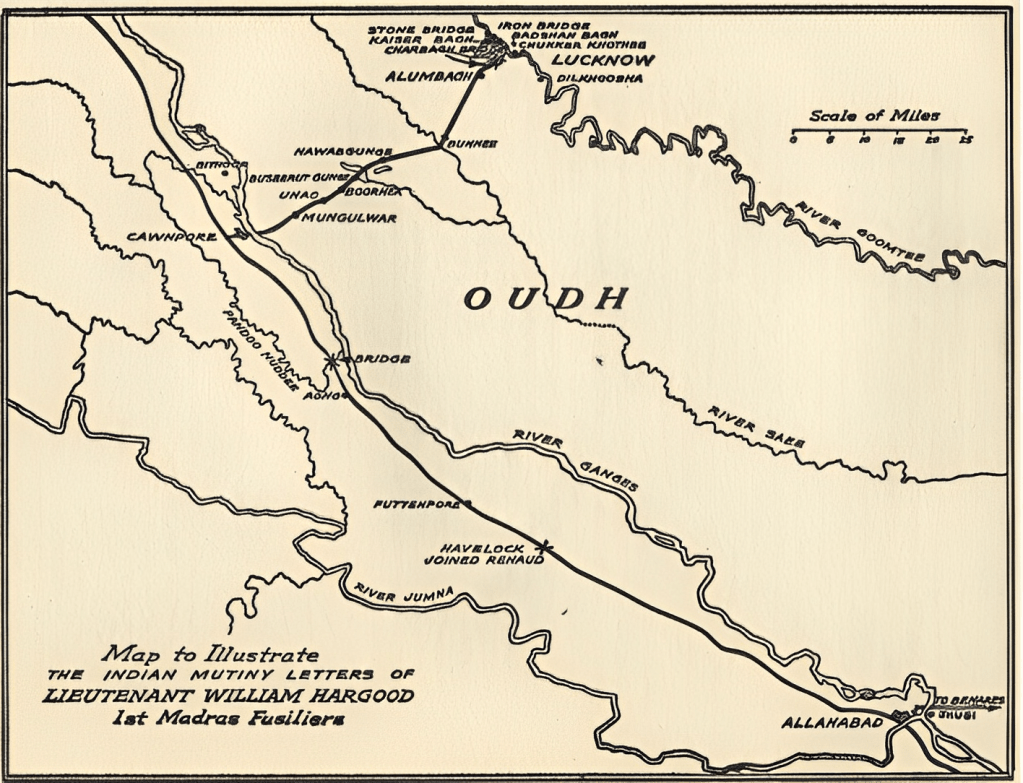
14th – “We began to march at 3 a.m. About 8 a.m. we saw the enemy Cavalry riding about the trees, so we we were ordered to skirmish. We kept firing and following them up ’til about noon – we then stopped for about an hour, then fell in again, to march towards a bridge that was about 2 miles distant. As we were marching along, suddenly the 24lb shot fell about our ears, and you would see enormous branches cut from off the trees. We were then ordered to skirmish, as we are the only corps with the force, that is armed with the rifle. As we approached the guns under very heavy fire of shot, we fired into them, as we got within 600 yards we halted. Our artillery came up and let into them – the enemy then bolted leaving 2 guns.” (Letter 6 – Lt. William Hargood)
The Battle of Aong
The Battle of Aong and the Battle of Pandu Naddi were both fought, one after the other, on the 15th of July- and were as swift as they were bloody. On the evening of the 14th, Havelock’s spies brought him the intelligence that the rebels were entrenched across the road at Aong, a village a few miles up the road in advance of his position. The men camped for the night and early on the 15th, they marched on Aong, with Lieutenant-Colonel Tytler and his small body of mounted volunteers leading the way. Maude and his guns, supported by the Madras Fusiliers, followed.
Major Renaud was mortally wounded at the head of the Madras Fusiliers and Maude mourned the loss of a young bombardier named Harding, wounded while laying his gun. A round shot ripped his arm from his fingers to the elbow. The bewildered young man looked at Maude, holding up his mangled arm, and said,
“If you please, sir, may I fall out?”
He then saluted the captain as if on parade and made his way to the back. He died later that night from blood loss.
Maude lost his horse. Dismounting to lay Harding’s gun, his syce, who should have held the animal, as it was, under fire, took fright and bolted. The mare broke her bridle and for a moment Maude watched her as she galloped off the join the rebel Cavalry. Then it was back to work.
Although entrenched, the defences the rebels had constructed were not formidable. They had the advantage of the thick growth of trees which provided them ample cover as bodies of cavalry swept out on both of Havelock’s flanks with the intention of capturing the baggage wagons. The attacks were more troublesome than dangerous as the cavalry would not openly attack the force but Havelock was determined to put a stop to it. He only had 20 cavalrymen himself, Havelock was obliged to protect the flanks with the infantry in the second line and by ample use of artillery fire. The final attempt on the baggage was thwarted by the baggage guards themselves – invalids under the command of a sergeant of the 78th and their Enfield Rifles.
As Havelock approached the village, rebel skirmishers came out in “excellent order” and attacked Havelock’s skirmishers on the left, leaving Major Renaud severely wounded. Maude was busy engaging the rebel cavalry; twice obliged to load with canister to make their welcome troublesome – the cavalry hesitated and refused to charge. The rebels rapidly fell back and cleared out of the village – it was a short, sharp victory for Havelock.
In the village, the troops were astonished the find several casks of Commissariat porter – so suspiciously placed and temptingly arranged, that Maude quickly suspected the liquor was poisoned. He would not let his men touch it without first appointing tasters – two men volunteered for the task and quickly filled their cups with a quart of the liquid. Then Maude watched them for the next 15 minutes to see if they fell over dead or showed any signs of poisoning. When they neither complained of ill effects nor died, Maude allowed the rest of the men to have their fill. The tipple, Maude found was most excellent.
The men moved on to the other side of the village where they halted. The wounded were looked after, and the artillerymen settled themselves to cleaning their guns, shifting their ammunition and any number of tasks required to be ready for the next fight.
The Battle of Pandu Naddi
After a short halt, the force moved on again, in column formation, towards a tope of mango trees. To their surprise, the 24lb which so astonished Lt. Hargood, came crashing through the trees killing and wounding three of the infantry outright. Maude immediately deployed the battery into line and advanced in this order: “taking the guns on the road myself, assisted by Lieutenant Crump of the Madras Artillery. Maitland (RA) and Harward (Bengal Artillery) each commanded a sub-division on the respective flanks.” The ground on both sides of the road was waterlogged, heavy and broken, so as the artillery advanced to answer the rebel’s 24-pounders they found themselves increasingly alone and a fair mark for the very guns they were trying to silence. To their luck, the rebels did not depress their guns to meet the advancing troops – consequently, while some of their shots, aimed at the right and left rear did some damage, killing two gun-bullocks and their Indian driver, Maude was able to advance 600 yards range and commence “the usual dual” with the enemy guns. It did not last very long.
“…in three rounds of spherical case shell, we broke both the sponge staves of their heavy guns which were beautifully posted, so as to sweep the bridge over the Pandoo Nuddee.”
The rebels had mined the bridge to thwart Havelock’s advance but under the incessant fire of Maude’s guns, they fumbled in the attempts to light the train. Havelock’s guns and infantry continued their steady advance, driving the rebels from the left bank of the river, where they retired in good order.
While young Hargood might have been surprised by the 24-pounders, Havelock was not. He had been told the rebels were holding the bridge, one mile up from Aong. The river, swollen with monsoon rain, would have been unfordable and Havelock needed the bridge to advance his men onto Cawnpore. The rebels, for their part, were going to make that as troublesome as possible. Placing two 24-pounders to defend the bridge, they were able to sweep the road from a mile, using the telegraph posts to mark the range of the guns. While the columns of attack formed up, the 24 lb shot crashed right into them, knocking over “men and bullocks on the right hand and the left.” Ordering the men to lie down,, Havelock waited for the artillery and the skirmishers to move to the front where they deployed in line and advanced steadily in parade order, “reckless of the heavy shot that kept plunging in rapid succession into their ranks.” As Maude’s guns were too light to answer at a distance, they were moved with all haste forward towards the rebel battery, which showered him with shot as he advanced. When he was no more than 600 yards to their front, he unlimbered and poured as much shrapnel shot as his guns could manage; so rapid and accurate was his firing that the rebels found themselves unable to reply. As the fire slackened, the Madras Fusiliers, who had been extended along the bank of the river as Enfield riflemen, made a rush at the battery, “swept over the guns and carried to bridge in gallant style.”
Havelock would lose 25 men, killed and wounded.
After 12 hours of fighting and the capture of the bridge, the Moveable Column was now within 24 miles of Cawnpore and the rebels were being beaten, one step at a time, back to the city. The rebels left behind their plunder, and it was here, on the banks of the river that Sherer recalled a strange incident. It befell not so much him, but a fellow volunteer, a railway man named Bews who, before the outbreak, had been in the habit of hearing from a fellow engineer, stationed at Cawnpore.
“The latter was a married man, and it was a curious instance of how our countrymen kept their spirits up, that he wrote very amusing accounts of what was going on, which Bews read out to us. The last letter Bews received from his friend was to the effect that a row was imminent, but, said he, ” we are quite prepared, and if the fellows break out there will be wigs on the green.” It was now nearly six weeks since that letter, and though the most ominous reports were current, there was no real certainty as to the details of what had occurred. The spot on the river bank where our little tent was going to be set up was a level area, just below some slightly higher ground, formed accidentally by the action of rains, but suggesting itself as a convenient resting place, and, as such, it had been apparently used by an outpost of the enemy’s Cavalry. For there was some of their rubbish lying there, ropes and straw, and earthen pots, one or two blankets, saddlecloths, etc. Bews had hardly entered this enclosure when his eye caught amongst the litter what he thought was a book. He took it up; it was a leather case. He opened it; it was a miniature of his friend’s wife. When I came up I found Bews naturally greatly cut up at the discovery. There was something so very appalling in the mystery of the affair. We never had reason to think the poor lady lived to reach the horrors of the Beebeeghur, and it is not improbable that, in the confusion of moving, the miniature was left at the bungalow, was looted, and accidentally came into the trooper’s possession. But that the one man in the force, to whom the fate of the lady was of deep interest, should find this sad memorial of her, was a remarkable coincidence.”
According to his last intelligence, Havelock was under the impression that the prisoners in Cawnpore were alive, and it was still his mission to save them. What he did not know as his men rested on the banks of the Pandu Naddi, the sepoys opened fire on the ladies in the Bibighar, and the butchers sharpened their knives. Havelock would be too late to save any of them.
 Mutiny Reflections