Chittagong, 17th of November
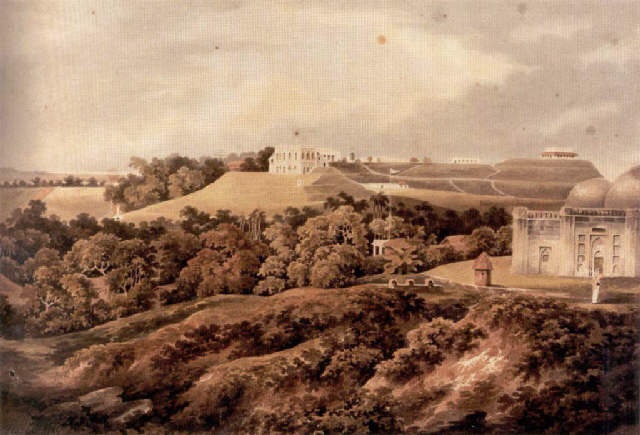
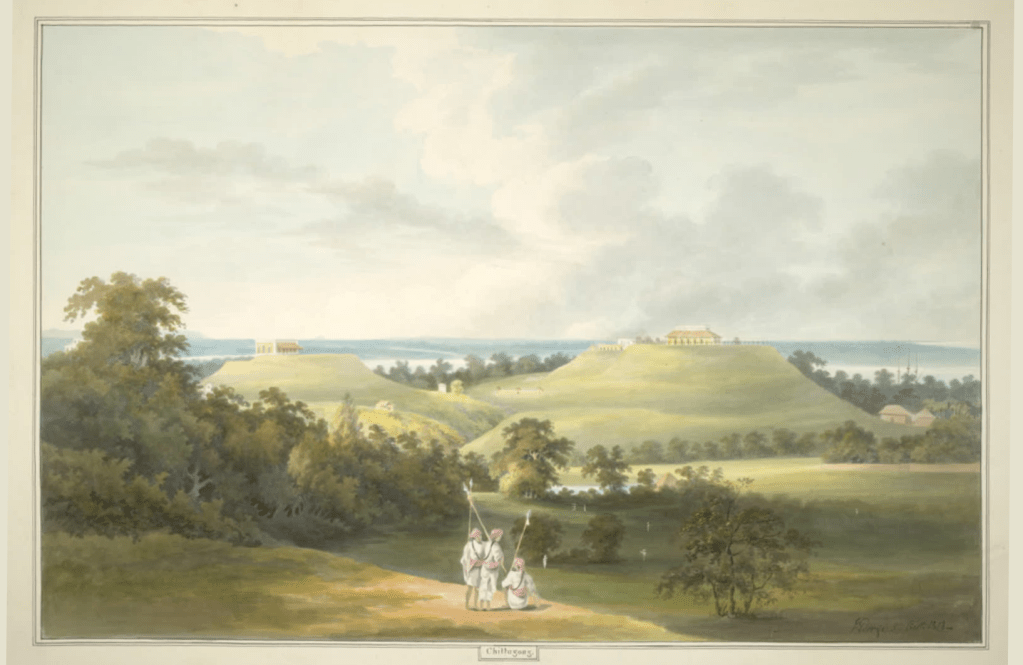
Wednesday, the 17th of November started, as had become the rule for the past three months, with nothing to report. The sepoys of the 34th BNI were placidly going about their duties in Chittagong; the authorities in the city were writing their demi officials on everything from trade to elephants. The weather was cool and pleasant; even the Portuguese had stopped living on their boats. The mood in the bustling bazaar reflected nothing out of the ordinary. It was, in fact, a very ordinary day in these rather strange times. The news from Calcutta had been encouraging — European troops were now arriving in greater numbers than before, and soon, a cold-weather campaign would begin, and this blasted mutiny would finally be resigned to the annals of history. In the evening, the officers and civilians took their customary drive and then returned to their homes to dine and wile away the night with conversation, cards, and cheroots.
Suddenly, at 9 p.m., a noise was heard from the direction of the 34th Lines. It started as a low rumble but turned into a shout as hundreds of voices rose in an excited cry. The first officer to hear the noise was Captain Dewool, whose house was close to the Lines. Dewool quickly armed himself, buckled on his sword, and calling Lieutenant Hunter, who was likewise prepared, the two men proceeded, on foot, towards the Lines. The intention was to parade the regiment, but when they arrived, they found that part of the regiment had already run off and taken up their position in the Magazine, while the rest were hovering around the parade ground, loading their muskets. Their demeanour was quite changed -from the mild sepoys they had seen but a few hours ago, they were now “very violent.” Unperturbed, De Wool ordered Hunter to retire while he proceeded to the Magazine alone.
He found a strong guard in front of the Magazine, and like their compatriots on the parade ground, were hardly in a pleasant mood. They challenged De Wool with shouts of “Don’t care for him!” and “Go away, you have no business here!” Still, De Wool advanced, his hands outstretched. He first tried arguments – if only the men would return to their lines, this whole business would be over. He then opted for persuasion, insisting they return to their duty. Still, the men stood firm. A Mohammedan, who De Wool noticed was not wearing his uniform and standing away from the others, called out in a loud voice, “The whole detachment is in a state of mutiny, and we have determined to die if it is necessary. Go away!” He followed this up by shaking his fist in De Wool’s face with “violent gestures.” From the rear, a shout now rose up, “Shoot him! Shoot him!” Fortunately for De Wool, several voices replied, “No! No! Don’t hurt the captain!”
Thinking there might be some reason left in the 34th, De Wool again endeavoured to recall them to their sense of duty. He appealed to a few sepoys, who had previously been noted for their good character, and, addressing them by name, asked them to think “what they were about and to remain faithful to their salt.” It was no use; the men shook their heads and replied they had joined the mutineers and could no longer withdraw. Again, cries rose to shoot De Wool, and again, pleas were made for his life. At the same moment, three sepoys, with their muskets at the charge, advanced towards De Wool. He stepped back a few paces, moving his way out of the crowd that had gradually come up around him. Suddenly, a Sikh from No.4 Company came forward and roughly pushed De Wool back. “Go away from this!” he shouted. De Wool, realising that not a single commissioned or non-commissioned officer, not one sepoy or Sikh would stand by him and to stay, at this point, meant certain death, he quickly retreated.
De Wool rushed to Lieutenant Hunter’s house, close by, and found Lieutenant Thomson pacing on the veranda. He told the two men what had occurred at the Magazine – there was nothing for it but to accept the 34th was no longer under their control. Hunter and Thomson, armed, decided they would give it one more try and went to the Lines. For his part, De Wool now made the round of every house in the cantonment to give warning to the residents, only to find that most of them had already fled. At the far end of the cantonment, the Civil Surgeon and his family were still in their bungalow, and De Wool joined them. Escape was now the only option, but on the parade ground and all around the cantonment, mutineers were prowling, and their numbers were growing. De Wool, with the surgeon and his family, broke open the wall behind the house and scrambled into the adjoining property, which they found empty. Here, they found the servants had not joined their employer in his flight but stood ready in the darkened bungalow, ready to help in any way they still could. For the next two hours, having procured “native clothing” for the party, they stood vigilant, watching the movements of the mutineers. No one, however, approached the house. As soon as there was a moment’s respite, the servants hurried the party down a jungle path behind the cantonments to the banks of the river and, after some difficulty, managed to secure a boat. Then, for the rest of the night, they sailed downriver until they finally reached the rest of the civilians who had gathered at the port. Hunter and Thomson shortly after made their appearance and confirmed what De Wool already knew. The 34th had lost all reason.
Things could have gone in one of two ways. The 34th, well-armed and violent, could have made their way down to the river and massacred every European in sight. The Europeans would have been unable to defend themselves for too long; their only hope would have been to sail away from Chittagong and escape to Dacca by the river route. As it was, the 34th chose a different direction altogether. Their objective was not blood; it was treasure.
They plundered the treasury down to nearly the last cent, leaving behind just 340 Rupees in cash and stamps, the Government securities and records. Then they broke open the jail, killing a helpless guard from a local levy who tried to stand in their way. It was not so much to release the prisoners but to coerce the most able-bodied to carry the treasure they had just looted. Then they blew up the Magazine and burned down their Lines. They swept through the cantonment, not to plunder the bungalows but to steal a few horses to use as baggage carriers and with that, leaving all private property untouched, they marched out of Chittagong, acquiring as they moved onwards, three elephants of the commissariat department. Thakur Bux, a jemadar of the Provincial Chittagong Battalion who they caught on their way, was forced to accompany them down to the river, but there they let him go – Pay Havildar Rujub Ali Khan of No. 4 Company assumed command of the mutinied detachment and directed their flight across the Fenny River. They entered the territories of the Tipperah Raja and, for a moment at least, vanished from sight.
For the Europeans at Chittagong, the fright was over. Not a single one had been injured or, indeed, killed. They returned to their houses and began writing their reports.
The 73rd Disarmed, Dacca, 22nd November
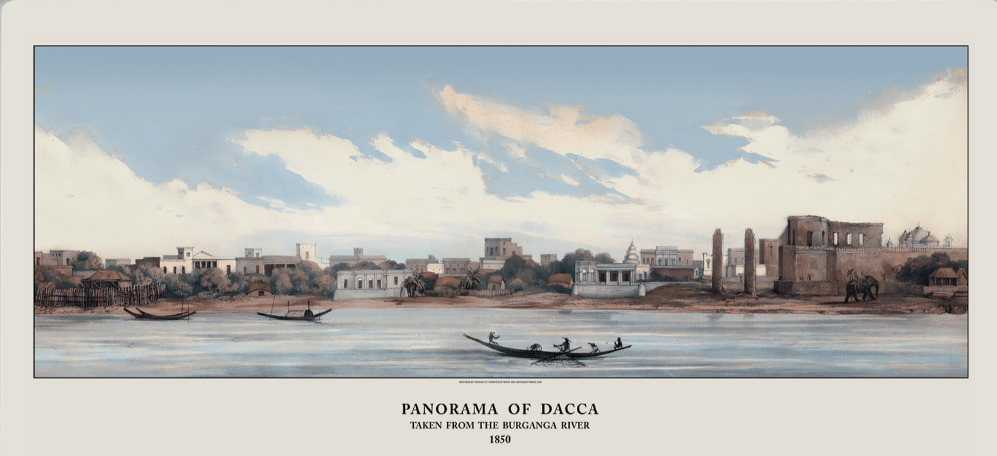
Throughout the day, on the 21st of November, boatmen from Chittagong arrived at Dacca with horrifying stories. Chittagong, they said, was destroyed. Everyone had been murdered, the sepoys had looted the town, and there was nothing left of Chittagong, they said but flames and ruins. This was far from the truth, and as the authorities well knew from their own sources, Chittagong was, in fact, untouched, and the Europeans had escaped death. However, there was little for it but to place Dacca in a state of alert. However, the cricket match scheduled for that afternoon continued as planned, the Volunteers were at their usual exercise with ball cartridge and in the evening, everyone went out for a drive.
The commissioner, however, had removed some of the treasure from the collectorate and placed it under the guard of the sailors; he then set about, with the assistance of Lieutenant Lewis of the Naval Brigade, to secure the city. A watch was set on the Megna River to prevent any of the 34th from crossing over should they be so inclined. Messages from Chittagong had been sent to the nearby districts and indeed to Dacca, warning them of the flight of the mutineers – above all, vigilance was needed. The Raja of Tiperrah had received the news, and he was preparing to intercept the 34th. The 73rd at Dacca had not shown any signs of dissent, but it was hard to know what the sepoys would do when they heard the news from Chittagong.
On the 21st, towards evening, the Dacca authorities, both civil and military, assembled. The question was not so much what to do if the 34th suddenly arrived at their doorstep but how to treat the 73rd BNI. Their officers protested that the two companies had done nothing wrong, and if the regiment at Jalpaiguri could be taken as an example, it was likely they would continue to be faithful to their salt. They had fought well since their raising in 1825 and proudly carried the battle honours, “Mooltan, Moodkee, Ferozeshuhur, Punjab” on their Colours. But protests were useless in front of men determined that nothing would be left to chance. The officers were out-voted, and the decision was made to disarm the 73rd. There would be no parade, no conciliatory words from their officers, no chance to redeem themselves. It had been noted that over the past months, the sepoys of the 73rd, some 260 men in all, had begun to take objection to the presence of the sailors who, by this time, were somewhat bored of the endless patrolling cooped up as they were in Dacca. Their behaviour towards the locals was not exemplary, and it is likely the sepoys had borne the brunt of it. It is little wonder the men of the 73rd had protested they would not stand to be disarmed if this was the rabble that would do it.
At daybreak on the 22nd of November, the Naval Brigade under Lieutenant Lewis and the 30 volunteers assembled and set out from the quarters of the sailors. They resolutely marched through the town, disarming sepoy guards as they found them at the treasury and other public buildings – there was no resistance. Mr. Brennand, who accompanied the volunteers, found the scene at the treasury most depressing.
“There were about fifteen of the sepoys standing or sitting outside their quarters, and the rest of them, making about 36, were supposed to be inside the building. They appeared very much dejected, and they reproached their officers for subjecting them to such disgrace, protesting they would have given up their arms at once to their own officers had they only been asked to do so.”
News, however, had swift feet that morning. By the time the party reached the Lal Bagh – the sprawling old fort now being used by the 73rd as their headquarters and magazine – according the Lieutenant Lewis of the Naval Brigade who led the party, they found the sepoys drawn up by their magazine with the two 6-pounder guns of the native artillery in the centre. They had taken care to position men at their hospital, at the barracks, which were on the top of a hill within the fort grounds and were taking care of the loopholes in the walls. If the report of Lewis is to be believed, the sepoys were well-organised and, above all, ready for a fight. This is insofar true but only to a point.
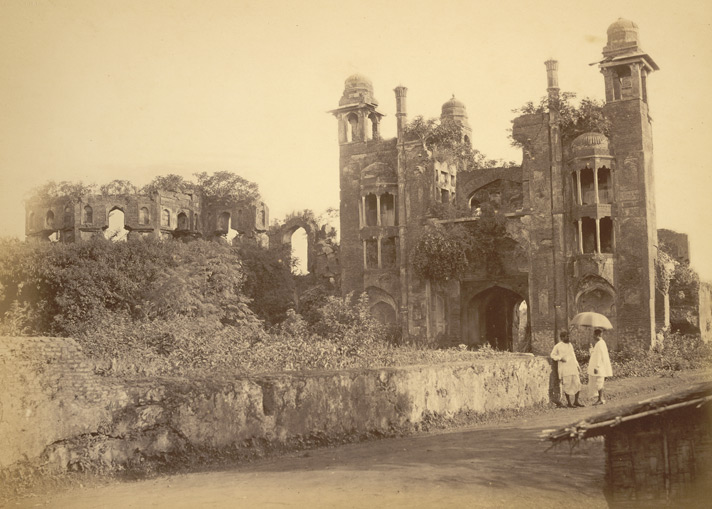
Lieutenant Lewis immediately deployed his men into line – the sepoys opened fire from the front and left flank with canister and musketry.
“We gave them one volley, and then charged with the bayonet up the hill, and carried the whole of the barracks on the top of it, breaking the doors with our musket butts, and bayonetting the sepoys inside. As soon as this was done, we charged downhill and, taking them in flank, carried both their guns and all the buildings, driving them into the jungle. While we were thus employed with the small-arm men, the two mountain train howitzers, advancing within 150 yards, took up a position to the right, bearing on the enemy’s guns in the rear of their magazine, and, unlimbering, kept up a steady and well-directed fire. Every one, both officers and men, behaved most gallantly, charging repeatedly in face of a most heavy fire without the slightest hesitation for a moment.”
The report, as presented by Lieutenant Lewis, is a far cry from what Mr. Brennand witnessed.
“The sentry first fired his musket and killed one of our men; his example was followed by the others and a volley was fired on the sailors as they advanced through the broken wall near the southern gateway. The guns had been placed in front of Beebee Peri’s tomb, to command the entrance, and they opened fire upon our men with grape. As soon as the sailors had got well into the place, they fired a volley. Lieutenant Lewis then led them up the ramparts to the left, charging the sepoys and driving them before them at the point of the bayonet. The sepoys took shelter in their quarters but were driven from building to building by the sailors. At this time, Mr Mayo, a midshipman, at the head of eight men under his command, made a gallant charge from the ramparts down upon the sepoys’ guns; they were soon taken and spiked, and the sepoys began to fly in every direction. There was a severe struggle at the end of the rampart; many of the sepoys were driven over the rampart. Mr Bainbridge also had a fall over the parapet as he stepped back to avoid the thrust of one of the sepoys. The sailors obtained a complete victory; the sepoys fled and concealed themselves in the jungle, leaving about forty killed.”
There was no attempt made to actually disarm the sepoys at any point – when the battle was over, 41 sepoys lay dead, eight were found to be desperately wounded, and three were shot at as they tried to escape across the river and drowned. The rest fled – one of their officers – Lieutenant Hitchens – had taken part in the raid, and only at the beginning of events did he attempt to speak to his men – after which he actively took part in shooting at them. It would be hard to find men more sorely abused than the two companies of the 73rd at Dacca.
The remainder of the 73rd would try to find their way to Jalpaiguri – but for the authorities at Dacca, they could say they had saved this most eastern of cities from wreck and ruin. No one considered the sepoys had reacted from fear and most likely could have been brought to reason had their officers been half the men Colonel Sherer had proved himself to be. But it was too late for the men of the 73rd now. They would become hunted fugitives.
List of Killed and Wounded during the raid on the 73rd
Lieutenant T. E. Lewis, Indian Navy, commanding the detachment, slightly.
Dr. Green, civil surgeon, severely. He was wounded in the thigh while kneeling down to attend to a wounded sailor.
Lieutenant Dowell, Bengal Artillery, slightly (spent ball).
HMS Punjab
John Jones, C.F.C., slightly.
Able Seamen
Henry Smith, mortally, since dead.
Neil McMullen, A.B., dangerously.
William Hesden, A.B., dangerously.
Alexander M‘Miller, A.B., dangerously.
George List, A.B., severely.
HMS Zenobia
Thomas Kean, artillery gunner, severely.
Robert Brown, artillery gunner, severely.
Samuel Hughes, Zenobia, Bombay Artillery, severely.
Able Seamen
James Munro, dangerously.
Charles Gardiner, dangerously.
James Hughes, artillery gunner, severely.
George Adams, severely.
William Alfred, severely.
Patrick O’Brien, slightly.
Calcutta greeted the news from Dacca and Chittagong along with their customary official letters, heaped praise on the men of Dacca. Then, with surprising speed, they despatched, on the 26th of November by river from Calcutta, three companies of H.M.’s 54th and one hundred seamen, followed the next day by another party of 100 sailors. The 54th was to proceed first to Dacca and then take up the chase of the 34th as soon as anyone figured out where they were actually headed. The sailors were to move northwards towards Rangpur and Dinajpur to protect the country from any mutineers who might consider making their way upcountry. It was suddenly deemed of the utmost importance to “secure the country,” albeit a little late.
“The morning after the fight, Monday, the 23rd of November, the three Sepoy prisoners were taken before the Zillah judge, who summarily sentenced them to be hanged on the following day. There was not the least doubt or hesitation about it, and Lord Canning’s celebrated Five Acts, which conferred upon every civilian in the country the powers usually exercised under martial law by a General Drum-head Court, fully warranted the procedure. At the appointed hour, the ground being kept by the sailors and Volunteers, the three Sepoys were escorted under the ugly and grim-looking beam by a strong guard of Native police. A dense spectre-like multitude, dressed in white, had assembled from the city and occupied every point from which a view could be obtained of the drop. A dead silence prevailed among the vast multitude of people, who could be seen in every direction as far as the eye could reach. The magistrate read and explained to each of the three men their crimes and sentences, but they said nothing; the sharp cold of a chilly November morning made them shiver, and the near approach of death had apparently struck them dumb with terror. The two wounded men had to be assisted up the drop; the other, a Hindu, went up the ladder unaided and met his doom with much fortitude. He, at the last moment, preferred a request to the magistrate that his body should not be buried but be thrown into the river. He was told that his request was granted. When the bolt was drawn and the three men were seen suspended in the air, a low, long-continued moan arose from the hitherto silent multitude, which soon afterwards dispersed as quietly as it had assembled. This was the last act of the mutiny at Dacca. For seven long months, the European inhabitants had been sleeping with revolvers under their pillows and with their guns loaded by their bedsides, ready for immediate use. All care and anxiety were now removed.” (History of the Indian Navy, Vol II, p.443, Lowe, 1877)
Sources:
A Postscript to the Records of the Indian Mutiny – Lieutenant-Colonel G.H.D. Gimlette (1927)
Further Papers Relative to the Mutinies in the East Indies, No. 6, No. 9 (1858)
Bulletins and other State Intelligence for the Year 1858 Part I – T.L. Behan (1860)
History of the Indian Mutiny 1857-1858, commencing from the close of the second volume of Sir John Kaye’s History of the Sepoy War, Vol II – Col. G.B. Malleson (1878/1879)
A Short Account of Events during the Sepoy Mutiny of 1857-58 in the Districts of Belgaum and of Jessore -Walter Scott Seton-Karr (1894)
Eastern Bengal District Gazeteers, Dacca – C.Allen (1912)
Dacca, the Romance of an Eastern Capital – F.B. Bradley-Birt (1914)
 Mutiny Reflections