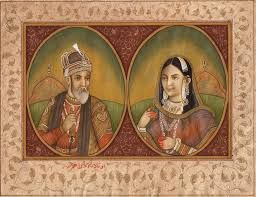
In 1857, Delhi was home to the last Mughal Emperor, Shah Mohammed Abu Zuphur Saraz-o-dain Mohammed Bahadur (or as he is better known, Bahadur Shah Zafar) descendent of the great Emperor Shah Jahan, and now, at the age of 82, an old man, the only power left to him was his name. He was given to sitting cross-legged on his bed and writing poetry while surrounded by intrigue and strife in this curious world where he existed as much in the past as others in the present.
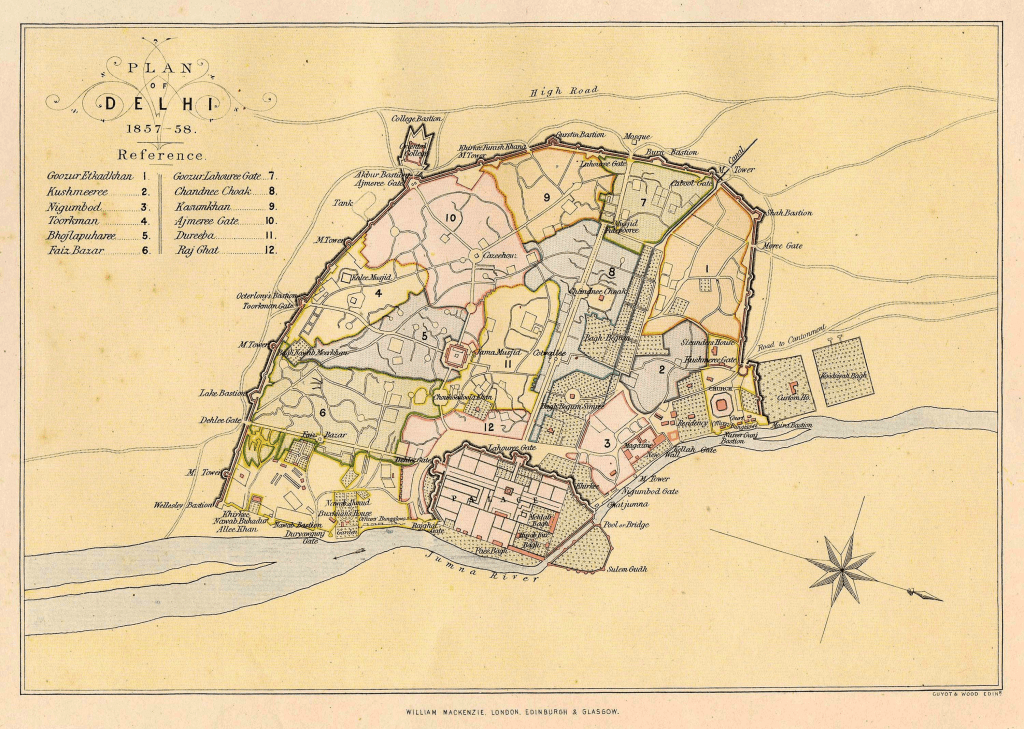
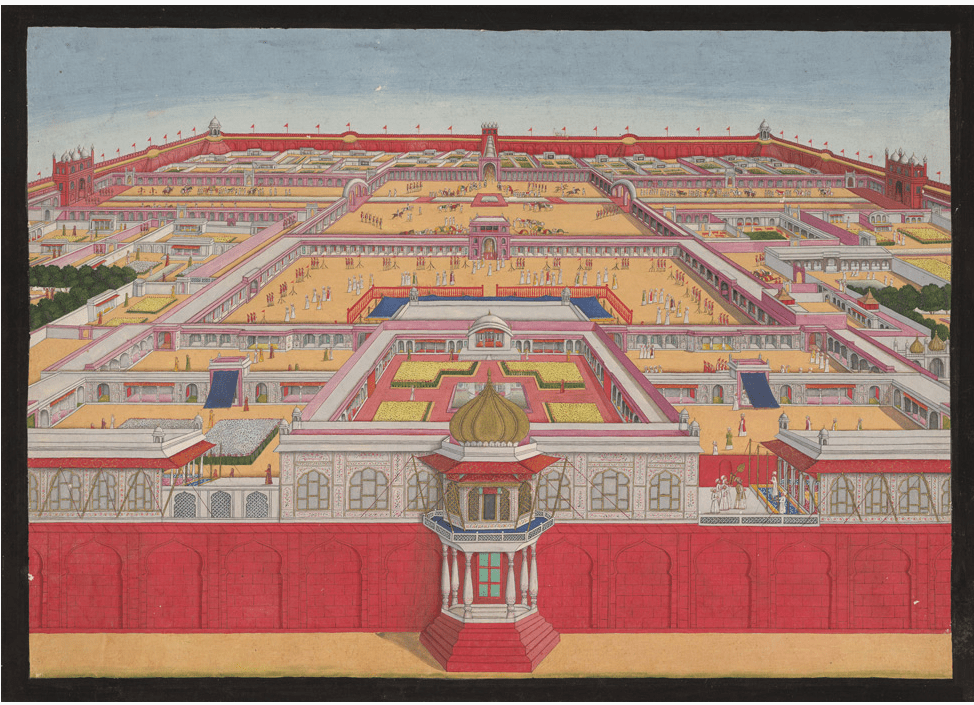
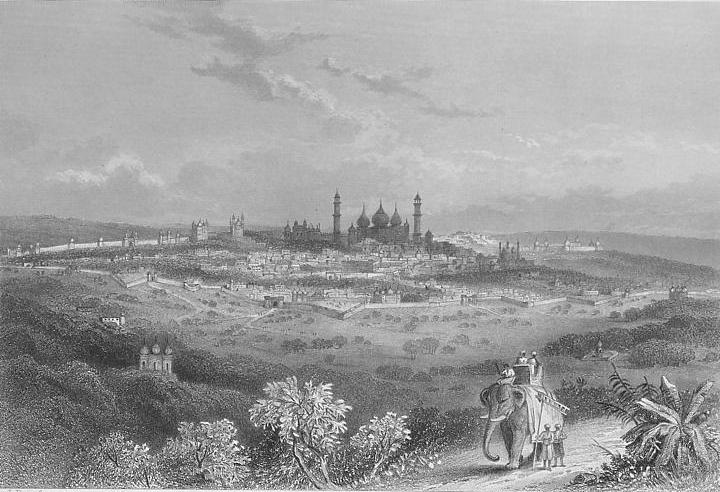
The Red Fort, built by Shah Jahan, with walls running for a mile and a half in circumference and some 110 feet high, overlooked the River Jumna. It had eight uneven sides, with two longer sides on the east and west, and six shorter walls on the north and south. A ditch some 75 feet wide and 30 feet deep circled it, making it virtually impenetrable from without, while from high on the walls, thousands of loopholes looked down on the moat.
Inside the Fort, a veritable warren of royal dwellings, meeting halls, and council chambers presented itself, intertwined with gardens. Royal baths sprayed fountains of rose and lavender water, the courtyard was spread with carpets from Persia and silk curtains, while a Rhapsodist, whose only duty was to tell stories to the king who lay on his scented couch listening in serene contentment.
Within the walls, the world was given over to
“A maze of houses, some of masonry, some of mats, some of mud. The larger houses contained underground rooms, intricate passages, enclosed courtyards, dark and mysterious holes and corners, secret doors and outlets which communicated from house to house. Hundreds of young men and women, living without occupation and with little to amuse them…hundreds of worn-out old men and women with nothing to look forward to but the grave. The young were given over to lust, the old to intrigue.”
Bahadur Shah Zafar had been on the throne since 1837, but he was nothing more than an emperor in title. The vast Mughal Empire existed but in name alone, and his own authority was now greatly diminished. This once vast empire had been decimated by war with the Marathas in the Deccan, who had effectively ended Mughal rule back in the 18th century, their territories gradually becoming assimilated by the Marathas or declaring independence and turning into small kingdoms of their own. The Marathas installed Shah Alam II on the throne in 1772; the Mughal Empire was reduced to a tributary state. With the growing political and military power of the East India Company by the mid-nineteenth century, the emperor of the once mighty Mughals was further reduced. He was provided a pension by the Company and allowed to collect taxes from Delhi, and he kept a ceremonial military force in the fort, which was under the command of a British officer. By 1857, the emperor’s territory was confined to these red walls and only as far as Palam, some 20 kilometres away, as the crow flies. However, a name can travel far and still carry weight.
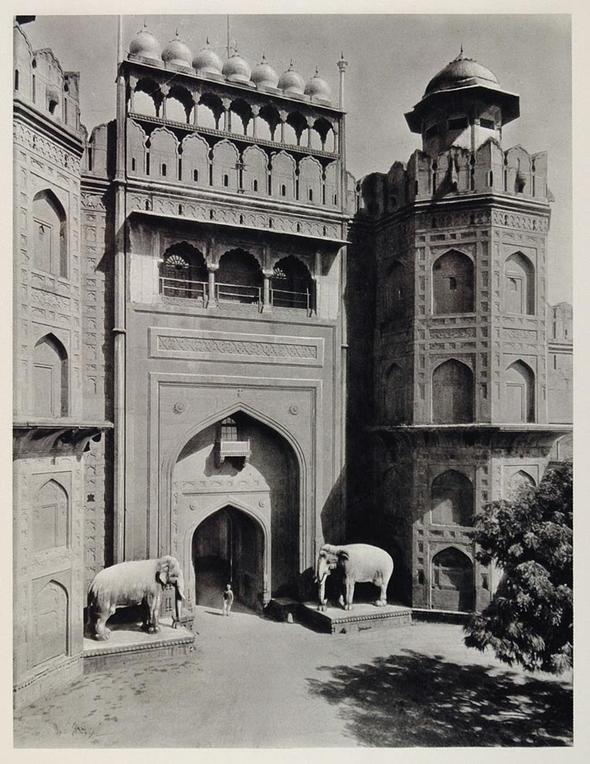
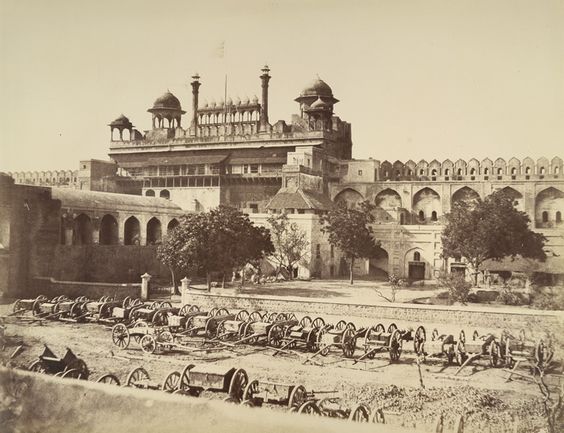
The civil lines of Delhi were located above and below the Fort and housed offices, bungalows, and a European enclave called Daryaganj. To the west was the Delhi Bank, and north of it, St. James’ Church with the Main Guard just behind it. The northwest walls of the fort looked out over the river, which was crossed by a bridge of boats, and led then onwards to the Meerut Road. The walls themselves were cut by gates of formidable size, Lahore Gate (where the British officer, Captain Douglas, had rooms above it) and Delhi Gate, both standing 41 feet high and 24 feet wide. A further six smaller gates completed the picture.

The Mutineers from Meerut Arrive – The 11th of May
Sometime during the afternoon on Sunday, the 10th of May, a few sepoys from Meerut arrived in Delhi. Although it isn’t clear as to what news they brought with them, one can be sure the story of the horrifying shackling parade was probably not far from their minds – very likely, they had more than a few words to say about it. But when they arrived, Meerut was only just starting to simmer. Later on that night, a horseman arrived from Meerut – exhausted and desperate to give a letter to Simon Fraser, the Commissioner of Delhi.
Mr Fraser wasn’t in the mood for visitors – he had supped all too well and was now dozing in his chair on what was a hot and sultry May evening, his servants too scared to wake him from his slumber, even if it was for what appeared to them a very important letter. Yet awakened he was – and in his sleepy stupor and not realising what the message was, he put the letter in his pocket, unread, and resigned himself back to Morpheus.
This wasn’t the only news to reach Delhi. The men at the telegraph office had been puzzling things out, too, on Sunday. The heat drove everyone indoors, and the telegraph office was shut during the worst of it, only to reopen again around 4 p.m. Before shutting shop around 11 am, the Delhi signaller, 18-year-old Anglo-Indian William Brendish, heard about a disturbance in Meerut regarding the sentencing of the cavalrymen. What he was given to believe was that the 85 men were to be blown from guns – a notion so absurd that Brendish didn’t listen for more news. He simply closed the doors and went home. When he returned, he found that all communication with Meerut had ceased. Curious as to what could be causing the interruption, Brendish and his equally young assistant, J. W. Pilkington, decided to follow the cable to the cable house located on the far side of the river. Testing the line there, they found the fault must be closer to Meerut, but it was slowly getting dark, so further investigations would have to wait until morning. They reported to the superior, Mr Todd, who arranged to drive out the following morning to find the break.
Unfortunately for Mr Todd, he met the very first mutineers from Meerut – 20 sowars of the 3rd Cavalry – on the road on Monday morning, the 11th of May, and was never heard from again.
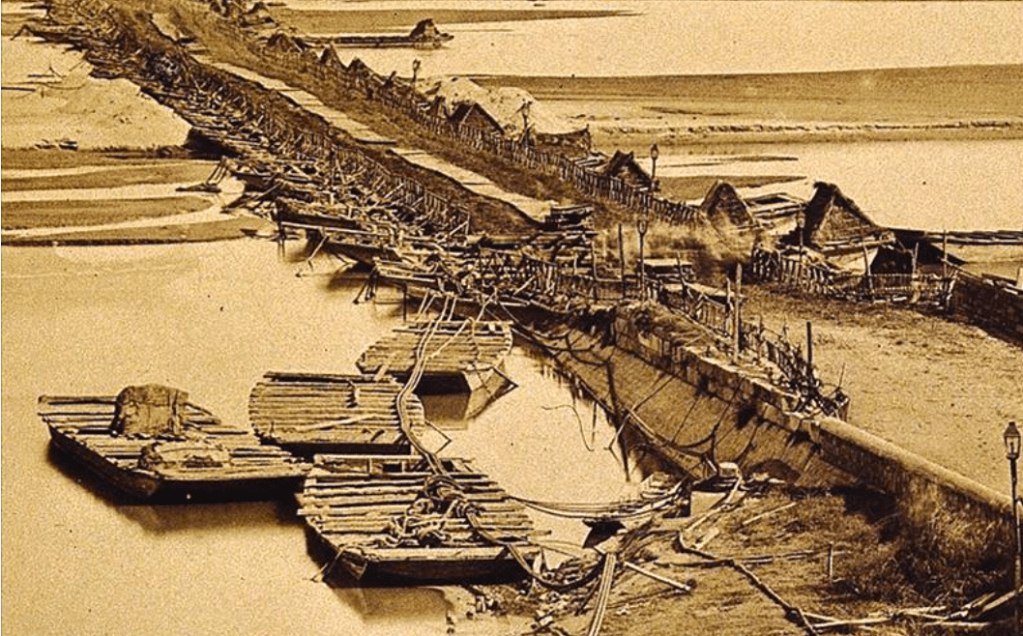
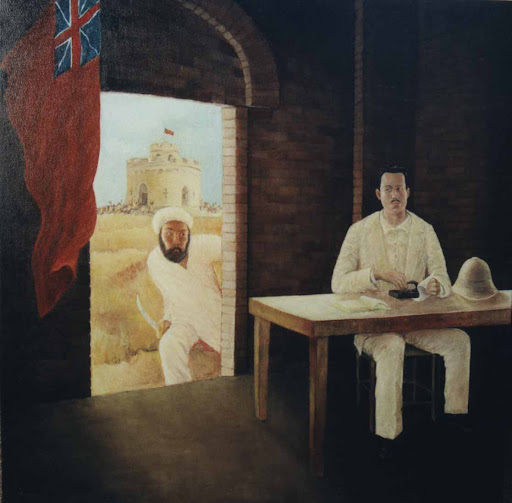
The mutineers from Meerut arrived in Delhi quite unexpectedly in the morning, crossing the Bridge of Boats over the Jamuna, killing not just Mr Todd but the bridge toll keeper. At first, a lone rider made his way to the Lahore Gate but was refused entry by a guard of the 38th Bengal Native Infantry. Captain Douglas, Commandant of the Palace Guard, was informed of the man’s arrival, and he came down from his rooms to find out what he wanted. The sowar replied that he had just arrived from Meerut, where he had mutinied and had come to the guard for a drink of water and a pipe. Douglas immediately ordered his arrest, but it was too late; the man put spurs on his horse and rode off.
The old King, too, from his chambers, could see the arrival of the rest of the mutineers from Meerut. Advised to shut the gates below, he gave the order and sent for Captain Douglas. Soon, more of the mutineers arrived and began loudly to demand an audience with the King. Afraid of letting Douglas open the gate and go down to meet the men, the King advised Douglas to speak to them from the balcony. Douglas told them, “Don’t come here! These are the private apartments of the ladies of the palace. Your standing opposite them is a disrespect to the King!” On hearing this, the men moved off, heading to the Rajghat Gate in the south. The King instructed Douglas to close all the city gates, which Douglas proceeded to do, starting with the Calcutta Gate, where he found the commissioner Simon Fraser, the magistrate John Hutchinson and Fraser’s head clerk, Mr Nixon, and was briefly joined by Theophilus Metcalfe.
The Calcutta Gate was already closed, but the men received a message that the mutineers had entered the city via the Rajghat Gate and were already plundering Daryaganj, where most of the European populace lived.
As if by command, a group of sowars now appeared from that direction and fired a volley at the gathered men, wounding Hutchinson in the arm and causing the rest to flee. Fraser, hiding in a sentry box, found a musket and shot dead one of the assailants, then, mounting his buggy, he sped off towards the Fort. Douglas, Hutchinson and Nixon followed Fraser on foot, but along the way, Nixon was killed and would later be found with a biscuit stuffed in his mouth. Seeing no other means of escape, Douglas and Hutchinson leapt into the ditch which surrounded the fort. However, the jump injured Douglas severely on his feet and his back. Only with the help of some loyal servants were they then carried back to Douglas’ apartments above the Lahore Gate. Here, the injured men were tended to by Miss Jennings, the Reverend Jennings’ daughter and Miss Clifford, her friend who had arrived in Delhi the previous day. Meanwhile, Mr Fraser attempted to send the two girls into the protection of the King’s wife, Zeenat Mahal, but it was too late.
Armed only with a sword, he went down to meet the mob.
“Mr Fraser, seeing such marked feelings of hostility, began to return to Captain Douglas’ quarters, and as he reached the foot of the stairs, Haji, lapidary, raised his sword and made a cut at him. Mr Fraser, who had a sheathed sword in his hand, turned sharply around and thrust at him, with the sword in its sheath, saying to the havildar of the gate guard, “What kind of behaviour is this?” Upon which the havildar made a show of driving off the crowd, but no sooner had Mr Fraser’s back turned than the havildar nodded with his head to the lapidary to signify to him that now he should renew the attack. The lapidary, thus encouraged, rushed upon Mr Fraser and inflicted a deep and mortal wound on the right side of his neck. Mr Fraser at once fell, when three other men…rushed out and cut him with their swords over the face, head and chest until he was quite dead.”
Unhindered, the mob rushed upstairs to Captain Douglas’ apartments and, armed with tulwars, quickly killed Mr Hutchinson, Reverend Jennings and the two ladies. One of the King’s bearers, Mamdoh, grabbed hold of Jokhun, Captain Douglas’ mace bearer (who was trying to flee the apartments) and forced him back upstairs.
“I said, ‘You have yourselves killed all the gentlemen already,’ but on reaching the room where Captain Douglas was, I saw that he was not quite dead. Mamdoh, perceiving this also, hit him with a bludgeon on the forehead and killed him immediately. I saw the other bodies, including those of the two ladies. Mr Hutchinson was lying in one room, and the bodies of Captain Douglas, Mr Jennings and the two young ladies in another, on the floor, with the exception of that of Captain Douglas, which was on a bed.”
Bahadur Shah was told of the killings, and he decided it would be best to close all of the gates to the fort before anything worse could happen. Yet the two companies of the 38th BNI on guard at the palace were no longer in the mood to be given orders by anyone and flatly refused. Instead, they marched to the Hall of Audience, calling out to the king. Gradually, the hall filled with men from Meerut who told Bahadur Shah what they had done in Meerut and proclaimed they had come to him for protection. The king was not particularly impressed by their behaviour, admonishing them for having acted “very wickedly”, but he was not going to win this battle. The gates were open, and now before him stood 200 men of the mutinous Meerut regiments, each one declaring the king must join their cause. Bahadur Shah sat himself down on his chair, and one by one, the men came forward, bowing their heads, “asking him to place a hand on them. The King did so, and each withdrew.” He had become a titular leader of a mutinous army.
Delhi Explodes
Back at the telegraph office, Brendish and Pilkington were manning their station, as usual, waiting to hear back from Mr Todd and still puzzling over the break with Meerut. They did not have to wait long – a messenger from the Delhi Gazette brought them the first news that those men from Meerut had indeed arrived – they promptly sent the news to Ambala, where a British garrison was stationed. Then, they waited. They could hear the sound of shouting outside their office, and as the din became louder, it became increasingly clear that something was not right in Delhi. At noon, Brendish finally decided to see what was happening, and to his surprise, he could see what looked like an exodus of Delhi’s population all rushing down the road with as many of their belongings as they could carry, all moving as fast as their baggage would allow, a mad throng escaping in one violent rush. All of a sudden, a voice from the crowd shouted out to Brendish,
“For God’s sake, get inside and close your doors!” It was a British officer in a torn and bloodied uniform, and unable to get out of the moving mass of people, he quickly disappeared in the writhing crowd. Realising that their situation was certainly worse than they could imagine, Brendish and Pilkington did just that – unarmed as they were, they shut the doors and now tried to persuade Mrs Todd, who had come down earlier to the office searching for her husband, that waiting for him now was probably an exercise in futility. It would be another two hours before they could persuade the woman her husband was probably never coming back.
The final act of William Brendish was to send a message to Ambala, which would send waves through the country.
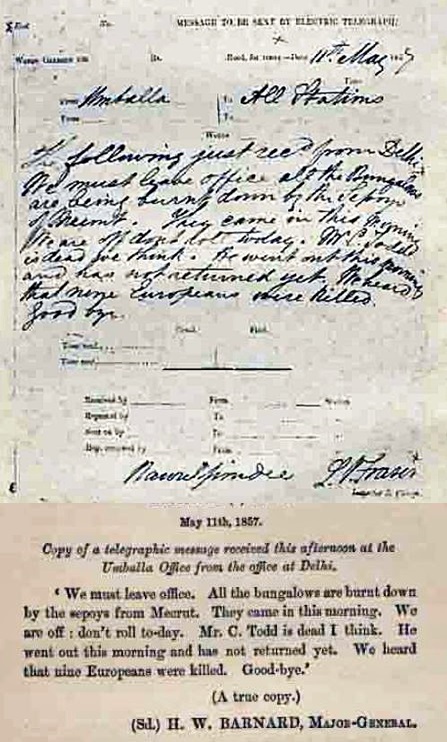
Then Messrs Brendish and Pilkington and Mrs Todd made their way to Flagstaff Tower. It was not the last message William Brendish would send to Ambala -later on in the day, under orders from Brigadier Graves, he would telegraph the following:
“Cantonments in a state of siege. Mutineers from Meerut 3rd Cavalry, numbers not known, said to be 150 men. Cut off communications with Meerut. Taken possession of the bridge of boats. 34th NI sent against them, but would not act. Several officers killed or wounded. City in a state of considerable excitement. Troops send down but nothing known yet. Further infantry will be forwarded.”
On Tuesday morning, the British authorities all over India woke up to the very real threat they had done so much to ignore, sent by a girl from Meerut and an 18 year old signaller from Delhi.
Delhi Infected
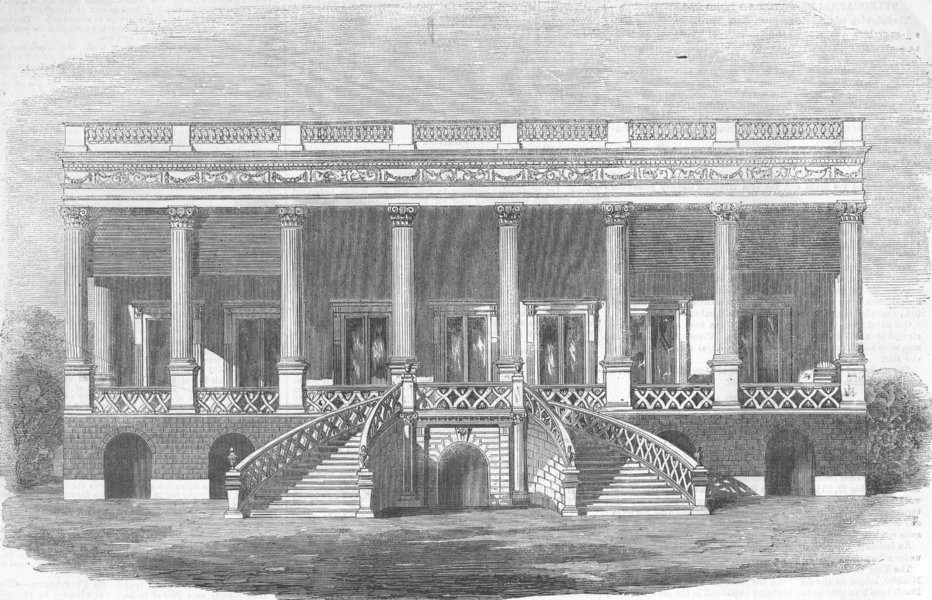
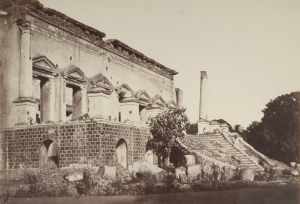
As in Meerut, mob rule had infected elements of the population and, gloating from their success of murdering Captain Douglas and his companions, the riotous mob took to the streets of the city, plundering and killing as they went, leaving behind destruction and death. Shops were plundered, and old grudges were taken care of as swarms of people, civilians and sepoys alike, tore through the city, hell-bent on grabbing anything of value. They stormed the Delhi Bank and massacred the staff who had valiantly tried to fend off the looters with ledgers and sticks, while the manager, Mr George Beresford, his wife and their daughters found refuge on the roof of an outbuilding. Armed with nothing but a sword and his wife carrying a spear, the Beresfords put up a fight, but their attackers outnumbered them, and soon they were overwhelmed and murdered. Having broken open the vaults and stolen everything they could, the mob set fire to the Delhi Bank.
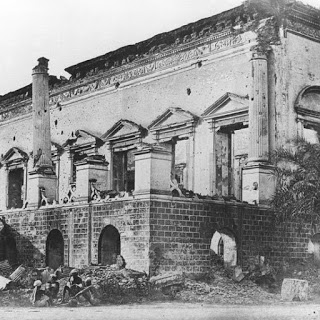
In the office of the Delhi Gazette, a group of diligent Christian compositors were hard at work setting the type for a special edition of the paper bearing the stamp “Delhi Gazette EXTRA” when they were set upon by the mob who rushed into the building and killed nearly all of them and then proceeded to demolish the premises, throw the presses into the river and “meltdown the type into slugs.” They ransacked St. James’ Church, smashing the monuments on the walls with hammers and axes, stealing the sacramental plate, destroying the furniture, and, after ringing them in glee, they cut down the bells, which came crashing down to the floor below.
Killing Christians was the order of the day, whether European or Anglo-Indian and anyone unlucky enough to be caught out by the mob very swiftly met a gruesome end. While the soldiers would set their sights on killing their officers, like in Meerut, the local population was not so discerning. Although some 50 prisoners were taken and brought to the fort, their inevitable fate was only postponed for a few days before they, too, were brought out and killed.
In the Kashmir Bazaar – one of the first areas to rise up the families of the English merchants, Mr William Clark and Mr John Morley, who shared a house, were in a state of alarm. Leaving their servants to watch out for any approaching mobs, the two families hid at the back of the house. Three hours passed, and the crowds had drifted elsewhere, so Mr Morley decided to head out into the city, if nothing else, to figure out if they could somehow escape. He had not gone far down the empty street when he saw a crowd of men in the distance. As he watched the group with the growing fear they could be heading to his house, he did not see the others who suddenly made a rush for his gateway, which was behind him. John Morley, only armed with a stick, started to run. Some men now gave chase. Although he managed to evade his attackers, it would be a few hours before he returned home.
Upon coming back to his house, he found the garden strewn with broken furniture, shattered crockery and burning clothes. His thoughts immediately turned to his own family and that of the Clarks, all of whom he had left alive but a few hours ago. He found his washerman, cowering in a cowshed at the back of the house, who told him what had happened.
“..Oh Sahib, when you were gone away, the Memsahibs and the children all sat together very frightened, for we could hear a great noise and firing of guns. And Clark Sahib got out his fowling piece and loaded it….Soon, a large crowd with sticks, swords and spears came into the compound. Clark Sahib stood on the steps and said, “What do you want?” They only abused him and said they would kill every Feringhee…The people rushed in. The servants all ran away. Only I remained behind…” Mr. Clark implored the mob to take everything and leave them their lives, but they only laughed at him and proceeded to” break and loot everything. My memsahib had taken three babes into the ghosoulkhana and shut the door. Mr. Clark had stood with his gun behind him. But they saw it and said, “Give it to us.” Then, one man went to Mrs. Clark and spoke bad words to her. Clark Sahib called out in a terrible voice, ” You soour!” and shot him dead. He then wounded another man with the other barrel and commenced fighting with his gun like a lattee. I knew now they would murder everyone…”
The dhobi tried to save Mrs. Morley and the children, “…but there were people all around the house. They hit me and told me to go away, or they would murder me, too. I went into the garden and sat behind a hedge. I heard a great crying, and they threw things out of the house and broke the panes of glass in the doors. Then they said, ‘Let us go and loot.’ And they all went away.”
Inside the house, Morley found everything had been destroyed, the furniture was smashed to bits, and the contents of the food cupboards were strewn about, leaving a nauseating smell of brandy and wine mixed with broken bottles of jams and preserves. He steeled himself enough to enter the next room where he found the Clarks side by side, dead on the floor, their little son “pinned to the wall with his head hanging down.” He did not have the strength to enter the ghosoulkhana, where he knew he would see his own family massacred. He would eventually escape Delhi, which will be told elsewhere.
Dr Chaman Lal, a Hindu convert to Christianity, had been attending to his patients in his Daryaganj clinic when he was murdered, having been pointed out by people on the street to the sepoys charging into the city from Raj Ghat Gate. “One soldier pinned him down, sat on his chest and asked what religion he was. When Dr Lal replied that he was Christian, the sowar shot him dead at point-blank range with his pistol.” The cavalry then proceeded to ransack the hospital and burn it down.
It wasn’t just Christians – some of the first people to be looted in Delhi who, besides being unpopular, were also immensely rich. Some of the city’s wealthiest patrons were targeted for the same reason, and anyone found harbouring English fugitives could expect nothing but death at the hands of the mob.
The civilian population at Delhi had had no warning, no possible way to protect themselves. Those who could made a rush to Flagstaff Tower, and others tried their best to hide and avoid capture, with greater or lesser success. Delhi too had a military, but just like in Meerut, they had been thrown into confusion.
 Mutiny Reflections