We all die, and like the waters that return no more, we fall into the earth (2 Kings, xiv, 14)
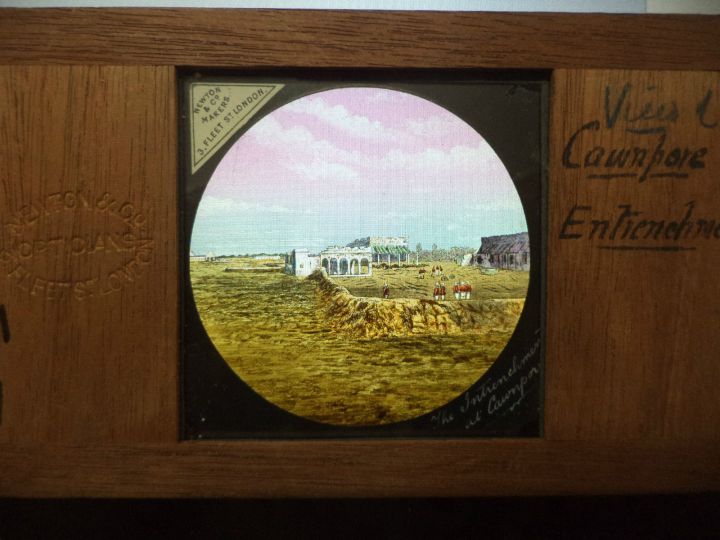
There were three separate massacres at Cawnpore:
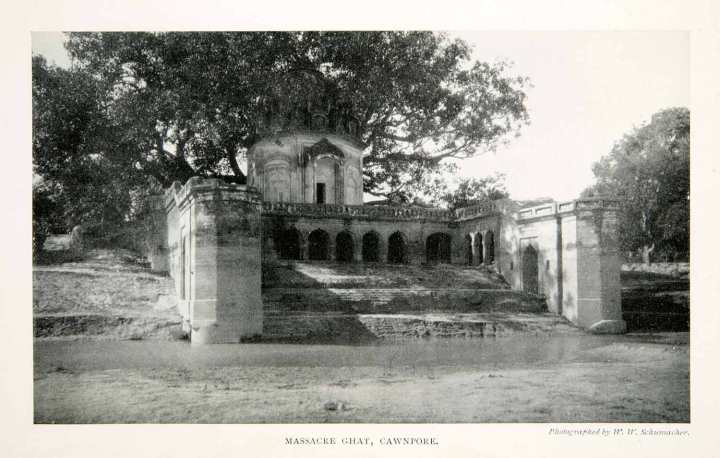
27th of June – Satichaura Ghat
30th of June – Those who had escaped in the boats were captured and executed at Savada Kothi
15th of July -Bibighar – A more complete list of the victims of Bibighar can be found in “Names of Those Who Perished at the Bibighar. Here, they are marked in italics.
A.
Anderson, J.C. (East Indian Railways -EIR) and wife and child – killed at Satichaura Ghat
B.
Baines, J.C. (Assistant Engineer) died on the 30th of June
Baines, Mrs. and son Philip
Barlow, Mr. – killed during the siege
Mrs. Battie
Mrs. Barbing
Batavia, Martha, Miss – aged 17. Orphaned niece of Jonah Shepherd. Killed at Satichaura Ghat
Mrs. Bell and daughter, Alpen, aged 6
Bennett, Eliza – granddaughter of pensioned bazaar Sergeant Ried.
Berrill, Mr Thomas A., East Indian Railway
Berrill, Mr Henry, East Indian Railway
Bisset, Miss
The Blairs
Blair, Mr.
Blair, Mrs. Susan (aged 49, née Kennedy)
Blair, Susan Miss (aged 17)
Blair, Isabella – died of fever in the entrenchment (aged 24)
The Alexander, Blair, Kennedy, Master and Newenham families all shared losses at Cawnpore; however, for one member of this bewildering family, the tragedy had started long before.
Susan Kennedy was born in India and possibly in Cawnpore in 1808. She was the eldest of General James Kennedy’s (of the 5th Bengal Light Cavalry) 11 daughters and four sons. At 16, she married Edward McLeod Blair of her father’s regiment and bore him eight children. Captain Blair went on active duty with his regiment to Afghanistan and was killed during the retreat from Kabul at Jagdalak. In 1856, Susan Blair, with her daughters Isabella and Susan, returned to India from England. Her youngest sister, Charlotte, the wife of Arthur Wellesley Robert Newenham (one-time resident surgeon at the Indore Charitable Hospital, now attached to the 1st Bengal Native Infantry), was residing in Cawnpore as was her nephew, Lieutenant Gilbert Augustus Master, the 25-year-old son of Brigadier Colonel Robert Augustus Master (at Lucknow in 1857) – the colonel’s wife, Marian, was none other than the fourth daughter of General James Kennedy and Susan’s sister.
Her ageing parents and other members of Susan Blair’s extended family were residing in Benares. Among them was Lieutenant-Colonel William Alexander, of the 8th Bengal Light Cavalry, who had been married to her sister Ann until she died in 1844. Their son Augustus Hay was stationed with the 68th Bengal Native Infantry at Allahabad, where he would be killed during the uprising.
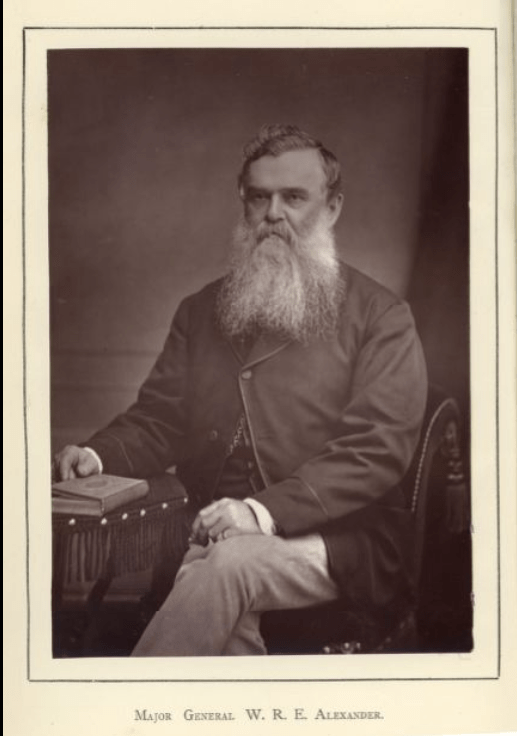
As things go, one of Susan’s daughters, also named Charlotte, had married her cousin Captain William Ruxton Eneas Alexander (the brother of Augustus Hay), 1850, of the 53rd Bengal Native Infantry. When the mutiny broke out, they were stationed at Oorai and would escape death.
As it is, the last news anyone would have about the Blairs would be from Lieutenant Master, who wrote from Cawnpore to his father on the eve of the Satichaura Ghat massacre:
“We have now held out for twenty-one days under tremendous fire. The Raja of Bithoor has offered to forward us in safety to Allahabad, and the General has accepted his terms. I am all right, though twice wounded. Charlotte Newnham and Bella Blair are dead. I’ll write from Allahabad. God bless you. Your affectionate son, G.A. Master.”
Meanwhile, Susan Blair’s three sons, James, Charles Renny and Thomas Hawkes, were also in India. They would join the Bombay army – it would be Captain James Blair, with the 2nd Bombay Light Cavalry, who would win the Victoria Cross in Central India in 1857. A cousin, Lieutenant Robert Blair of the 9th Lancers, would win his at Bulandshahr. Sadly, Captain Thomas Blair, of the 19th Bombay Infantry Regiment, died at Mahidpore in 1862. Susan’s father, General James Kennedy, died in 1859 – her mother lived long enough to meet the Prince of Wales in Benares during his India tour in 1876.
Bothwick, Mrs
Brightman, Miss – died in the entrenchment. Sister of Mrs. Harris. She “died of fever consequent upon the fatigue she had incurred in nursing Lieutenant Martin, who was wounded in the lungs.”
Brierley, Edwin, Mr. – (E.T. Office)
Brett, Mrs.
Burn, C. Miss
Burn, Miss
Bunney, Mr.- Horsebreaker. Killed at Satichaura Ghat.
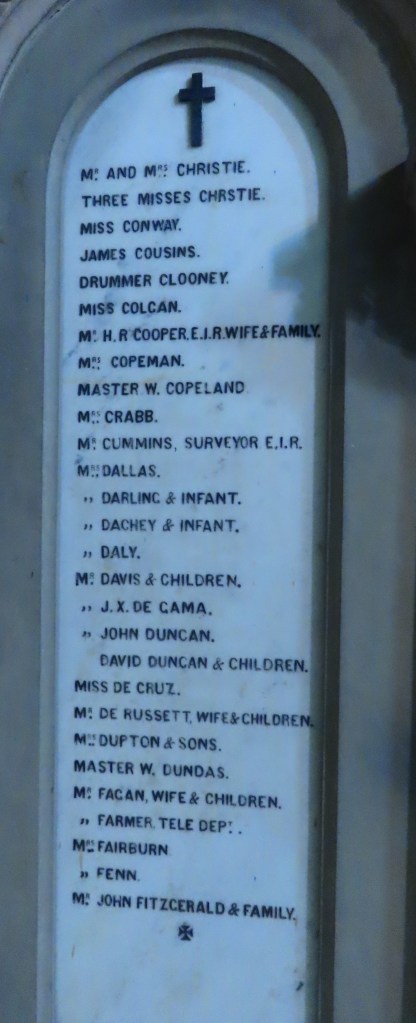
C.
Calay, two Masters, George and C.
Chandler, Emma, Miss – Killed at Satichaura Ghat
Cheeters, Mary, maid to Mrs Prout
Campbell, Mr.
Campbell Mrs.
Carroll, Mrs
The Christies
Christie, Henry, Mr. – Killed 21st June
Christie, Mrs. – Killed at Satichaura Ghat – her sisters, the two Miss Macmoran’s, were also in Cawnpore.
Christie, 3 Misses – Henrietta killed at the Bibighar
Christie, Master
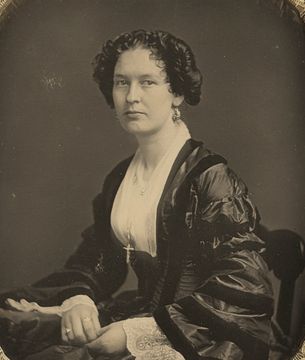
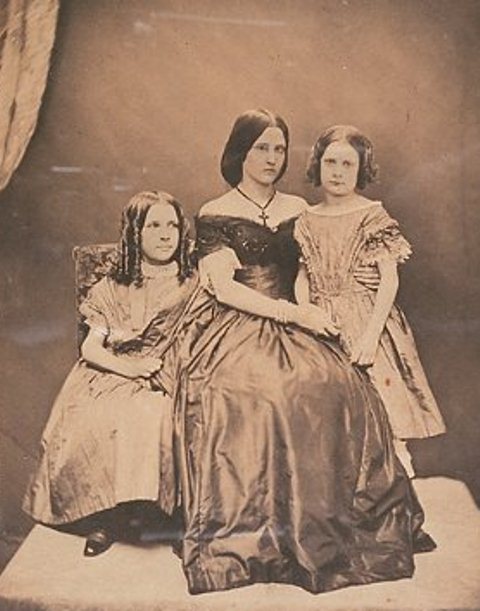
In better times, Henry Christie had been a prosperous businessman in Cawnpore in the firm Bathgate & Co., Chemists and Druggists. With his wife Mary and three of their daughters, Constance, Henrietta, and Georgiana, they had lived in a house on a hill overlooking the Sati Chaura Ghat. While Henry and Georgiana would succumb to heat stroke during the siege, Mary and her daughter Constance would be murdered within view of their former home. Henrietta alone braved her fate at the Bibighar.
Collins, I.R., Inspector, Post Offices
Conway, Maria, Miss and one Miss Conway
Cousins, James, Master
Connelly, Mrs.
Cockey, H.E. Rev. – 27th June
Colgan, Mrs.
Cook, R.B. Mr. (Opium Dept)
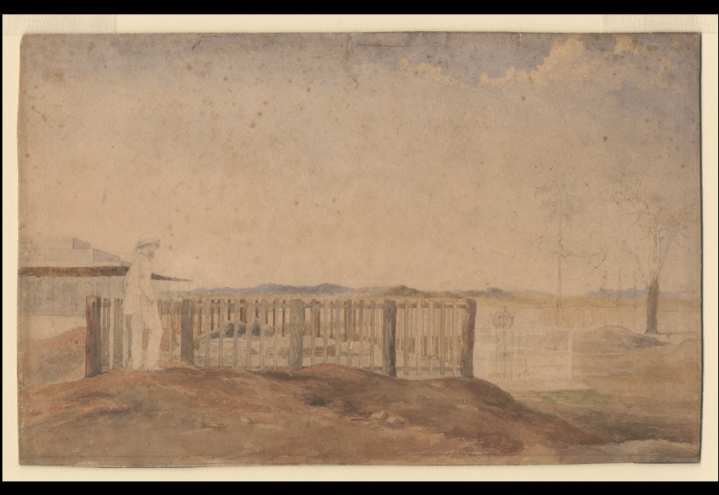
Cook, John Hampden – killed at Satichaura Ghat. His wife, Emma Elizabeth, was the
mother of Amelia Horne.
Children: Florence Trevor Cook (1849-1857), William Thomas Hampden Cook (1851-1857), Ethel Trevor Cook (1852-1857), Herbert Hampden Cook (1853-1857), Mary Trevor Cook (1855-1857)
Mrs Cook was 8 months pregnant.
Copeman, Mrs.
Cooper H.R. Mr. (EIR) -killed on the 30th of June. Jonah Shepherd would find his portfolio in October 1857, but it had been badly damaged by water when searching for the body of Dr Harris and the others who had been murdered at Savada Kothi. As he was collecting theremains, he saw something sticking out of the ground that looked like a towel. He had it dug up and found, “…that a large portfolio was wrapped up in it…the leaves were glued together and could not be separated now that it was dry; and there were traces it contained fancy note paper and envelopes, also many fragments of poetry written in a neat lady’s handwriting.” One of the compartments of the portfolio contained visiting cards, most of which were illegible, but he discovered one with the name, “Mr H.R. Cooper” on it.
Cooper, Mrs.
Cox, Mr., killed by a shell in the entrenchment. “On one occasion, a shell from the enemy’s mortar battery fell into Whiting’s battery, into the midst of a group of soldiers’ wives who were sitting together in the trench, — seven of them were killed and wounded; Mr. Cox, formerly of the 1st Bengal Fusiliers, lost both his legs and died; and Mr. Jacobi, a watch-maker, was also killed by that one missile.”
Crabb, Mrs.
Cripps, S.E. Mrs., died in the entrenchment
Cummins, Mr., Railway Department, was wounded in the entrenchment and died of his wounds.
D.
Dallas, Mrs.
Darling, Mrs., and infant
Dachey, Mrs., and infant
Darby, Mrs., and infant – her husband was in Lucknow. He died of wounds in November.
Daly, Mrs.
Davis, Mr. & four children
De Cruz, Miss (Teacher at the Free School)
DeRussett, Mr. (Merchant of the firm Brendon and Co.) – Killed at Satichaura Ghat
DeRussett, Mrs. – died in the entrenchment, 11th June. She had been unstable before the siege but the first shots drove the poor woman out of her mind. She died of fever and exhaustion.
DeRussett – 2 children, presumed killed
Duncan, David, Mr. (Manager of the United Service Hotel) – Killed at Satichaura Ghat
Duncan, Mrs. – wife of the above. Her twins, a boy and a girl, were killed on the 20th of June when a shell burst in the barrack where they were sleeping. Mrs Duncan was killed at the Satichaura Ghat, and her son Henry, at the Bibighar.
Duncan, Henry, Master – he was killed at the Bibighar
Duncan, John Mr. – older brother of David Duncan
Dupton, Mrs. and three sons – Charles, William and Henry
Durdan, Weston, Master
Dundas, W. Master
Duffey, Apothecary
E.
Elliot, Mr.
Evans, Mrs. and 2 children killed by a fall of masonry. Her husband was serving in Lucknow
F.
Fagan, Mr., wife and 2 daughters
Faulkner, Mr.
Farmer, Mr.
Farnon, Mr. (Telegraph Dept.) escaped
Fairburn, Mrs.
Fenn, Mrs.
Finlay, Mr.
Fitzgerald. John, Mr. and five children. He was killed during the siege and his wife at Satichaura Ghat. The children, Margaret, Mary, Tom, Ellen and John were killed at the Bibighar
Forsyth, W., Assistant Engineer, East Indian Railway – killed at Satichaura Ghat
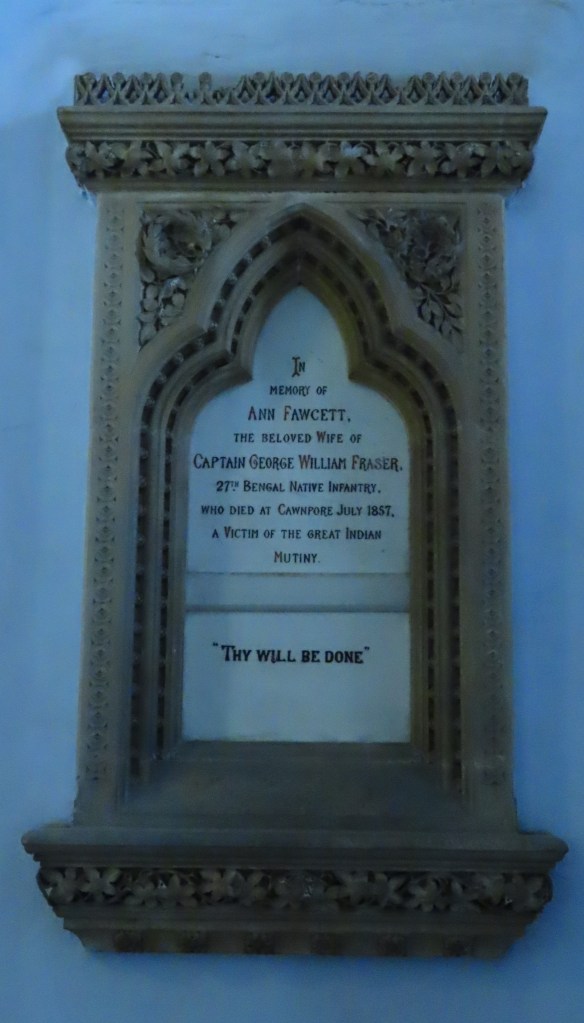
Fraser, Mrs Ann Fawcett -she had escaped to Cawnpore from the Delhi mutiny in May, with just her coach driver for protection. She was the wife of Captain George William Fraser, 27th NI. She escaped in the boats but was brought back and died at the Bibighar.
Freeman, Mr. – killed during the siege.
Frost, Mary, Mrs., aged 60 years – killed at Satichaura Ghat. Mother of the late Francis Frost, Head Assistant of the Presidency Executive Commissariat’s Office, Calcutta.
Frost, Rebecca, Mrs., aged 25 years and infant son – killed at Satichara Ghat, widow of Francis Frost.
Rebecca Frost was the sister of Jonah Shepherd. When her husband, Francis, died at Calcutta, Jonah took a month’s leave from his post in Cawnpore and travelled up to the city. Arrangements were made for her, the two children and Mrs Frost to travel with Jonah to Cawnpore. They travelled down together with Daniel, Jonah’s brother, who had resigned his job in Calcutta to accompany them. They arrived at Raniganj – the railhead for Calcutta – on the 10th of May and proceeded to Cawnpore and reached five days later, having heard of the Meerut mutiny while at Fatehpur.
Frost, Emelina, Miss, 17 years – killed at Satichaura Ghat, daughter of Mrs Frost senior.
Fulton, Sophia, Miss
Fulton, W. Master
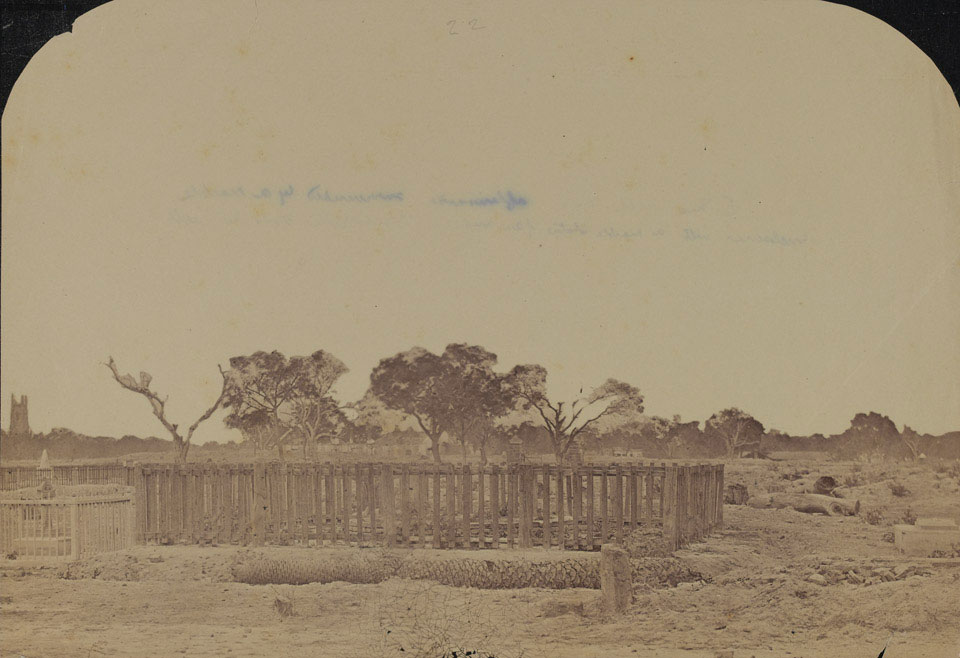
“Jesus answered and said to him, “What I am doing, you do not understand now, but you will understand later.”
G.
Garrett, Mr., Engineer
Galway, Mr., Telegraph Office – killed at Satichaura Ghat.
Gee, W. Mr. (A retired, and aged merchant and Agent of the Inbound Transit Co.,) killed in the entrenchment by roundshot, on the 7th of June.
Gee, Rose Anne, Mrs. died of fever in the entrenchment, wife of the above
Gibson, Mrs. and daughter – killed at Satichaura Ghat
Gill, Mr. (Headmaster, Free School) – killed in the entrenchment, 13th June. He had been “leaning against a wall in the guard room, had his skull fractured from a round shot hitting the wall outside of the building and endured several days of intense pain…”
Gill, Mrs. – killed in the entrenchment, 13th June, wife of the above. Three of their children were killed at Satichaura Ghat, while 1 child, J. Gill, was killed at the Bibighar.
Gilpin, Mr. and wife Sarah. She perished at the Bibighar with her four children: Harriet, Sarah, Sam and baby S.
Gillie, Mrs.
Glasgow, 2 Misses
Goodings, Mr Thomas, Electric Telegraph Department, and wife, Mary Ann (née Walsh). They were married by Reverend Moncrieff in Cawnpore on 21 February, 1857. She was the daughter of William Walsh.
Green, Mr – East Indian Railway – killed at Satichaura Ghat
Green, Mrs. and two children, Edward and Susan, family of Mr. Green, East India Railway.
Greenway, Thomas, Mr. (Merchant) – died of fever in the entrenchment
Greenway, Mrs., wife of the above. Burnt in the boats at Satichaura Ghat with her son Henry. Four other children were unaccounted for, presumed killed in the entrenchment.
Greenway, Miss Louisa – died of fever in the entrenchments
Greenway Samuel, Mr. (Merchant) – killed, 30th June
Greenway, Mrs., and the infant died of fever in the entrenchment. Their daughters, Ann and Rosaline, are presumed to have died in the entrenchment.
Grey, Mr., Sub-inspector, Public Works Department – died in the entrenchment
Grey, Mrs.
Grinsey, Mrs. – killed at Satichaura Ghat
Guise, Mr.
Gun, Mr. – East Indian Railway – killed at Satichaura Ghat
Guthrie, Master, and sister, Catherine.
H.
Harkness, Mrs. and child (Free School)
Haycock, Reverend – died 20th June. Reverend Haycock lost his mind during the siege when his mother was injured and took to running around screaming. His mother cared for him until he died.
Haycock, Mrs. (mother of Rev) – killed at Satichaura Ghat.
Haycock, Mr. (Watchmaker) and wife – both died in the entrenchment
Hay, John Duncan, Mr., (Merchant) – killed on the 16th of June when he was shot in the temple, as he came out of the room where his wife had just given birth. His wife and 3 children perished. Two daughters, who were not in Cawnpore at the time, survived. One would later marry a Mr G.T. Jackson of Lucknow, and the other a Mr M. Michel, C.E.
Hampton, Miss – killed at Satichaura Ghat
Hanna, Robert – Assistant Engineer, East Indian Railway – killed at Satichaura Ghat. Fourth son of the late William Hanna, Barrister.
Heberden, Alfred Charles, Mr., Resident Engineer, East Indian Railway (wounded) – killed at Satichaura Ghat. Second son of the Revd. W. Heberden, of Great Bookham, aged 30. He had once worked as a civil engineer under the famous Mr. Isambard Kingdom Brunel. During the siege, he proved he was an excellent shot and was sorely missed when he was wounded.
“Mr Heberden, of the railway service, was handing one of the ladies some water when a charge of grape entered the barrack, and a shot passed through both his hips, leaving an awful wound. He lay for a whole week upon his face and was carried upon a mattress down to the boats, where he died. The fortitude he had shown in active service did not forsake him during his extraordinary sufferings, for not a murmur escaped his lips..”
Henderson, E., Mr, (drowned) – died at Satichaura Ghat
Heron, Sergeant-Major (Pensioner) and family
Hillersdon, C.G., ( Magistrate and Collector) – killed by round shot -13thJune, “…while standing in the veranda was disembowelled by a round shot and fell at the feet of his wife a corpse.” His wife died on the 19th of June by falling masonry, and their two children died of fever in the entrenchment. She was the daughter of Mrs Margaret Prole of Belmont Villa, Bath.
Hogan, Mr – killed at Satichaura Ghat
Holmes, J., Articled Inspector, East Indian Railway – killed at Satichaura Ghat
Holmes, Elizabeth, Miss
Hill, Mrs.
I.
Ives. J. Mr.
J.
Jackford, Mrs.
Jackson, Mr., and wife – killed by round shot in the entrenchment.
James, Mrs. and son James, W.
Jacobi, Frederick Ernest (Coach builder) – killed in the entrenchment by a shell.
Jacobi, Mrs.
Jacobi, Henry
Jacobi, Lucy
Jacobi, Hugh
Their daughter Charlotte had previously been sent to Calcutta for her health and thus survived the mutiny and was orphaned, aged 11. Charlotte married James Hogan in Fort William on the 13th of July 1863.
Jenkins, Mrs.
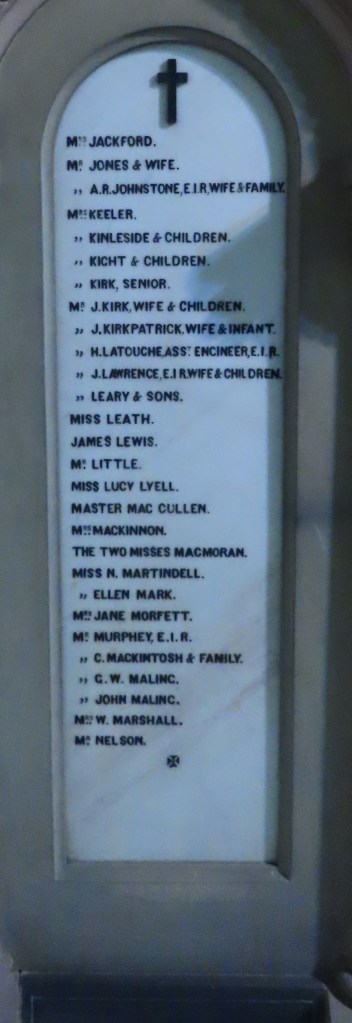
Johnston, A.R., Mr., East Indian Railway
Mrs Johnston, wife of the above and children
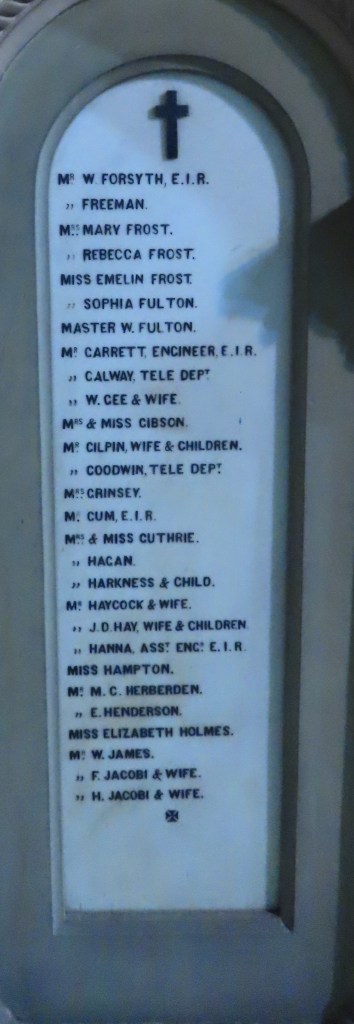
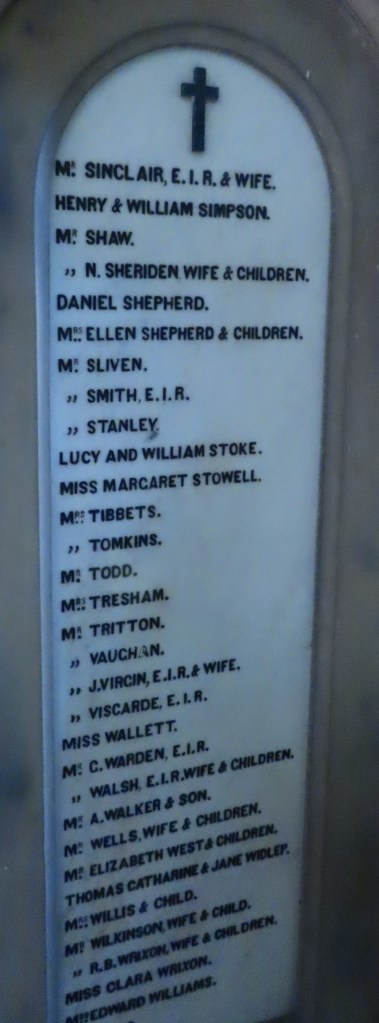
It is presumed this is the same Mr Johnstone as on the tablet (albeit he signed himself without the “e” ) who wrote on the wall in General Wheeler’s room, just above the writing of Postmaster Roche. A Freemason, Johnstone wrote in Masonic script the following, which he signed as R.A.B. Johnston, Wor. Master:
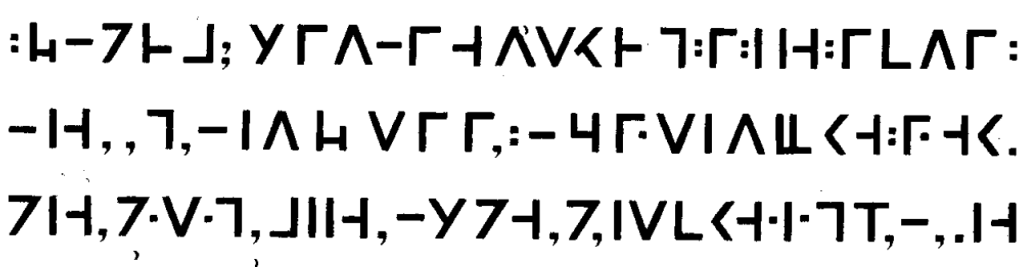
The text translates to (when using Pigpen cypher):
“MY SON, FORGET NOT MY LAW; BUT LET THINE HEART
KEEP MY COMMANDMENTS: FOR LENGTH OF DAYS, AND
LONG LIFE, AND PEACE, SHALL THEY ADD TO THEE.”
The text caused some consternation among the Freemasons in India, who debated whether it was not, in fact, merely a Biblical reference but a code, in which Johnston tried to tell his brother Masons where a case of the Lodge regalia and papers had been hidden. It was believed the hiding spot was just south of the barrack but nothing was ever found.
Jones, Mr. – killed at Satichaura Ghat
Jones, Mrs. – wife of the above
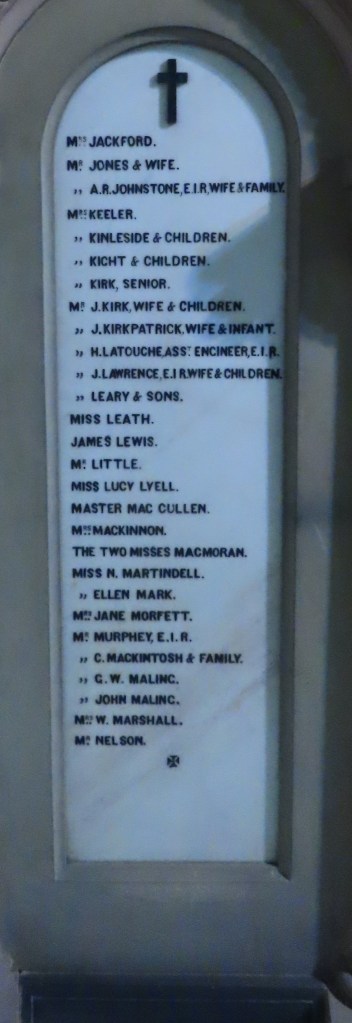
K.
Keeler, Mrs. – killed at Satichaura Ghat
Kinlisdale, Mrs. and 2 sons Henry and Willie
Kight, Mrs. and 2 children. Wife of the late editor of the Central Star Press, Fitzherbert Kight.
Kirk, Mrs Senior – killed at Satichaura Ghat. She was the widow of John Kirk, a merchant. She had sent her youngest son, Colin, to Mussoorie in April 1857, and he would be the only member of the family to escape. The remainder of the family was killed either at the Satichaura Ghat or in the Bibighar, as listed below:
Kirk, Grace, Miss
Kirk, Charlotte, Miss
Kirk, William, Master
Kirk, John, Mr (Merchant and Trader in Country Produce), wife and infant – killed at Satichaura Ghat. Son of Mrs Kirk (Senior)
Kirkpatrick, Mr J.(Merchant and Trader in Country Produce), wife and infant – killed at Satichaura Ghat. He was the son-in-law of Mrs Kirk (Senior). Amelia Horne saw Mr. Kirkpatrick for the final time at Satichaura Ghat, who, “in warding off blows, had both his arms cut off and lay in the water alive for some time.”
L.
La Touche, William Digges, Assistant Engineer, East Indian Railway – killed at Satichaura Ghat. Second son of the Revd. T. Digges La Touche
Lawrence, John, Mr. East Indian Railway – killed during the siege
Lawrence, Mrs., wife of the above, and 3 children – died in the entrenchment
Mr. Leary, presumed killed in the entrenchment. His wife and their sons James and Charles perished at the Bibighar.
Leath, Miss – killed at Satichaura Ghat
Lewis, James, Master
Little, Mr., (Merchant) – killed at Satichaura Ghat
Lyall, Lucy, Miss
M.
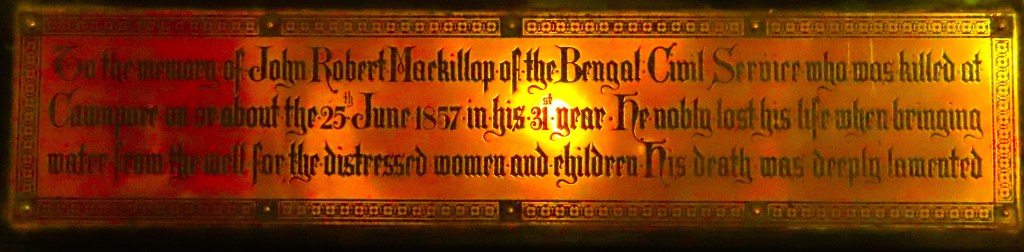
Mackillop, John Robert Mr (CS) – The Joint Magistrate of the Cawnpore, aged 31. He was the “self-constituted captain of the only well in the garrison and employed himself in drawing water for the besieged women and children. After a week of this self-imposed duty, he was hit in the groin by grape shot.” It is said he died on 25 June.
MacCullen, Mrs.
Mac Cullen, Master – killed at Satichaura Ghat
Mackenna, Mrs.
Two Misses Macmoran – sisters of Mrs Christie
Manville, Conductor, wife and four children
Mark, Ellen, Miss – killed at Satichaura Ghat
Martindell, J., Miss
Maxwell, Mr. (Deputy Opium Agent)
Miller, A.M.M. – Resident Engineer, East Indian Railway – killed at Satichaura Ghat
Morfett, Jane, Mrs.
Murphy, Mr. – “Mr Murphy, who had been attached to the railway corps, went out of the intrenchments and came back severely wounded by a musketball; he died the same day and was the only one of our slain buried in a coffin, one having been found in the hospital.”
Murray, Drum-Major (Pensioner) and wife. He was killed during the siege.
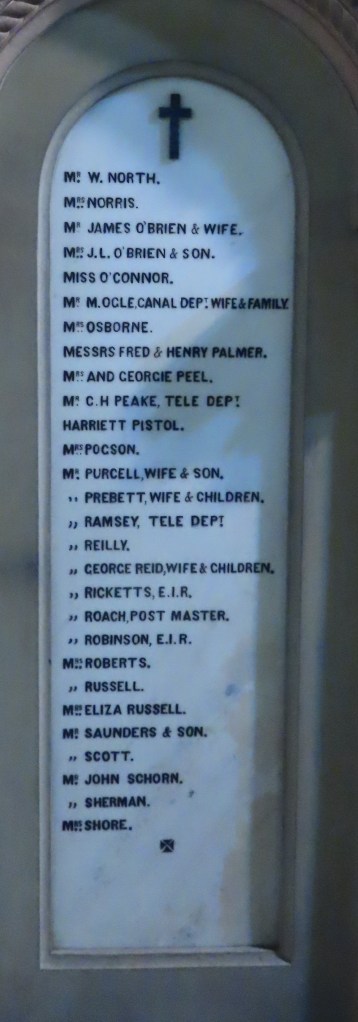
N.
Nelson, Mr. – killed on the 30th of June
Newman, Arthur, Master
Newman, Charlotte
North, W. Master
Norris, Mrs.
O.
O’Brien, James, Mr., (Collectors Office, Head Clerk) – killed at Satichaura Ghat
O’Brien, Mrs. – wife of the above -died of apoplexy in the entrenchment.
O’Brien, Mrs., – Widow of J.L. O’Brien of O’Brien Castle, Meerut and mother of James O’Brien. Her daughter was in Meerut at the time of the mutiny, where she had married Mr Ludlam in 1846.
O’Brien, Rory, master, son of the above – killed at Satichaura Ghat
O’Connor, Miss
Ogle, M. Mr., (Canal Dept.), wife and 6 children – killed at Satichaura Ghat
Osborne Mrs., aged 48 years – killed at Satichaura Ghat. She was a relative of Jonah Shepherd.
P.
Palmer, Fred, Mr., (Medical Depot) died of sunstroke
Palmer, Henry Mr. died of wounds
The Palmer brothers were employed in the Medical Depot. and were carried away by their servants from the entrenchment, in a desperate condition, as the garrison was leaving for Satichaura Ghat. They died at their house in Cawnpore. They were related to the John family of Agra.
Parrott, Mrs.
Peake, C.H. (Telegraph Office) – killed at Satichaura Ghat
Peel, Mrs. and Georgie (son)
Peters, Mrs. son James and daughter Mary; two Miss Peters
Pistol, Harriett
Pogson/Pokeson, Mrs
Price, Mr. (Pensioner) died in the entrenchment
Probett, Mr. William Morris died of wounds in the entrenchment. He ran the Dak service from Cawnpore. He had been married twice, and at least two of the children were from his first wife. Ellen was only 20 at the time of her death, having married William in 1852 at the age of 15, shortly after the death of his first wife, Amy (née Izzard).
Probett, Mrs. Ellen (wife of the above) and children – Amy Ruth (1849-1857), Emma, Louise, Nelly, and John (these four Probett children are recorded as victims of the Cawnpore Massacre but none of their baptisms has been found in the Ecclesiastical records so their parentage remains unconfirmed). Kate Ann Hazell – born October 1856 is presumed to have died in the entrenchment, and William Stephen Walsh (b. 1855) is said to have died at the Bibighar. Charles Thomas Probett (1847-1918) was at the Martinere College at the time of the mutiny. He was the only member of the Probett family to survive, together with his cousins, the Walsh brothers.
Purcell, Mr. ( Livery Stable Keeper), his wife and son, left the entrenchment on the 10th of June and were killed in the city.
R.
Ramsay, Mr. (Telegraph Department)
Raselier, Mrs.
Reid, George, Mr.,( Merchant, trader in country produce) – killed at Satichaura Ghat, wife and five children –
James, Julia, C., Charles and infant
Reid, Nixon (Pensioner) – killed during the siege
Reid, Bazar Sergeant and wife – he was killed at Satichaura Ghat, his wife in the Bibighar.
Reilley, Mr., Overseer, roads – killed at Satichaura Ghat
Ricketts, Mr., Railway Department – killed during the siege
Roche, Mr J. W. ( Postmaster) – during the siege, he occupied a corner of General Wheeler’s room. According to the pencil writing found on the wall, he was
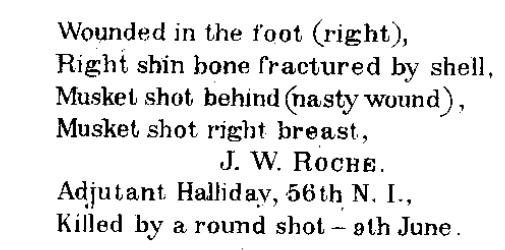
Roche however, was instrumental in the capitulation of the garrison along with Captains Moore and Whiting.
Robinson, Mr, Railway Dept. – killed at Satichaura Ghat
Roberts, Mrs.
Rooney, Joseph, (the Revd., Roman Catholic) – killed at Satichaura Ghat
Russell, Mrs. and daughter Eliza
S.
Sanporo, Mrs Eliza
Saunders, Mr His wife and son, William, perished at the Bibighar
Scott, Mr.
Scott, Mrs.
Shaw, Mr.
Schorn, John Mr., (Merchant) – killed at Satichaura Ghat. He had initially wanted to accompany Jonah Shepherd, in disguise, on his mission outside the entrenchment, but the death of Mr Christie from heat exhaustion compelled him to remain behind to look after Christie’s family, as it had been the dying man’s last wish. He tried to leave again on 26 June as he “wished to visit his business premises to remove some Government Securities”, but he was denied.
In better days, he had been a merchant in the Cawnpore firm, Crump & Co., whose premises had been situated within what would become the Bibighar Memorial Garden – a large public well had once been at their entrance gate.
Sherman, Mr.
Shepherd, Jonah Mr., aged 32 years – he left the entrenchment to reconnoitre, but was arrested and imprisoned. Shepherd left his family behind in the entrenchment and presumed they had perished at Satichaura Ghat.
Shepherd, Ellen, Mrs., aged 22 years and 6 months
Shepherd, Louisa, aged 5 ½ years
Shepherd, infant – wounded by bullet in the entrenchment, died on the 18th of June
Shepherd, Daniel Mr., aged 22 years – brother of the above
The first few days of the shelling on the entrenchment were so severe, that Jonah, believing they would not survive, pencilled a message on the barrack wall,
“Should this meet the eyes of any who were acquainted with us, in case we are all destroyed, be it known to them that we occupied this room for eight days under circumstances so distressing as to have no precedent. The destruction of Jerusalem could not have been attended with distress so severe as we have experienced in so short a time – W.J. Shepherd (wounded in the back), his wife and two children, Rebecca and her infant, Emmelina, Martha, old Mrs. Frost, Mrs Osbourne, Daniel, Thakkurrani, Conductor Berrill, his wife and daughter together with other friends – 11th of June.”
Sheridan, N. Mr., (Bank Manager) – killed on the 30th of June,
Sheridan, Mrs., and two children
Shorman, Mr. (Merchant) wounded in the middle finger of the right hand during the siege and was killed at Satichaura Ghat
Miss Shore
Simpson, Henry and William, Masters
Sinclair, Mr. Railway Dept. – killed at Satichaura Ghat
Sinclair, Miss
Slane, Mr.,(Asst. Apoth.) – died in the entrenchment
Sliven, Mr. – killed at Satichaura Ghat
Smith, Mr., Railway Department – killed at Satichaura Ghat
Stacey, Mr., Railway Department
Stanley, Mr. (Wounded) – died of wounds
Stoke, Lucy and William
Stowell, Miss Margaret – killed at Satichaura Ghat
Swan, Sergeant (Pensioner, attached to the Ganges Canal) – killed during the siege
Swinton, Mrs. and 3 children – killed at Satichaura Ghat
T.
Tibbetts, Mrs.
Todd, Mr. – ” The only English resident at Bithoor…Mr. Todd, who had come out in the employment of the Grand Trunk Railroad but for some reason had exchanged his situation for that of a teacher of English to the household of his Excellency Seereek Dhoondoo Punth. Mr. Todd was allowed to join us in the intrenchment; when the siege began, he was appointed to my picket and was one of those who perished at the time of embarkation.”
Tomkins, Mrs., (Milliner for Mr Patten of Lucknow, Proprietor)
Tresham, Mrs. – killed at Satichaura Ghat
Tritton, Mr. – killed at Satichaura Ghat
Twoomy, Mr. (Apothecary) – killed at Satichaura Ghat; his wife and child perished at the Bibighar
V.
Vaughan, T. (Merchant ) – killed at Satichaura Ghat
Virgin, Mr., Railway Department – died of sunstroke in the entrenchment
Virgin, Mrs. – killed at Satichaura Ghat
W. & Y.
Wallet, Miss
Warden, George, Railway Department – killed at Satichaura Ghat
Walsh, William, Railway Department – killed in the entrenchment. Father of Ellen Probett, Bridget Roche, Mary Ann Goodings and Margaret Young. He had two unmarried daughters (born in 1844, as yet unnamed and Jane, born in 1847), both of whom, along with his wife Catherine, were killed in the entrenchment. His two sons, John William and Henry, were both pupils at Martiniere College, Lucknow and would survive the siege.
Bridget married Garrett Roche in 1854. He was an ex-artilleryman of the EICo army from Mitchelstown, Co. Cork, having enlisted at age 20 in 1846. In 1857, he was serving as road overseer for the Department of Public Works. With their two children, Edward (b. 1853) and Eliza (b. 1855), the Roches were living in Fatehgarh. When the mutiny broke out, the Roches, with their children, would join the ill-fated boats fleeing from the Fatehgarh towards Cawnpore. Garrett Roche was killed, and his wife and her children would subsequently meet their fate in the Bibighar.
Margaret had married John Young (Revenue Surveyor) in 1855 – they subsequently moved to Jhansi, where John was conducting a revenue survey. They would be killed in 1857 at Jhansi.
Mary Anne Goodings and her husband, Thomas Henry (Electric Telegraph office), were killed in the entrenchment.
Wade, Francis L., Mrs. – died of fever in the entrenchment. She was one of the only victims to be interred within the entrenchment, together with Mr Murphy.
Warren, Sergeant (Pensioner)
Wells, Mr. (Coach builder), wife and children – killed at Satichaura Ghat
West, Elizabeth, and 2 children
Weston, Emma and George
Wheelan, Mrs and two children
White, Mrs.
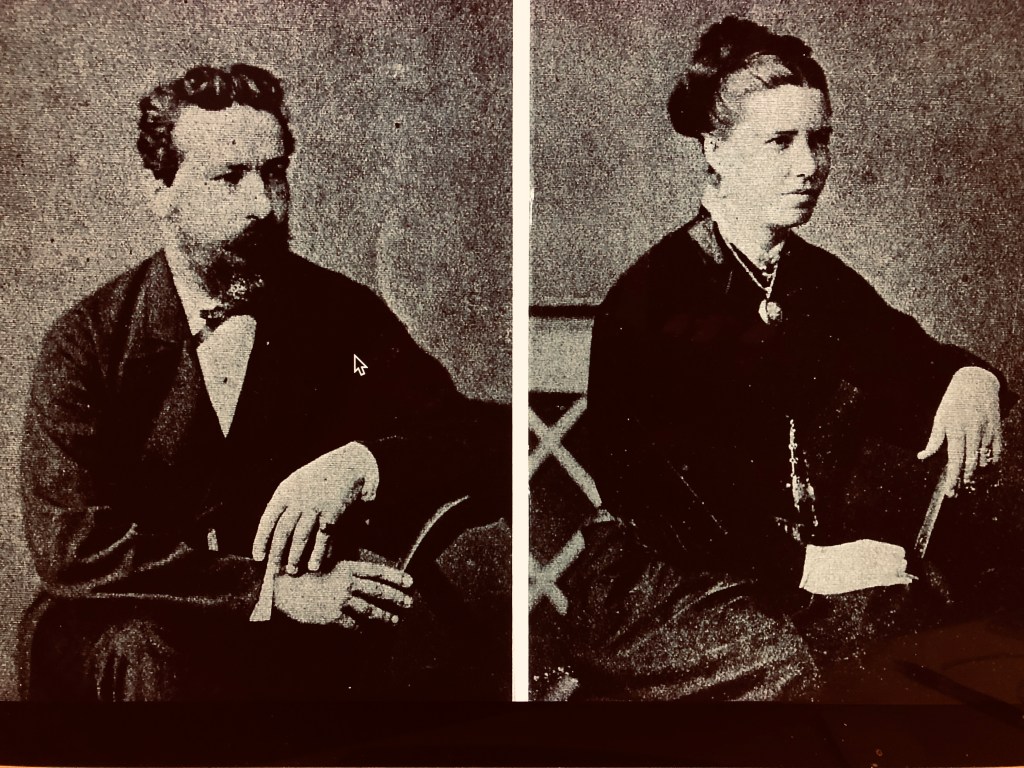
Isabella White
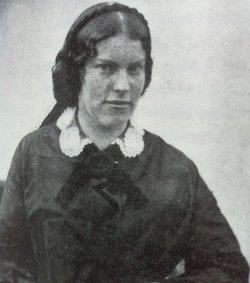
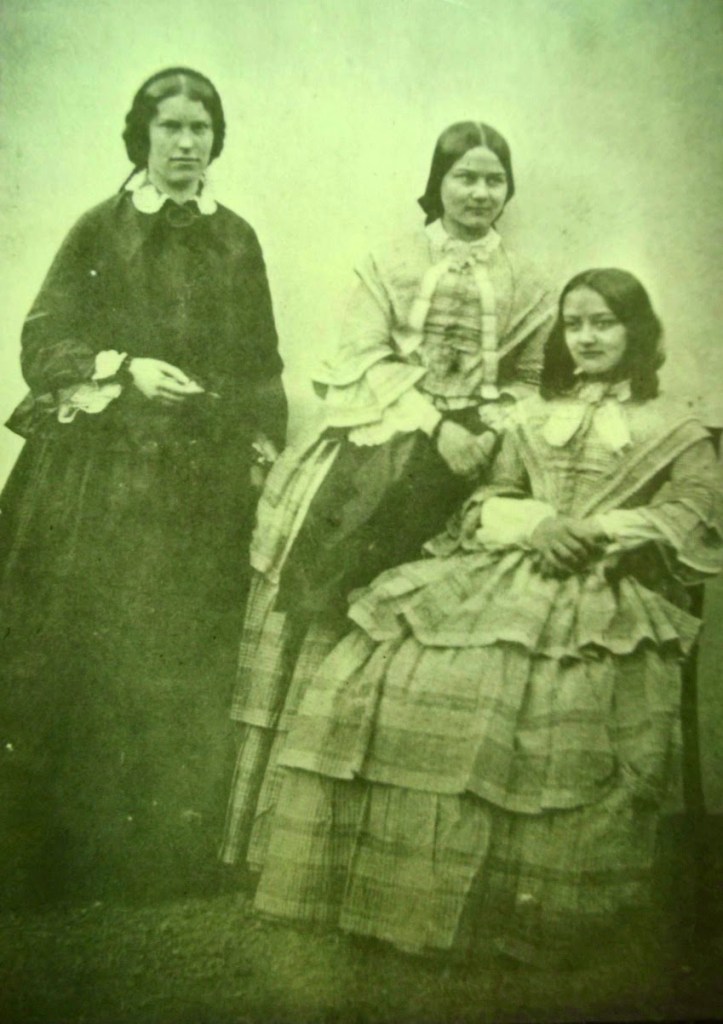
Isabella White had travelled to India with her friend Louisa Chalwin from Taunton, Somerset in 1855, for the very explicit reason of finding a husband. She is pictured here with the Ommanney girls in happier times at Lucknow. Shortly after, Isabella was killed in the Bibighar.
Widlep, Catherine, Jane and Thomas
Willis, Mrs., and child
Williams, Mrs – killed at Satichaura Ghat
Wrixon, R.R., Mr. – killed at Satichaura Ghat. His wife and three children, Clara, Lucy, and Edward (aged 12), were killed at the Bibighar.
Yates, Mrs – Killed at Satichaura Ghat
Indian Medical Service & Ecclesiastical Department
Harris, Horatio Philip Dr (Civil Surgeon at Cawnpore) born 11 July 1823 at sea, near Ceylon. Third son on of Henry Harris (Asst-Surgeon Bengal Army). Dr Harris escaped the slaughter at Satichaura Ghat. According to Jonah Shepherd, Harris was captured on the riverbank and sent as a prisoner back to Cawnpore by the Zamindar of Pewinda on 28 June. He was shot on 30 June in Cawnpore in the Savada Kothi compound together with the remaining fugitives from the boats. Jonah Shepherd collected their bones in October 1857 and had them buried. They were subsequently removed to the Memorial Church. In all, Shepherd had collected 17 skulls and 30 baskets of bones from the compound.
Harris, Mrs Myra Nuthall, née Brightman. Eldest daughter of H.G. Brightman Esq., formerly of Calcutta. She married Dr Harris at Hove Church, near Brighton on 4 January 1848. She was killed at Satichaura Ghat.
Assistant Apothecary A. Peters and family – left the entrenchment. Along with Cattle Sergeant Ryan, the Peters’ left the entrenchment on the 10th of June. For three days, the party remained hidden in a village but on the 12th of June they were discovered by rebels and taken to Savada Koti where they were killed.
Reverend Edward Theophilus Russell. Moncrieff, wife and child. At the Satichaura Ghat, Reverend Moncrieff was heard to shout out, “If we English take prisoners, we do not put them to death but imprison them. Spare our lives and put us into prison! ” He was captured at Satichaura Ghat and imprisoned with the others at Savada Kothi. When it was clear the men would be put to death, Moncrieff asked for permission to lead their last prayers just before their execution.
Born on 27 May 1824 in Belfast, Edward was educated at Trinity College Dublin and King’s College, Aberdeen. He served as a missionary in Hong Kong before entering the EICo service as an assistant chaplain. He was appointed to Cawnpore in August 1855. Reverend Moncrieff was the chaplain for the station. During the siege, he was “most indefatigable in the performance of his ministry of mercy with the wounded and the dying…” His wife and child perished at Satichaura Ghat.
Department of Public Works
Sergeant Brooke, wife and child – killed during the siege
Sergeant Carmody and wife (milliner) – killed at Satichaura Ghat
Sergeant Kelly, wife and child – killed during the siege
Sergeant MacLanders, wife and infant – killed at Satichaura Ghat
Sergeant Wheelan, wife and children – killed during the siege
Overseer Parker – killed during the siege
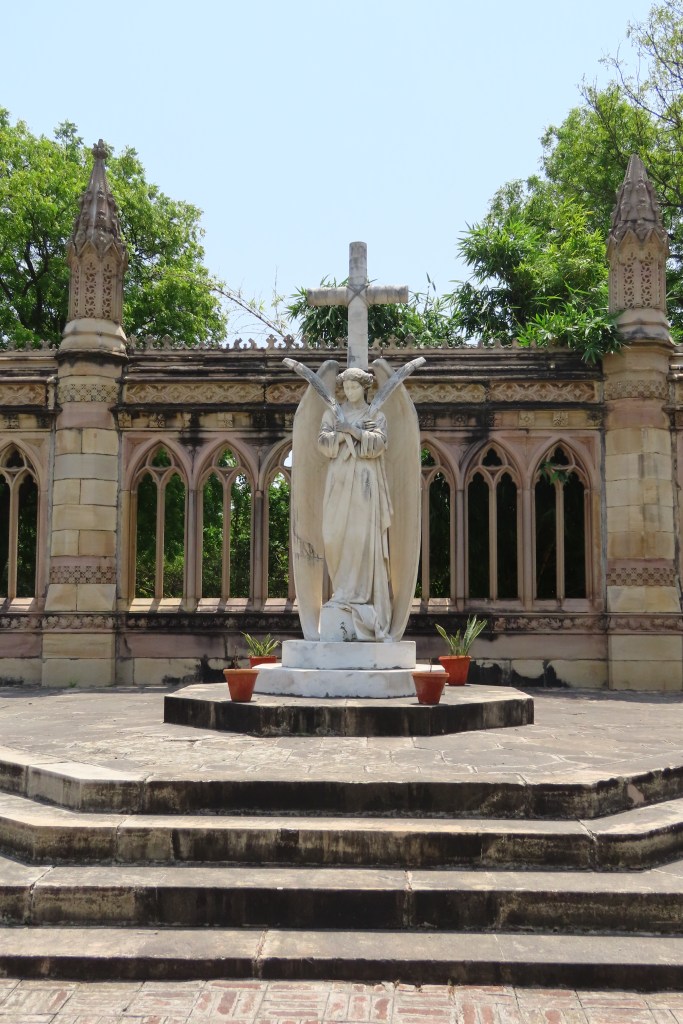
Our bones are scattered at the grave’s mouth as when one cutteth and cleaveth wood upon the earth. But our eyes are unto Thee, O God the Lord. (Psalms)
Residents who did not go to the Entrenchment and remained in the City
A.
Auchin, Chinaman, Shoemaker – killed, 12th June
He was captured in the city and taken before the Nana Sahib. Auchin pleaded that he was a “mere tradesman, a shoemaker, like one of the natives and not a European or a Christian.” No amount of pleading would save his life, and Auchin was beheaded.
C.
Carter, Joseph, Mr., tollkeeper, executed, 10th Jun by the sowars of Nana Sahib on the parade ground opposite the Subhdar’s Tank; he was shot and then decapitated.
Carter, Mrs. and infant, killed, 17th July by the guard of the Nana Sahib.
Joseph Carter had been kept at his post at Sheorajpur, his young and pregnant wife with him. However, as the situation worsened, he attempted to fly to Cawnpore, only to be captured on the Grand Trunk Road by the Nana’s sowars. They were brought to Bithur before the Nana, who ordered their execution. Whether the pleading of Mrs. Carter or that of the widows of Baji Rao ( who threatened suicide if Mrs. Carter was killed), Mrs. Carter was spared and gave birth to her daughter in the Zenana. The ladies of the house protected her, but when they were forced to leave on Havelock’s arrival at Cawnpore, Mrs. Carter and her baby were put to death by the Nana’s guards.
Clooney, Mr. He was a discharged drummer of the 2nd Grenadiers, native infantry, living in the city of Cawnpore. Before the outbreak of trouble and seeing it pointless to go to the entrenchment, Clooney and “a few native Christians” took up residence in a small but strongly built house with a flat roof. They then barricaded the doors with bricks and stones. For the first days after the outbreak, Clooney and his friends, armed with matchlocks, managed to keep their attackers at bay, but on the 8th of June, the thatched verandah which surrounded the house was set on fire, and the men burned to death.
D.
DeGama, Ignatius Xavier, Merchant , killed 10th June
DeGama had declined on advice of his one-time and best customer, the Nana Sahib, to enter the entrenchment. Instead, he hid himself in a perforated box which he had installed on the roof of his house. However, he was found and dragged to the Nana. He never had the chance to plead his case nor did he receive any mercy – the Nana refused to speak to DeGama and ordered him killed. The guard “slashed repeatedly” at the merchant “cutting through his mouth and sending him into the dust, where he rolled and writhed about in a fearful manner” until a few more sword strokes put him out of his misery.
Duncan, John, Mr, Road Superintendent, killed 10th June. He was sent in as a prisoner from the village of Pewindi – his captor received a reward of Rs 10. However, he would find himself facing the hangman when Sir Henry Havelock arrived.
G.
Green, Mr. (Pensioner) – superintendent of the bridge-of-boats. He was hidden in the house of his Indian companion (bibi), but as the situation deteriorated, she tried to help him escape out of Cawnpore. Unfortunately, Green was discovered close to the old native infantry lines, where he was brought out to the parade ground and killed, either by the troops of the Nana Sahib or a local mob.
The Greenways were initially held hostage by the Nana Sahib but were ultimately put to death on the 15th of July. Rose Anne Greenway, the mother of Samuel, Edward and Thomas and, by all means, the matriarch of this hefty mercantile family, remained with her son Edward at the Greenway indigo factory (16 miles outside Cawnpore), while Samuel and Thomas went with their families to the entrenchment. They were joined at the factory by Captain Hollings, the editor of the Greenway-owned Central Star newspaper.
The factory was attacked on the 8th of June by an armed mob, but they were held at bay. Captain Hollings had provisioned the roof, where the family now found themselves, with a row of double-barrelled shotguns, and it would appear his firing was so devastating the mob took flight and only returned when they had acquired reinforcements from Cawnpore. Hollings, by then, had run out of ammunition and was “sitting out on the balustrade, contemptuously baring his chest and challenging the soldiers to shoot him.” The newly arrived troopers obliged, and several shots later, Hollings tumbled dead from the roof, mortally wounded in the breast.
The family would have been killed had Mrs. Greenway not offered the mob and the troopers a significant ransom – as such, they were taken away from the factory by bullock cart to the Nana Sahib, once a patron of their town shop and a social acquaintance of the brothers. The Nana agreed to provide them safe passage to Allahabad, provided Mrs. Greenway paid for it – his demand was no less than Rs 200’000. The Greenways immediately handed over what they had on their person, and it would appear Mrs. Greenway told the Nana of a treasure chest her son had buried in the garden on the house. The Greenways were left outside, in the sun, while the troopers went to search for the chest, but after several hours of searching, they claimed they could not find it. Instead, Mrs. Greenway now offered the Nana the remaining amount from her bank at Calcutta, after which they were brought, as hostages, into the Savada House.
Rose Anne Greenway, Mrs.
Greenway, Edward and his son were shot on 15th July with the officers from Fatehgarh.
Mrs. Greenway
Miss Greenway
Frederick Greenway
Martha Greenway
Jane Greenway
John Greenway
Mary Greenway
H.
Hollings, Captain, killed at the Greenway Indigo Factory by troops of the Nana Sahib, 8th or 9th of June.
Haman, Indigo Planter, killed, 13th June
J.
Jacobi, Henry, Watchmaker, died of sunstroke, on 10th June
The Jacobis were held by the Nana Sahib and killed at the Bibighar.
Jacobi, Mrs.
Jacobi, Henry, Lucy and Hugh, children of above
Jacobi, William, son to above (grown up)
The family of Henry Jacobi, unlike his brother Frederick, refused to go to the entrenchment. Instead, they hid in a house owned by Indian friends, close to the Magazine. However, as searches were going on in Cawnpore for Christians, Henry and his family managed to secret themselves across the river, where they hid in the long grass. Unfortunately, the next morning, before they could find a better hiding place in the countryside, they were discovered by some local landowners and handed over to the Nana Sahib at the Savada House.
They would have “shared the same fate as the DeGama” had Mrs. Jacobi not raised her voice in temper and shouted at the Nana Sahib, “It is cowardice to kill helpless women and children, ” further admonishing him of his disgraceful conduct until he, in his shame, ordered them kept as hostages at Savada House. Her husband, however, died of sunstroke, and her eldest son, William, who was not with the family but trying to remain hidden in the city, was found out and killed.
M.
Maling, G.W. Mr., killed 8th June
Maling, John, Mr., killed 8th June
Mackintosh, Charles Merchant (aged 64 years), killed, 8th June
Mackintosh, Amelia, Mrs.(aged 57 years), killed, 8th June
Mackintosh, Joshua, son to the above, killed on 8th June
A long-term resident and wealthy landlord of several bungalows in Cawnpore and fluent in Hindi, Charles Mackintosh attempted to disguise himself and his son as watchmen. They tried to hide under the bridge, not far from the Greenway’s residence, but were discovered by some boys who betrayed them to the Nana’s sowars. Both father and son were hacked to pieces. His wife, Amelia, was found hiding in a native hut. She was taken before the Nana Sahib at his momentary residence in the city at Duncan’s Hotel and ordered beheaded. Her body was then laid in a ditch “on its back and the bleeding head placed on the breast in wich position it was left to decompose.” Their bones were eventually picked up and buried by their remaining son, who found them after Havelock arrived at Cawnpore.
Maloney, Pensioner, killed, 7th June
Marshall, Mrs. W., killed, 7th June
Murphy, Mr. (Railway Department), killed, 5th June
W.
Waterfield, Mr., killed 10th June
Walker, A. Mrs . aged 65 years
Walker, Daniel, Master
The Walkers were taken about the 5th of July and placed in the Bibighar, and killed on the 15th of July.
Williams, Mrs., wife of Edward Williams, House proprietor, killed with her three children on the 10th of June
Citing their stories on pages 21 and 33 of his book, Shepherd mentions “several others whose names are not known.”
Two Europeans (Conductor and Sergeant) with Magazine Boats.
Fulow, Joseph, Mr., left for Allahabad and was killed
Fulow, Sarah, Miss, left for Allahabad and escaped
Sources:
The Story of Cawnpore – Capt. Mowbray Thomson (1859)
A Personal Narrative of the Oubreak and Massacre at Cawnpore – Jonah Shepherd (1894)
Cawnpore – Sir George Trevellyan (1899)
Casualty Roll fo the Indian Mutiny – compiled by L.T. Tavender (1983)
Our Bones are Scattered – Andrew Ward (1996)
https://www.fibis.org/wp-content/uploads/2018/03/J31.pdf
The Tablets in the Memorial Church, Cawnpore, 1857 – a Key Describing all that is known concerning names recorded on the Tablets (Calcutta, Thacker, Spink & Co., 1894)
Some Further Reading
For the story of Captain Hollings, please refer to The Exotic Life of Captain Hollings
http://conthroughhistory.blogspot.ch/2012/05/exotic-life-of-captain-hollings.html
For further information about the Greenway family, please refer to
http://www.otherhouseofwindsor.co.uk/greenway.html
There is also some more information about the Jacobi’s surviving daughter, Charlotte, at this link:
https://thewildgeese.irish/profiles/blogs/stanley-garrett-hogan-some-of-our-irish-and-indian-history
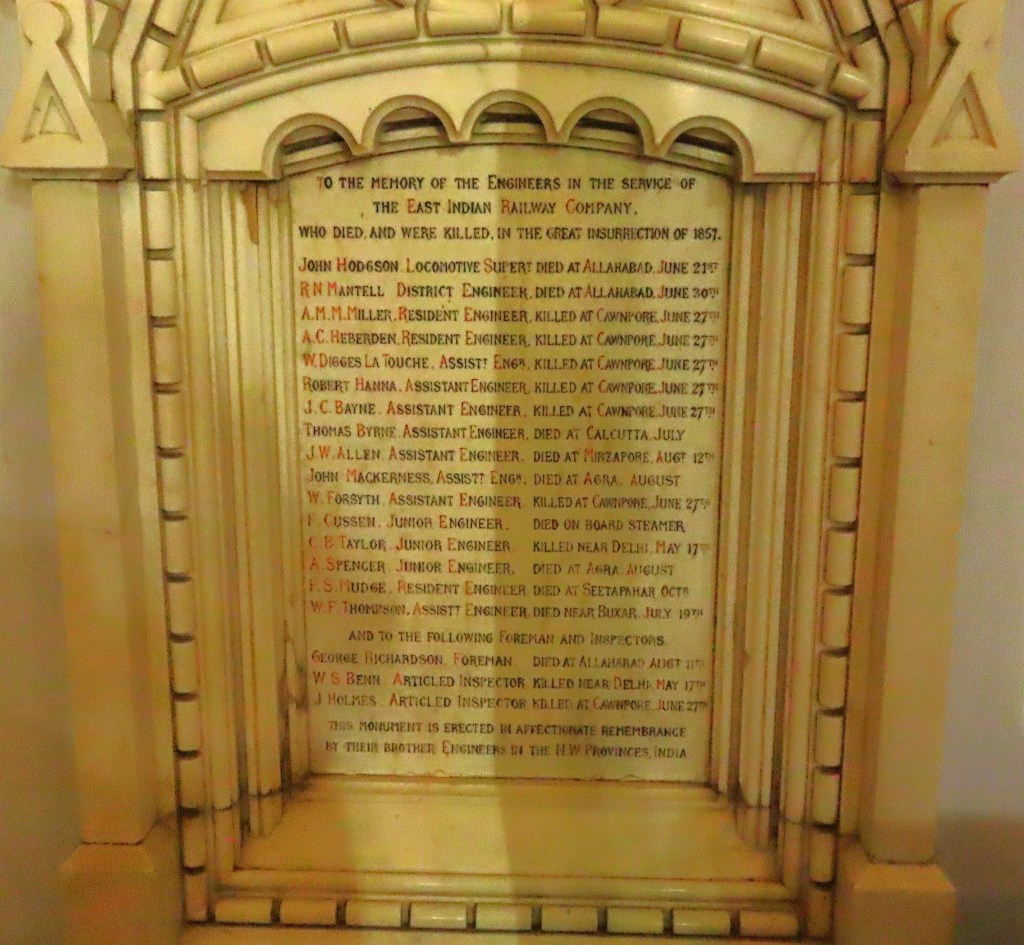
https://www.gracesguide.co.uk/East_Indian_Railway:_1857_Cawnpore_Memorial
 Mutiny Reflections