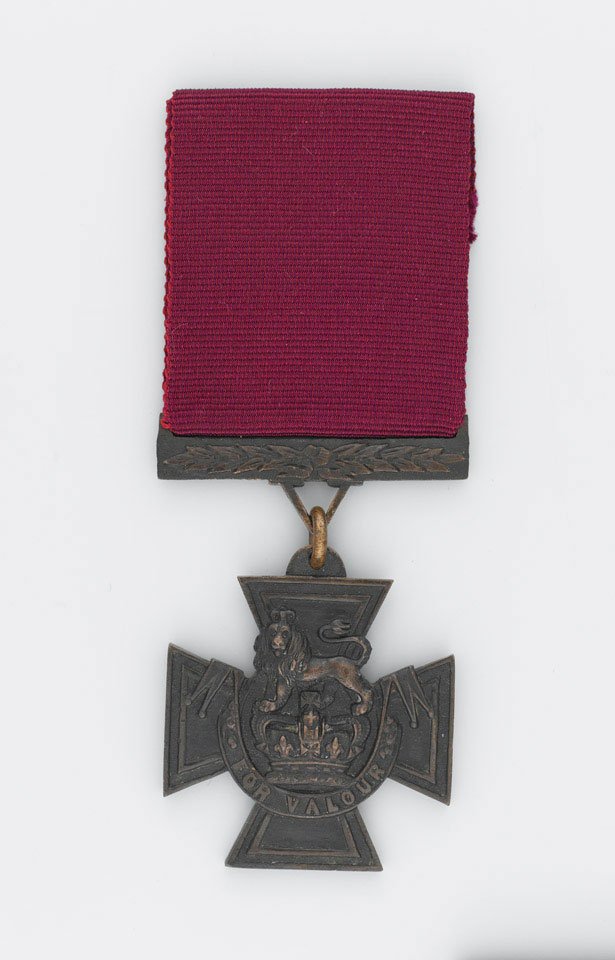
In 1826, in the coastal village of Prestonpans in East Lothian, Scotland, a potter named George and his wife Agnes (née Thomson) welcomed a baby boy into the world. They likely named him John, but the boy would find his place in history as Same Shaw. The History of the Rifle Brigade gives him the name Samuel.
Of the boy’s life we know little; Prestonpans at the time was known for coal mining, pottery, its saltworks and glassmaking, providing employment to day labourers. If Same went to school, it was likely not more than any other boy of his father’s means. At 23, now a labourer himself, he enlisted in the Rifle Brigade on 6 April 1849. There is no mention of Shaw having served outside England until 1855, when the Rifle Brigade was sent to Crimea. Shaw would return home with the Crimea Medal and clasps for Alma, Balaklava, Inkermann and Sebastopol. He was also the recipient of the Distinguished Conduct Medal. In 1856, he transferred to the 3rd Battalion.
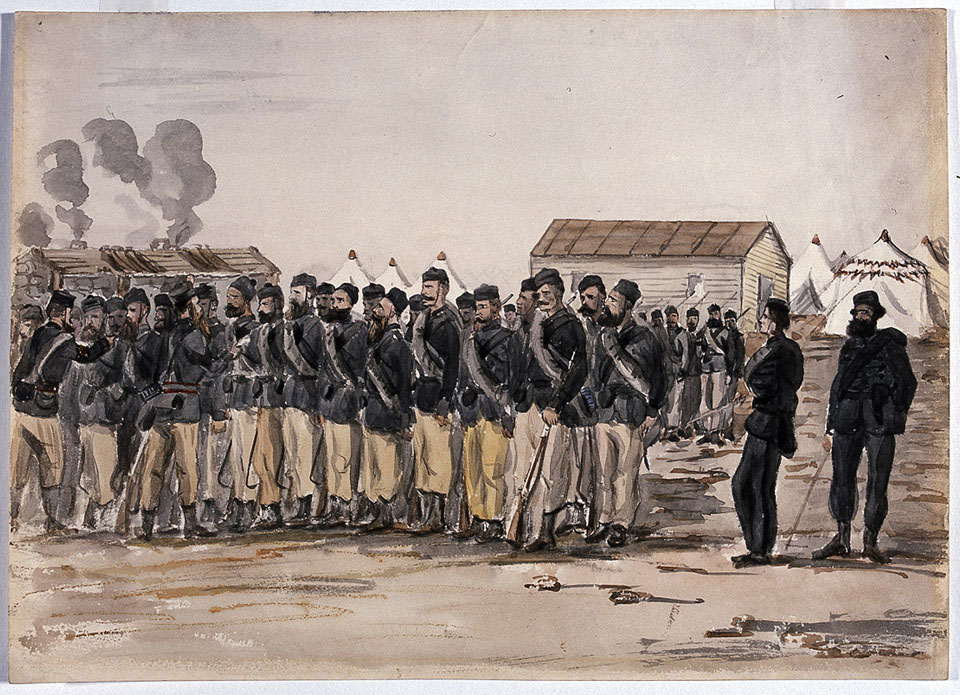
With the news of the mutiny, there was a call for troops to be sent out from England to quell it, and the 2nd and 3rd Battalions of the Rifle Brigade were given their orders to embark with all haste for India. By the beginning of August, they were on their way. By November, the Rifle Brigade was trickling into Calcutta. Their stay in Calcutta was short, for there was still a pressing need for reinforcements for Cawnpore. The 2nd Battalion arrived at said place on the 26th and was quickly joined by two divisions of the 3rd Battalion on the 27th. The 2nd Battalion had already had its first fight with the rebels at Pandu Nadi, so it was just as well the 3rd Battalion had made haste, for on 28 November, Windham had his disagreement with the Gwalior Contingent regarding possession of Cawnpore.
“Captain Atherley’s company of the 3rd Battalion arrived at Cawnpore on the 27th. They had landed at Calcutta on the 8th, and on the next day started by rail for Raneegunge, and thence proceeded by bullock-cart up the country. On nearing Cawnpore, a messenger met them with instructions that Atherley was not to advance, as the force at Cawnpore was in retreat, and he might be cut off. A second messenger informed him that he was to push on, as every man was wanted. A third soon followed with a repetition of the first message. All this time, for many hours, and while marching many miles, the sound of heavy firing was heard.
About six in the evening, a youth (a cadet), mounted on a pony, met them, saying that the road was clear, and that they were to hasten on and reach the town if possible. He added that General Windham’s force was getting the worst of it. Accordingly, Atherley pushed on as fast as possible. The firing seemed to become heavier and more furious. As the company approached the bank of the canal, a mounted officer, extremely agitated, rode up and said,
‘Leave all your carts, except the ammunition; fix your bayonets, and I will show you the way.’
Atherley, with great sang-froid, said, ‘We have not got any bayonets; we have swords.‘
‘ Well,’ said the other, ‘fix what you have got.’ Saying this, he galloped off, and they saw him no more.
Neither as they advanced, did they see any enemy, but they met some of the 2nd Battalion retiring in good order. Captain Atherley found General Windham in or near the intrenchment and reported his arrival. Windham, expressing himself much pleased at being reinforced with a hundred ‘fresh Riflemen’ (they had just come off a fatiguing march), told him to patrol during the night and guard the house in which he was living. He then asked if Atherley had had anything to eat, and being answered in the negative, he gave him a bone with some meat on it, which he and his two subalterns devoured in the veranda of Windham’s quarters, cutting it off with their clasp knives. They patrolled all night in front of the intrenchment and guarded Major Bruce’s house, which General Windham occupied. But the night passed without any attack from the Sepoys or any alarm.”
However, no amount of Riflemen could have stopped Windham from nearly losing Cawnpore; his mismanagement of the entire affair cost everyone dearly, not least the Rifle Brigade, who now buried Lieutenant-Colonel Wolford and five men. T Captain Dillon and Lieutenant Lawton, 1 bugler and 18 men were injured, Dillon severely and 1 Rifleman was listed as missing. Sir Colin Campbell arrived in Cawnpore on the 29th to give Windham the wigging he deserved and to organise the retaking of the station. The first work was given to the Rifle Brigade. Ordered by Campbell to capture some guns that were causing damage to the British position,
“Two companies of the 2nd Battalion and Atherley’s company of the 3rd, under Lieutenant-Colonel Fyers, who had succeeded to the command on Woodford’s death, made a sortie. Running out over some very uneven ground, they attacked some Sepoys… and were for some time exposed to a very severe fire. However, after a while, they drove the enemy out of these buildings, and as these were escaping by the back of the compound, some Riflemen of Atherley’s company crept round stealthily under the wall, and succeeded in catching the retreating rebels on their swords as they leapt over it. They thus slew a large number. However, as they did not receive reinforcements, they were unable to take the guns and returned to the intrenchment. On this occasion, Captain the Hon. Lewis Milles was severely wounded, 1 man was killed,1 sergeant and 6 privates were wounded, of whom died on December 1, and 1 on December 7, and 1 was missing.”
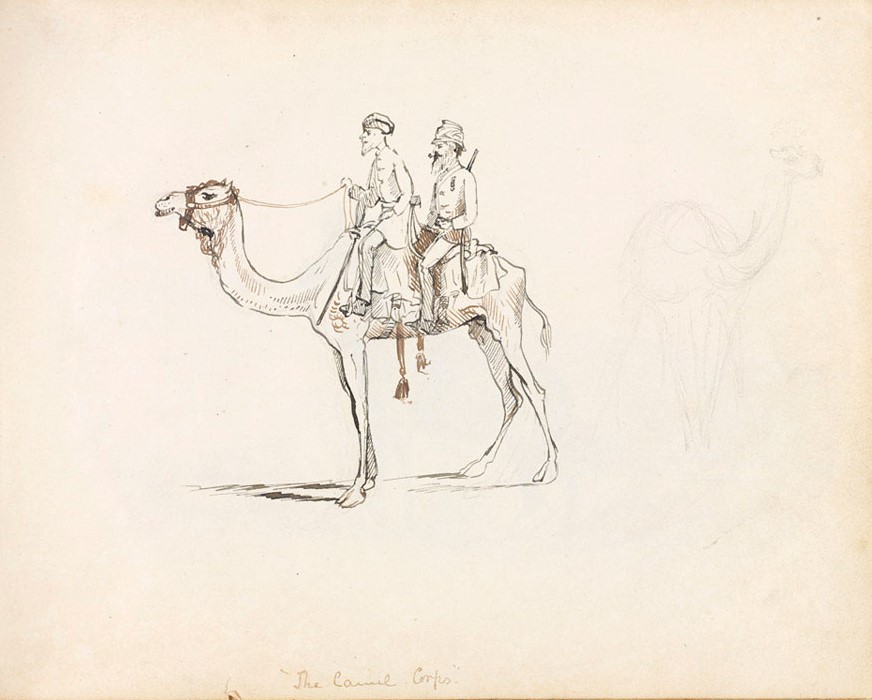
Cawnpore was retaken by Campbell on 6 December; the Rifle Brigade, whose part was well noted and their service gallant, would be divided, with the 2nd Battalion taking their place in Walpole’s Brigade for short skirmishes and a stint in fort destruction, while the 3rd Battalion remained in Cawnpore. In March 1858, the Rifle Brigade, with the Army of Oudh, retook Lucknow, where, on one day, three men of the 2nd Battalion would be awarded the Victoria Cross. Following the taking of Lucknow, the Rifle Brigade formed part of Hope Grant’s division. On April 5, the Camel Corps was formed at Lucknow, consisting of 200 select riflemen—100 each from the 2nd and 3rd Battalions of the Rifle Brigade—who were paired with 200 Sikh troops. Each camel carried a fully-equipped Rifle Brigade soldier alongside an Indian driver. This provided the infantry with an unprecedented level of mobility and endurance across the harsh, uneven terrain. The sole purpose of raising the corps was to pursue, hunt down and suppress scattered groups of rebels who were still hiding in Rohilkhand and Oudh. The Corps operated under the command of Major John Ross and would remain at work until it was deemed that the region was indeed pacified. They were disbanded on June 1, 1860.
As we have seen in the Baiswara Campaign, much of the work under Sir Hope Grant had been relegated to the 2nd Battalion, but the Battle of Nawabganj-Barabanki would see both battalions, once again, on the same field.
The battle would also be the only time that Private Same Shaw would come to light, and all too briefly would that light shine. He would do something so extraordinary that his Sir Hope Grant would award him the Victoria Cross on the spot.
Seventhly, It is ordained that the Decoration may be conferred on the spot where the act to be rewarded by the grant of such Decoration has been performed under the following circumstances:
I. When the Fleet or Army in which such Act has been performed is under the eye and command of an Admiral or General Officer commanding the Forces.
II. Where the Naval or Military Force is under the eye and command of an Admiral or Commodore Commanding a Squadron or detached Naval Force or of a General Commanding a Corps, Division or Brigade on a distinct and detached Service, when such Admiral Commodore or General Officer shall have the power of conferring the Decoration on the spot, subject to confirmation by Us.
In theory, both Duncan Home and Philip Salkeld were nominated for the VC under the same clause for blowing up the Kashmir Gate at Delhi in September 1857, when Major-General Sir Archdale Wilson provisionally conferred their VCs on the spot. However, because both men died shortly after, they technically violated the contemporary rule banning posthumous awards. The Crown bypassed this rule by categorising them specifically as Clause 7 “on-the-spot” awards to honour the General’s field declaration. Private Shaw remains the only person during the Indian Mutiny to receive a Clause 7 field-conferral, survive the immediate aftermath, and actually be physically presented with his Victoria Cross while still alive in India. Major-General Sir James Hope Grant issued the immediate operational command order just four days after witnessing the event, making Shaw’s award the most direct execution of Clause 7’s second proviso during the entire conflict.
For the Act of Bravery recorded in a despatch from Major-General James Hope Grant, K.C.B., Commanding the Lucknow Field Force, to the Deputy Adjutant-General of the Army, of which the following is an extract:
Nowabgunge, 17th June, 1858.
I have to bring to notice the conduct of Private Same Shaw, of the 3rd Battalion, Rifle Brigade, who is recommended by his Commanding Officer for the Victoria Cross. An armed rebel had been seen to enter a tope of trees. Some officers and men ran into the tope in pursuit of him. This man was a Ghazee. Private Shaw drew his short sword and, with that weapon, rushed single-handed on the Ghazee. Shaw received a severe tulwar wound, but after a desperate struggle, he killed the man. I trust His Excellency will allow me to recommend this man for the Victoria Cross, and that he will approve of my having issued a Division Order, stating that I have done so. (The London Gazette of 26 October 1858, No. 22194, pp. 4574-5)
The event which secured for Shaw the VC was somewhat more elaborate than the citation. The men of the 3rd Battalion, while advancing on the rebels, who had been distracted by hares that were hastily evacuating their burrows and were now scurrying about the field, had momentarily taken their eyes off the rebels and were taking pot shots at the hares. The rebels, for their part, took it as an opportunity to send a smart fire towards the 3rd Battalion. As the fighting continued, the rebels gradually became less of a coherent force but were increasingly engaging in isolated hand-to-hand combat. A Ghazi, cut off from his companions, had no recourse left but to rush to a tope of trees. With his back up against a tree, and sword in hand and “glaring fiercely” at some officers and men who had pursued him, he decided he would sell his life as dearly as he could. Some of the riflemen tried to dispose of him by firing at him, but he dodged around the tree, avoiding the shots. Finally, one did hit home, but the wound only made him more desperate to fight on and even more dangerous. There he stood, tulwar still in hand, his back up against a tree, issuing oaths when suddenly, there appeared Same Shaw. The Ghazi’s first cut was true, and he gave Shaw a savage blow across the head; Shaw, undaunted, pulled out his short sword and “sawed at him with the serrated back and despatched him. Shaw rose from the ground covered with blood, but his opponent was slain. Many who witnessed it declared that this combat with a fanatic determined to sell his life to slay his foe was the greatest instance of cool courage they ever saw.” (Cope) According to Knollys, the men who had witnessed Shaw’s act stood around him in awe and applauded.
Cope mentions that Shaw’s sword was serrated, not a typical feature for short swords of the Rifle Brigade. He is, however, in the regimental history as Pioneer Shaw, which explains why he was thus equipped, as this puts our Same Shaw into a different category of soldier altogether. For the work entrusted to him and that he had trained for, Shaw would have been physically strong, taller than most and likely with a robust constitution. Regimental pioneers traditionally were the only rank-and-file soldiers allowed to sport full beards, as these gave some protection from flying splinters and the like to their otherwise exposed faces. As light infantry, the Rifle Brigade relied on speed and skirmishing. Pioneers used their axes and sawback short swords to rapidly clear dense jungle brush, fell trees, and forge paths through thickets so the main body could advance. Because pioneers marched at the very front of the battalion column to clear obstacles, they were frequently the first to make contact with the enemy; they were fully trained marksmen wielding the standard battalion firearm, but their specialised tools were always strapped to their bodies or carried in heavy leather aprons. If an ambush occurred—such as the religious Ghazi fighters charging out of the trees at Nawabganj—the pioneers could not easily deploy long firearms in dense brush and, like Shaw, transitioned to hand-to-hand combat using their heavy, 22-inch short-swords with the serrated back-edge. Because of his role as a pioneer, Shaw was one of the few men in the regiment wielding a truly serrated short sword in battle.
Shaw would be the only man to receive a VC for Nawabganj and indeed for the entire Baiswara Campaign. Queen Victoria subsequently approved the award, and it was formally gazetted on 26 October 1858 in the London Gazette. Shaw received the medal while still in India, in February 1859. He was also promoted to corporal. Together with his Crimea medal, the Distinguished Conduct Medal, the Indian Mutiny medal with one clasp for Lucknow and the VC, at the age of 33, Corporal Same Shaw might have been on his way to a fine career or perhaps a decent retirement. That is, if his life had been just a little longer. The 3rd Battalion, Rifle Brigade, remained in India until 1872; however, Shaw, likely due to the effects of his wounds and his health shot, boarded a ship in December 1859 and set sail for home. It would seem this had been left a little too late – he died at sea off the coast of India on 27 December and was subsequently buried at sea. His VC and other medals are held by the Royal Green Jackets Museum. His name is also inscribed on the Rifle Brigade Memorial at Winchester Cathedral.

In the Coronation Gardens in Prestonpans, since July 2004, there is a plaque dedicated to Same Shaw that reads,
IN MEMORY OF/ CPL. SAME (JOHN) SHAW V.C./ 3rd BATT. PRINCE CONSORTS RIFLE BRIGADE/ AWARDED THE VICTORIA CROSS/ FOR VALOUR ON 13th JUNE 1858/ DIED AT SEA 27tH DECEMBER 1859.
And so ends the story of Same Shaw, private and pioneer, and the only man to receive a VC in the field during the Indian Mutiny. Like so many before him, for a brief moment, he walked the boards of history and then vanished, his life a mystery, known only to his God.
Sources:
Behan, T. L., ed. Bulletins and Other State Intelligence. Part 3 (1858). London: Harrison and Sons, 1858–1859.
Cope, William H. The History of the Rifle Brigade (The Prince Consort’s Own) Formerly the 95th. London: John Chatto & Windus, 1877.
Knollys, Henry, ed. Incidents in the Sepoy War, Compiled from the Private Journals of General Sir Hope Grant. Edinburgh: William Blackwood & Sons, 1873.
Knollys, William Wallingford. The Victoria Cross in India. London: Dean & Son, 1891.
Links:
Scholagladiatoria – 1856 Pattern Saw-Back Pioneer’s Hanger (short sword) – https://www.youtube.com/watch?v=n7yKxvOZ0AE&t=39s
National Army Museum: https://collection.nam.ac.uk/detail.php?acc=1972-07-37-1
https://www.nam.ac.uk/explore/rifle-brigade-prince-consorts-own
https://www.victoriacross.org.uk/ggatsea.htm
https://vcgca.org/our-people/profile/1145/Same-John–SHAW
 Mutiny Reflections