For the failed action at Ruiya, four Victoria Crosses were awarded. A fifth recipient, killed on that day, would eventually receive the recognition he deserved, half a century later. No posthumous VCs were awarded during the Indian Mutiny – due to the regulations surrounding the Victoria Cross at the time of the mutiny that insisted the Cross could only be given to living recipients, entries in the London Gazette stated simply “would have been recommended to Her Majesty for the decoration of the Victoria Cross, had he survived.” When King Edward VII, in 1907, changed the Royal Warrant to permit posthumous awards, 50 years after the Indian Mutiny, four such VCs were presented and an amended entry was published in the London Gazette for not only Ensign Everard Aloysius Lisle Phillips (Delhi), Lieutenant Duncan Charles Home (Bengal Engineers, Delhi), Lieutenant Philip Salkeld (Bengal Engineers, Delhi) but also Private Edward Spence (Fort Ruiya). The only VC to escape the posthumous clause was awarded to Cornet Bankes at Lucknow, although Bankes never wore his Cross – the recommendation was made when Bankes was still alive and provisionally conferred by Sir Colin Campbell; Queen Victoria personally ensured it was confirmed, and Bankes’ mother would subsequently receive the VC in the mail. As the recommendation was processed before Bankes died, it could not be blocked by stipulations of the Warrant current at the time.
For Ruiya, the five men singled out for the Victoria Cross were:
Captain William Cafe – 4th Punjab Rifles
Quartermaster-Sergeant John Simpson – 42nd Regiment of Foot
Lance-Corporal Alexander Thompson – 42nd Regiment of Foot
Private James Davis – 42nd Regiment of Foot
Private Edward Spence – 42nd Regiment of Foot
Three of the crosses were awarded for what adds up to being the same action, and that was rescuing not Lieutenant Edward Cotgrave Parr Willoughby, but the attempt to retrieve his lifeless body. The action would see one man seriously wounded and cost the other his life.
A Life in Pictures – Lieutenant Edward Cotgrave Parr Willoughby
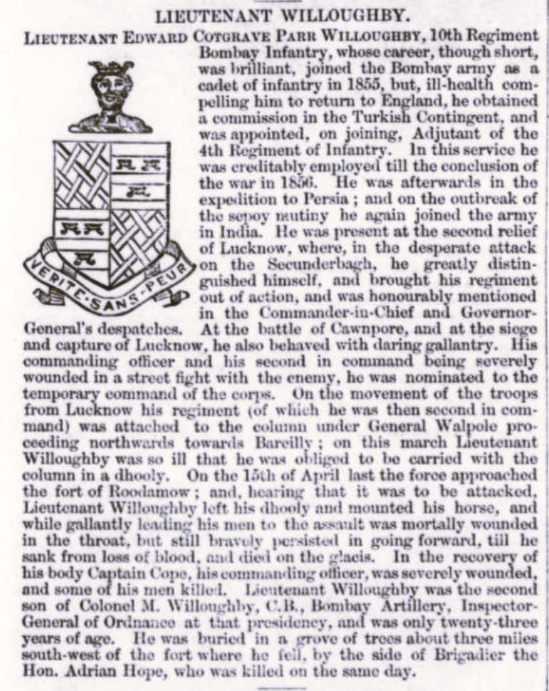
Lieutenant Edward Cotgrave Parr Willoughby was the second son of the illustrious Major-General Michael Francklin Willoughby (CB), who had served in India with the Royal Artillery, mostly in Gujarat and the Southern Maratha Country in the 1820s. He was present at the Capture of Aden in 1839 and then later commanded an artillery battery at Hyderabad. He ended his career on a less war-like path, as Principal Commissary of Ordnance and Inspector General of Ordnance at Bombay. During the Mutiny, he was appointed to the Staff of the India Office as Deputy-Inspector General of Stores and, in 1858, as Inspector. All his sons who survived to adulthood (three out of seven) would serve in India, and while it is tempting to think that one of them was responsible for the blowing up of the Delhi Magazine, this is a fallacy. George Willoughby was the son of a solicitor and not the major-general. However, George Willoughby too served in the artillery, and like the Major-General, had attended Addiscombe. If similarities must continue, both George and Edward would die in the Indian Mutiny holding the rank of lieutenant. We now return to the Major-General’s son.
Lieutenant Edward Willoughby was born in Pune in 1834. He was sent to England for his education and arrived in India in 1855 with a posting to the Bombay Army. The London Illustrated News for July 17, 1858, published a detailed obituary, detailing a young man’s very short but very active life.
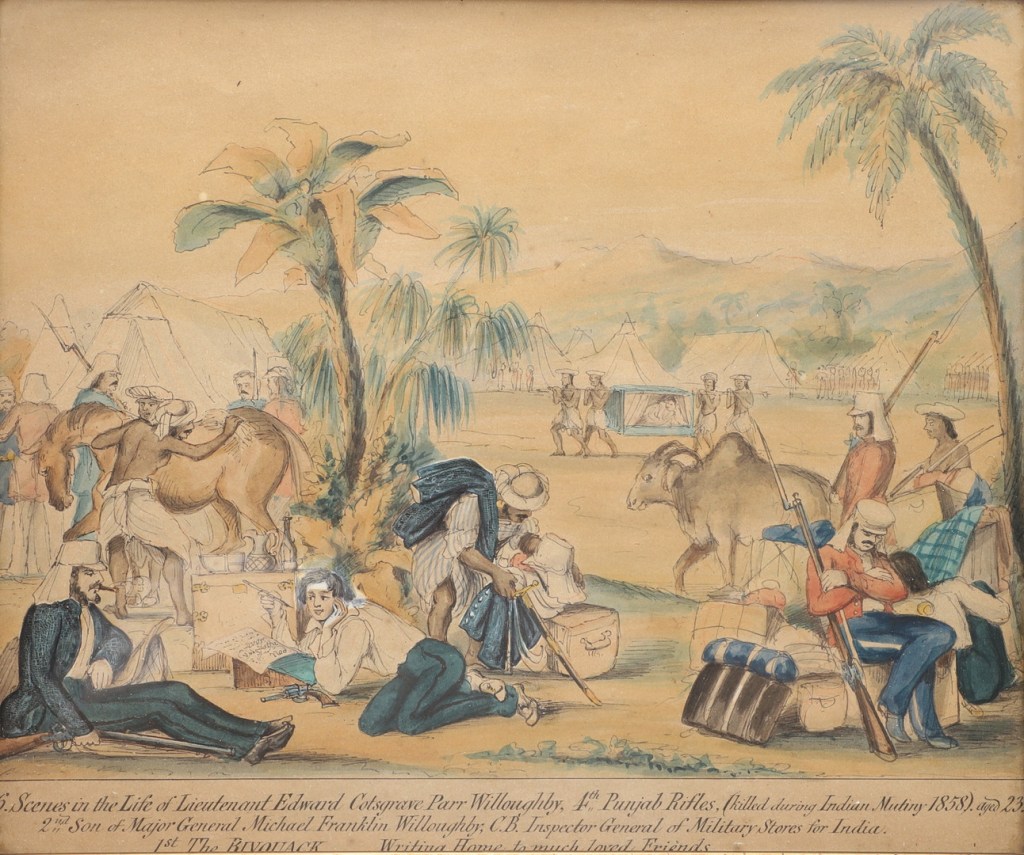
Six illustrations were recently sold at auction and titled, “Six scenes in the life of Lieutenant Edward Cotgrave Parr Willoughby, 4th Punjab Rifles (killed during the Indian Mutiny 1858) aged 23. 2nd Son of Major General Michael Franklin Willoughby C.B., Inspector General of Military Stores for India.” It is unclear who the illustrator was but it is presumed it was a member of his family.
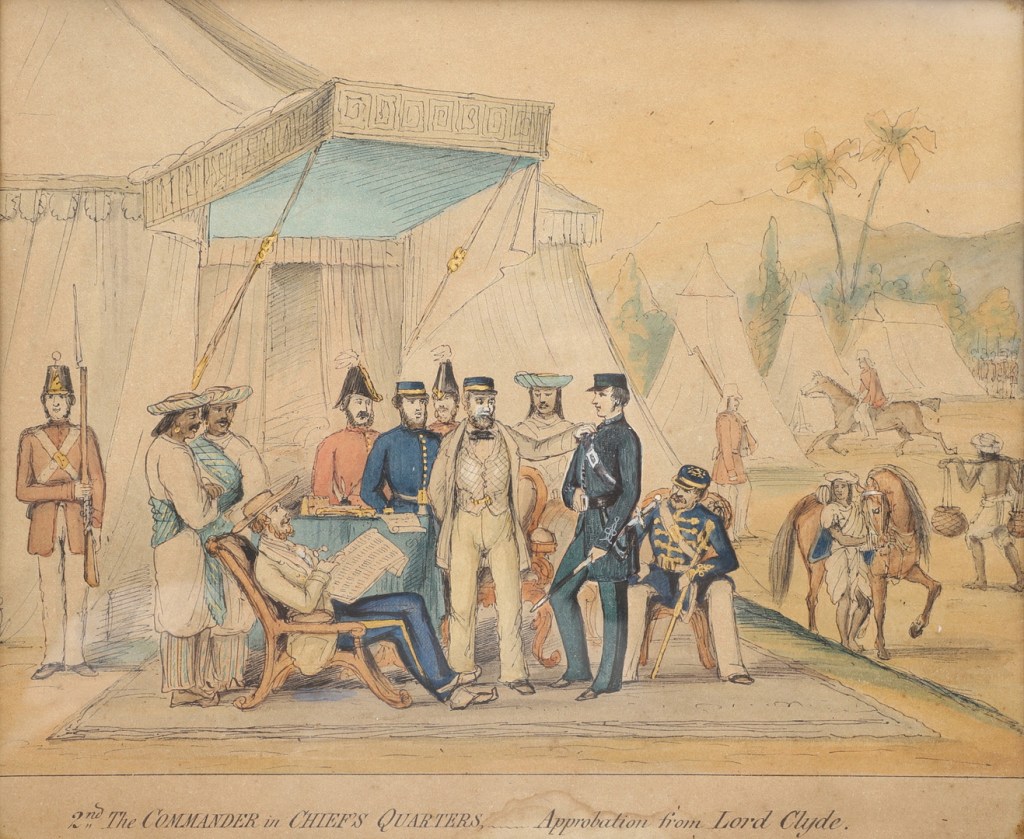
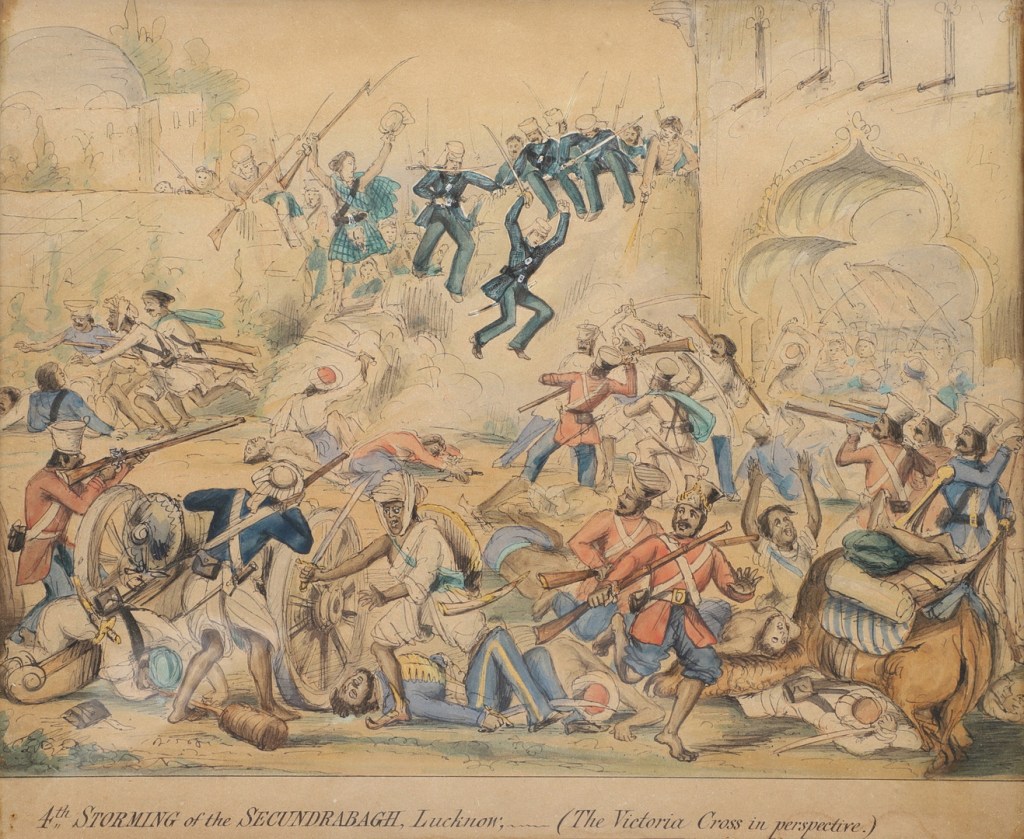
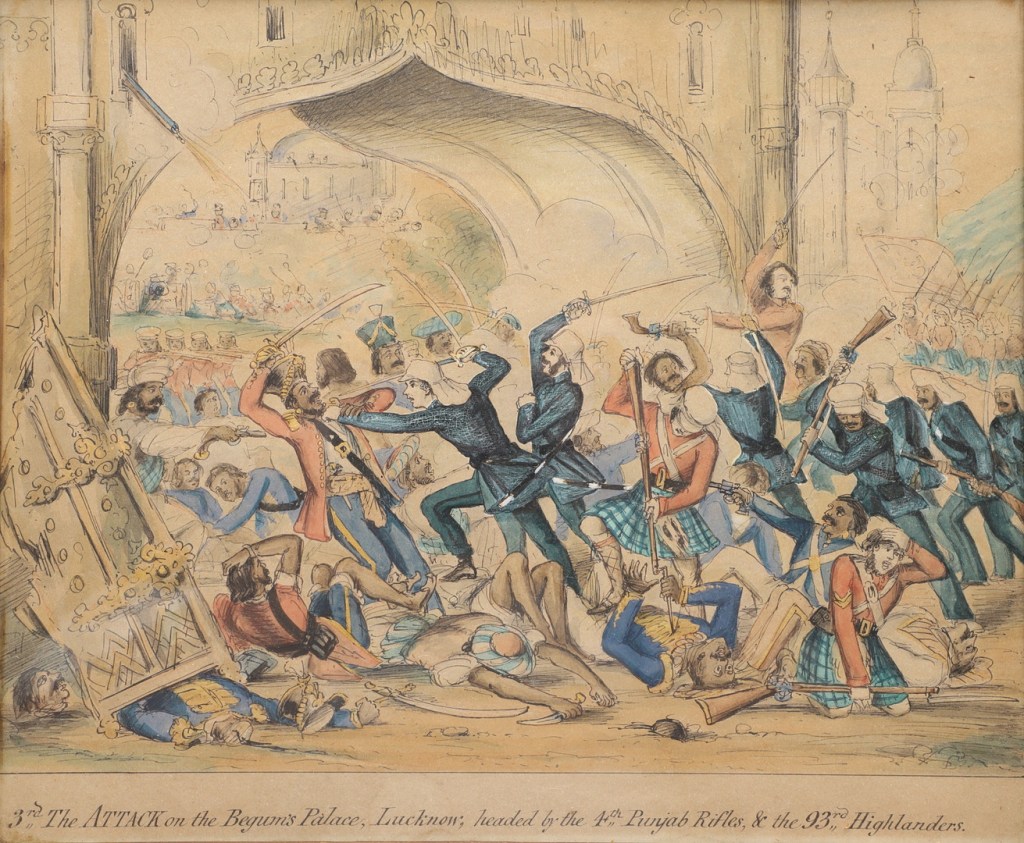
Willoughby was well-liked by his adopted regiment, the 4th Punjabis, although he had only joined on 7 November 1857, shortly before the Relief of Lucknow. He would temporarily be left in charge of the regiment when the senior officers were wounded, firstly at Lucknow and then at the Battle of Cawnpore. There is no doubt about the fight in the young man. Although suffering from a sore throat and obliged to be carried in a doolie on the march to Ruiya, with the battle imminent, he insisted on joining his regiment, much against his own presentiments. Wrote Fairweather:
“Curiously enough, although as cool as anything in action, he was despondent when ill and that morning, particularly so. When he heard there was the prospect of a fight, he jumped out of his doolie in the highest spirits… So he went to fight in his slippers just as he had come out of his doolie. However, he remarked to me, ‘ I wish I could get a flesh wound, for I feel almost sure that when I do get a wound, it will be mortal.’ ” It was the last time Fairweather would speak to Willoughby.
So Willoughby joined the 4th Punjabis in front of Ruiya Fort.
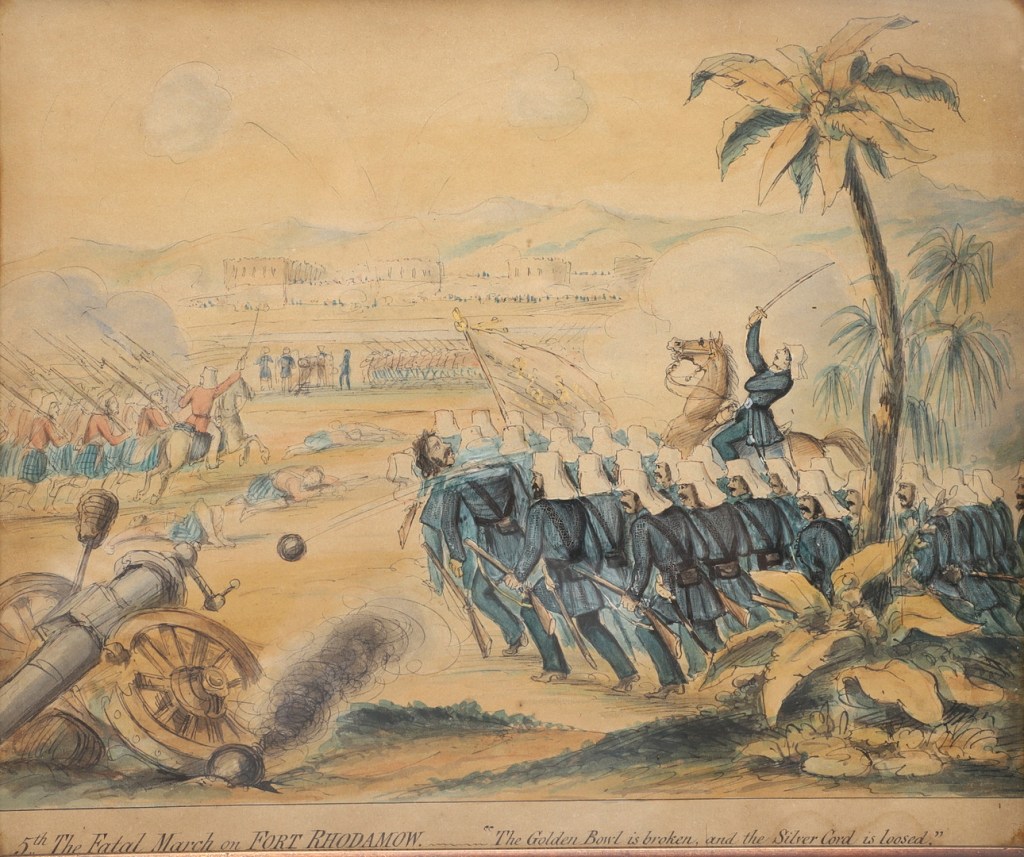
Early on in the fight, Willoughby was shot across the collarbone (other accounts say he was shot in the throat -as it was Fairweather who dressed his body for his funeral, we can take Fairweather at his word regarding the nature of the injury, and the shot was not in the throat directly). He sat down on the glacis, where Captain Cafe passed him and ordered him to retire to the field hospital. Unfortunately, Willoughby never regained his feet and bled to death where he sat. Here, Cafe passed him when the 4th Punjabis retreated.
Cafe called to his men to pick up Willoughby’s body and bring it back with them – it was very much the honour of the Punjabis to never leave their wounded and dead behind, so the order was not unusual in the circumstances; however, still being under heavy fire from the fort, they were unable to pick him up. Cafe now called on volunteers – immediately, two men of the 42nd, Lance-Corporal Thompson and Private Spence, and three Punjabis stepped up and together “they all went towards the body and dragged it back by its feet into cover.”
“In doing this one of the 4th Punjabi Infantry sepoys was killed and one of the Highlanders had his thigh bone broken; as he was lying on the ground, he called out, ‘ You are surely not going to leave me here,’ and Cafe again went out and helped the man in but not before his left arm was smashed above the elbow by a bullet.”
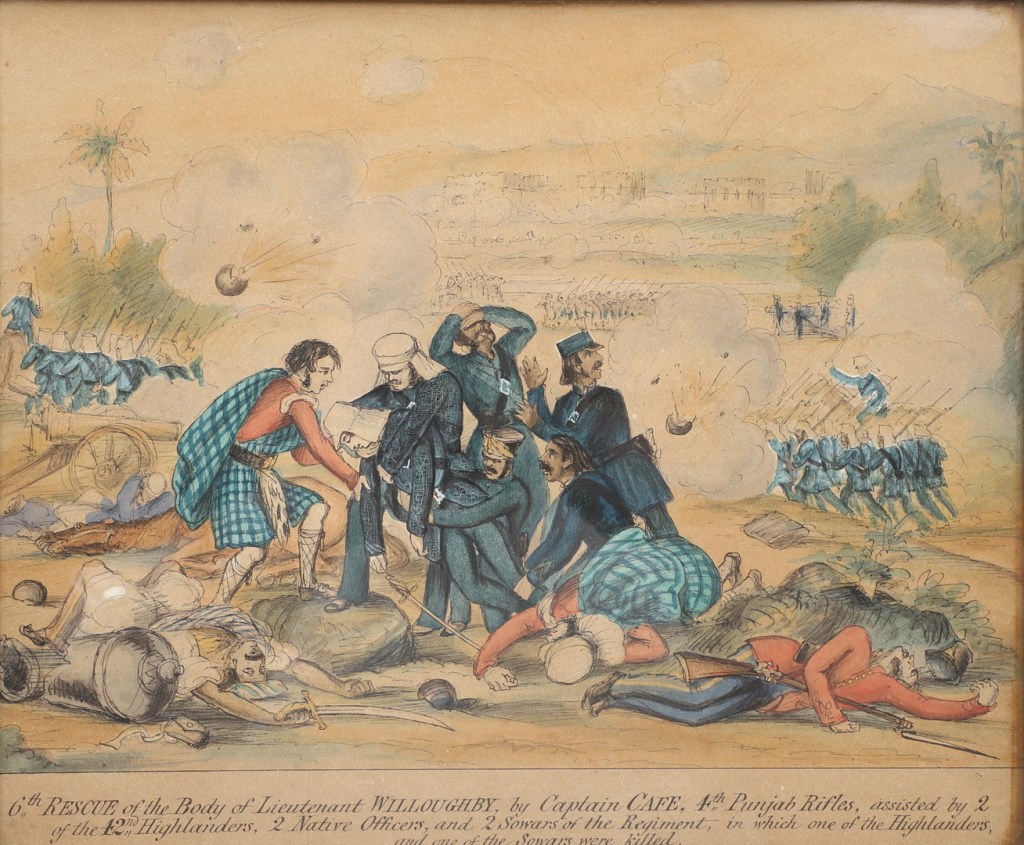
Willoughby’s body was not the only one retrieved from the field that fatal day.
Quartermaster Simpson of the 42nd, on hearing the retreat, immediately rushed back to the ditch and brought back Lieutenant Douglas; he then returned and brought out a wounded private of the 42nd. The story of Simpson’s bravery has, in part, been embellished in certain accounts ( according to Malleson, he saved seven men from the ditch – Malleson also gave him credit for saving Lieutenant Bramley – this can be taken as a mutiny exaggeration and considering the circumstances, while nobly intended, rather fanciful).
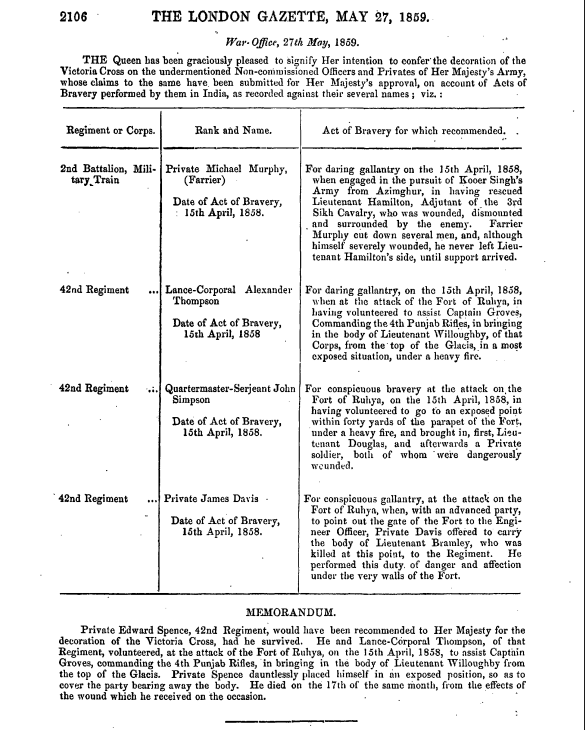
The two Punjabis who survived recovering Willoughby’s body received the Order of Merit.
Captain William Martin Cafe – 4th Punjab Rifles
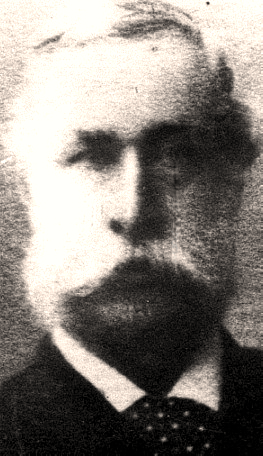
William Martin Cafe was born in London on 23 March 1826 to Henry Smith Cafe, an auctioneer and his wife Sarah (née Waine). It would appear the army held some appeal to the young man, for on 11 June 1842, he was already in India, serving as an ensign to the 56th Bengal Native Infantry. Promotion was rather swift, at least at the start, for by 12 April 1843, Cafe was a lieutenant. However, he had already seen war, for 1843 was the same year of the Gwalior Campaign, and he served at the action at Maharajpur for which he received a Gwalior Star.
As Captain Cafe, in 1849, he then served throughout the Punjab Campaign, including Sadulapur, Chillianwala, and Gujerat. Where Cafe was when his regiment, the 56th BNI, mutinied at Cawnpore is unclear, as quite obviously, he was not with them. The next time we hear of Captain Cafe, he had joined the 4th Punjab Rifles. He fought not only at Delhi but also at Lucknow at the Relief in 1857 and the retaking of the city in March 1858.
His citation in the London Gazette is as follows:
For bearing away, under a heavy fire, with the assistance of Privates Thompson, Crowie, Spence, and Cook, the body of Lieutenant Willoughby, lying near the ditch of the Fort of Ruhya, and for running to the rescue of Private Spence, who had been severely wounded in the attempt. (The London Gazette of 17 February 1860, Numb. 22357, p. 557)
Ruiya put an end to Cafe’s association with India for quite some time – the wound was so severe that he was obliged to return home on sick certificate from July 1858 until 1860. Cafe was gazetted quite late and received his VC at a private investiture in India in December the same year.
When Cafe returned to India, he joined the Adjutant General’s Department and would spend the rest of his career on the Staff before retiring in 1894, with his final rank of general. He died in 1906 at his home in Kensington and is buried in Brompton Cemetery. His medals, including his VC (Gwalior Star ‘Maharajpoor’, Punjab Medal 1848-49 with clasps Chilianwala, Goojerat; Indian Mutiny Medal 1857-58 with clasps Delhi, Relief of Lucknow, Lucknow), are held by the National Army Museum in Chelsea.
QUARTERMASTER-SERGEANT John Simpson, 42nd Regiment of Foot
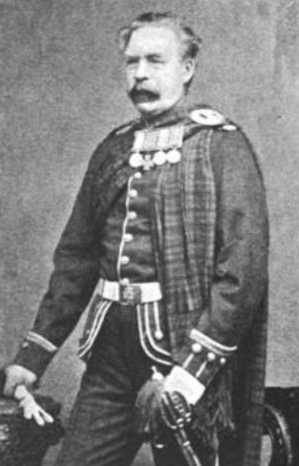
John Simpson was born on 29 January 1826 at West Church Parish Edinburgh, the son of James Simpson a general grocer and his wife, Mary. He enlisted in the 42nd Regiment on 8 June 1843 and served with his regiment in Crimea. Simpson was present at the Battle of the Alma, Balaclava and the assaults on the Redan at Sebastopol on both 18 June and 8 September. As Quartermaster-Sergeant (7 Sept, 1855), Simpson served through the Indian Mutiny (Mutiny Medal, one clasp, ‘Lucknow’). Following the mutiny, he received a commission as Quartermaster of the 42nd in India in 1859.
When Brigade Depots were formed in 1873, Simpson was appointed Quartermaster of the 55th Brigade Depot at Fort George, Madras. He also served in the 2nd Ashanti War. In 1874, Simpson transferred to the 58th Brigade Depot at Stirling and in 1879, to the Perth Militia, returning to the Black Watch in 1881 as Quartermaster of the 3rd Battalion.
Simpson was made an honorary Captain in 1883 and retired as an honorary Major in 1883, the same year he was gazetted as Quartermaster for the 2nd Perth Highland Volunteers. Upon his retirement, his Good Service Pension amounted to £ 50. As for his Victoria Cross, it must have been with mixed feelings, for it was presented to him by Brigadier General Robert Walpole at Bareilly in 1860. Major John Simpson died on 27 October 1884, aged just 58, and was buried with full military honours by the 2nd Perthshire and the 3rd Battalion Black Watch in attendance. His grave is at Balbeggie Churchyard, St. Martin’s, near Perth, Scotland. The question is, what happened to his medals? The site, http://www.blackwatch.50megs.com/ offers the following explanation:
According to the Red Hackle of July 1924, Simpson’s medals formed a prize centre piece in the collection of Medals of the Black Watch formed by Captain John Stewart and which was then in the Officers’ Mess of the 1st Btn at Aldershot. Now, according to one of the major VC websites, the medal is located in the County Museum of Natural History in Los Angeles. However, no one can explain how it ended up in the United States and why the VC remains outside his native land.
Lance-Corporal Alexander Thompson – 42nd Regiment of Foot
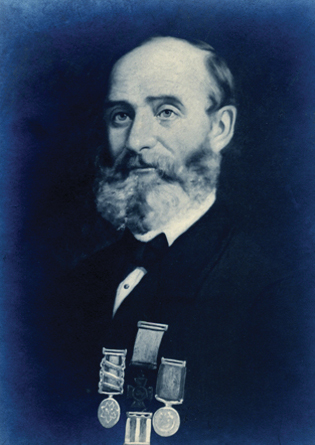
Unfortunately, we know little of the early life of Alexander Thompson – he was born in 1824 in Tolbooth Parish, Edinburgh, Scotland; his father, John, was a mason by profession. In 1842, Alexander enlisted in the 42nd Regiment at Stirling, citing his profession as a weaver. Like Simpson, he served in the Crimean War and in 1855 was promoted to corporal. This, however, was short-lived, for seven months later, in May 1856, he was demoted to private. It would seem Thompson was determined to turn himself around, and by the time Ruiya came about, he was Lance Corporal. His career is a series of promotions and a short demotion:
Corporal – 21 July 1858
Lance-Sergeant – 24 September 1859
Reduced to Corporal – 10 February 1860
VC investiture at Bareilly, 7 April 1860, under the auspices of Brigadier-General Robert Walpole
Lance-Sergeant – 26 January 1861
Sergeant – 3 February 1861
Sergeant Thompson was discharged on medical grounds in July, 1863 at Netley Military Hospital. For the remainder of his life, he worked as a twister, a grocer, a timekeeper and a labourer. He died in 1880 in Perth, Scotland. Besides his Victoria Cross, at the time of his death, he had an impressive set of medals that resides at the Black Watch Museum – Crimea Medal 1854-56 with clasps Alma, Balaklava, Sebastopol; Indian Mutiny Medal 1857-58 with clasp Lucknow; Turkish Crimea Medal 1854-55.
Private James Davis – 42nd Regiment of Foot
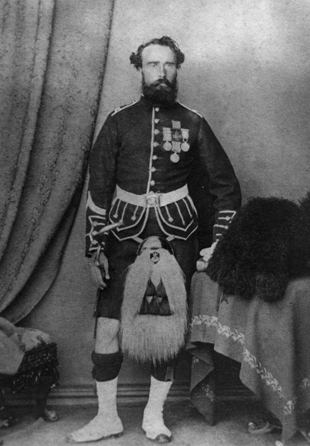
James Davis was born James Davis Kelly in Canongate Parish, Edinburgh in February 1835 to William Kelly, a labourer and his wife, Bridget. James’ career as a shoemaker was likely not quite as interesting as enlisting in the Black Watch in 1852, but he did so as James Davis, dropping his last name, Kelly. It does not appear that promotion was written on his cards for when he was discharged at Portsmouth in 1873, it was as a private. What became of him after is not known, but James Davis is the only man who left his own account of the Ruiya affair, as related to the Strand Magazine, in March 1891.
“I belonged to the Light Company under the command of Captain MacLeod. We got orders to lie down under some trees for a short time. Two Engineer officers came up and asked for some men to come with them to see where they could make a breach with artillery. I was one who went. There was a small garden ditch under the walls of the fort, not high enough to cover our heads. After a short time, the officers left. I was on the right of the ditch with Lieutenant Alfred Jennings Bramley of Tunbridge Wells, as brave a young officer as ever drew a sword, and saw a large force coming out to cut us off. He said, ‘Try and shoot the leader. I will run down and tell McLeod.’ The leader was shot, by whom I do not know. I never took credit for shooting anyone. Before poor Bramley got down, he was shot in the temple, but not dead. He died during the night.
The captain said, ‘ We can’t leave him. Who will take him out?’ I said, ‘I will.’
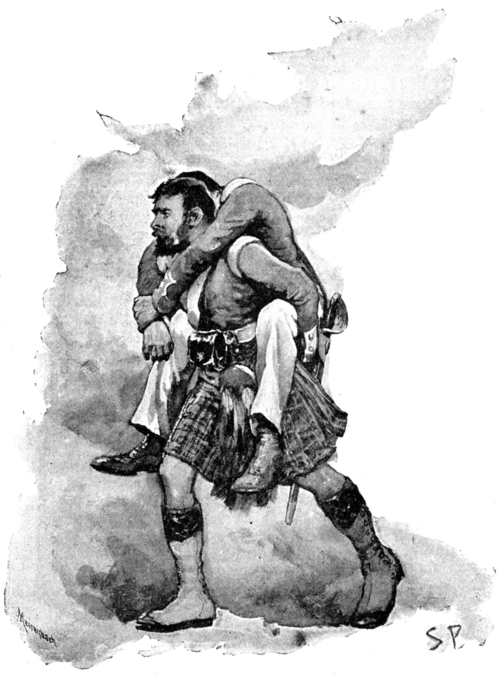
The fort was firing hard all the time. I said, ‘Eadie, give me a hand. Put him on my back.’ As he was doing so, he was shot in the back of the head, knocking me down, his blood running down my back. A man crawled over and pulled Eadie off. At the time, I thought I was shot. The captain said, ‘We can’t lose anymore lives. Are you wounded?’ I said, ‘I don’t think I am.’ He said, ‘Will you still take him out?’ I said, ‘Yes.’
He was such a brave young fellow that the company loved him. I got him on my back again and told him to take tight around the neck. I ran across the open space. During the time, his watch fell out; I did not like to leave it, so I sat down and picked it up, all the time under a heavy fire. There was a man named Dods, who came and took him off my back. I went back through the same fire and helped to take up the man Eadie. I returned from my rifle, and firing a volley, we all left. It was a badly managed affair altogether.”
Like Simpson and Thompson, Davis received his VC from the man who cost Bramley his life. Davis died in 1893 and lies buried at North Merchiston Cemetery in Edinburgh in an unmarked grave. His VC resides in the Lord Ashcroft Collection. His medals, besides the VC, included:
Turkish Crimea Medal ( 1855-56 )
Crimea Medal ( 1854-56 ) – 3 clasps: “Alma” – “Balaclava” – “Sebastopol”
Indian Mutiny Medal ( 1857-58 ) – 1 clasp: “Lucknow”
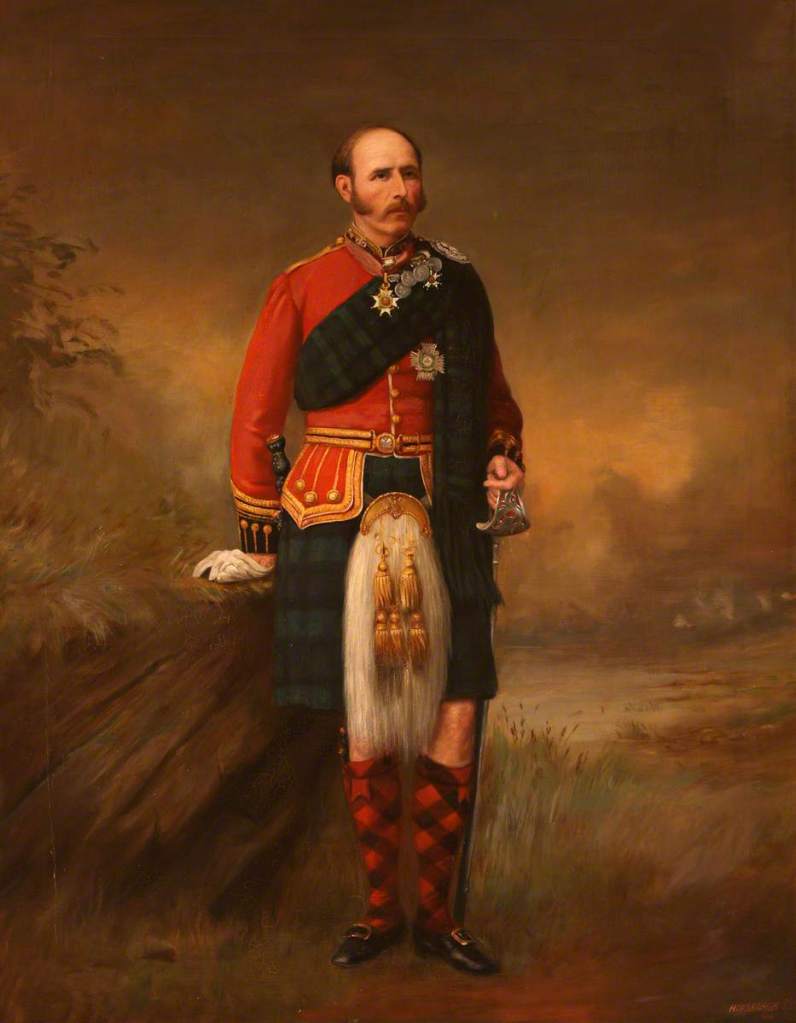
Private Edward Spence – 42nd Regiment of Foot
“Private Edward Spence, 42nd Regiment, would have been recommended to Her Majesty for the decoration of the Victoria Cross, had he survived. He and Lance-Corporal Thompson, of that Regiment, volunteered, at the attack of the Fort of Ruhya, on the 15th April, 1858, to assist Captain Groves, commanding the 4th Punjab Rifles, in bringing in the body of Lieutenant Willoughby from the top of the Glacis. Private Spence dauntlessly placed himself in an exposed position, so as to cover the party bearing away the body. He died on the 17th of the same month, from the effects of the wound which he received on the occasion. (The London Gazette of 27 May 1859, Numb. 22268, p. 2106)
VICTORIA CROSS. Errata in the London Gazette of Friday, May 27, 1859.
In the notifications of the Acts of Bravery performed by Lance Corporal Alexander Thompson and the late Private Edward Spence, of the 42nd Regiment, For Captain Groves, commanding the 4th Punjaub Rifles, Read Captain Cafe, commanding the 4th Punjaub Rifles. (The London Gazette of 21 October 1859, Numb. 22318, p. 3793) War Office, January 15, 1907.
The King has been graciously pleased to approve of the Decoration of the Victoria Cross being delivered to the representatives of the undermentioned Officers and men who fell in the performance of acts of valour, and with reference to whom it was notified in the London Gazette that they would have been recommended to Her late Majesty for the Victoria Cross had they survived:– London Gazette, 27th May, 1859. “Private Edward Spence, 42nd Regiment, would have been recommended to Her Majesty for the decoration of the Victoria Cross had he survived. He and Lance-Corporal Thompson, of that Regiment, volunteered at the attack of the Fort of Ruhya, on the 15th April, 1858, to assist Captain Cafe, commanding the 4th Punjab Rifles, in bringing in the body of Lieutenant Willoughby from the top of the Glacis. Private Spence dauntlessly placed himself in an exposed position so as to cover the party bearing away the body. He died on the 17th of the same month from the effects of the wound which he received on the occasion.” (The London Gazette of 15 January 1907, Numb. 27986, p. 325)
Born in Dumfries, Scotland, on 28 December 1830, and, after enlisting in the Black Watch, like his colleagues, would serve in the Crimean War. As we know so little about Spence, I have included his citation not only from 1859 but 1907. The Victoria Cross, after a six-month hunt for relations, was finally handed over to the son of his father’s cousin – it now resides in the Black Watch Museum in Perth, to whom it was anonymously donated. Spence lies buried at Ruiya.
“As the four men were nearing the edge of the jungle with the body (of Willoughby) Captain Cafe turned to see if Spens (Spence) was safe and following, but saw him kneeling on the edge of the ditch and beckoning with his hand. Desiring Thompson to go on to the dhoolie with the body, Cafe turned and went back to Spens, and found that he was wounded through the thigh and unable to get up. While standing beside him and encouraging him to make an effort to rise, Captain Cafe saw one of the enemy preparing to take a shot either at himself or Spens through an embrasure, so quickly stooping down, he picked up Spens’ rifle and shot the man. At last Spens, making an effort, got upon his feet, when Captain Cafe, giving him the support of his left arm, and carrying the rifle and the feather bonnet in his right hand, retired slowly with the wounded man. Before they could reach the shelter of the jungle, a bullet passed through Cafe’s arm above the elbow, the arm upon which Spens was leaning, but he continued to give the support of his wounded arm until he put Spens in a place of safety. Spens was morally wounded (the femoral artery cut through) and died in a few minutes, and Captain (now General) Cafe has almost lost the use of his left arm, the result of the wound received that day.” (Munro)
And all this misery for a man who refused to reconnoitre.
Sources:
Gordon-Alexander, William. Recollections of a Highland Subaltern. London: Edward Arnold, 1898.
Malleson, George Bruce. History of the Indian Mutiny. Vol. 2. London: William H. Allen & Co., 1879.
Munro, William. Records of Service and Campaigning in Many Lands. Vol. 2. London: Hurst & Blackett, 1887.
Munro, William. Reminiscences of Military Service with the 93rd Highlanders. London: Hurst & Blackett, 1883
Russell, William Howard. My Diary in India. Vol. 1. London: Routledge, Warne, & Routledge, 1860
Wright, William, ed. Through the Indian Mutiny: The Memoirs of James Fairweather, 4th Punjab Native Infantry, 1857-58. Stroud: Spellmount, 2011.
Links:
https://vcgca.org/
https://www.victoriacross.org.uk/
https://www.victoriacross.org.uk/
http://www.blackwatch.50megs.com/
Strand Magazine, Volume 1, Issue 3, March 1891
https://auctionet.com/en/events/705-militaria-medals-coins/163-a-fascinating-set-of-six-studies-of-scenes-in-the-life-of-lt-edward-cotgrave-parr-willoughby-whose-career-though-short-was-brilliant-and-whose-death-resulted-in-the-award-of-three-victoria-crosses – Six scenes in the life of Lieutenant Edward Cotgrave Parr Willoughby, 4th Punjab Rifles (killed during the Indian Mutiny 1858) aged 23. 2nd Son of Major General Michael Franklin Willoughby C.B. Inspector General of Military Stores for India.
 Mutiny Reflections
