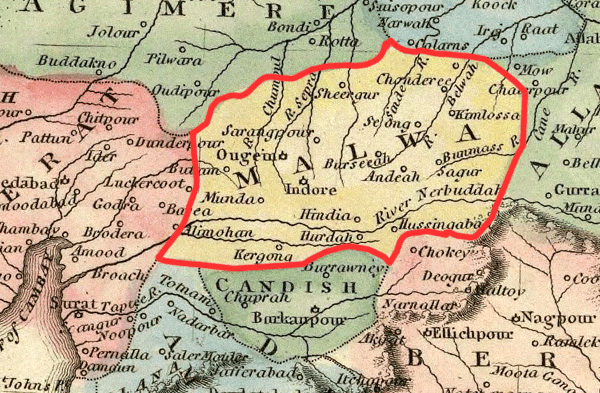
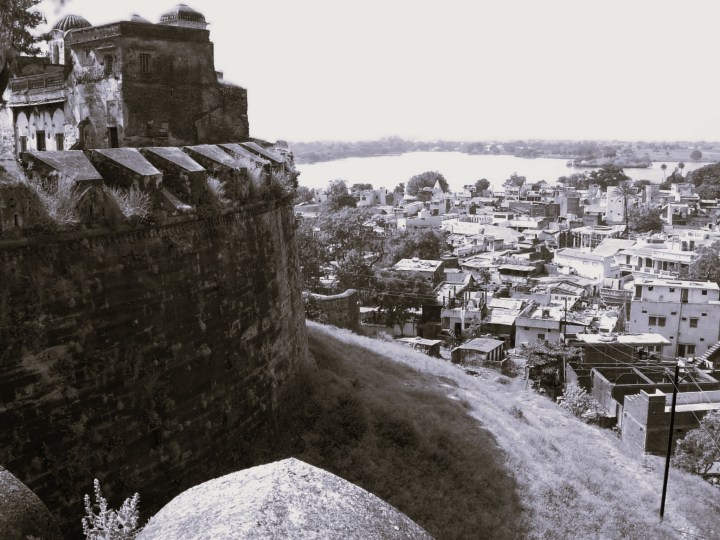
In August, the mutinied troops of Gwalior joined forces with mercenary Afghans, Makrani and Mewati rebels at Mandsaur, some 120 miles from Indore. By September, the force was estimated at 15’000 men with 18 guns and under the command of Firoz Shah Shahzada, a prince with connections to the Imperial House of Delhi. They plundered Bhopawar and Siradpur and then marched on Dhar, which they completely occupied on 31 August.
The uprising at Mandsaur threatened to engulf not just all of western Malwa but Neemuch as well. “Impressed with confidence” at the obvious lack of resistance put up by the British in their quarters, they now began to show a definite and most aggressive temperament, far worse than the sullen rumblings of Holkar’s men. The more active of these had long since left Indore and had proceeded to Gwalior, but the progress of the Mandsaur rebellion was so rapid it became of absolute necessity to hold the line of the Narbada and, in effect, when the time came to finally disarm Holkar’s troops. Meanwhile, Durand received letters towards the end of September, intercepted by stealth from Hyderabad, Nagpur, Surat, Gwalior and Mandsaur, all telling the same story – a general uprising would take place at the close of the great festival of Dusshera, which, fortunately, corresponded with the end of the rainy season. Early in October, as if to make their plans a reality, the troops of Feroz Shah advanced on the Bombay road to close off Durand’s communications with Bombay and to command the line of the Narbada along the Bombay front and, with all purpose, to attack Neemuch. So emboldened by their progress, the rebel leaders sent invitations to Holkar’s troops to join them.
Meanwhile, the Nana Sahib had been chased away from his grounds in Cawnpore and Bithur and was seen “hovering” in the vicinity of Kalpi, where now the worry was that he might actually send his troops to Central India, hoping to bring himself one step closer to the Maratha Empire he so desperately wanted. The question now was how quickly the Malwa Field Force could strike. It was finally decided in October that any further delay was only causing the Malwa situation to escalate. The Malwa Field Force finally opened the Malwa Campaign with a march on Dhar. At the same time, the Hyderabad Contingent Field Force was on their way and would, while the British were fighting at Dhar, keep the rebels busy. The British victory at Dhar would have repercussions throughout Malwa and into Rajputana; however, the Malwa Field Force would still have to wrest Mandsaur from the Firoz Shah Shahzada.
Sources:
A Memoir of Central India, Including Malwa, and Adjoining Provinces. With the History and Copious Illustrations, of the Past and Present Condition of That Country Vol I & II – Sir John Malcolm (1823)
The Life of Major General Sir Henry Marion Durand, Vol I – H.M. Durand (1883)
The Revolt in Central India 1857-59, Compiled in the Intelligence Branch (1908)
The Bayard of India – A Life of General Sir James Outram – Capt. L.J. Trotter (1909)
A Short History of the Malwa Bhil Corps (1890)
A Memoir of the Khandesh Bhil Corps – A.H.A. Simcox
The Revolt of 1857 in Central India -Malwa – K. L. Srivastava (1966)
Shahzada Firoz Shah – A Forgotten Hero of 1857 – Dr. Suresh Mishra (2018)
 Mutiny Reflections