Jodhpur and Captain George Henry Monck-Mason
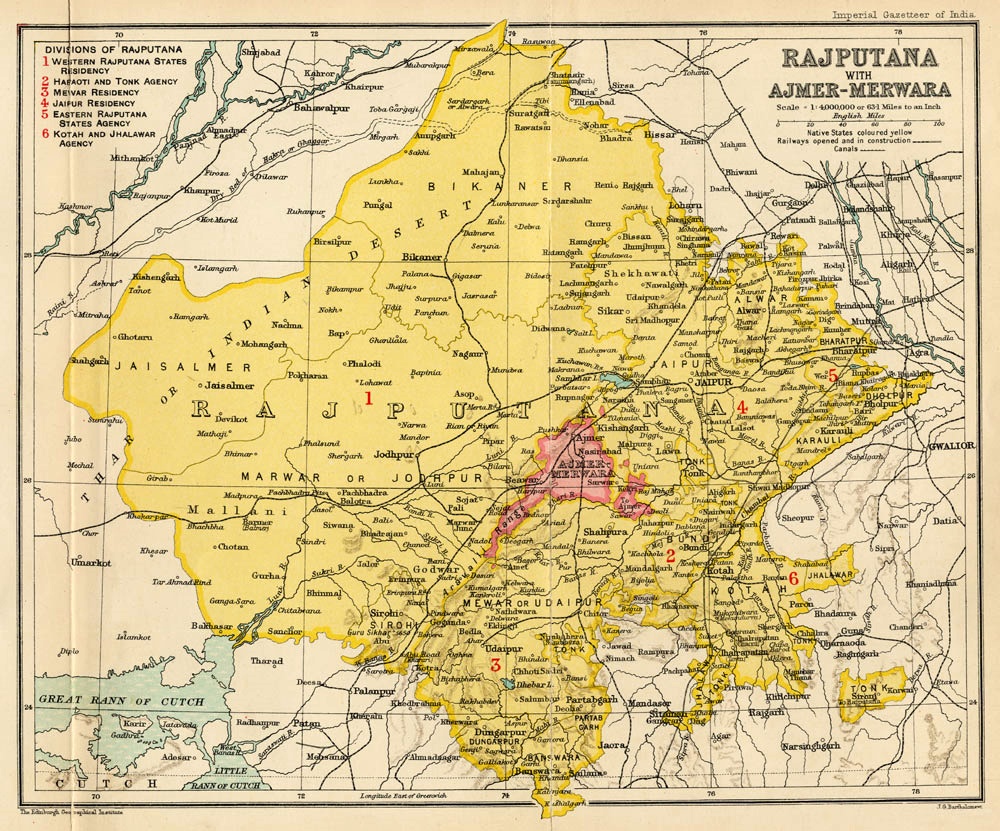
Western Rajputana
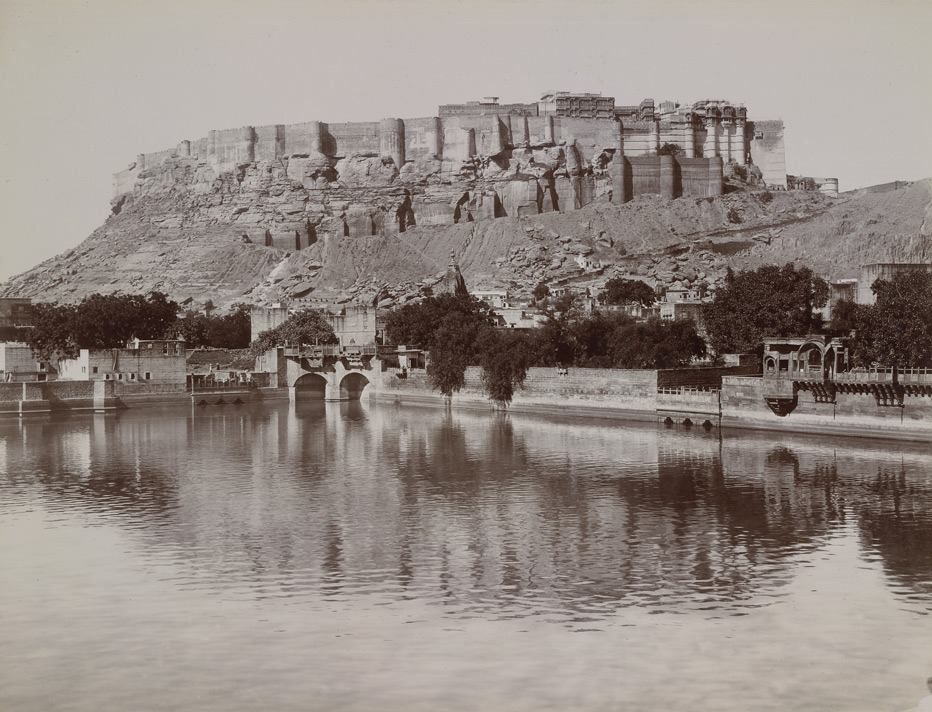
Jodhpur or Marwar is one of the most extensive of all the Rajputana States of some 33’061 square miles: it is a wild country, comprised mostly of desert, and its rulers are the most remarkable of the race of Rajputs, the Rathores.
They are the ruling family of Marwar, of the Surajwansh, or Sun family, who are said to be descendants of Kush, the second son of Rama, the celebrated king of Ayodhya. Their long and turbulent history began in 470 AD when Kanauj was conquered by Nenpal of the Rathore clan. He was succeeded by Bharat, who had 13 sons and, from them, sprang the many branches of the Rathores. The clan ruled for 700 years and formed one of the four great Rajput kingdoms, which divided India at the time of the first Mohammedan invasion.
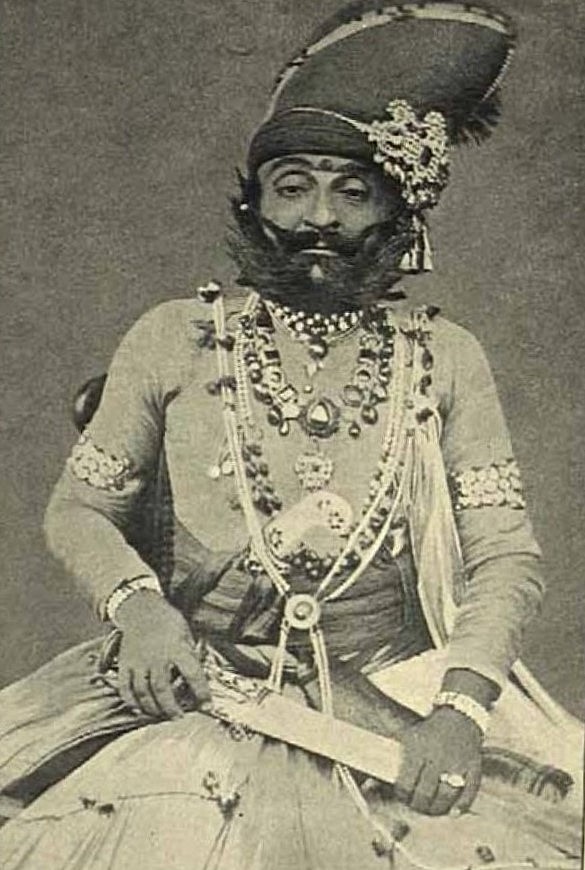
Volumes can be written about the Rathores – their battles and conquests; however, we shall focus our attention on Maharaja Takht Singh of Jodhpur, the erstwhile ruler of Jodhpur in 1857. His history was complicated — as the adopted heir of Maharaja Man Singh.
Maharaja Man Singh ruled for nearly 40 years and would be the last independent ruler of the Marwar Kingdom and Jodhpur State. He was appointed heir by his grandfather, Vijay Singh, in 1791, but upon his death, a cousin of Man Singh – Bhim Singh -seized Jodhpur and proclaimed himself regent. Man Singh spent the next years at Jalore, waiting for Bhim Singh’s death. He finally took the throne in 1803 and in 1804, promptly broke his treaty with the British and formed an alliance with the Yashwantrao Holkar: Scindia of Gwalior however, invaded Jodhpur forcing Man Singh to break his treaty with Holkar and pay tribute to Scindia. Opposition to Man Singh was rife, and he turned to the support of successive factions to keep him in power. Of these, the Naths, the Maharaja’s spiritual advisors, finally began taking control of the state, leaving Man Singh little more than a puppet king.
This intolerable state of affairs led Man Singh to strike a deal with the British, and at the advent of the Pindari War, he concluded a treaty of alliance with them in 1818. In 1839, with the growing power of the Naths still causing turbulence in Jodhpur, a British force under Colonel Sutherland entered Jodhpur and remained for five months until some semblance of order was restored. Confusion, however, descended again on Jodhpur when Maharaja Man Singh died in 1843 without an heir.
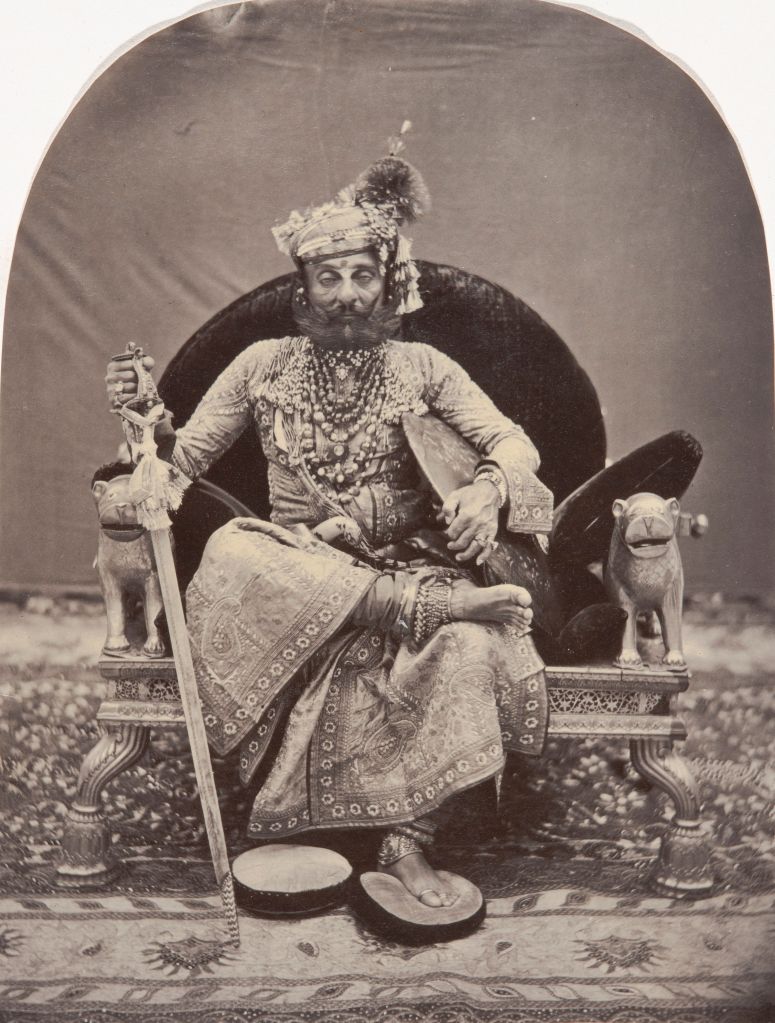
Maharaja Takht Singh
Although a Rathore, Maharaja Takht Singh was not a Marwari by birth but a descendant of a branch of the family that had long since settled in Gujarat — at the time of Man Singh’s death, Takht Singh was the ruler of Ahmednagar. Declared heir to the Jodhpur throne as Man Singh had left no legitimate heirs, Takht Singh was granted the throne after he relinquished his claim to Ahmednagar in Idar State — a concession insisted upon by the British. In 1843, he took his place as the Maharaja of Jodhpur.
An adopted heir was generally not a problem, but in this case, he was not considered a Marwari by most of the Thakurs, but, at best, an outsider.
“Many of his thakurs or nobles were extremely ill-disposed towards him; some were in veiled, others even in open rebellion. The Maharaja himself had no love for his Suzerain. Still, he was not blind to the fact that, in the state of ill-feeling that existed between him and his nobles, it behoved him to cling to the British as his surest anchoring ground.”
If he had been a strong ruler from the onset, things might have been different, but as one political agent pointed out, there was practically no government to speak of in Jodhpur — a state of affairs which was still rampant in 1857. For all his shortcomings, however, Takht Singh remained a wholehearted supporter of the British and left much of the administration to their political agent. Even today, Maharaja Takht Singh is remembered not for his wise and insightful rule, but for his obvious love of the arts, particularly paintings in which he features in various forms of leisure. He was revered for his hospitality and famous for the “excellence of his wine.”
Containing the strife between Takht Singh, the various nobles and landowners of Jodhpur in 1857 was the British Political Agent to his court, Captain George Henry Monck Mason.
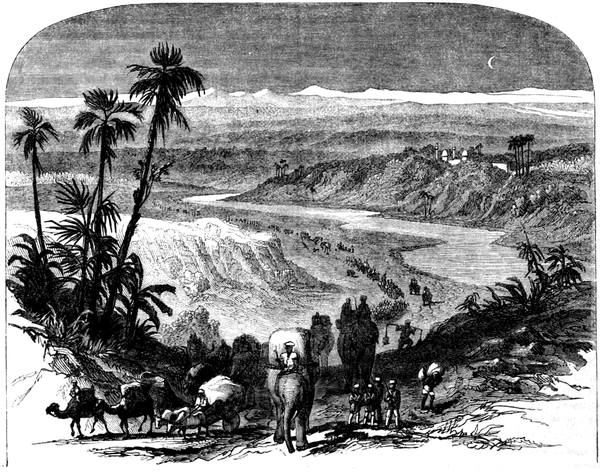
Born in 1824, Monck Mason was the son of Captain Thomas Monck Mason of the Royal Navy. In 1842, young George was gazetted an ensign in the 74th Regiment of Bengal Native Infantry, rising to lieutenant in 1845 and assistant to the political agent in Rajputana in 1847. An energetic young man, Monck Mason soon made a name for himself by capturing several robber chiefs on the nearby borders of Scind — he would ride out, accompanied only by a few trusty sowars, traversing vast tracts of desert on camelback, sometimes as much as 80 miles (ca. 129 km) in a day. He insisted on simplicity in his forays, travelling with no personal retinue, and occasionally subsisted on nothing but chapattis and heartening doses of arrack. His reputation gained him the notice of the government, and he was rewarded with his own post as political agent to the small Rajput state of Kerowli. For six years, he stood firm, using tact and persuasion, dealing with the disputed succession to the raja’s throne — Dalhousie was not blind to Monck Mason, and he was quick to thank him for his efforts. In March 1857, Monck Mason succeeded Sir Richmond Shakespeare as Resident in Jodhpur.
At the first sign of the trouble to come, Maharaja Takht Singh unhesitatingly placed a small contingent -2000 men and 6 guns – at Monck Mason’s disposal, barely two months after the agent had arrived in Jodhpur. It was a positive start, and until the end of June, things looked well in Jodhpur.
The Beginnings of the Jodhpur Legion
Under the many articles of the treaty, Maharaja Man Singh had signed with the British in 1818, one of the stipulations was the formation of a force to be maintained at the expense of the Jodhpur State, but equipped, disciplined and officered by the British. The contingent, known as the Jodhpur Legion, was to furnish 1,500 horses for service at the behest of the British government whenever their need arose. In 1832, when such a requirement was desired, the troops sent to fight freebooters at Nagar Parkar proved themselves useless in battle; therefore, a further stipulation was added in 1835, in which an annual sum of Rs 1’150’000 was to pay towards the formation of the Jodhpur Legion and maintain them at that expense. They were on an equal standing with the Gwalior and Kota contingents.
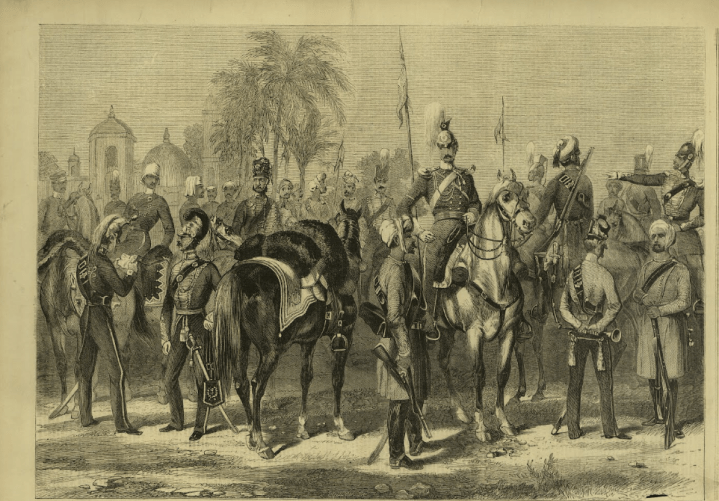
In 1857, the commandant of the Jodhpur Legion was Captain Hall, the second-in-command, Captain Black and the adjutant, Lieutenant Connoly. Under Hall was a substantial army, consisting of an infantry regiment comprising eleven companies, of which eight were sepoys recruited from the Bengal Presidency and three of Bhils, three well-mounted troops of cavalry, mostly formed of Ranghars of Haryana and Shekhawati and artillery consisting of two camel-drawn 9-pounders and manned by men from the infantry.
In each troop of cavalry, there was a risaldar (native captain), a naib risaldar (native lieutenant), one kote duffadar (pay-sergeant), six duffadars, one standard-bearer, one trumpeter and 72 troops. This particular branch of the Legion was considered the best mounted and best equipped of all the irregular cavalry bodies in service at the time, and their horses were “a constant subject of comment among officers altogether unconnected with the regiment.” The eight sepoy companies of infantry each had 80 men, two native officers and 12 NCOs. The three companies of Bhils, however, were only 70 strong each. As such, there was little sympathy between the sepoys and Bhils, who were men from the region and had little in common with the presidency-recruited sepoys.
On the whole, the legion was, like at Gwalior,
“… officered on what used to be the system of the Bengal irregular troops, that is to say, each regiment would have merely its (European) commandant, second in command, and adjutant, all officers of the line, taken from their legitimate duties with the corps on whose rolls their names were borne, and enjoying higher salaries than they would have received in their own regiments; the appointments to these corps, legions, and contingents were much sought after, and highly prized by the army in general. The duty was light and pleasant, the post considered an honourable one, and the pay good.”
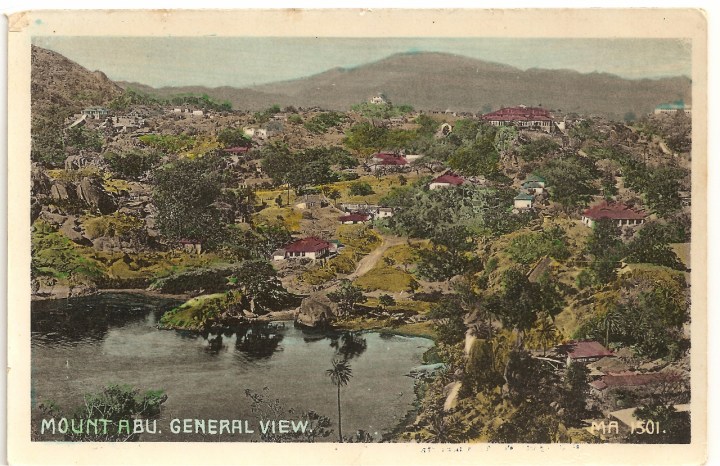
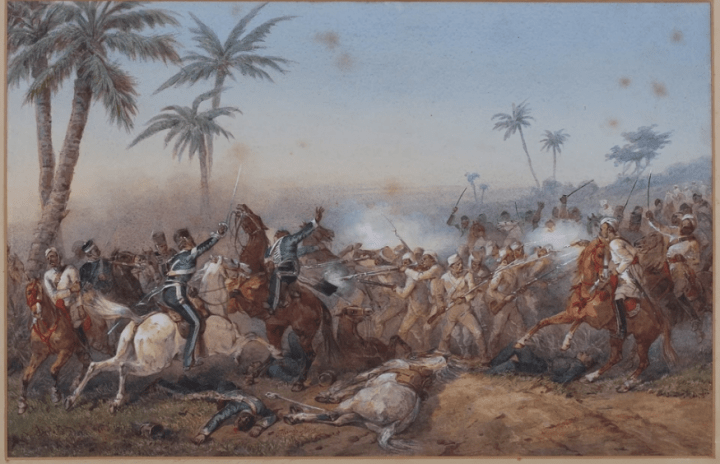
The headquarters of the Jodhpur Legion was at Erinpura, situated in Jodhpur territory, bordering the Sirohi State and 50 miles (ca. 80 km) north of the hill station of Mount Abu. It is here that their story mutiny, mayhem and mishap begins.
Sources:
Adams, Archibald. The Western Rajputana States: A Medico-Topographical and General Account of Marwar, Sirohi, Jaisalmer. London: Junior Army & Navy Stores, Limited, 1899.
Great Britain Parliament. Accounts and Papers: Army, Medical Department; Medical Statistics. Vol. IV. London: Harrison and Sons, 1861.
Intelligence Branch, comp. The Revolt in Central India 1857-59. Simla: Government Monotype Press, 1908.
Kaye, John William. A History of the Sepoy War in India, 1857-1858. Vol. III. London: W. H. Allen & Co., 1876.
Lawrence, George. Reminiscences of Forty-Three Years in India. Edited by William Edwards. London: John Murray, 1874.
Malleson, G. B. History of the Indian Mutiny, 1857-1858, Commencing from the Close of the Second Volume of Sir John Kaye’s History of the Sepoy War. Vol. I (1878); Vol. II (1879). London: Wm. H. Allen & Co.
Prichard, Iltudus Thomas. The Mutinies in Rajpootana: A Personal Narrative. London: John W. Parker and Son, 1860.
Sahai, Munshi Jwala. The Loyal Rajputana. Benares: Medical Hall Press, 1902.
Sharma, G. N., ed. Proceedings of the Second Rajasthan History Congress. Jaipur: Rajasthan History Congress, 1969.
Singh, Zabar. “Mutiny of the Jodhpur Legion.” Proceedings of the Indian History Congress 32, vol. II (1970): 73–78. jstor.org.
 Mutiny Reflections