The Dilkusha and the First Advance, 2 March 1858
On the morning of the 2nd of March, the advance began, and it started with the taking of Dilkusha Park. Joining Sir Colin on this first move were:
Artillery Division Headquarters under Archdale Wilson and Colonel Wood
Three Troops of Horse Artillery – D’Aguilar, Tombs and Bishop
Naval Brigade (detachment) – Captain Peel: two 24-pounders and two 8-inch howitzers
Two companies, Sappers and Miners
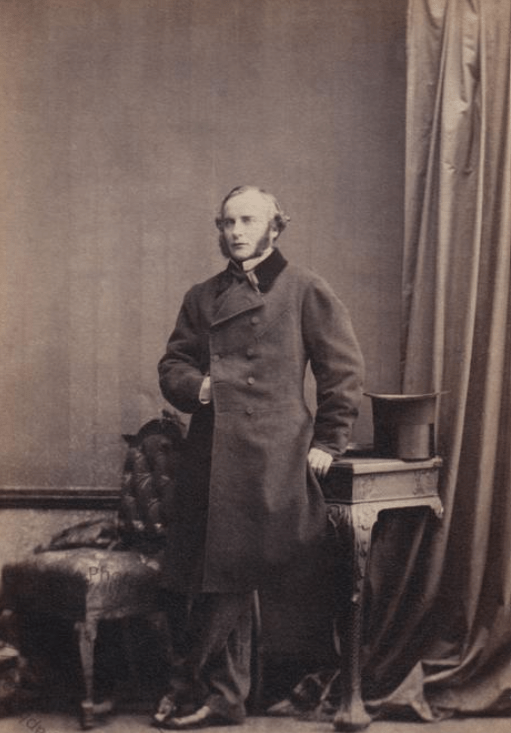
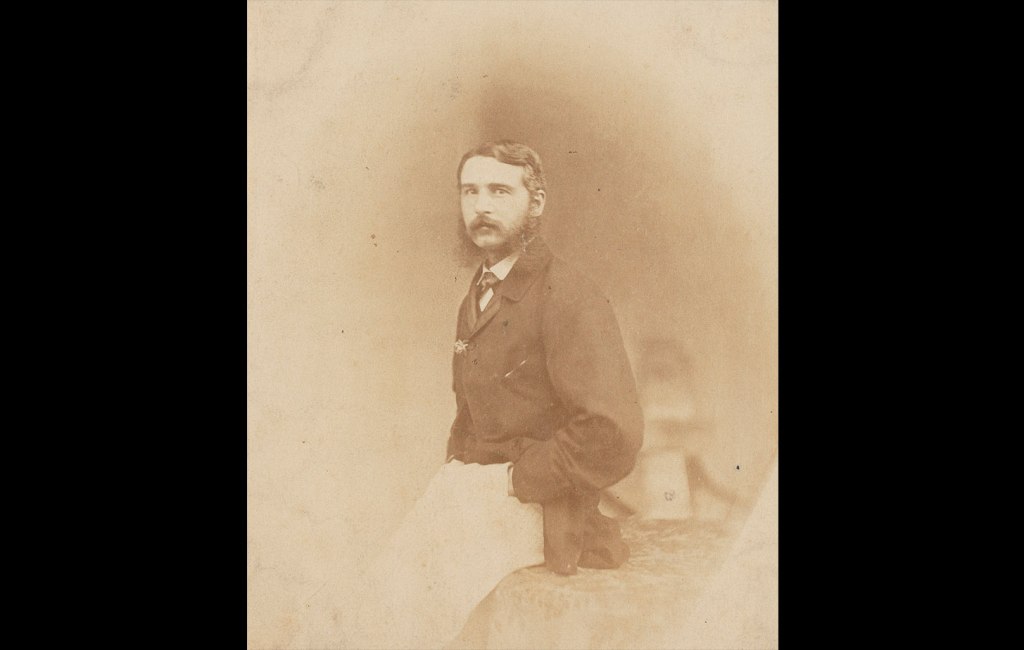
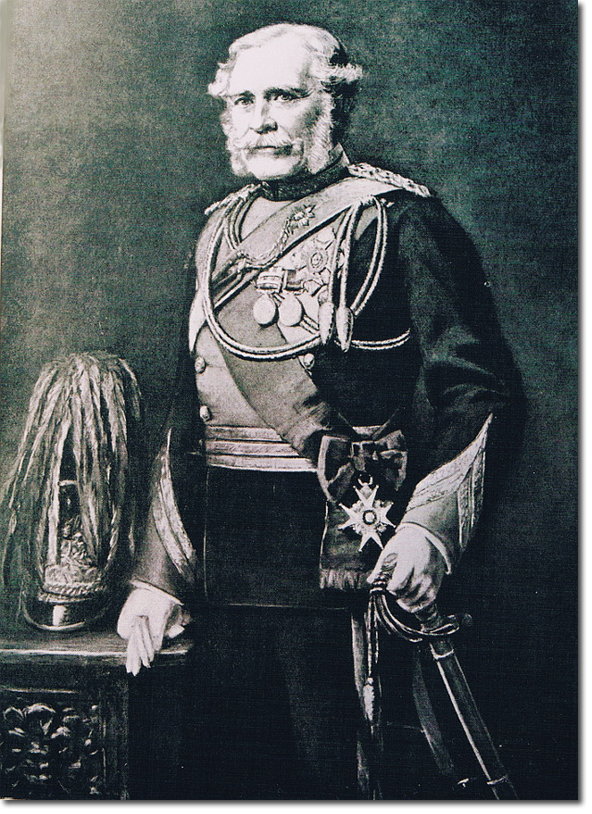
Cavalry Division Headquarters – Sir Hope Grant
Little’s Cavalry Brigade of 9th Lancers, 2nd Punjab Cavalry, detachment 5th Punjab Cavalry and 1st Sikh Irregulars
2nd Division of Infantry, 3rd and 4th Brigades – Sir Edward Lugard
3rd Brigade: Brigadier P.M.M. Guy – detachments of the 34th, 38th and 53rd Regiments
4th Brigade: Brigadier Adrian Hope – 42nd and 93rd Highlanders, 4th Punjab Rifles
Long before dawn, on 2 March, the first troops were drawn up and the advance began. The disappointment in the Naval Brigade was audible; however, Captain Peel remained firm; not everyone was needed for today’s work, and they would be called up when the time came. That would be sooner, however, than the disappointed sailors imagined.
For now, Sir Colin Campbell was determined to set up a new camp on the grounds adjacent to the Dilkusha. Before him, was a 12-mile march from his camp at Banthera to the Dilkusha grounds.
“Very early in the morning of the 2nd of March, the first bugle sounded. It was followed by the shrill pipe of the boatswain’s mate. Many a smouldering campfire cast its fitful glare upon the regiments as they fell in. A few lances glimmered in the firelight, and Sir Colin, accompanied by his small cavalry escort, rode up and inspected the Highlanders. As the grey dawn began to break, they marched off with the pipers playing ‘The Campbells are coming.’ The siege of Lucknow, which all had so anxiously longed for, had opened.”
The road they were taking was a straight line through a sandy plain, interspersed with clumps of short grass. The heavy guns struggling through the sand were placed in the middle, flanked by the infantry and the cavalry, with the horse artillery on the outermost sides and the baggage following up in the rear. After nine miles, they passed the Alambagh, and Sir James Outram came outside to meet the C-in-C. The force proceeded for another mile and halted a mile from Jallalabad Fort.
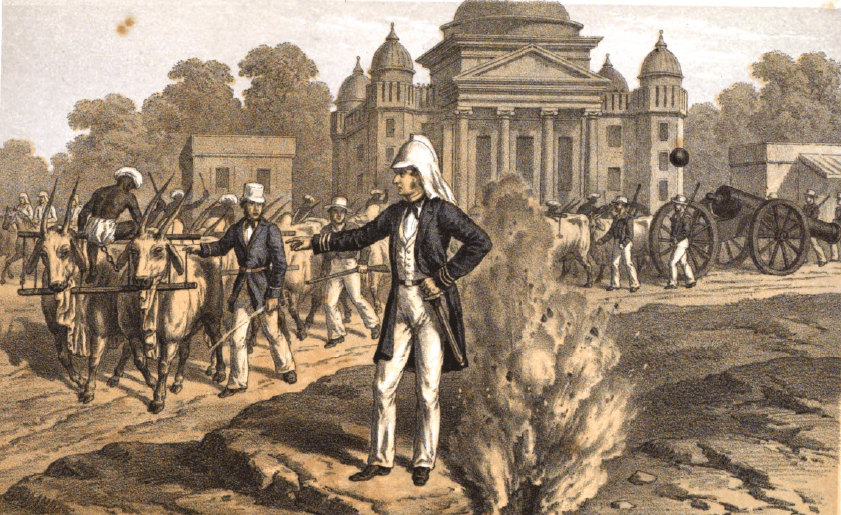
While the two men held their meeting, the rain had begun to fall in torrents, dampening the dust around the resting men, who, under any shelter they could find, ate what breakfast their haversacks provided. Then, with the rain still falling, the order came to form, and the march recommenced. Their way was through a field of high crops until it opened up again into a wide, grassy plain. It was by no means a pleasant sight for the ground was littered with the bones and “mummy-like skeletons of rebels killed some time ago.” In front was an abandoned village, resting on a slight elevation and to their left stood a seemingly innocuous grove of trees. Suddenly, without warning, a gun of large calibre opened up, well masked by the trees.
The Lancers dashed forward, followed closely by the Horse Artillery, “bounding over low dykes
and ditches, as if the heavy field-pieces and carriages were baby-carts.” Things quickly became difficult. One horse of the artillery was shot and had to be left behind, dying. Then the Horse Artillery flew into a narrow lane, traversed on both sides by pits and chasms, making it impossible for them to turn around. One horse took objection to the lane as a whole and refused to make a single step forward, blocking the carriage advancing from behind. A gunner swiftly unbuckled the traces of the reticent animal and sent it off, thus unblocking the road, allowing for the cavalry and the artillery to push forward.
Although there was only one gun in the grove, its rapid fire raked the Lancers mercilessly until the field pieces could be brought into position, leaving Captain Turner horribly mutilated, losing half his jaw and tongue. However, there was nothing for it, and under the cover fire of the artillery, the Lancers and the Sikh Cavalry swooped through the grove, killed the gunners and captured the gun. With the objective accomplished, the march continued with no further incidents.
That is, until they reached the vicinity of the Dilkusha.
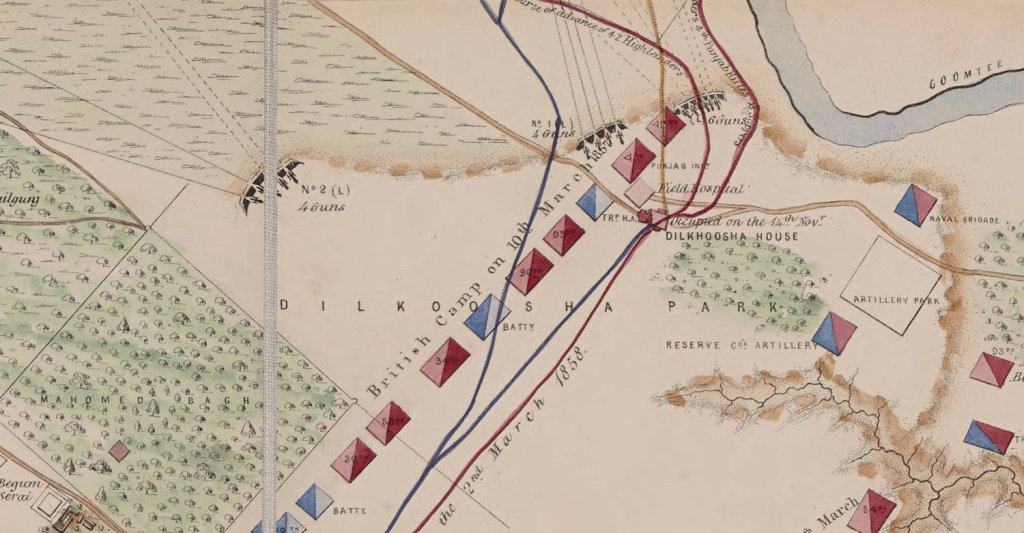
When the infantry brigades began to close in on the advanced guard, the rebels opened fire from several guns they had placed in bastions along the line of the canal and began a heavy and sustained barrage. To keep down the fire, the Naval Brigade and some of the heavy guns were quickly placed in battery on the brow of a hill just to the right front of the Dilkusha with “Peel, as was his custom, leading his guns, and perfectly indifferent to the balls which occasionally struck the ground within a short distance of his feet.”
Meanwhile, Sir Colin Campbell took his position.
For all their planning, the rebels had not occupied the areas around the Dilkusha nor the building itself, and Sir Colin deployed an advanced picket on the right of the building and Mahomed Bagh, which was situated in a large mango grove, surrounded by a wall, on the south left. By early afternoon, they were supported by two guns from the Shannon, which were posted near the corner wall of Mahomed Bagh. However, the rebel fire was relentless – two sailors were injured by the same shot – one, named Terry, lost his leg to round shot and died during the night, and the other had his forehead shot off. “A comrade jumped up and stuck it on again—a large piece of skull and brains…” With a piece of shot “as large as half a crown” stuck in his brain, he would take three days to die. Brigadier Little was shot in the elbow by a rebel hiding in the Mahomed Bagh, and Sir Colin narrowly missed losing his head when three bullets struck the tree he was.
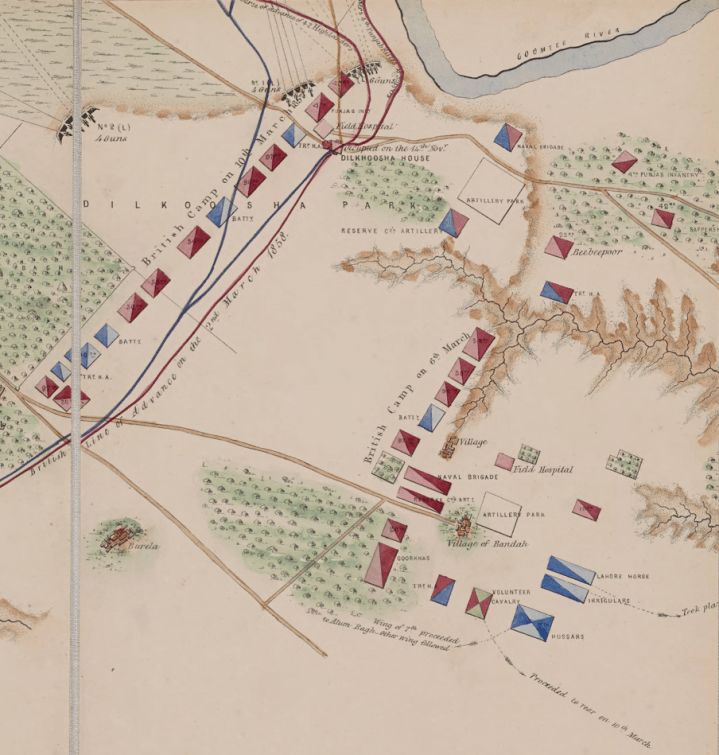
Although it was not his plan, Sir Colin was obliged to move his camp as far back as possible, but unfortunately, due to ravines in the rear of it, it was only just short of the range of the firing that continued for the rest of the day. The Quartermaster-General’s department rapidly marked out the camp and placed it behind the wall of the Dilkusha Park, with its right resting on the Gumti River and the left extending nearly two miles, facing the Mahomed Bagh. Dilkusha Park itself was swiftly occupied by Turner’s Battery and the infantry, while the Lancers took a position in a tope situated in the low ground to the left.
The Reverend Goes Visiting
Curiously, Reverend Mackay, who had accompanied the force, was now wending his way on horseback from one position to the next, stopping briefly to exchange pleasantries with Dr Munro of the 93rd and Lieutenant Ewan Macpherson, who were in the Dilkusha park with their regiment. He then crossed a deep ditch and joined General Lugard and his staff, watching the day’s work. Adrian Hope offered Mackay a “ginger pop” and showed him the plan of Lucknow. Lugard, with his telescope firmly in place, was watching the rebels and sending off instructions.
Leaving Hope, Lugard and their staff, Mackay crossed paths with Major Turner who was just rushing off to command his battery – he had no time for a chat, but the two men shook hands and Turner went on his way and Mackay on his, who now rode to a knoll on the inside of far gate of the Dilkusha park, where he found the 42nd Highlanders lying under arms. He talked briefly with Mr. Ross, a Presbyterian chaplain who just happened to be having tea with some officers under the gateway. Mackay, standing next to his horse, was surprised during his pleasant conversation with Ross by a round shot that came, “bowling like a cricket ball” among the prone Highlanders, covering them with dust but harming no one.
It seemed like the perfect spot to be a casual observer. Mackay climbed up on a wall, notebook in hand and sat on the broad top, next to a young officer, whose name he did not know. For an hour, they watched the movements of the troops, commenting on the “effect of the round shot which came tumbling into the park in considerable numbers,” until one whistled straight over their heads and smacked into a tree behind them. The young man decided this was not called for, and “scuttled down the wall with indecorous haste, and fell sprawling on the grass…” with Mackay not far behind.
Bidding goodbye to his companion whose ” self-esteem and approbation” had been knocked by his unceremonious leap, Mackay went off to find the 9th Lancers. On his ride to their position on atop a slope in the rear of the Dilkusha, he noted the rebels had dug rifle pits in front of the Martiniere, which were so well protected, the British cannonballs occasionally sent them “scampering from point to point.” He also saw puffs of smoke from the windows of the college, but their rifles were well out of range.
There was no one to give him a welcome in the Lancer’s camp, but he did watch with some distress as Brigadier Little was carried past in a dhoolie, the surgeon giving strict instructions that the man was to remain in perfect silence as “the difference of an inch or two would have sent the bullet through his heart.” As it had been ordered that no tents were to be pitched, Little lay out in the open on a charpoy, the surgeon at his side, chasing away well-meaning visitors.
Mackay was of course, in search of a meal. At half past six, he sat down to beef steaks and tea with another young man, named House, and waited for the Lancers to turn up.
The Lancers did not reach their lines until 7.30 pm to find their tents had not been pitched, nor had they been pitched for anyone else, but their Mess had been prepared, and Mackay was not adverse to joining them for another meal. The men spent their first night in the open. After fifteen hours in the saddle, much of it under fire and most of it in the rain, Anson lay down on his bed under the night sky, and slept “very soundly.. in my clothes.”
The Reverend’s bearer, who must have been chasing the man all around the Dilkusha with his things, placed the Reverend’s bed among those of the Lancers. The firing continued sporadically through the night, and Mackay was roused twice to visit young Turner of the Lancers, whose face was destroyed, and the sailor with the smashed leg. He spoke briefly to both as they lay in their doolies, administering the last rites, there in the dark with only the light of a small candle, to the sailor who would be dead before morning.
Back in Banthera, another man was preparing for bed. It was 10.30 pm, and Cadet Watson of the Naval Brigade, who had spent the entire day listening to the bombardment from the direction of the Dilkusha, had just climbed under his covers. Without warning, an ADC of Sir Colin Campbell’s galloped up to Lieutenant Vaughan’s tent – Vaughan was in charge of the Naval Brigade in Peel’s absence – and ordered him to rouse his men and prepare to march without delay. Grumbling at losing a night’s rest but excited to be going to Lucknow, Watson found the cold night air took away all his sleepiness. Within an hour, the Naval Brigade was ready to move.
Along with the remaining detachments of the 93rd and 42nd Highlanders, the Naval Brigade set off, and the first five miles went off without a hitch. The next seven, however, were not so. After passing Jallalabad, the road suddenly narrowed, and the men missed the turn. For the next ten hours, mostly in the dark, they floundered through fields, alternately pushing or pulling their guns through ravines and over sand. Finally, at 10.30 in the morning, they arrived in Sir Colin’s camp. Young Watson had slept in snatches in his saddle throughout the night, narrowly missing a tumble off his horse’s back, but now, in the morning, after a quick nap and a little breakfast, he was ready to accompany his fellow sailor, Lascelles, to see their guns.
These were stationed some three hundred yards on the other side of the Dilkusha, commanding the Martiniere. “We found Captain Peel by the guns, and we were employed attending on him the rest of the afternoon, during which time we were under a very heavy fire from the enemy’s guns, but we returned the compliment, and they got as good as they gave us. Occasionally, they sent out clouds of skirmishers, which began firing away on us, but did very little harm, except two or three wounded among the soldiers. We returned to our camp in the evening, and a party under Lieutenant Young were left in charge of the guns. From the place where they were stationed, we got a splendid view over the town, which was a beautiful sight, as it contains so many large buildings and domes, &c.”
Lieutenant Verney, of the Naval Brigade, too, found the whole scene impressive.
“On the right is the blue winding river Goomtee, an inconsiderable stream at this time of year, with fertile plains stretching beyond it. On the right front is that splendid building, the Martinière College, having two guns at one corner, doing a good deal of mischief to our battery of four guns. In front of the Martinière is a loop-holed wall, used by the Sepoys as a rifle-pit, and opposed by a similar one for our riflemen. In front of the Dilkusha is another gun, partially concealed by trees; in the distance are seen the domes and minarets of Lucknow, looking not unlike a view of Stamboul from the land side: on the left stands our camp. I remained in our battery for about an hour, the firing not being very heavy, or the enemy’s guns particularly well aimed.”
The 3rd of March also brought news of a celebratory kind to the camp, in the form of a telegram sent to Sir Colin Campbell, stating that Hope Grant, Edward Lugard and William Peel had been made K.C.B.’s.The chaplain of the Naval Brigade broke the news to Peel by holding out his hand and saying, “Allow me to congratulate you, Sir William.” Peel looked at the man blankly and asked him what he meant. “The Chaplain explained, and the new knight’s eyes filled with tears. For a few moments, he was completely overcome...It is said that the Lords of Admiralty disapprove of Peel’s being engaged in fighting on shore. This may be one reason, besides the true modesty of genius, why the news took him by surprise.” To the hearty cheers of his men, Captain Sir William Peel smiled, and went back to his work.
3rd and 4th of March
The same day, the Engineering Brigade and a further three infantry regiments joined the camp. The engineers quickly set to work establishing their park below the Dilkusha on the right bank of the Gumti, in an area called Bibipur. The very next day the sappers threw up a breastwork for two guns immediately in front of the Dilkusha. The work continued during the night as they extended into a battery for four guns, especially to keep down the fire of the rebel batteries directly in front and of the three guns they had boldly advanced to the north angle of the Martiniere.
For some reason known only the them, the rebels did appear too concerned about Sir Colin or, for that matter, his camp. Still secure in the notion they had made Lucknow impregnable, the general sentiment appeared to be, as related by spies, that they were expecting this to turn into a prolonged siege, like Delhi had been and as such, made no large-scale attacks. Instead, they concentrated on playing long bowls with their artillery and peppering the infantry with musket fire. They could not have been more wrong, but it was the impression Sir Colin Campbell had hoped to achieve. As long as they were occupied on this front, then he could continue moving his force, piece by piece, into place.
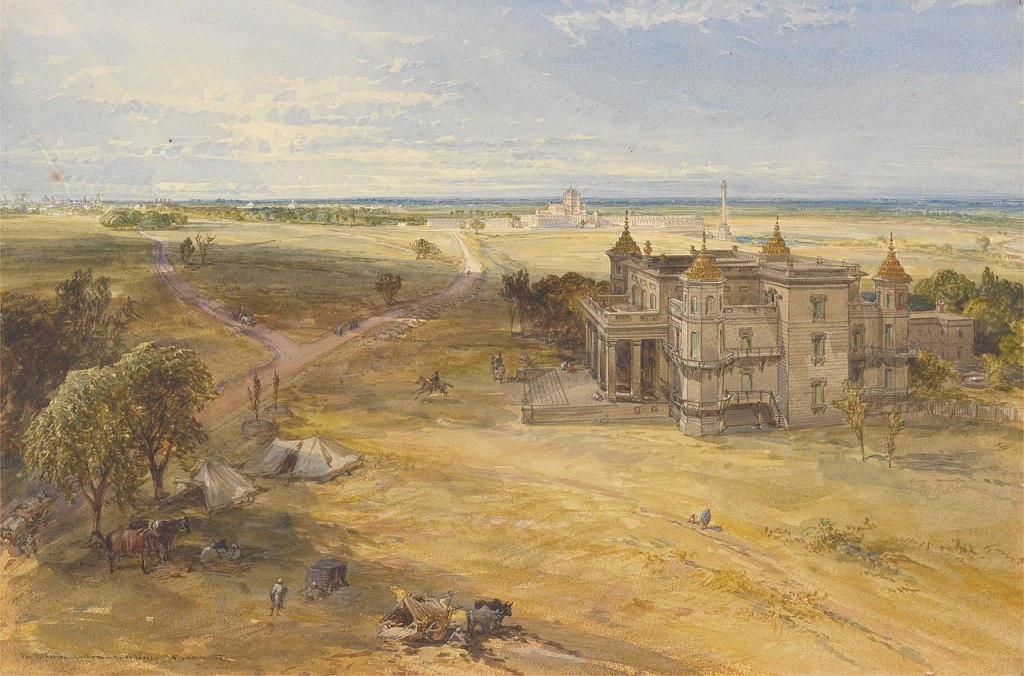
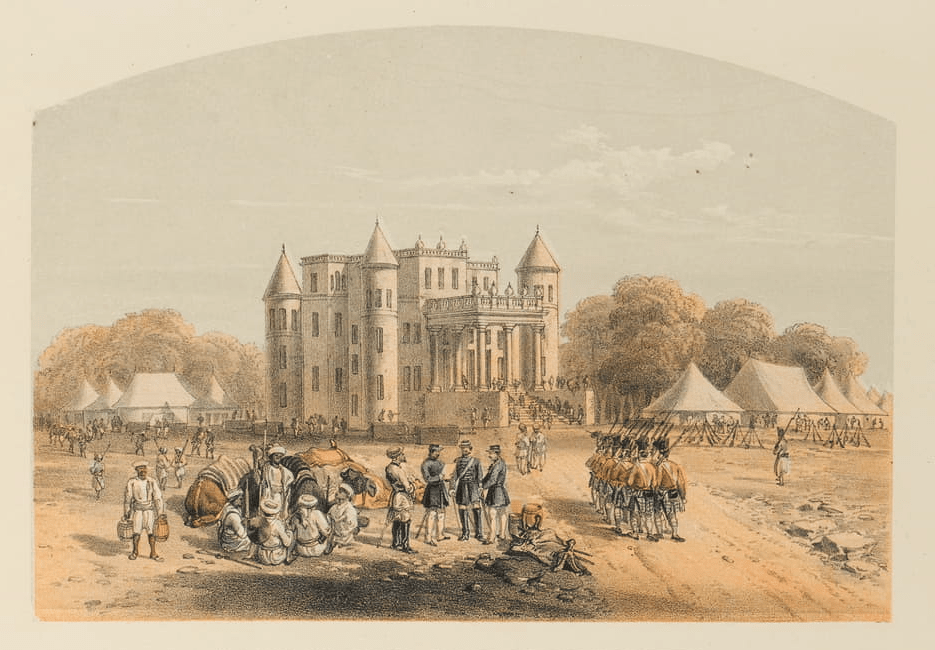
By the 4th of March, the remainder of Siege Train, together with Brigadier Walpole’s Division, closed up on the Dilkusha, and Sir Colin moved his headquarters to a “fine French chateau” in the Bibipur Park. The right of his line now rested on the Gumti, the left being towards the Alambagh – he now commanded all the open ground on the south-east borders of the city. Between his left and Jellalabad, there was only an interval of two miles. Here, he placed Hodson’s Horse while Brigadier Campbell, with a strong brigade of cavalry and horse artillery, secured not only the extreme left but the open country to the northwest. The camp had taken on an enormous proportion, stretching from close to the Dilkusha, which unhappily left some of the tents under constant fire, as the rebels were able to lob shots at them from the Martiniere, only 900 yards distant.

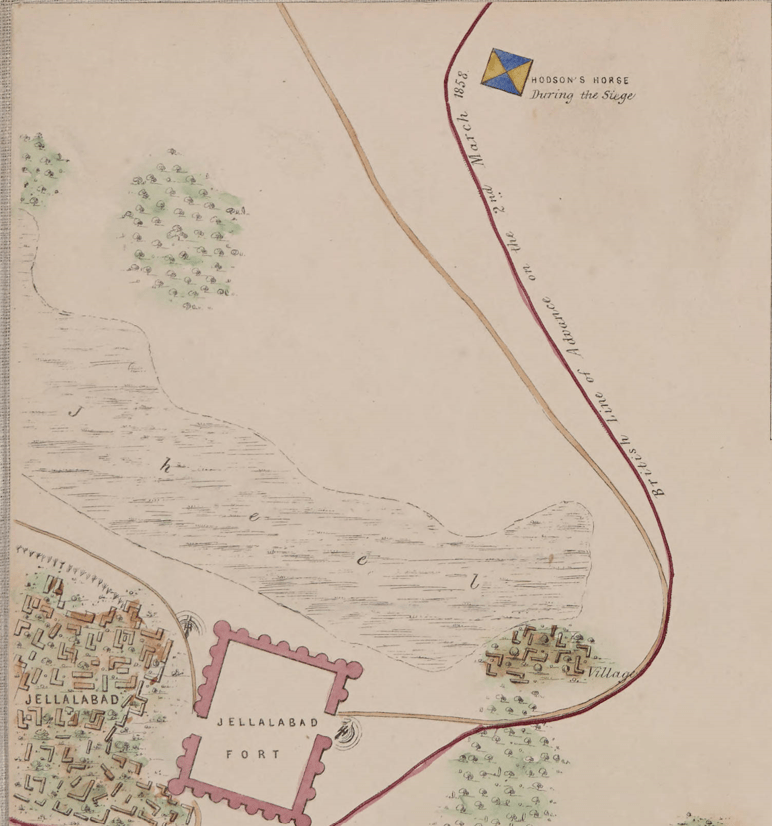
Meanwhile, the Naval Brigade guns were moved to the park and were replaced by four from the Royal Artillery. Peel was consequently displeased with the arrangement of the artillery guns and rode out to the Dilkusha to have it out with the artillery officer. During their discussion, both men went up three hundred yards to the front and stood behind a tree well in sight of a rebel trench, whose occupants wasted little time in redirecting their fire at Peel. Although both men did move back without injury, Captain Peel might have taken this as a warning. As it was, the artillery guns remained in their position, and the gunners had to be put up with the rebels who sent shot rattling around their feet for the remainder of the day.
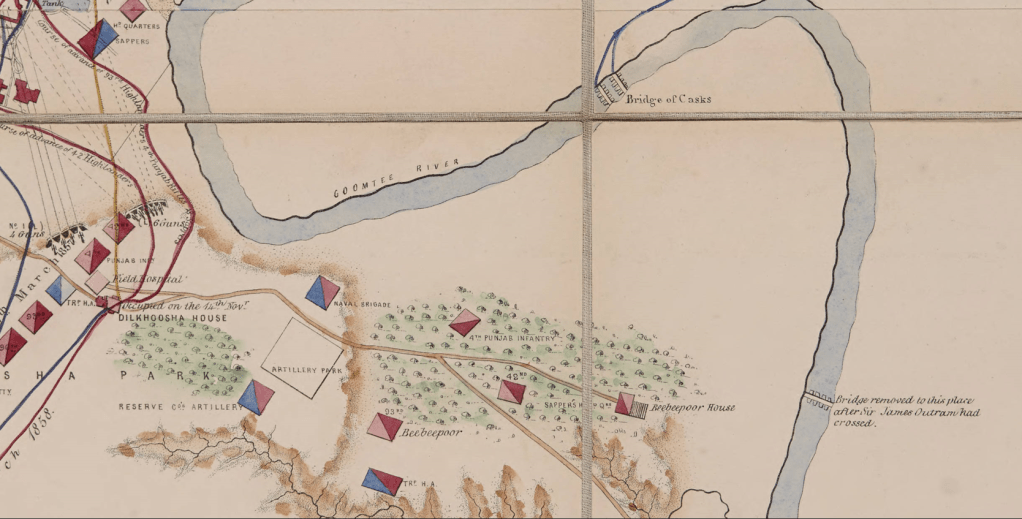
During the night, the engineers put the next part of their plan in place and constructed two cask bridges across the Gumti. One was just to the left of the Dilkusha in a bend in the river.
“The groundwork of each was a collection of empty beer-casks lashed by ropes to timber cross pieces and floated off one by one to their positions; a firm roadway of planking was afterwards afixed on the top of the whole range from end to end. Firm indeed must the construction necessarily have been, for troopers on their horses, heavy guns and mortars, ammunition waggons and commissariat carts, all would have to pass over these bridges, secure, as far as possible, from accident to man or beast.”
By morning, not only were the bridges in place, but a small earthwork had been constructed on the opposite side to assist a strong picket charged with defending the bridge. The rebels had missed out on the construction work, but at the first light of day, they decided this was quite unacceptable. A large body of cavalry descended on the left bank and approached the picket, but was quickly driven off by a well-aimed volley at close quarters. It would appear these were mere scouts, for the British had failed to notice the rebels had a well-hidden horse battery in a nearby grove of trees, which now began to play on the work parties. They had also managed to sneak a gun at an angle of the Martiniere and opened up on the bridge, causing round shot to tumble into the camp. The artillery returned fire, and soon the horse battery withdrew. However, the gun at the Martiniere was proving a sight more obstinate. Captain Peel brought forward two of his big guns to the riverbank and commenced a prolonged duel with the Martiniere, whose gunners smartly returned fire, shot for shot. The Lancers and the Bays, who had been sent to assist Peel if necessary, found themselves redundant. The rebels did not make an all-out attack, and their cavalry melted away. Captain Lennox of the Royal Engineers formed up a cover party of men and guns to protect the workers, and with little interruption, construction continued.
5th of March
Throughout the day, the engineers continued constructing bridges and the embankments that would connect the two sides of the river, but it was, in Majendie’s estimation, an uneventful day, in the course of which,
“…much ammunition was wasted, and many bullets fell harmless, and artillerymen and sailors grew hot with the exertion of manning the 18-pounders. And some curious specimens of hammered shot, unsightly, and far from mathematically spherical, came spinning into the camp and crashing through the trees, beneath the shade of which the drivers and horses of Gibbon’s field battery of Royal Artillery, whose guns were playing at long bowls aforesaid, were reposing; and but little harm was done, I wot, that day to friend or foe.”
At half-past nine in the morning, with two guns and four gun crews under command of Lieutenant Wilson, along with Lieutenants Verney, Wratislaw and young Mr Richards who had just passed for a midshipman barely two weeks earlier, brought their guns into position in their new battery.
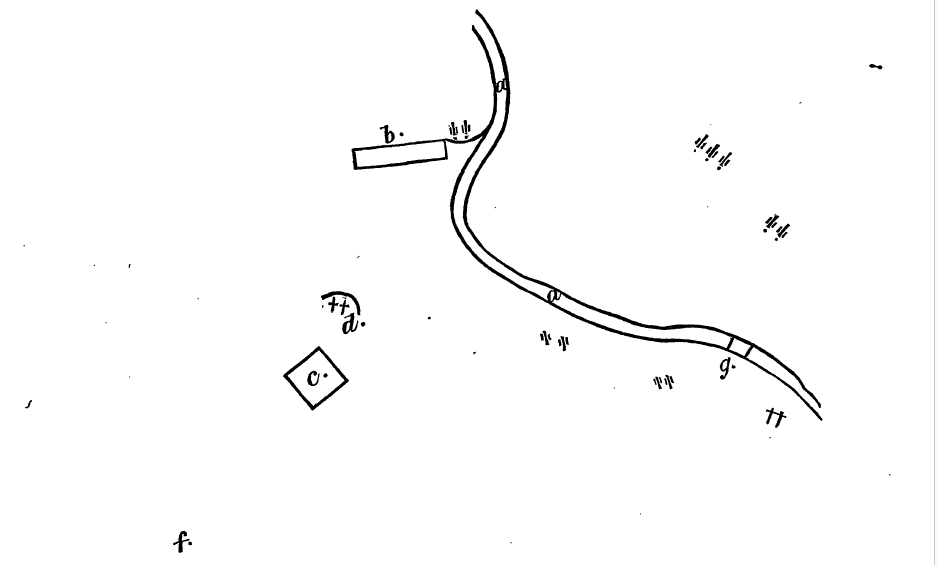
those of the Naval Brigade are marked with the other symbols. The rebel guns, as far as Verney could guess, were on the side of the Martinere.
They had barely been in position for ten minutes when the rebels opened fire from the Martiniere, and with some remarkable precision, for the second and third shots struck the ground just six feet short of Lieutenant Verney. Covered in a cloud of dust, for a moment, no one believed the lieutenant was alive, but as the dust cleared, they could see him, standing in the same place as if nothing had happened. Here they would remain until 8 pm, trading shots, when the rebels finally decided to call it a day. For reasons known only to them, they did not attempt to attack the now complete bridges during the night, and the engineers put the finishing touches on their work with no molestation.
While everyone was thus occupied, Brigadier Franks and the Jaunpore Field Force, called now the 4th Division, arrived, making the Army of Oudh the largest of its kind ever assembled in India. It now numbered nearly 25’640 men, with 164 artillery pieces – the arrival of Jung Bahadur would bring another 8000 men into the fold. The rebels might have been watching this spectacle with curious interest, for they completely missed another army, that of Sir James Outram, which, during the night of the 6th, was marching from the Alambagh.
The first part of this intricate operation was now at a close, and it was time to bring the fight to Lucknow.
Sources:
Forrest, G. W. A History of the Indian Mutiny. Vol. 2. Edinburgh & London: William Blackwood & Sons Ltd., 1804.
Grant, Hope. Incidents in the Sepoy War 1857-58, Compiled from the Private Journals of General Sir Hope Grant, K.C.B.. Edited by Henry Knollys. Edinburgh & London: William Blackwood & Sons, 1873.
Jocelyn, Julian R. J. The History of the Royal and Indian Artillery in the Mutiny of 1857. London: John Murray, 1915.
Kaye, John William, and G. B. Malleson. Kaye’s and Malleson’s History of the Indian Mutiny of 1857–58. Edited by G. B. Malleson. Vol. 4. London: W.H. Allen & Co., 1889.
Mackay, James. From London to Lucknow. Vol. 2. London: John Nisbet & Co., 1859.
Majendie, Vivian Dering. Up Among the Pandies: Or, A Year’s Service in India. London: Routledge, Warne & Routledge, 1859.
Verney, Edmund Hope. The Shannon Brigade in India: Being Some Account of Sir William Peel’s Naval Brigade in the Indian Campaign of 1857-58. London: Saunders, Otley & Co., 1862.
Watson, Edward Spencer. A Naval Cadet with H.M.S. Shannon’s Brigade in India: The Journal of Edward Spencer Watson. Kettering: W.E. & J. Goss, n.d.
 Mutiny Reflections