“If the world was to be governed by principles, nothing would be more easy than to conduct even the greatest affairs; but in all circumstances, the duty of a wise man is to choose the lesser of any two difficulties which beset him.” (The Duke of Wellington)
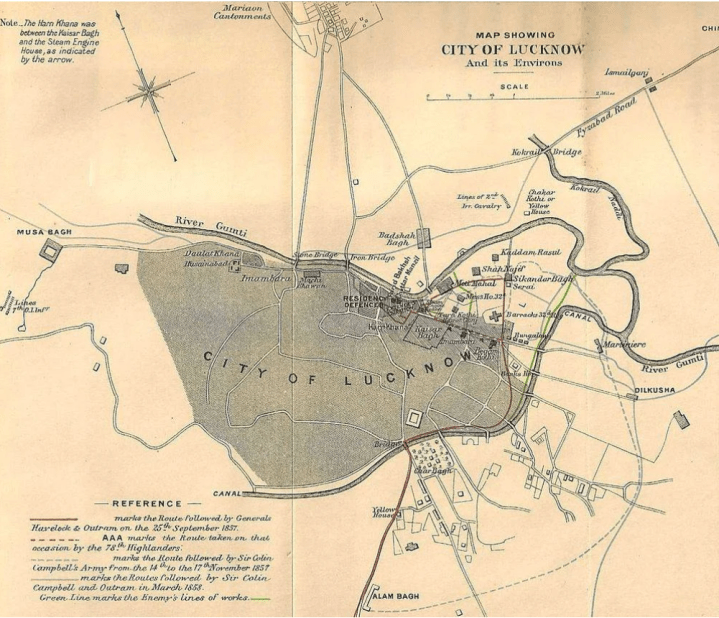
On the morning of the 14th, now joined by several detachments of various regiments, including some reserves of the Royal Artillery and the Sappers, some 200 men of the Military Train who had been equipped as dragoons and 2 Madras Horse Artillery guns, Sir Colin Campbell left the Alambagh and advanced on Lucknow.
Bourchier puts the force at:
Naval Brigade and Artillery…….400
Cavalry …………………………………900
Infantry……………………………….3’200
Sappers…………………………..………200
Total……………………………….…..4’700 men
Heavy guns………………………………12
Mortars……………………………………10
Light field guns………………………..27
Total Ordnance pieces………………49
This was exclusive of detachments that had joined on the morning of the advance. Campbell had had his misgivings regarding Lucknow – before moving from Cawnpore, he had been in two minds about whether to first attack the Gwalior Contingent, then at Kalpi and were threatening to continue their advance on Cawnpore, or proceed to the relief of the Lucknow Residency and then return to Cawnpore. As it would be impossible to hold Lucknow by any means, Campbell decided on the lesser of the two – he left a detachment at Cawnpore to ward off any threats in his rear and proceeded to Lucknow.
The relief would be executed in stages – unlike Havelock who had rushed directly through the city, Sir Colin took Outram’s advice and gave the city a “wide berth” – his first day’s march would bring him from the Alambagh to Dilkusha and the Martiniere.
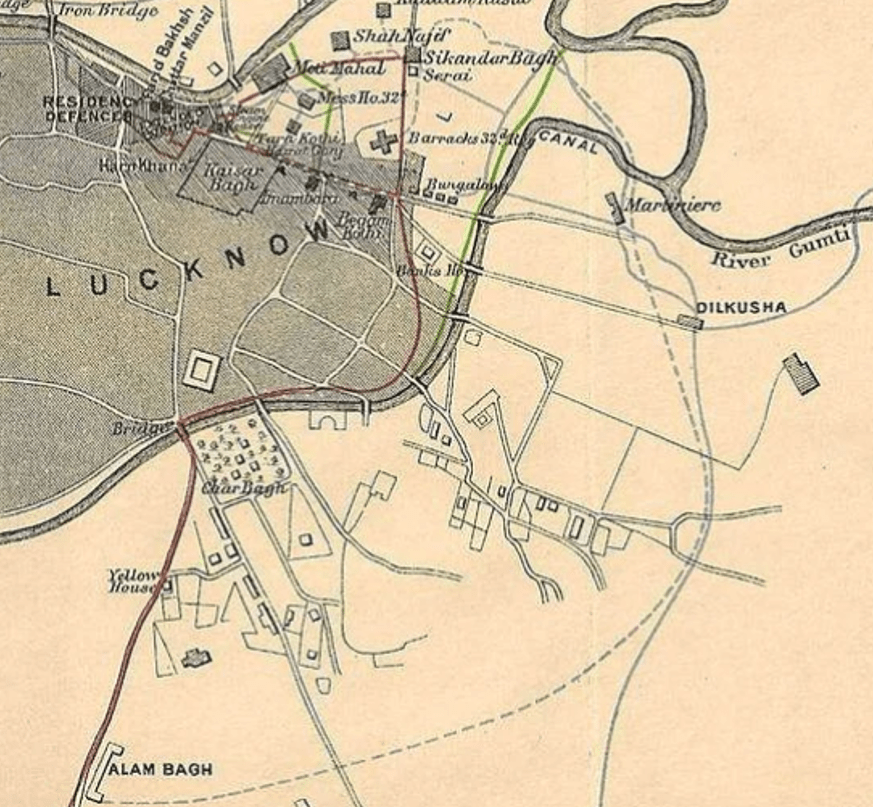
Leaving Captain Moir of the Bengal Artillery in command of the Alambagh with a garrison consisting of the HM’s 75th Foot, 50 of the Ferozepore Sikhs and a few artillerymen, Moir was to hold the Alambagh at all costs for it would be through here that Campbell would retreat from Lucknow and then take the road back to Cawnpore. As the force was told to take nothing in the form of unnecessary baggage, the Alambagh provided storage for all of the force’s camp equipment and extra stores. The men marched only with what they could carry including three days rations; tents were left behind at the Alambagh and the Commissariat followed on with only 14 days worth of provisions.
The decision to leave the 75th behind had somewhat sorrowed Roberts – they had been the first regiment down from the hills in May and had done stalwart service throughout the Siege of Delhi but by the time they reached the Alambagh they were badly in need of a rest. Their numbers for one had been decimated in the last six months and now mustered no more than 300 men – they had also lost 9 officers in action and from disease and a further 12 were wounded. Their adjutant Richard Barter remained with them, “a jolly good-hearted Irishman and an excellent officer” that Roberts felt most sorry to leave behind. How much rest the 75th would have we shall see later.
Watching Campbell’s every move and communicating thus with the Residency, were the signallers atop the Alambagh roof working the semaphore and whose every message was eagerly read by the beleagured garrison.
At 9 am, the columns were formed up and moved off across the open country between the Alambagh and the Dilkusha – it was imperative, on this first day of operations, to capture both the Dilkusha and the Martiniere. As highly defensible positions, they would serve as the basis of the subsequent operations on the canals and suburbs of Lucknow. The river would form some protection on the right flank.
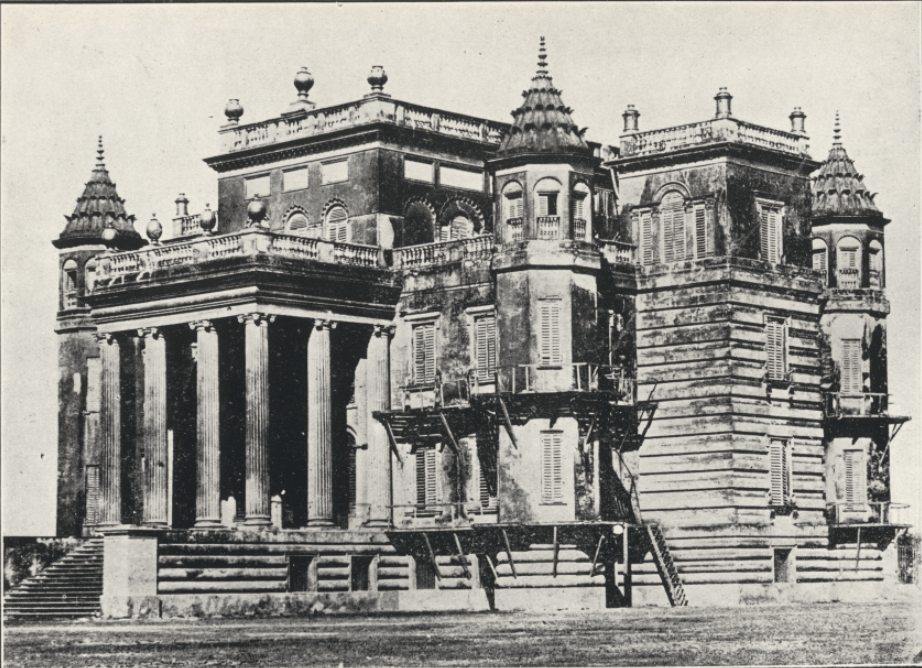
The rebels were for the moment, keeping their heads down and the advance proceeded with no incident. The guns opened up on the village of Bibiapore – a few rounds and the 53rd then skirmished up past the village towards the wall of the Dilkusha. Arthur Moffat Lang and an officer of the 9th Lancers rode up through a gap in the wall in the park to reconnoitre the house itself. Seeing no one about the building, the Lancer rode back to report “…the place empty; but I thought I saw a man come out of an outhouse and rode almost up to the steps of the house when I heard Watson shout to me to come back, and back I galloped as hard as I could, just in time, for some men came rushing from when I don’t know, and ping ping came a shower of bullets.” (Lang)
Campbell and his staff took shelter behind the wall and the infantry were sent skirmishing into the park. Some of the men thought they saw rebels hiding in trees – but it turned out to be monkeys, scurrying hurriedly away from the din and confusion that would soon reign.
As the men dashed through the park, the Sappers quickly levelled a piece of wall to admit the artillery.
Captain Remmington’s Troop and No. 17 Battery were hastily ordered to the front and supported by three infantry regiments, they were soon engaged in a running fight for the Dilkusha. As soon as they had gained the park surrounding the building, the infantry, well covered by the guns, advanced and drove the rebels out of the house.
“The gallop across the Dilkusha park was quite a pretty sight: deer, which had been quietly browsing, bounded away on all sides, frightened by our approach and the rattle of the guns; while the routed sepoys flew down the grassy slope leading to the Martiniere. We reined up for a few seconds to look at the view which opened out before us. In front rose the fluted masonry column of the Martiniere, 123 feet high; directly behind, the picturesque building itself, and in the distance the domes and minarets of the mosques and palaces within the city of Lucknow; all looked bright and fair in the morning sun.
We could see that the Martiniere was occupied; a crowd of sepoys were collected round the building; and as we showed ourselves on the brow of the hill, a number of round shot came tumbling in amongst us.” (Roberts)
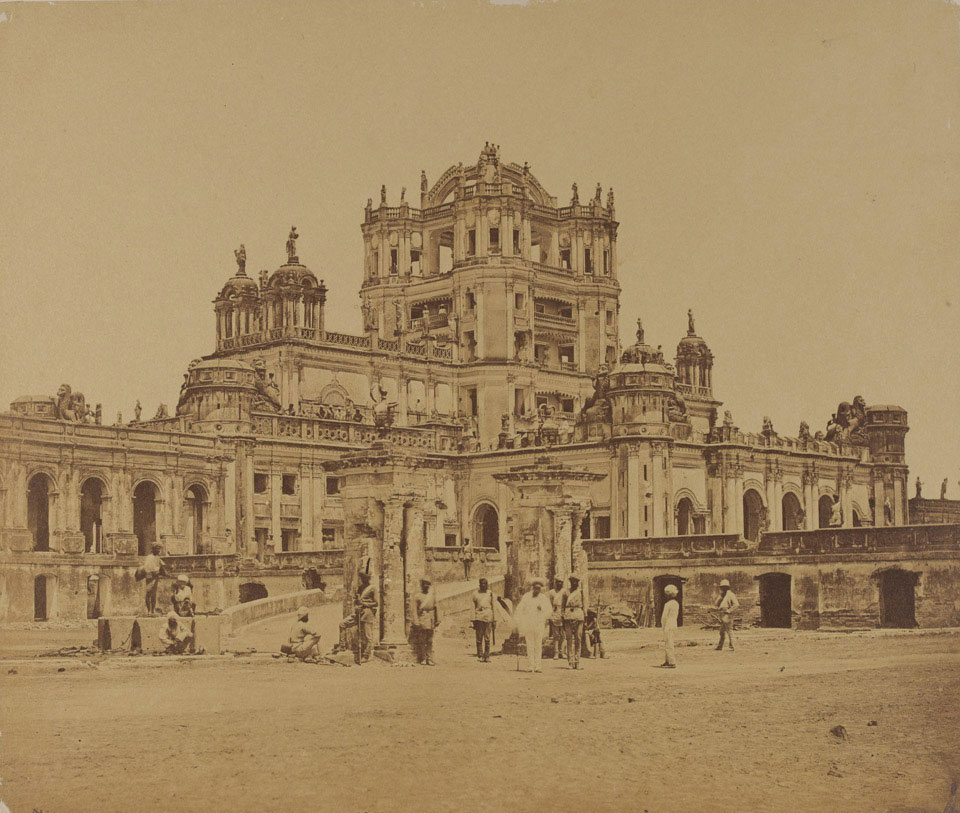
As they crossed the park towards the Martiniere College enclosure, the resistance became fiercer as they advanced. In their front, a number of guns now opened fire from their carefully arranged brushwood camouflage. Remmington’s Troop of Horse Artillery, Bourchier’s Battery and a heavy howitzer brought up by Captain Hardy returned fire – the 12 guns giving cover to the HM’s 8th and 1st battalion of detachments who now “bounding over the wall, drove them from the enclosure at the point of the bayonet, while the cavalry pursued for a considerable distance.” The cavalry chased the retreating rebels up to the canal. The rebels left behind 8 guns with ammunition and tumbrels and bullocks still attached.
The 90th had scarcely attained the Martiniere when they were called to support the 93rd who were bringing “their guns down and, as soon as they could get them into position, we were ordered to advance. After the Tars (Peel’s Brigade, from the Shannon) had fired a few rounds of shell into the enemy lines in first-rate style, we were ordered to fire a volley. Then we advanced between the guns. At this time one of the guns accidentally went off, killing the spongeman and wounding another man in the hand. It also had a serious effect on our company. It knocked over three or four of our men. One of our men was covered all over the head with the brains of the poor fellow who was killed.
After passing the guns we gave a hearty cheer, making a rush forward. But we soon came up to the river bank. We halted. The sepoys had crossed the river. The bridge over the river was cut in the centre. There we were compelled to remain where we were. The 93rd had retired back to the Martiniere park on our advance, where they remained all night.” (Wickins)
Wickins, as he left the Martiniere to support the 93rd, watched as the 4th Punjab Cavalry thundered past and charged one of the rebel guns, “giving a cheer at the same time that resounded again through the park.” The gun was found to be loaded to the muzzle with canister and grape.
It was also a day for another VC.
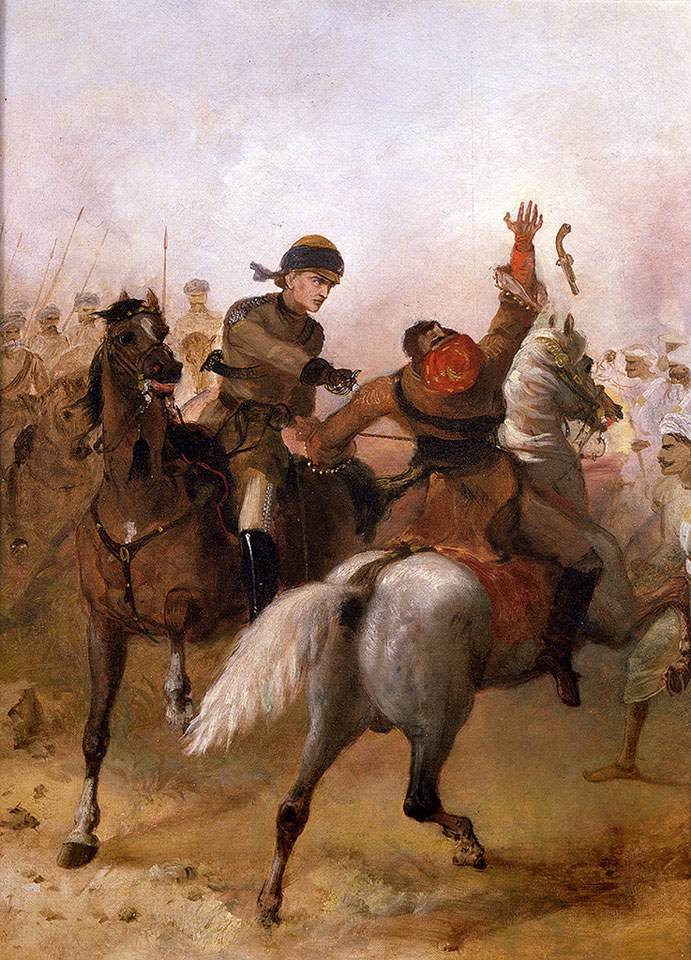
Lieutenant Watson, commanding the 1st Punjab Cavalry and the 2nd, under Lieutenant Probyn came upon a body of rebel cavalry who were none other than sowars of the 15th Irregulars which had mutinied in Sitapur in June. Their Rissaldar who commanded them, rode out to the front and backed up by half a dozen of his men, took the fight directly to Watson. Watson singled out the Rissaldar and attacked. At a yard’s distance, the Rissaldar aimed his pistol directly at Watson’s chest and fired. To his chagrin, the pistol failed to fire – it would appear the ball had fallen out. Watson took the chance and ran the man through with his sword, effectively dismounting him but the the Rissaladar, undaunted drew his tulwar and with his sowars renewed his attack on Watson. Watson received a blow on the head from a tulwar and another on his left arm which severed his chain gauntlet glove and another on the right arm but it only managed to split the sleeve from the jacket, while a bullet passed through his coat and another blow was levelled at his leg. Outnumbered and surrounded, he was still defending himself with every exertion when his men and those of Dighton Probyn, only some 800 yards off, galloped forward to his aid. The blow on the leg left Watson lame for a few days after but he came out of his fight at least in one piece. “For this ‘and gallantry on many other occasions,’ Hope Grant recommended Watson for the Victoria Cross.
By noon on the 14th of November, Sir Colin Campbell occupied not just the Dilkusha but the Martiniere. Outposts were rapidly placed along the right bank of the canal from the river to opposite Bank’s House; the left bank continued to be occupied by the rebels. Sir Colin Campbell fixed his headquarters for the time being at the Martiniere; the semaphore was set up on the roof to communicate with the Residency and from his lofty position he now had the assistance of Thomas Kavanagh, that stalwart messenger, who now pointed out various objects on the Lucknow skyline that would be of most interest to the C.&C. – positions held by the rebels, the Chattar Manzil still occupied by Havelock’s men, the Residency and the Kaiserbagh, “that pretentious, garish palace of the Kings of Oudh, the centre of every kind of evil and debauchery.”
Brigadier Adrian Hope’s Brigade occupied to gardens and the enclosures of the Martiniere, the rear of which abutted the canal. Remmington was detailed to the same position with Brigadier Russell to the left directly in front of the Dilkusha with Brigadier Little with the cavalry and No. 17 Battery occupying the plain in front of the Martiniere. Campbell was very clear in his orders that everything was to be done to prevent the left from turning as this would have cut off not only communications with the Alambagh but prevented the commissariat and reserve ammunition, still on the road, from advancing. As the army’s baggage would subsequently be stored in the grounds of the Dilkusha, Brigadier Russell pushed forward several companies of infantry to seize two villages on the right bank of the canal to further strengthen the position. The villages would be held by the Sikhs until the force was ready for the final march to Lucknow.
In the meantime, beaten but not defeated, the rebels began to gather in large bodies “in front of centre,” near Bank’s House. Captain Grant of the 9th Lancers galloped forward to reconnoitre -gallantly perhaps but was greeted with such a stout fire he was forced quickly back. Brigadier Little “ordered an immediate advance of the centre, at speed; which favoured by a rise in the ground, we were enabled to effect unseen, debouching on the level plain within 700 yards of the enemy who were on the opposite bank of the canal. A few rounds well put, sent them scuttling back to the city.” (Bourchier)
A second advance brought Bourchier and the rest to the bank of the canal to clear not just the bed of it but some orchards opposite, thus leaving Russell free from the heavy fire that had been turned onto the villages he and his men were occupying. It was not Campbell’s intention however to hold such an extended position which extended at that position the entire length of the canal bank, Brigadier Little thus fell back on the Martiniere.
The guns were barely unlimbered when heavy firing was again heard from the direction of Bank’s House. Roberts and Mayne quickly galloped off to figure out what was happening. As they approached the canal, Roberts turned to the right and Mayne to the left. Roberts found the piquets “hotly engaged” and the officer begged Roberts to bring up reinforcements. The lieutenant rode back to Hope Grant to report but on the way he met the needed support already advancing who were shortly followed by the rest of Hope’s and Russell’s brigades.
“Russell had, early m the day, with soldierly instinct, seized two villages a little above the bridge to the north of Banks’s house; this enabled him to bring a fire to bear upon the enemy as they advanced, and effectually prevented them turning our left. Hope opened fire with Remmington’s troop, Bourchier’s battery, and some of Peel’s 24-pounders, and as soon as he found it had taken effect and the rebels were shaken, he proceeded to push them across the canal and finally drove them off with considerable loss.”
The left flank was secured and now the supplies and reserve ammunition could proceed along the road, unmolested. The last carts would arrive at the Dilkusha the following morning.
At the end of the day when Roberts returned to camp, he heard, with “great grief” his friend Mayne had been killed. No one could tell him what had exactly happened but a few seconds after he had last seen him, Mayne, after he turned his horse and had proceeeded a little way along the left bank, was shot in the breast. Roberts spent the night vainly searching for his corpse.
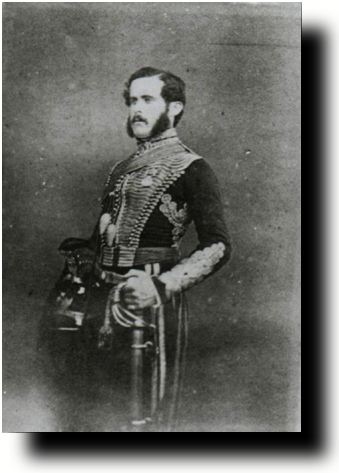
In that final attack, Captain German Wheatcroft (whom Bourchier names “Wheatley”) of the 6th Regiment of Dragoon Guards (Carabineers) had likewise been killed – Wheatcroft was struck by a shell. He had only volunteered the previous day to serve with the 9th Lancers. Bourchier recalled,
“Not many hours before, six of us, Wheatley and Mayne being of the number, were sitting under a hedge; a beautiful little bullock, chased by some soldiers, jumped into our circle; Wheatley caught him. It was unanimously voted that he should be kept for Christmas day, Wheatley adding, at the time, “ I wonder how many of us will be alive.” Both were gallant officers and deeply regretted.”
On the morning of the 15th, Roberts, accompanied by Arthur Bunny, the adjutant of the Horse Artillery, continued his search for Mayne’s body which was found in a doolie under the wall of the Martiniere.
“As there was no knowing how soon our services might be required, we decided to bury the poor fellow at once. I chose a spot close by for his grave, which was dug with the help of some gunners, and then Bunny and I, aided by two or three brother officers, laid our friend in it just as he was, in his blue frock-coat and long boots, eyeglass in his eye as he always carried it. The only thing I took away was his sword, which I eventually made over to his family. It was a sad little ceremony. Overhanging the grave was a young tree, upon which I cut the initials, ‘A.O.M.’ – not very deep, for there was little time, they were quite distinct, however, and remained so long enough for the grave to be traced by Mayne’s friends, who erected the stone now seen…” (Roberts)
As for Captain Wheathcroft, he had been struck in the breast by a fragment of shell and never spoke again, dying moments later. He was buried at the Dilkusha, and a wooden cross, with the initials “G.W.” was placed by his friend, Lieutenant R. of the 9th Lancers, at the head of his grave. His wife, who was in England at the time, would not be informed of his death by the War Office until December but she already knew he was dead.
“On the night between the 14th and 15th of November 1857, towards morning, she dreamed that she saw her husband, looking anxious and ill; upon which she immediately awoke, much agitated. It was bright moonlight; and, looking up, she perceived the same figure standing by her bedside. He appeared in his uniform, the hands pressed across the breast, the hair dishevelled, the face very pale. His large dark eyes were fixed full upon her; their expression was that of great excitement, and there was a peculiar contraction of the mouth, habitual to him when agitated. She saw him, even to each minute particular of his dress, as distinctly as she had ever done in her life; and she remembers to have noticed between his hands the white of his shirt-bosom, unstained, however, with blood. The figure seemed to bend forward, as if in pain, and to make an effort to speak; but there was no sound. It remained visible, the wife thinks, as long as a minute, and then disappeared.” The War Office eventually corrected the date of his death from the 15th to the 14th, leaving the widow without any doubt that her husband had appeared to her at the very moment of his death.
 Mutiny Reflections