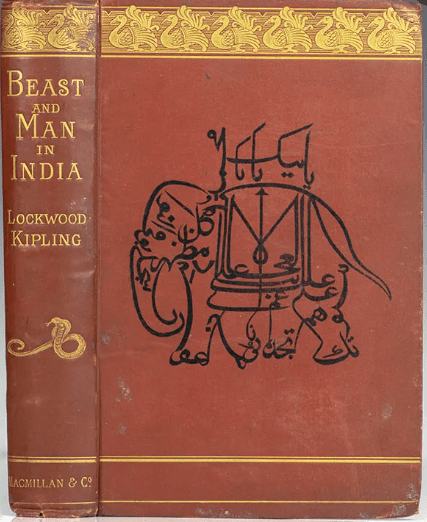
“A man can never have too much red wine, too many books, or too much ammunition”
― Rudyard Kipling

Researching 1857 is, on the face of it, easy. Information is not lacking and it would seem everyone at the time who could string together a sentence, had something to say.
Sir John Kaye and Colonel Bruce Malleson had plenty to write. Charles Ball and Mr. Forrest were no less prolific. Noah Alfred Chick, who survived the Siege of Lucknow put together a book which is a collection of eyewitness accounts interspersed with official reports. Mr. Dodson added his two bits and his book is a delight to read but only for those who enjoy a book laid out in columns with very small print.
There are personal narratives aplenty - military men writing their autobiographies, district officers explaining their actions and housewives "the ladies" stoically reliving their grief and fear. We have Florence Wagentreiber and Harriet Tytler writing from Delhi, the one an account of her family as they made their hair-raising escape, the other, Harriet, with an acid tongue condemning everyone who deserved it and some who did not, while quite a matter of fact, recounting her trials on the Delhi Ridge. Lucknow on its own has so many narratives it would fill up a large bookshelf.
Then there are the modern writers - Christopher Hibbert, Saul David, Andrew Ward, Rosie Llewelyn-Jones, Julian Spilsbury, Rudrangshu Mukherjee, Shasi Buhsan Chaudhuri, Surendra Nath Sen, Jane Robinson and more recently, Kim Wagner. One should of course include William Dalrymple.
Thanks to the digital age, a researcher or even the moderately interested are no longer having to spend their life savings buying books. The originals, when available are often expensive and as much as I would like to have a complete set of Kaye's and Malleson's History of the Indian Mutiny, all six volumes bound in beautiful leather, I must for now be content with online pickings. Occasionally reasonably priced copies they do show up on World of Books or Abe Books but it is rarely the full set.

I was asked recently by one of my readers where he should start with doing his own reading. That is not an easy question to answer. It really depends on what your knowledge of Indian history is, to begin with. Without at least a basic foundation, the events of 1857 are difficult to understand. The mutiny started long before that fateful year and in order to make any sense of it, one has to start at the beginning of the EICo itself. One can of course go all the way back in Indian history before European colonialism ever happened but anyone who has sat through an Indian history class will know that subject is bewildering, to say the least. I remember having to learn by heart all the names and years of rule of the Mughals when I was in class six and if you think the list of British kings and queens is terrifying, wait until you see the Mughals. And if it would only have ended with the Mughals!
However, if you do have time, below is a list of cunning empires and dastardly dynasties to fill the hours of many a rain-soaked day.
Indian History – List of Indian Empires and Dynasties
- Paleolithic Age
- Bhimbetka
- Mehrgarh
- Indus Valley Civilisation
- Dravidians
- Aryans
- Vedic Civilization
- Gautama Buddha
- Vardhman Mahavir
- Mahajanapadas
- Kuru Kingdom
- Gandhara Kingdom
- Kosala Kingdom
- Kalinga Kingdom
- Achaemenid Empire
- Alexander Invasion
- Haryanka Dynasty
- Shishunaga Dynasty
- Nanda Dynasty
- Mauryan Empire
- Shunga Dynasty
- Kanva Dynasty
- Satavahana Dynasty
- Kuninda Kingdom
- Pandyan Kingdom
- Chola Dynasty
- Chera Dynasty
- Kushan Empire
- Western Kshatrapas
- Gupta Empire
- The Huns
- Kalabhras
- Indo Greeks
- Indo-Scythians
- Indo-Parthians
- Indo-Sassanians
- Harshavardhana
- Chalukya Dynasty
- Pallavas
- Pratiharas
- Pala Dynasty
- Rashtrakutas
- Rajputs
- Hoysala Dynasty
- Kakatiya Dynasty
- Kalachuri Dynasty
- Vijaynagar Empire
- Delhi Sultanate
- Mughal Empire
- Maratha Empire
- Mysore Kingdom
- Qutub Shahi Dynasty
- Sikh Empire
- British India
https://www.gloriousindia.com/history/index.php
As you can see, the Mughals were but a drop in the vast vat of Indian history.
India seems to have begun before time itself, epoch upon epoch came and went, while civilizations rose and disappeared – each leaving their footprints in the sands of eternity to form what India is today. It is fascinating, to say the least, and anyone who wants to go down that road, begin, when you can with the Indus Valley Civilization, one of the greatest peoples to ever have walked on the face of this earth. For cultural knowledge, read the Mahabaratha, the Ramayana and the Bhagavad Gita and make sure to add a treatise or three on Buddhism and the advent of Islam in India.
However if you plan to be finished with reading before the ferryman comes to collect his toll, I would suggest specialising your booklist and if you are interested in Raj era history and the mutiny, then I have a few suggestions for you:
Background
India’s Ancient Past – R.S. Sharma ISBN-13: 978-0195687859
India: A History. Revised and Updated – John Keay ISBN-10 0802145582
A History of India 6th Edition – by Hermann Kulke and Dietmar Rothermund
The Honourable Company – John Keay ISBN-13978-0006380726
Raj: The Making and Unmaking of British India – James Lawrence ISBN-10 0312263821
Should one not be gripped with the desire to study Indian history for the rest of one’s natural life, an alternative does exist in the form of
“The Shortest History of India” – by John Zubrzycki, published in 2023. https://theexperimentpublishing.com/catalogs/fall-2023/the-shortest-history-of-india/
It is indeed short and covers what one needs to know of India’s 5’000 year history.
When you are ready to move on from history, you can try your hand at any of the following categories:
Social History
One of the classic books on social history of the British Raj, if you want to explore more in how the British lived and died in India, the easiest starter book is
Plain Tales from the Raj: Images of British India in the Twentieth Century – Charles Allen ISBN-10 9780349104973
This could be followed by:
Days of the Raj: Life and Leisure in British India – Pramod K. Nayar ISBN-10 014310280X
The Memsahibs: In Praise of the Women of Victorian India – Pat Barr ISBN-10 571278949
The Fishing Fleet: Husband-Hunting in the Raj – Anne de Courcy ISBN-10 0062290088
The Two Monsoons – Theon Wilkinson ISBN-10 0715621645. This book is out of print but you can still find secondhand copies. It deals with death in India and is quite a poignant read.
If however, you are more of a history magpie, like me, then you will enjoy most certainly the following three books:
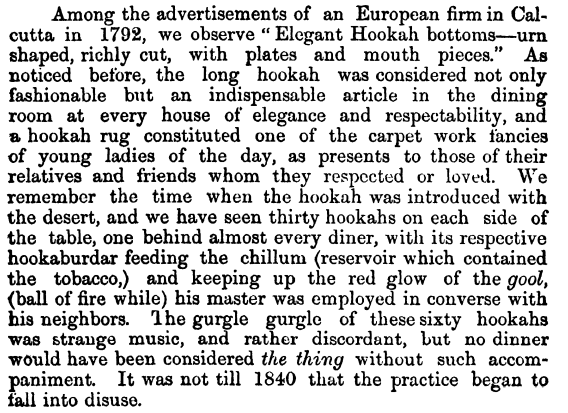
The good old days of Honorable John Company; being curious reminiscences during the rule of the East India Company from 1600-1858, complied from newspapers and other publications Volume I – III by W.H. Carey. They are available archive.org. Be a little careful when selecting copies to download, some are not scanned nicely and you end up having creepy gloved fingers on the side of the page. These books have a wealth of social history on hand. Though much of it is Calcutta centric, it gives you an interesting insight into a long-lost time and is awash with rather brutal honesty.
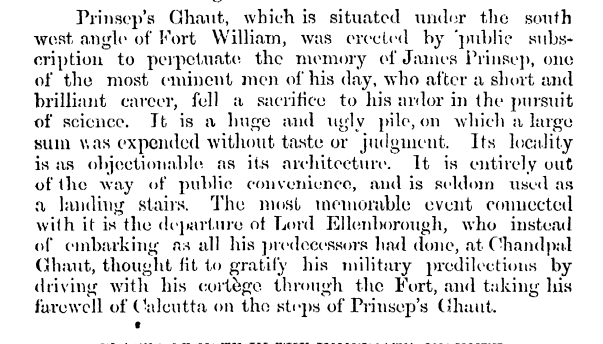
Life in India – Contemporary Sources – 19th and Early 20th Century
Unless otherwise stated, these books are all available on archive.org. If not, then try Google Books or write to me and I will send you a PDF.
The European in India and Medical Guide – Edmund C.P. Hull and R.S. Mair, M.D. (1878)
Wanderings of a Pilgrim – In Search of the Picturesque In 2 Volumes – Fanny Parkes (1850) – This book is a classic must-read! Fanny Parkes was one of the few women who so early on went on a romp through India, a dignified backpacker with many, many elephants. Witty and exhilerating.
Real Life in India – by An Old Resident (1847) – This one gives you a good idea of what to pack for a steamer, which route to take, how the government is set up, what examinations to expect, how to get a cadetship or a writer’s position or join the navy and the good, bad and terrible in each Presidency. I can imagine some of the people I write about devouring this book on their passage out to India. Though I do wonder if all the ladies packed 18 nightcaps but only two nail brushes.
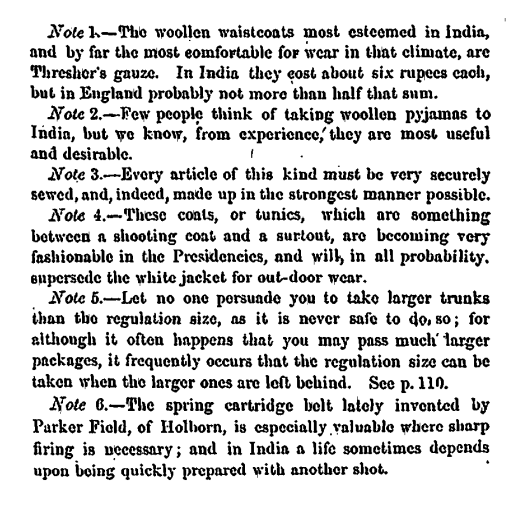
Anglo-Indian Domestic Sketch- A Letter from an Artist in India to his Mother in England – Grant Colesworthy (1849). This book has beautiful illustrations and was written on the ground, so to speak.
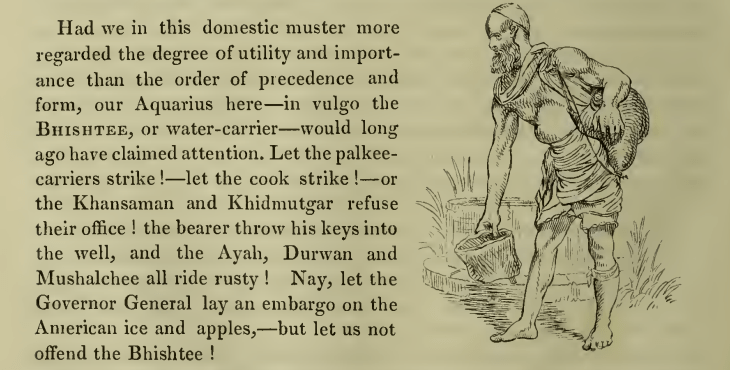
The Englishwoman in India – by A Lady Resident (1864) – available on Google books. A practical, no-nonsense help book. “How much I should have saved myself and my friends, had there been a little book of useful, practical advice on the wants of an Indian lady then available…” She covers just about everything, and the terrified, tearful bride never needs to worry as long as she reads this book and follows the sage advice given within:
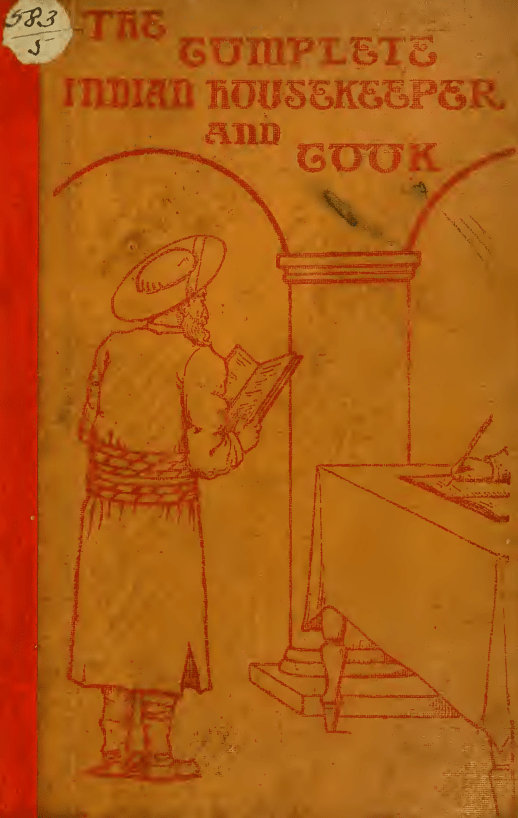
The Complete Indian Housekeeper and Cook (Oxford World’s Classics Hardcovers) – Flora Annie Steel and Grace Gardiner. ISBN-13: 978-0199550142 Another classic book for anyone who wants to know how to pack a camel, cook up a casual luncheon for 10 and what to pay for domestic help in the three presidencies. An absolute gem of information.
Remarks on the Uses of some of the Bazaar Medicines and Common Medical Plants of India – Edward John Waring C.I.E., M.D. (1883). I love this one and it is even practical now, especially when deciphering the different fruits, spices and vegetables India has to offer.
On the Management of the European Child in Health, in India -Edward A. Birch (1886), A singularly terrifying book but very interesting.
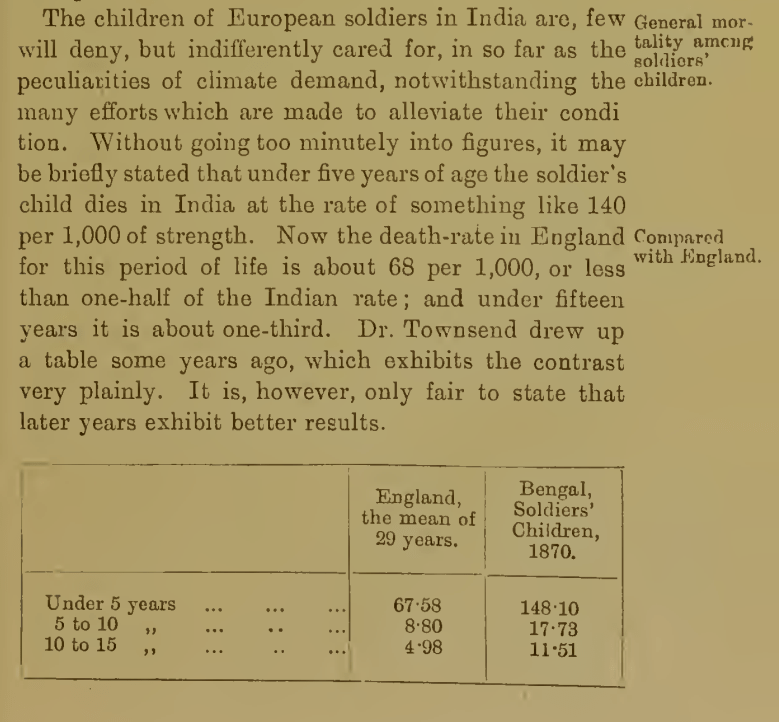
The English Baby in India – Mrs. Howard Kingscoate (1893). No less terrifying than Birch’s book but Mrs. Kingscoate is certainly well-meaning.
Mothercraft in the Tropics – Kennie Macperson (1947) I found it very useful after my son was born in Sri Lanka and as we were based in Trincomalee, in the middle of a war, away from modern conveniences and occaisionally it seemed, from civilization. This book helped untangle the mysteries of motherhood and seeing that my son survived, the advice must have been of some use!
https://wellcomecollection.org/works/enjae2kh
For Aspiring Cooks
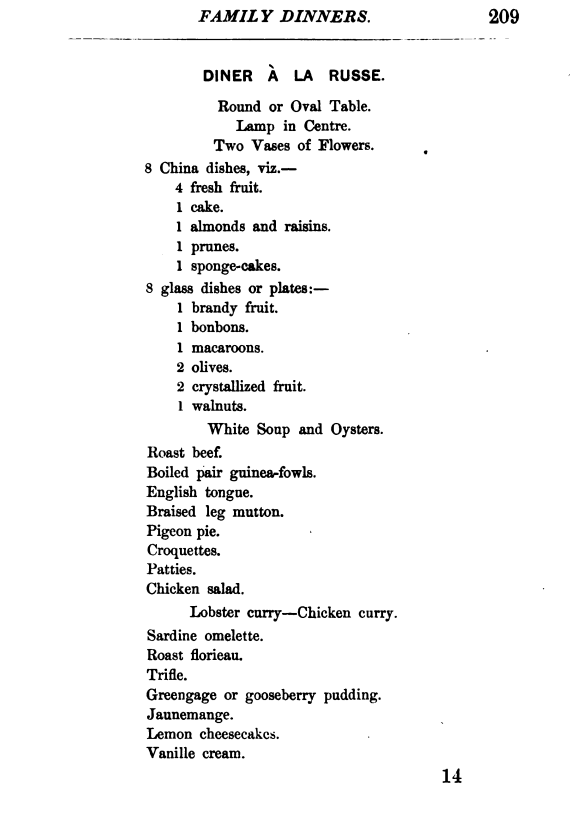
As everyone claims to love a good curry, these books will get you into the kitchen, rustling up feasts for your friends and family. Just remember the following advice, and you will be fine!
“All the cooking utensils should be scrupulously clean,and the degchees (cooking pots) should be tinned at least once a month, or, if possible, every fortnight.”
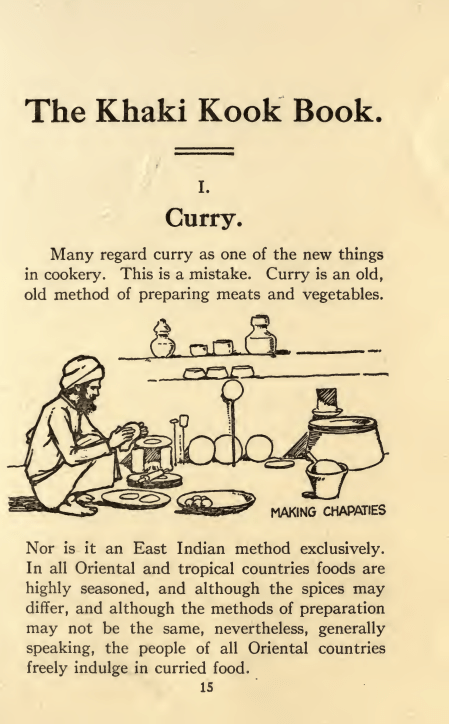
Dainty Dishes for Indian Tables – unknown author (1893)
Indian Dishes for English Tables – Ketab (1902)
The Khaki Kook Book – Mary Kennedy Core – a somewhat more modern take on Indian recipes by an American author.
And yes, the one below is a book, well more of a pamphlet. I do not know where I found this one, but it is thrilling.
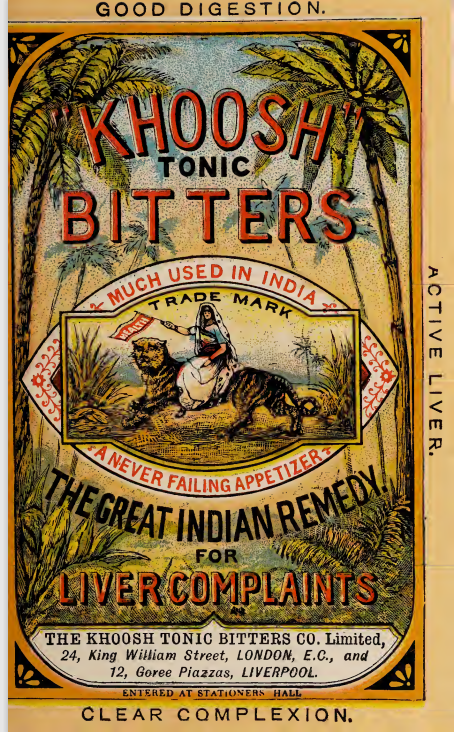
Before I complete veer into the absurd, I shall continue with my original intent, presenting my poor, bewildered, Khoosh-less reader with some more books.
Soldiering
Sahib-The British Soldier in India – Richard Holmes ISBN-10 0007137540
Redcoat – The British Soldier in the Age of Horse and Musket – Richard Holmes ISBN-10 0006531520. Although not India specific, it gives an excellent overview of the British army.
Soldier Sahibs: The Daring Adventurers Who Tamed India’s Northwest Frontier – Richard Holmes ISBN-10 0786708611
I know, three books by Richard Holmes might seem accessive but he was an incredibly gripping writer. I have learned a lot from him.
Various accounts exist from military men – these can be somewhat ponderous to read and frankly some of them are just downright tedious. It really depends what you are looking for. If you want something a little more Victorian, I can recommend:
Forty-One Years In India – From Subaltern To Commander-In-Chief – Field-Marshal Lord Roberts of Kanadhar. I have a 2 Volume version I found many years ago in a thrift shop. It is worth the read and Lord Roberts knew a thing or two about writing, which some of his breathren did not.
From Sepoy to Subadar – Sita Ram, Edited by James Lunt (1873). This book is readily available second hand on World of Books. It is written by a sepoy and was translated by his commanding officer and it is marvellous to read words from a different view point.
Cadet to Colonel – The Record of a Life of Active Service – Major-General Sir Thomas Seaton (1866)
The Armies of India – Major Lovett and Major G.F. MacMunn(1911). Very good for an overview of the history of the army and it has some lovely illustrations.
Hindustan Under Free Lances 1770-1820 – H.G. Keene C.I.E. (1907) As it says on the inside page:
“Sketches of Military Adventure in Hindustan during the Period Immediately preceding British Occupation.” All the great freelancers are here – Skinner, Law, General Sombre-Medo, General Martin, General de Boigne, Gardner, Thomas..Early adventurers in a new land. Men who threw off their European conventions and took up some rather surprising habits.
Retreat from Kabul: The Catastrophic British Defeat in Afghanistan, 1842 – Patrick Macrory (2002) ISBN-10 1599211777. This book is incredibly detailed and for anyone interested in Afghanistan, is an excellent read.
Mutiny
I am sure by now, you, my dear reader, are on the verge of mutiny. So I will keep this short.
The obvious answer is –
Kaye’s and Malleson’s History of the Indian Mutiny 1857-58. This is of course, the panultimate collection of books and regardless of what many modern writers may think, it remains a staple of mutiny literature. There is no way around Kaye’s and Malleson’s.
At the end of all my posts is a list of sources. Most of them are specific to the topic and again, most of them are readily available either on Google Books or archive.org.
There are other books from that era, but many of them use Kaye’s and Malleson’s as a crutch of sorts, so if you can slog your way through all 6 the others will be rather easier to read. However if you find 6 books daunting then you can try:
History of the Indian Revolt and of the Expedition to Persia, China and Japan 1856-7-8 – Charles Dodd or Dodson, depends on where you find the book (1859)
Annals of the Indian Rebellion – Noah Alfred Chick (1859) – be careful when you download this one, there are various versions and some of them are incomplete.
The Indian Mutiny Vol. I-II – Charles Ball (1912)
A History of the Indian Mutiny, Reviewed and Illustrated from Original Documents – Vol I-III G.W.Forrest C.I.E (1904)
If you are not ready for Kaye’s and Malleson’s then any of these will set you on your way:
Eighteen Fifty Seven – 1857 Surendranath Sen (1957)- a well balanced account written by an Indian historian for the 100 year anniversary of the mutiny. It is not easy to find but well worth the read. I only have a pdf copy which is far from satisfactory, so do try and find an actual book. I am currently on the hunt for a nice copy myself.
The Great Mutiny: India 1857 – Christopher Hibbert (first edition, 1978, subsequently republished in 2002) ISBN-10 9780140047523
The Indian Mutiny : 1857 – Saul David (2003) ISBN-10 9780141005546
The Indian Mutiny – Julian Spilsbury (2008) ISBN-109780753824023
If you want the stuff of nightmares, then read
Our Bones Are Scattered: The Cawnpore Massacres and The Indian Mutiny Of 1857 – Andrew Ward (1996). ISBN-10 0805024379
This is an excellent book but I warn you, Mr. Ward brings the whole horror of Cawnpore to such vivid life, the hopelessness and misery, it can leave you in tears. I have read the book several times over and it never ceases to shock me.
Although I had started reading about 1857 many years before my first site came into existance, my imperfect knowledge required I gain a better understanding of life in India in the 1850s. So, I started to study:
-cookery – this has led to Eating the Raj, a more detailed exploration of food and society
– social customs
– clothing
– transportation
-politics
among other things.
As this is a military conflict, I needed to understand:
-weaponry
– the organisation of the army of India in the Victorian period
– how to clothe, feed and move an army
– who was involved and what are their histories
– medical considerations, such amputations, treatment of wounds and disease
Since this was still not enough although my reading list was getting longer and longer, it was imperative to read the history of India to make the connection between the East India Company and the vast country they were so hell-bent on. I did not make a syllabus but consciously included books on every one of these aspects in my regular reading. This prevents the inevitable boredom that creeps in after one has read Victorian writing for a very long time. One’s mind begins to smoulder. For a list of the books which I do have in my possession, this will be looked at in detail in another post.
 Mutiny Reflections