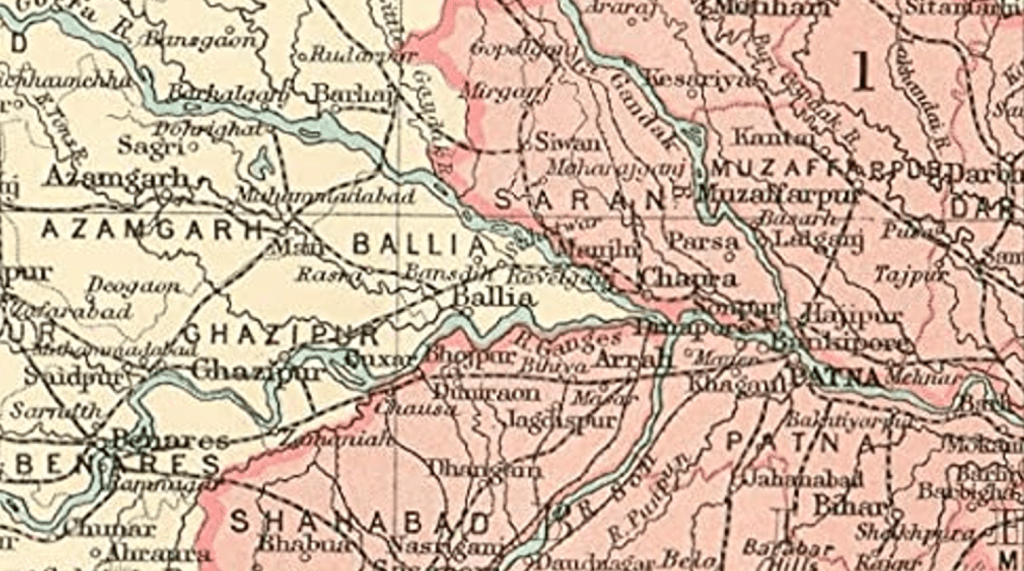
On 22 April 1858, Brigadier John Douglas halted his force on the banks of the Ganges. While he wrote his report to Brigadier Lugard and then waited for further orders, Kunwar Singh retreated to Jagdispur. The objective had been to drive Singh out of Oudh and as far away from Benares and Allahabad as possible. The road to Cawnpore was once again secure, but here the British displayed a certain sense of folly. Instead of following Singh to Jagdispur, they allowed him to retake his jungle fortress and form a juncture with his brother, Amar Singh. Their combined army now numbered anywhere upwards of 7000, all ready to restart hostilities in Bihar. Their cause was not a pan-India cry of freedom. What was happening in other quarters of northern India was not their concern – their objectives had started with and had always been securing their own territories in western Bihar.
Since the beginning of November 1857, a body of European mounted police had been patrolling the Bihar district, and they would be reinforced by 250, and then a further 300 by January, all of whom were low-caste, local recruits. In January, 100 sailors of the Naval Brigade took up their station at Gaya and HM’s 85th Regiment was sent on a march through Bihar, as much to make their presence known as to put an end to some of the lawlessness that still prevailed. This particular violence was not directed at the British but was of a homegrown nature, with various local rajas plundering and pillaging their neighbours. The Rani of Tikari, who had managed to stay out of the way during the mutiny, had been forced to take up arms for her own protection, something which the British, in their single-mindedness, viewed as a threat. Although they did not dismantle her fort, they certainly relieved her of her ammunition and guns. When Futteh Singh began creating a ruckus in western Bihar, the Deo Raja and the Sonepura Raja took it on themselves to give him a thrashing, putting an end to his pillaging ways.
“The so-called rebels like Hyder Ali Khan, Kosheal Singh, Jodhur Singh and Futteh Singh indulged in indiscriminate plunder. The result was they could not enlist the support and sympathy of the people in general. The Zamindars, on the whole, were well disposed towards the British.“
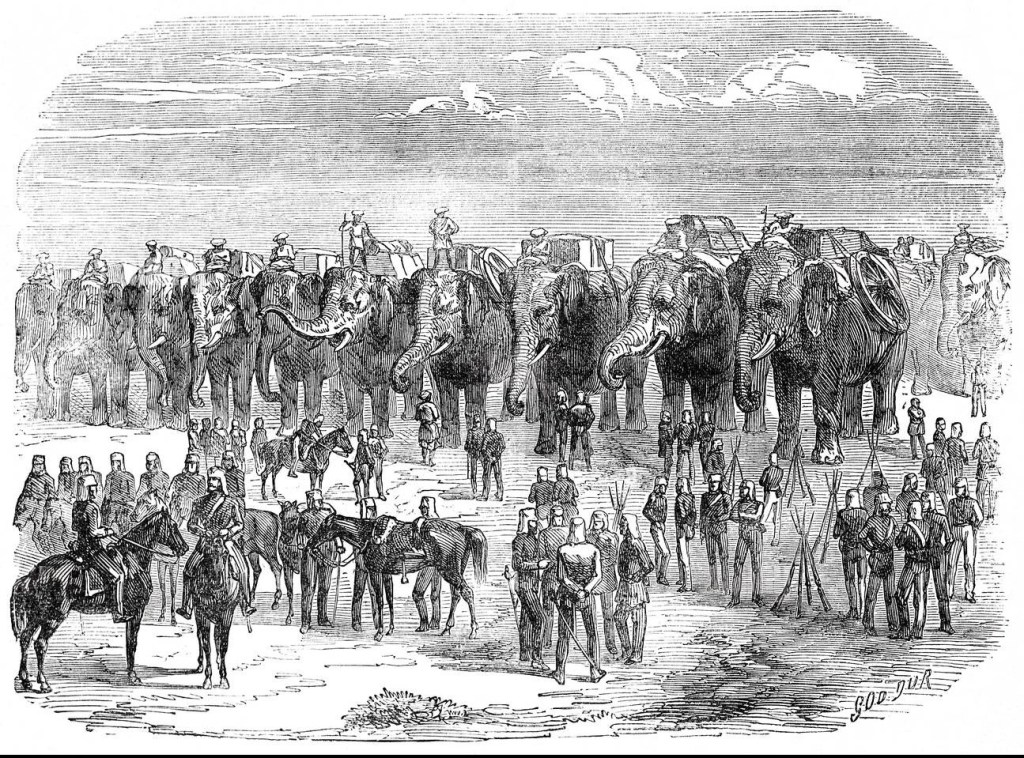
Three zamindars raised their own levies, with Deo Raja keeping the peace on the stretch of the Grand Trunk Road that ran through his territories at his own expense. Others furnished the British with volunteers for local police forces, and even granted them use of their personal elephants for service against the rebels. In all, 41 elephants were thus loaned out to the British. As it was, their interest was to prevent any further lawlessness against their own people, who were heartily sick of being robbed by either mutinous sepoys crossing Bihar or by any of the other gangs who traversed the province at a whim and plundered them indiscriminately. While British rule had not been in the interests of the Bihari people, this kind of chaos was not either. They saw no benefit in supporting the rebel movement, which had proved itself to be both disorganised and violent.
As for the British, they secured their interests where it was thought most necessary, ensuring that they were never wholly absent from the district. Dinapore and Patna had never fallen into rebel hands; Gaya, although there would be three outbreaks at different times, remained under their control; the stud farm at Buxar and even Arrah had never been empty of British forces. They also held critical posts along the river and the roads. While the peace in Bihar was fragile, it was still holding. However, the return of Kunwar Singh could certainly change that. His circle of influence was wide and his followers many. However, in his last encounter with Douglas, Singh had been critically injured, something his compatriots were eager to keep secret from his followers and even more so from the British. When Singh and his men reached Jagdispur, they were dispirited, and another encounter with the British was not on their cards. That is, of course, until a man as stupid as Captain Le Grand tossed them a temptation they could not fail to take, for on the 23rd of April 1858, Le Grand attacked Jagdispur.
And what a mess he made of it, we shall now find out.
The idea that Kunwar Singh would make for Jagdispur eventually had been a probability not lost on the British since his encounter with Milman in March. As Arrah was situated some 20 miles from Jagdispur, it was seen as prudent to ensure the station’s safety and for this purpose, on April 9, Captain Le Grand and Lieutenant Massey’s companies of HM’s 35th, comprising in all 150 men, accompanied by five artillerymen and an officer with a complement of 2 small pound 12-pounder howitzers, marched out from Dinapore, arriving at Arrah two days later. They were joined a few days after by 150 of Rattray’s Sikhs and 50 sailors of the Naval Brigade. Nothing happened at Arrah over the next week, but on 21 April, the garrison could clearly hear the sound of guns firing a few miles away. During the day, the magistrate of the station was able to ascertain that Kunwar Singh had crossed the Ganges and was on his way to Jagdispur. Without ascertaining the situation for himself, Le Grand, who had been led to believe Jagdispur was only 12 miles away and not the said 20, immediately began making preparations to take on Singh, parading his entire force at seven the same evening.
He was just on the point of ordering the advance when a few planters arrived at the station, stating it was quite a pointless venture. Singh was not at Jagdispur; they had just passed that way. Where he was exactly, they could not say, but with no more information forthcoming from the magistrate, the force remained at Arrah. The next evening, on 22 April, the magistrate had finally heard from his informants that Jagdispur was once again occupied, and here, the story takes a strange turn. The return of Kunwar Singh had given Le Grand sudden delusions of grandeur. Perhaps the weeks of boredom at Dinapore and then at Arrah had addled his judgement, but Le Grand seemed to believe he was an officer of the same calibre as Major Vincent Eyre. Eyre had sent Kunwar Singh on the run in August 1857, when he had squarely booted him out of Jagdispur with a small force, but Le Grand failed to remember Singh had also annihilated Captain Dunbar and his superior force barely days before his ousting by Eyre. As it is, Le Grand completely misjudged the situation, ignored the warnings of the Arrah magistrate who thought that attacking Jagdispur with inaccurate information was not wise, nor did Le Grand interest himself in telling any of his superiors what he was planning to do. What he believed was that he could recreate Eyre’s victory and gain for himself a few laurels, perhaps a knighthood and a promotion to boot. He was, after all, 39 years old and his career until now had been of the humdrum kind. Among his men, he was known to be something of a martinet, not unlike their old colonel, but not essentially a bad sort of officer.
So off they marched, the entire garrison of Arrah, under Captain Le Grand. They left the station on an oppressively hot night, even the badly trained artillery ponies were seen flagging beneath their loads and looked as if they would soon collapse from the strain. The men, with all their kit, in their red coats and pipe-clayed belts, were certainly not in better shape; only Rattray’s Sikhs, who flitted silently alongside the marching army, seemed indifferent to both heat and hardship. At one in the morning, and still two miles from the Jagdispur jungles, Le Grand called a halt. He now realised that the 12 miles he had been led to believe was the distance to Jagdispur was in fact 20, and much of it from here on would be through thick woods, with barely a path and hardly any visibility in the dense undergrowth. While Le Grand pondered this particular obstacle, the force halted for a little rest. Barely four hours later, Le Grand ordered them to their feet. Not adverse to a little grumbling now, was Lieutenant Richard Parsons of the 35th.
 Mutiny Reflections