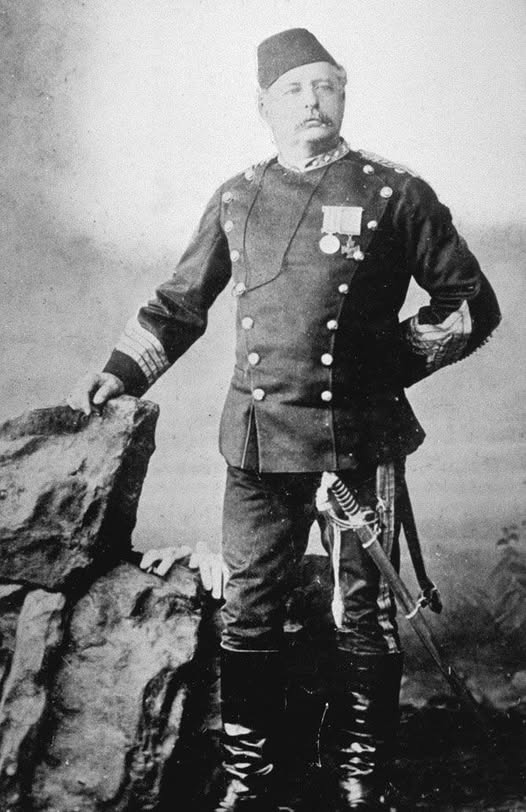
Charles George Baker was born on 8 December 1830 at Noakhali in East Bengal, to John Baker, a surgeon of the East India Company and his wife, Lydia. His early life was likely spent in the climes of this once remote backwater of what is today south-eastern Bangladesh, and perhaps it was here that young Charles first heard the call of the sea.
George was sent to England for his education, attending schools in Halesworth and Lowestoft in Suffolk. Our next glimpse of Charles comes not from the army, but as a midshipman in the EICo Maritime Service, with the intention of transferring to the military. However, the waves led him to the Peninsular & Oriental Company instead. By 1854, he was serving as second officer aboard the SS Douro.
Unlike Baker, who was destined for a long and illustrious career, the Douro would have a very short life and ignoble end. Built by Tod & McGregor in the Partick Yard, Glasgow, she was launched on 25 June 1853 and was noted, on 13 August 1853 on her arrival at Southampton, as “One of the few P&O ships of her time to be given painted ports; barquentine rigged, she looked very smart.” She was registered on 23.08.1853 as Douro for The Peninsular and Oriental Steam Navigation Company for £28,050. After two voyages between Southampton and Constantinople to iron out any remaining issues (it turned out her compasses were faulty, causing “poor landfalls”), she was finally assigned to the “China Run” on 27 December 1853 to carry passengers, mail and cargo between the ports of Bombay, Singapore and Hong Kong. At 810 tonnes, she was an iron-hulled, wooden-decked ship with a single screw, a steeple-geared steam engine, capable of achieving 10 knots in ideal conditions. However, as it turned out, she was no match for the China Sea and her storms.
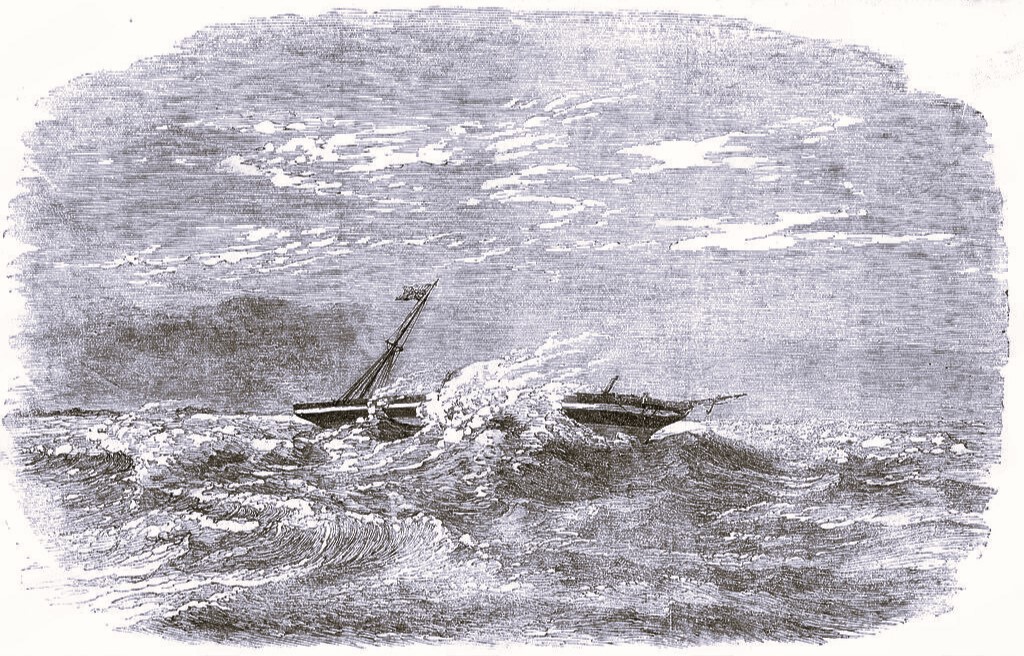
WRECK OF THE “DUORO” STEAM-SHIP.
(From a Singapore Correspondent)
Illustrated London News, No. 696, Vol XXV,
Saturday, August 5, 1854
One of the fine steam-ships of the Peninsular and Oriental Company, the Duoro, has just been wrecked under the following distressing circumstances on her voyage from Hong Kong to Singapore. On the night of May 24, the Duoro encountered a a typhoon, in which she lost her funnel and her boats, and was wrecked on the north shoal of the Paracels, a group of islands and shoals in the China Sea, as shown by the accompanying illustration:
The following is a detailed account of the wreck by another of the passengers of the vessel:-
“We left Hong Kong, with all the mails and passengers, for England, on May 22nd at 2pm, with fine weather and a fresh breeze from N.E., making a capital run for the first forty-eight hours. A heavy sea then began to set in, with more wind, which gradually increased to a typhoon, on the night of the 24th: we were in the middle of it.
Our lifeboats were washed away, sails blown from the yards, and eventually our funnel blown overboard. This was about one a.m. of the 25th. The engines were stopped, and the ship lay very well until daylight, the gale rapidly moderating. The captain deemed it advisable to bear up for Hong Kong, which was accordingly done, and the day was spent in repairing damages, shifting sails, disconnecting the screw, &c. At noon by observation we were in lat. 15.15 N., long. 110.3 E., course steered N. by E., afternoon.
Shortly after midnight we were all startled from sleep by feeling the ship grating on the rocks, and very soon bumping heavily and sea washing over her. The foremast was cut away, and we soon became a helpless wreck, but getting more firmly fixed on the rocks, as each sea struck her. We anxiously awaited daylight, which, when it came, showed us our position on a reef, without any land in sight. This we concluded to be the north shoal of the Paracels, (which proved to be correct by observation at noon), distant from the nearest land, Woody Island, over 25 miles; and from Hainan, east of China, 120 miles. By eight o’clock, the ship lay comparatively quiet – the sea having gone down in a wonder manner in so short a time. A consultation was held, in which it was resolved to send our small six-oared boat to Hainan, in charge of Mr Baker, second officer, and Mr Norie, late commanding officer of ‘Lady Mary Wood’ to endeavour to get assistance. They were accordingly started off, with the prayers of all hands, for their success, as all our hopes depended upon so frail a chance.
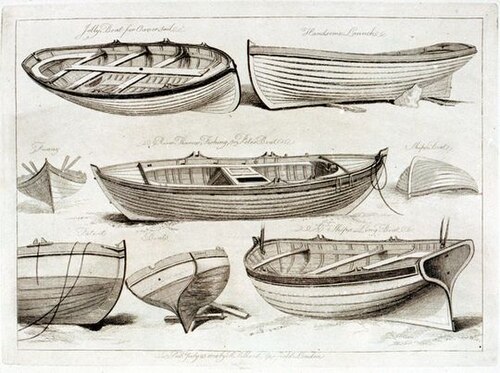
Too much praise cannot be given to these gallant fellows, who, after eight days of great hardship, danger and privation, succeeded in reaching Hong Kong, having travelled over a distance of 500 miles in a small jolly- boat, encountered a gale of wind, and being nearly taken prisoners by the pirates of Hainan. The ‘Malta’ and the ‘Tartar,’ Peninsular and Oriental Company’s steamers, were immediately dispatched to our assistance. We remained in this helpless condition for 10 days, constructing rafts, building a boat, and making preparations in case the ship should break up; but the weather remained beautifully flat and the sea smooth during the whole time, a thing very unusual in the China Sea, particularly during the change of the monsoon. We were very much cheered and comforted by the prayers offered up every morning by the Rev. Mr Young, a missionary, and which all Europeans, without exception, attended. Two Chinese junks were seen at different times. With one we succeeded in communicating, but her captain refused to take anybody on board, and would not go to Hong Kong though offered 1000 dollars. We could not catch her, or under these circumstance we should have taken her by force, and sent a part of the passengers and crew to Hong Kong. Only one life was lost – as Lascar, who, with some others rushed for our only serviceable boat, when we struck, and in attempting to lower her down he fell overboard and was drowned.
The mails and passengers were put on board the Malta on the 6th of June, and turned over to the ‘Pekin’, which left Hong Kong with the mails, with orders to call at the North Shoal. Great hopes were entertained of getting the Douro off, should the weather remain fine. The barometer during typhoon was down to 28.35.”
It is a misconception to think only Baker and Norie set off in the jolly-boat; it had six oars and, as such, six further passengers. Besides the two officers (Norie was not serving on the Duoro; he was an officer of the P&O, but was proceeding home on sick leave), there were two quartermasters, two lascars and two passengers. It was, as described, a perilous venture. They first encountered a Chinese junk and endeavoured to get assistance. A passenger, who happened to be Chinese, boarded the ship, but he was swiftly robbed of what little he had on him and sent off. For days on end, heavy seas would make their lives miserable; running low on provisions, they arrived on Hainan Island, only to find, according to Baker’s log, they were unable to find any signs of habitation. Now, they could have given up, but instead, it was decided to push on towards Hong Kong. On this leg of the journey, they would encounter pirates who refused them food and water unless they allowed themselves to be robbed – providentially, they managed to escape their clutches, returning to the sea to face not only bad weather but a jolly boat that was rapidly taking on water. They finally arrived in Hong Kong and the rest, as they say, is history.
As for the SS Duoro, she was never recovered and remains to this day a wreck in the China Sea.
It would seem that Charles had seen quite enough of the sea and made his way back to India. To his surprise, when he had arrived in Calcutta he found he had erroneously been reported as dead from smallpox, with
his “untimely end was lamented by a numerous circle of credulous friends.” However, there was certainly much life ahead of Charles Baker. He joined the Freemasons and was initiated in into the True Friendship Lodge, No. 218, in Calcutta on 13th August 1855 and in 1856 he was commissioned as a lieutenant in the Bengal Military Police, the very year the regiment was raised at Lahore.
He was appointed its second-in-command, and at the age of 26, he was off on his next adventures with Rattray’s Sikhs.
His chance at command came at Sahejani, when Lieutenant Broughton suddenly decided to hand it off to him in the field – accustomed to taking swift decisions, accompanied by the brash and the headstrong Sikhs of his detachment, Baker charged a massed army of some 1000 men, over rough ground, through watercourses and over broken fields, to win the day. He was not specifically recommended for the Victoria Cross by Captain Rattray, who wanted some sort of a commendation for his actions, which would certainly be a boost for the morale of the regiment; it was Sir Colin Campbell, who notoriously despised the VC and all it stood for, who decided Baker was an ideal example of derring-do in action. In a letter to Lord Canning, Campbell directed his Adjutant-General, Lieutenant-Colonel William Mayhew, on 6 October 1858, to write to Lord Canning:
“I have the honour to request, on the part of his lordship, that you will have the goodness to direct the attention of the Right Honourable the Governor-General to the brilliancy of the exploit performed by Lieutenant G. C. Baker, of the Bengal Police Battalion, which is deserving of the highest encomium, on account both of conception and execution. His lordship is of the opinion that the Victoria Cross should be awarded to Lieutenant Baker, and to Mr Chicken, of the Indian Navy, and he will take immediate measures for the execution of his intention in this respect.“
However, the citation would not appear in the London Gazette until 1862 and would consist not only of Sir Colin Campbell’s recommendation but Baker’s entire despatch. (London Gazette, 25 February 1862, Issue: 22601 Page: 957). It is unclear why it took so long to publish. Part of the problem might have been Baker’s lax attitude towards dates, for his original dispatch gives the date of the action as 26 September and not the 27th. It was also an unusual VC that did not fall into the regular clauses – neither Rattray (who recommended him for a reward) nor Sir Colin (who commended him) had seen the action. As such, there was only Baker’s word for it. The other issue was that Baker was not part of a regular unit, but was serving with the Bengal Military Police, which at the time was still an irregular force. It would take time to figure out if Baker was indeed eligible or not. Then there came the bureaucratic hoops – gathering formal dispatches, securing the necessary eyewitness statements and then clearing them. The mutiny had thrown India into something of an administrative quagmire, with delays in the postal service and communication. Once the file was cleared in India, it would then travel to England for some more work, including a review by the Secretary of State for War, until it was ultimately approved by Queen Victoria.
By the time Baker received his VC, he had further adventures.
In 1859, he was appointed Second-in-Command and Officiating Commandant of Cavalry within the Bengal Military Police, overseeing the reorganising and managing of local irregular horse units following the aftermath of the rebellion. In 1861, we find him taking part in the punitive Sikkim Expedition (under Lieutenant Colonel John Christopher Gawler). A year later, Baker was back in England – he received his Victoria Cross in the post and married Charlotte Campbell Ashmore, the daughter of Major William Ashmore, on 25 November at Holy Trinity Church in Bath. He then returned to India in 1863, taking the post of Officiating Deputy Inspector of Police at Dacca, coming, as it was full-circle as he would spend the last year of his India career in East Bengal. It was a short posting; in 1864, his health was poor, Baker retired and returned to England. For a time, he settled in Malvern with his wife and four children, and spent some time in the United States, visiting relations, in particular his brother William, who had settled in Iowa.
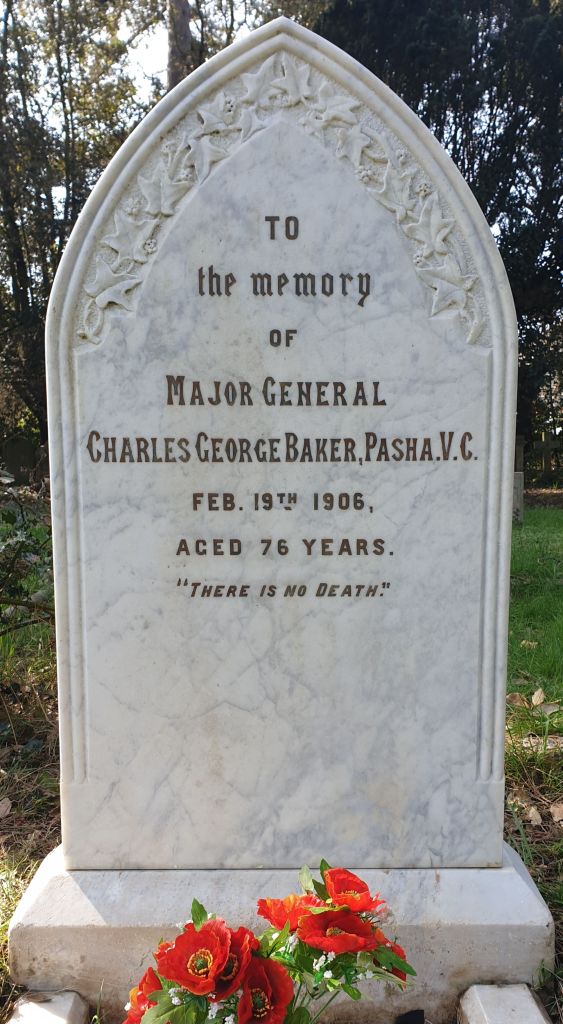
However, it was hardly the end of his career. In 1877, during the Balkan Campaigns, Baker served with the Turks under Valentine Baker Pasha and would spend some time as a prisoner of the Russians. The Sultan, like Sir Colin Campbell, all those years ago, was suitably impressed with Baker and, for his services in Turkey, granted him the rank of Major General and appointed him Lewa Pasha. In 1882, he transferred to the Egyptian police, rising to Major General (Lewa Pasha – a title once widely used in the military forces of Egypt and the Ottoman Empire) and finally retired as Major General (Egyptian Gendarmerie) in 1885 and as Chief of the Public Security Department for the Egyptian Ministry of Interior. Following his return to England, Charles George Baker and his wife Charlotte took up residence in Southbourne, living at South Cliff Hotel on Belle Vue Road. Here he died on 19 February 1906 and lies buried at Christchurch, Christchurch Borough, Dorset, England.
Sources:
Illustrated London News, No. 696, Vol XXV, Saturday, August 5, 1854
Supplement to the London Gazette 22224, 31 January 1859
London Gazette, 25 February 1862, Issue: 22601 Page: 957
https://victoriacrossonline.co.uk/charles-george-baker-vc/
https://vcgca.org/our-people/profile/1154/Charles-George-BAKER
https://www.findagrave.com/memorial/8108502/charles-george-baker
https://poheritage.com/wp-content/uploads/ship-data-pdfs/DOURO%20(1853).pdf
https://www.bulwer1068.org.uk/history/eminent-members/major-general-charles-george-baker-v-c
https://gw.geneanet.org/
Christchurch History Society:
https://web.archive.org/web/20150418003817/http://www.historychristchurch.org/connected-to-christchurch/
 Mutiny Reflections