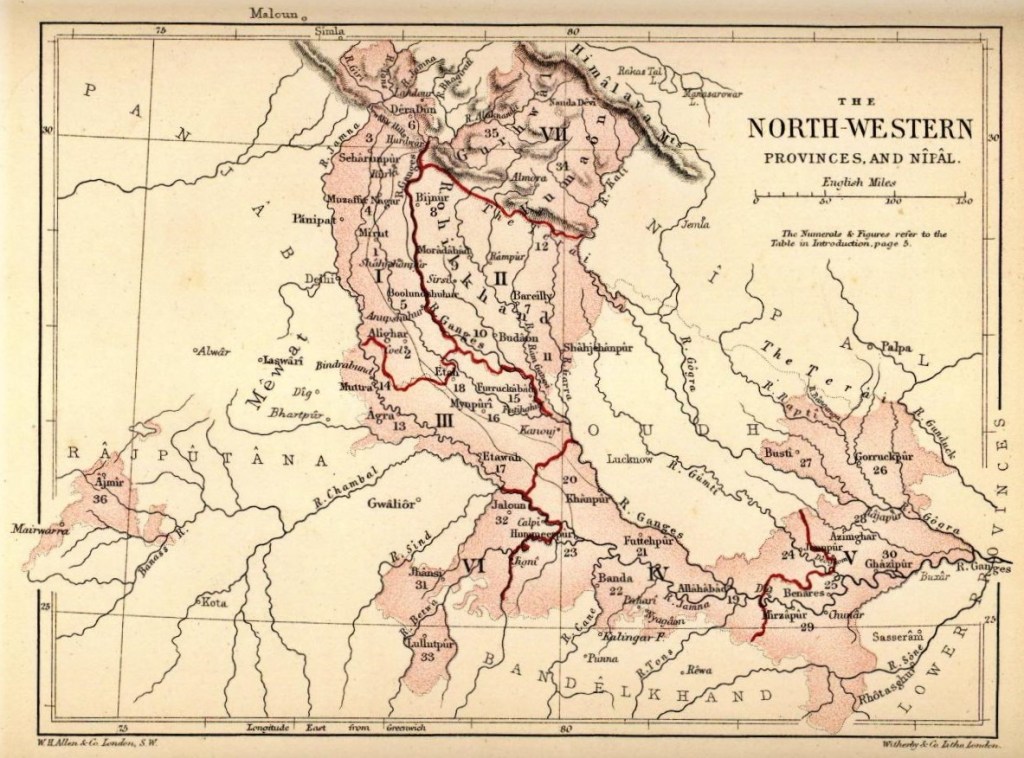
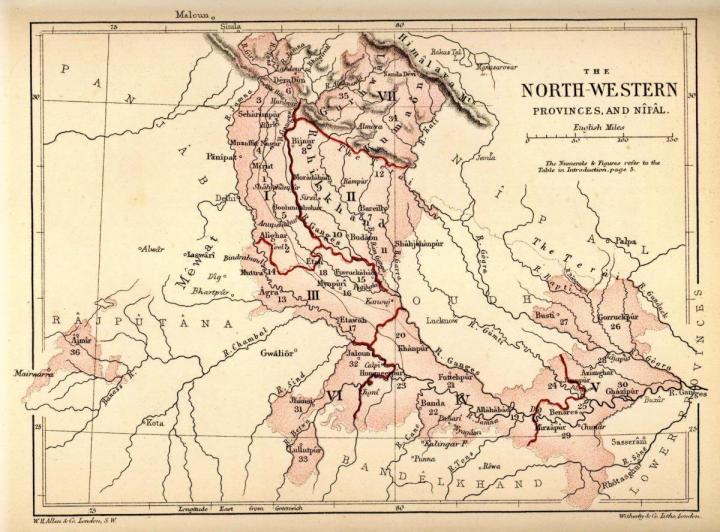
Between 1836 and 1902, a large tract of what is today known as Uttar Pradesh was titled the North-Western Provinces. It had before, had rather ostentatiously been named the “Ceded and Conquered Provinces”, which, while being an honest title, considering, was hardly a politic one. The extent of the North-Western Provinces included the Delhi territory (1836-1858), Merwara (1846-1871) and the Saugor and Nerbudda Territories (1853-1861). This administrative behemoth spanned a vast area of 72’000 square miles, from the source of the Ganges and Jamuna rivers in the north to the Caramnasa in the south: it was subdivided into six divisions comprised of 31 zillahs or districts. The population in 1857 was no less than 30 million, comprising one of the most culturally diverse landscapes in northern India.
As there was a positive mania for subdivision, each of the six divisions had, within its boundaries, five or six zillahs. At the headquarters of each of these resided a Commissioner with authority over the police, the revenue affairs and the district officers, who in turn were named “Collector and Magistrate” in each district of the division. Courts and criminal justice were controlled by district judges at different stations, with each judge holding jurisdiction over one or two districts. The entire system was supervised from Agra, where the Lieutenant Governor – the “Civilian of Civilians” – the Sudder Court (the chief civil and criminal tribunal) and the Revenue Board held office. All of these noteworthy individuals belonged to the Covenanted Civil Service of the East India Company. Unlike the Governor-General or the Governors of Madras and Bombay, he was not assisted in his endeavours by council, nor did he have his own army; the most important divisions of the army were located in NWP, with Meerut, Cawnpore and Saugor all falling under Agra’s rule.
Geographically, Rohilkhand, bordered by Oudh to the southeast, was considered in the North-Western Provinces by the British, although until 1801 it had belonged to Oudh, when it was ceded to the EICo by the Nawab. For administrative purposes, the British added it to the North-Western Provinces, within the Bareilly Division. Likewise, Moradabad and Mohamdi were part of Rohilkhand. The Meerut Division included Delhi, Rohilkhand, and Agra, the Cawnpore Division comprised the districts of Allahabad and Benares, and, at the time, included Oudh; the Saugor Division consisted of both Jabalpur and Jhansi. Into this fray came the civil divisions, but the organisation at least was consistent. The administration was handled by several EICo administrators, headed by the commissioner, under whom served judges, magistrates and revenue collectors. The principal Commissionerships were those “of Delhi, Meerut, Rohilkhand, Agra, Allahabad, Benares, Jubbulpoor and Jhansi” (Kaye, Vol. III, p.195), but the headquarters of the civil government remained at Agra. In 1856, following the annexation of Oudh, the region was known as the North-Western Provinces and Oudh and covered a massive 72’0000 square miles.
1. Delhi Division – Added to the province in 1836 until it was transferred to the Punjab in 1858 following the 1857 Uprising.
Districts: Paneeput (Panipat), Hurreeaunah (Haryana), Delhi, Rohtak, and Gurgaon.
2. Meerut Division
Districts: Meerut, Bulandshahr, Aligarh, Saharanpur, Muzaffarnagar, and Dehra Dun.
3. Rohilkhand Division
Districts: Bareilly, Bijnor, Budaun, Moradabad, Shahjahanpur, and Pilibhit.
4. Agra Division
Districts: Agra, Farrukhabad, Etawah, Mainpuri, and Etah.
5. Allahabad Division
Districts: Allahabad, Cawnpore (Kanpur), Fatehpur, and Bundelkhand (Banda and Hamirpur).
6. Benares Division
Districts: Benares, Mirzapur, Jaunpur, Ghazipur, and Azamgarh.
Additional Non-Regulation Territories
Several peripheral regions were incorporated into the province for varying periods:
Ajmer-Merwara: Administered within the North-Western Provinces from 1832/1846 until becoming its own minor province in 1871.
Saugor and Nerbudda Territories: Added in 1853 and later absorbed into the Central Provinces in 1861.
Kumaon: Operated as a localised non-regulation district.
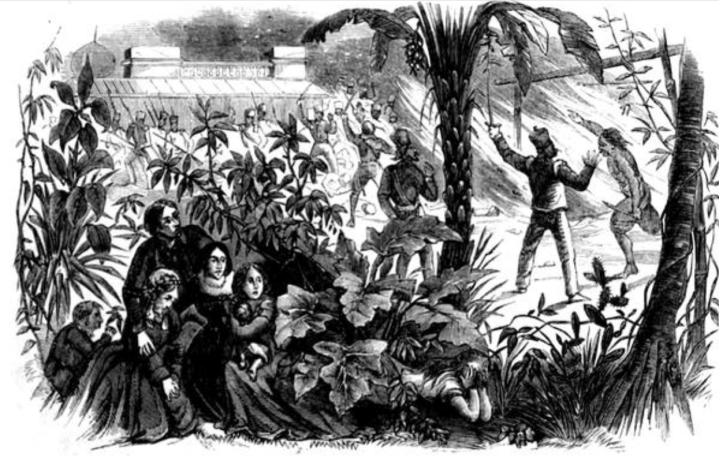
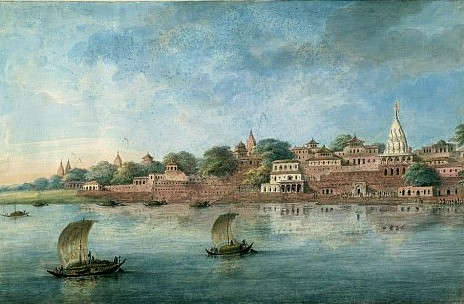
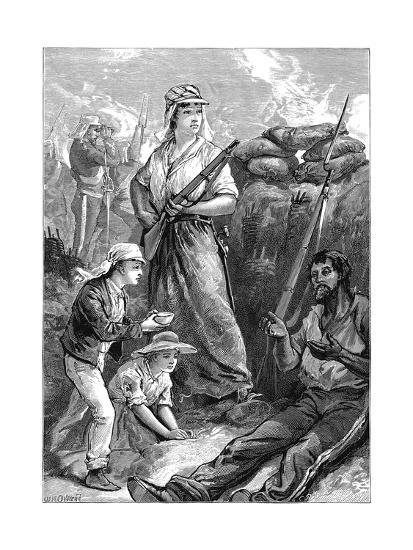
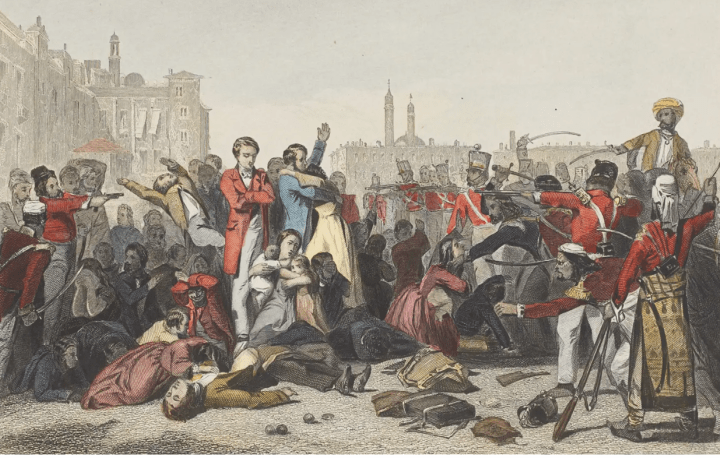
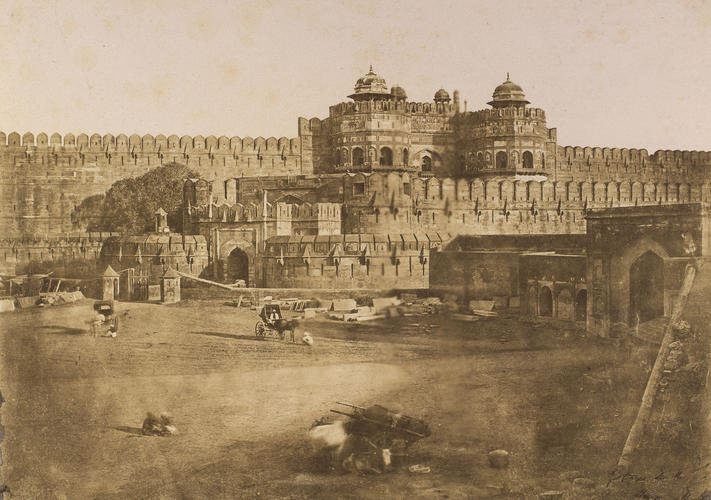
It was from Agra that Calcutta would first learn of the uprising in Meerut; the NWP would see more than its fair share of bloodshed in 1857 as station after station collapsed. Agra, Allahabad and Benares would never fall completely out of British control during the mutiny, acting as anchors for the first major operations in the 1857 campaigns; they would act as anchors for fleeing civilians as the mutiny progressed. Agra would eventually be cut off as the roads surrounding the city were finally taken over by the mutineers, and contact with Calcutta and Delhi would all but come to a standstill for a time.
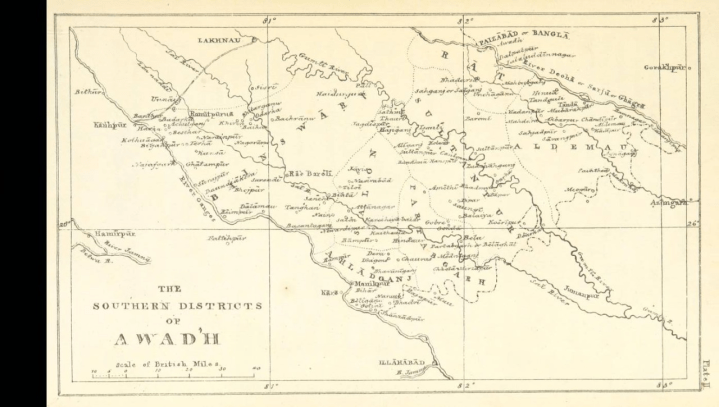
With the retaking of Fatehpur and Cawnpore by Havelock’s force in July 1857, the lines of communication were slowly becoming re-established, allowing for further troop movements and regular supply routes, all necessary for the eventual relief of Lucknow; however, it would not be until 1858 that the so-called “pacification” of the province would begin in earnest.
1858
It would take much effort on the part of the British to re-establish their control in the North-Western Provinces, and in 1858, there would be significant changes; with the end of EICo rule, the region’s capital was shifted to Allahabad, and the Delhi Territory was transferred to the Punjab. To begin the 1858 campaigns, however, it was considered imperative to regain control over Fatehgarh before any attempts could be made to either retake Lucknow. To secure Benares and Allahabad, the next station to be taken would be Azamgarh. However, this would by far not be the end of campaigning, and fighting would continue until 1859.
 Mutiny Reflections