Lieutenant Harry Hammon Lyster, 72nd Bengal Native Infantry
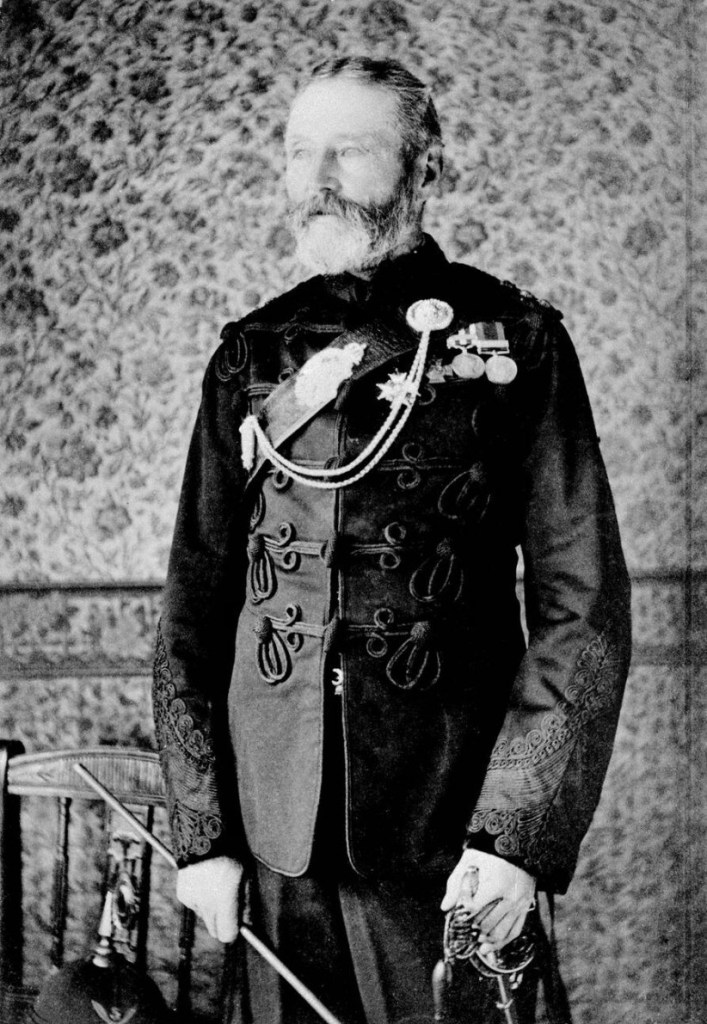
Born on 24 December 1830 in Dublin, Ireland, to Antony Lyster, a civil servant of Stillorgan Park, Dublin and his wife, Marcia, Harry Lyster served first as a special constable in London before receiving a commission to the East India Company’s army on 20 September 1848. Two months later, in November 1848, he was posted to the 72nd BNI, and just in time to fight in the Punjab Campaign, where he would see out the Siege of Multan.
His regiment, which added “Guzerat”, “Mooltan” and “Punjab” to their honours, would meet their inglorious end on 3 June, 1857, when they mutinied in Neemuch. They would become a part of the Kotah Brigade that would then fight the British on 5 July at Agra. That they attempted to reach Delhi was no surprise, but together with the Neemuch Brigade, they were routed at Najafgarh in August by Nicholson. The scattered remnants of the regiment would meet Greathed at Kala Nadi, but they were of little consequence, and the rest simply disappeared into Rohilkhand, never to be heard from again.
For Lieutenant Lyster, however, the mutiny left him unemployed and without a regiment; a knack for languages did serve him well, for in January 1858, with the start of the Central India Campaign, he was attached to the staff of Sir Hugh Rose as an interpreter and ADC. It was not long before Sir Hugh took notice of the young man at Barodia on 31 January.
“Sir Hugh Rose had a bodyguard of a troop of Hyderabad cavalry, and, as they had no European officer with them, he directed Lieut. Lyster to take command, and to advance against the enemy, who were at this time retreating. Lyster ordered the cavalry to charge, leading them himself, but, except for a native officer, no man charged. Lyster dashed through the enemy’s rear- guard, killing three men and having his horse wounded by a sword cut on the offside, and his bridle cut through on that side. He called to the native officer to charge through, but the poor fellow stopped to fight and was cut to pieces. Seeing at some distance off the enemy’s cavalry, Lyster stopped when the nephew of Mahomed FazilKhan advanced brandishing his sword, but leaving his men at the halt. As Lyster took this to be a challenge to single combat, he advanced also; they both met at a gallop, Lyster thrusting his sword through his enemy’s body, and himself receiving a wound in the right arm. The enemy’s cavalry, seeing their commander killed, turned and fled.”
The mention in dispatches came at the price of a deep sword cut on the inner part of his right forearm, but it was just the start.
At Jhansi, Lyster once again came to the forefront when Sir Hugh Rose, with his plans in the making for the taking of the fortress, still needed to reconnoitre the positions for the batteries that would bash holes in Jhansi’s walls. The task was so dangerous that Sir Hugh was reluctant to order anyone to go, but Lyster volunteered.
“If you will allow me, sir,” replied Lyster, ” I shall undertake it, if I can do it in my own way, and without a guard.” Accordingly, he set off, dressed in an old, inconspicuous shooting-suit, and accompanied by a native boy. When they got near the town, he left his horse with the boy in a thicket, with instructions that when he whistled for him, he was to ride up to him as quickly as he could. He then crawled through the scrub across the level space surrounding the walls, marked suitable positions for the artillery, and at last actually went up to the gate of the town, and, putting his ear against it, listened to the conversation of the guard inside. Then he commenced his retreat, but before he had gone very far, shouts and firing from the walls showed that he was discovered. The gates were flung open, and there was a rush of men in pursuit. Whistling for his attendant, he began to run as hard as he could. The boy came galloping up with his horse, and before the pursuers could reach them, he was mounted and off. When the siege took place, all the positions he had selected for the artillery were those upon which the batteries were erected. Well pleased, Sir Hugh once again mentioned him in dispatches, stating, “Nothing could be more conclusive proof of the skill of this officer.”
Eager to prove his worth again, Lieutenant Lyster devised a plan for Sir Hugh Rose to capture the prize of Jhansi, the Rani herself, by giving her a loophole, with Rose’s approval. He would withdraw a picket of troops from the cordon that surrounded the city one night, which, as soon as the Rani heard of this, would undoubtedly use this momentary, but deliberate, lapse of judgement to escape.
Next morning, the General, myself, and his other A.D.C., Captain Rose, started to go round the pickets; in one place the General ordered the picket to be withdrawn, thereby leaving a gap of about four hundred yards. Captain Rose remarked to me, ” Has the General gone off his head?” I said, ” I should rather think so.”
That very night, under the heavy firing of the pickets positioned on either side of the gap, the Rani did indeed escape; however, the plan did not work. The idea was that the 14th Dragoons would follow up the fleeing Rani and take her captive. Unfortunately, by the time Sir Hugh was informed of the night’s goings on, it was dawn, and the Rani was well away from Jhansi. The Dragoons nevertheless set off in pursuit, but after 20 miles the heat took its toll; the Rani was gone, and the Dragoons returned empty-handed. She would meet the Central India Force again, in far-off Gwalior.
While this might have been something of an embarrassment, it was only a matter of time before Lieutenant Lyster was again in the forefront, this time at the Battle of Kunch, one of the hardest-fought and decisive actions in the campaign’s history, where Lyster would win the Victoria Cross.
When the enemy retreated, worsted from the conflict, they fell back in good order, covered by skirmishers. General Rose had sent Lieut. Lyster with an order to the cavalry to charge. Threatened by cavalry, some of the rebels formed themselves into a rallying square when they were charged, not by a squadron, not by a troop, not even by a sergeant’s party, but by one horseman, who, driving in amongst them, broke the square and slew two or three sepoys, himself escaping without a wound. That single horseman was Lieutenant Harry Hammon Lyster. His horse was wounded by sword cuts and bayonet wounds. This gallant action was witnessed by Sir Hugh Rose himself and by Lt.-Col. Gall, C.B., of the 14th Dragoons.
The citation that appeared in the London Gazette is short:
Date of Act of Bravery, 23rd May, 1858
For gallantly charging and breaking, singly, a skirmishing square of the retreating Rebel Army from Calpee, and killing two or three Sepoys, in the conflict. – Major-General Sir Hugh Henry Rose, G.C.B., reports that this Act of Bravery was witnessed by himself and by Lieutenant Colonel Gall, C.B., of the 14th Light Dragoons (No. 22318″. The London Gazette. 21 October 1859. p. 3792.)
In all, Lieutenant Lyster would be mentioned in dispatches five times, including twice for gallant conduct in the field, seeing out the entirety of the Central India Campaign.
Between 1860 and 1863, he served as ADC to the Commander-in-Chief, received his promotion to captain in 1861, and in 1866 took up an appointment with the Staff Corps Communications. With his brevet-majority came a change in regiment to the 3rd Gurkhas in 1864. We will not task the readers with every promotion Harry Lyster in detail — Major 20 Sept. 1868; Brevet-Lieut.-Col. 18 March 1870; Lieut.-Col. 20 Sept. 1874 ; Brevet-Col. 27 May 1879 (1 Oct. 1877); Officer 2nd in Command 8 April 1872 ; 2nd in Command 23 June 1873; Commandant 1 Dec. 1879 — an illustrious career indeed.
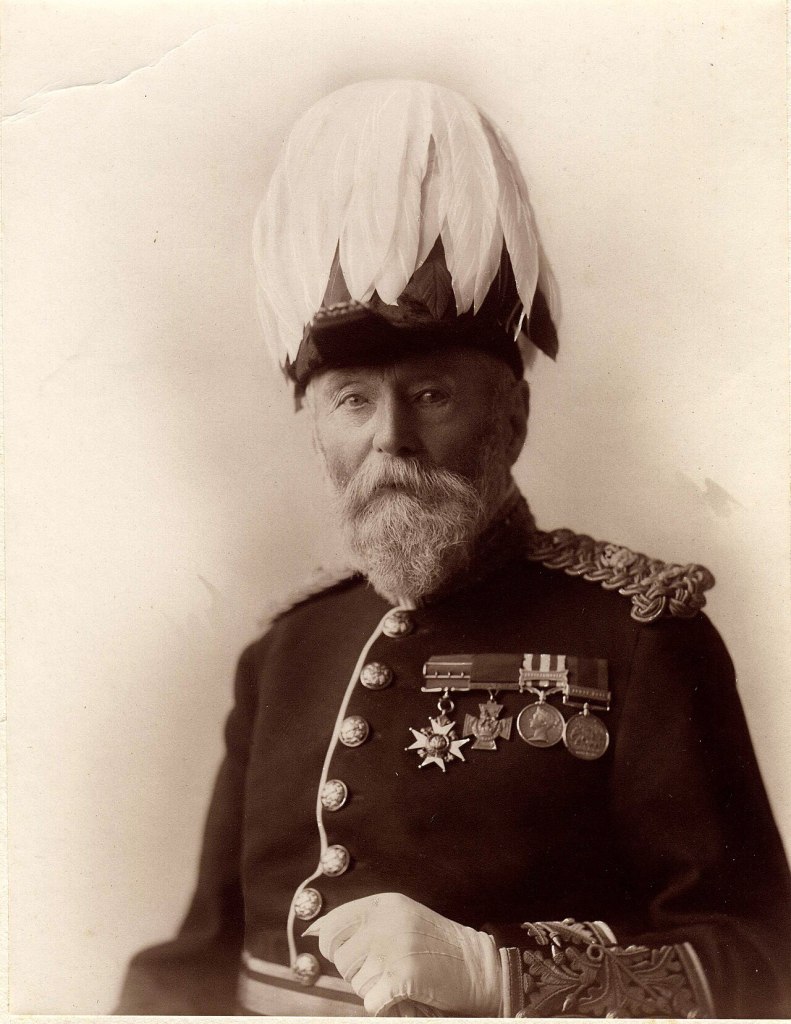
Lyster commanded the 3rd Gurkhas in the Afghan campaigns, 1878-79 and 1879-80; at Ahmed Khel he once again proved his mettle.
The Afghans, about 20,000 strong, held a position on an undulating ridge of the Galkoh range. The 3rd Goorkhas formed part of Gen. Hughes’ Brigade, which was ordered to advance and attack under cover of artillery fire. The Afghans, however, did not await the attack, but, charging down with desperate gallantry, enveloped three sides of the position, and penetrated the line, not waiting to fire, but rushing on, sword in hand. The artillery had by this time fired away all their case. The infantry stood firm and made a most gallant stand, but the right of the Brigade was shaken by the determined onslaught of the enemy. At this moment, their horse charged furiously down on the left flank. The cavalry was rolled back before the weight and impetus of the attack, and, mixed together in a struggling throng, the mass of horsemen bore down upon the 3rd Goorkhas. At this critical juncture, Col. Lyster, by his coolness and readiness of resource, saved the situation. Seeing his opportunity, he called upon his men to form company square, thus leaving space through which the blended mass of friend and foe was able to pass. Then, as the Afghan horse swept on through the openings, the 3rd Goorkhas opened a withering fire, in which other troops joined. The effect of this concentrated fire was terrible; men and horses rolled over in wildest confusion, and our cavalry, relieved from the pressure from behind, extricated themselves from their foes, and fell upon the head of the column, driving it back through the square, and the crisis was over. There can be no doubt that in the great victory which was gained, Col. Lyster contributed mainly to the success of the action.
He was once again mentioned in dispatches, a campaign medal with clasps and a CB. His good service pension now amounted to £100 a year, and he was appointed to command the Viceroy’s escort at Lahore. And yet there it was the government itself that would throw a spanner in Lyster’s career. On 30 May, 1887, the Civil and Military Gazette, Lahore wrote the following:
Last autumn we pointed out the superior claims of Col. Lyster over those who were selected for Brigade commands in Burma, and when a Gazette of India, in January last, announced his promotion to the rank of Major-General, more than one of our contemporaries expressed a hope that the Government of India would take the opportunity of advancing the interests of this country and of our army in giving him the command of a Division. It was stated that in doing this, they would, to a certain extent, ‘compensate a most capable officer for some injustice displayed towards him, chiefly because he strenuously upheld the rights of the Sepoys of his late regiment, the 3rd Goorkhas, in respect of the dearness of provisions, against short-sighted and cheese-paring economists.’
He was gazetted a Lieutenant-General in September 1891 and placed on the supernumerary unemployed list of the Indian Army in July 1892. When a circular was sent around by the Indian Government (according to the custom of the War Office) to appoint honorary colonels to Indian regiments, the 3rd Goorkhas, from both battalions, including the European and Indian officers and the men, elected Lyster. Although it was a unanimous decision, it was promptly ignored, and another man, junior to Lyster, was put in his place; to add insult to injury, he had hardly served with the regiment. The horrified Gurkhas took it on themselves to write to Lyster and their colonel was a very lame excuse from the government.
“…the Subadar Major of the regiment expressing their surprise and regret that he had not been appointed, to which he replied that the high compliment they had paid him in submitting his name was what he valued, and that had the wishes of the regiment been otherwise, he would, had the appointment been offered him, have declined it. Colonel Bishop, who had succeeded General Lyster, went to the India Office and asked why the Government had not appointed General Lyster,. The reply was that he was not a General. He asked why he had not been made a General, according to the usual custom in a Seniority Service. He was informed that they had altered their regulations. Comment on this is superfluous. It was part of a system which allowed distinguished officers to be deprived of the just rewards of their gallant services to their country by the
influences of social jealousies and personal spite.”
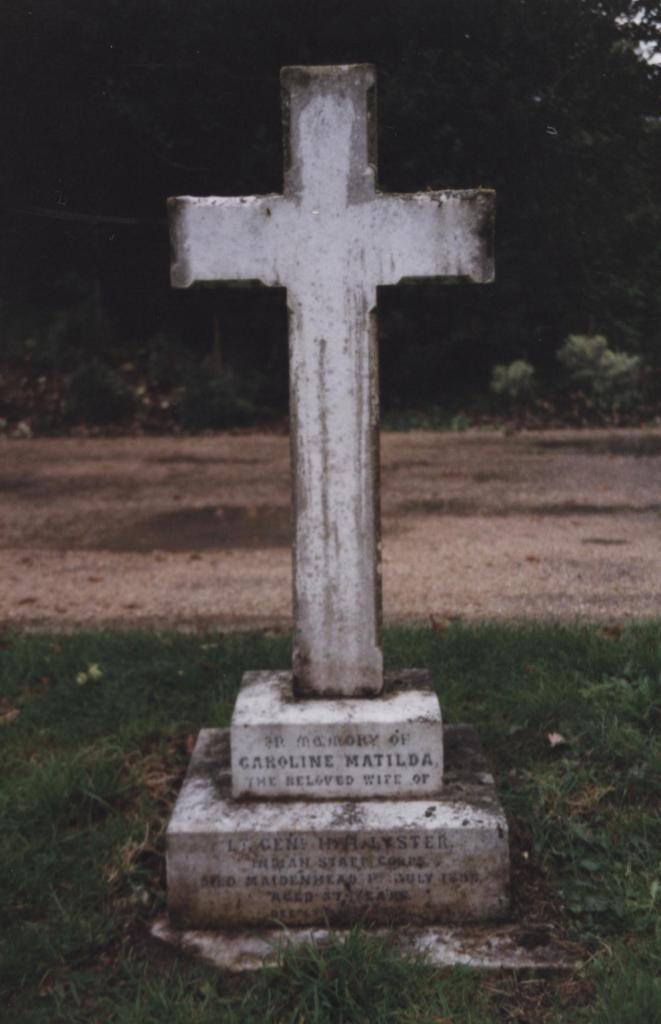
Despite an active career, Lyster married on 1 December 1865 at Fort William Calcutta to Caroline Matilda Underdown (née Davies). Sadly, they never had any children, and she died in 1895. His second marriage was to Ada Emily Cole, daughter of John Cole, Esq. The ceremony took place at the Sussex Register Office in Eastbourne, likely a quiet affair, considering the couple had 41 years between them. Lieutenant-General Harry Lyster died at his home at 1, St Mark’s Square, Regent’s Park, London, on 1 February 1922 at the age of 91. His remains were cremated, and his ashes were buried alongside his first wife, Caroline in the St James the Less Churchyard (Stubbings, Windsor and Maidenhead Royal Borough, Berkshire). Ada Lyster lived on until 1944; there were no children.
His VC is now part of the Lord Ashcroft collection.
In a different war, but with the same daring that had spurred on Lyster at Kunch, Captain Hamilton Lyster Reed (later Major-General), Royal Artillery, would receive a Victoria Cross for his actions at Colenso, Natal, South Africa, on 15 December 1899. He was Harry Lyster’s nephew.
Sources:
Denny, Henry Lyttleton Lyster. Memorial of an Ancient House: A History of the House of Lister or Lyster. Edinburgh: Ballantyne, Hanson & Co., 1913.
Forrest, G. W., ed. Selections from the Letters, Despatches and Other State Papers Preserved in the Military Department of the Government of India, 1857-1858. Vol. 4, Jhansi, Calpee, Gwalior. Calcutta: Military Department Press, 1912.
Intelligence Branch, comp. The Revolt in Central India, 1857-59. Simla: Government Monotype Press, 1908.
Links:
https://vcgca.org/our-people/profile/1144/Harry-Hammon-LYSTER
https://www.stbrigids300.com/uploads/6/1/1/7/6117774/memorials_in_church_feb_2024.pdf
https://www.victoriacross.org.uk/ccindmut.htm
 Mutiny Reflections