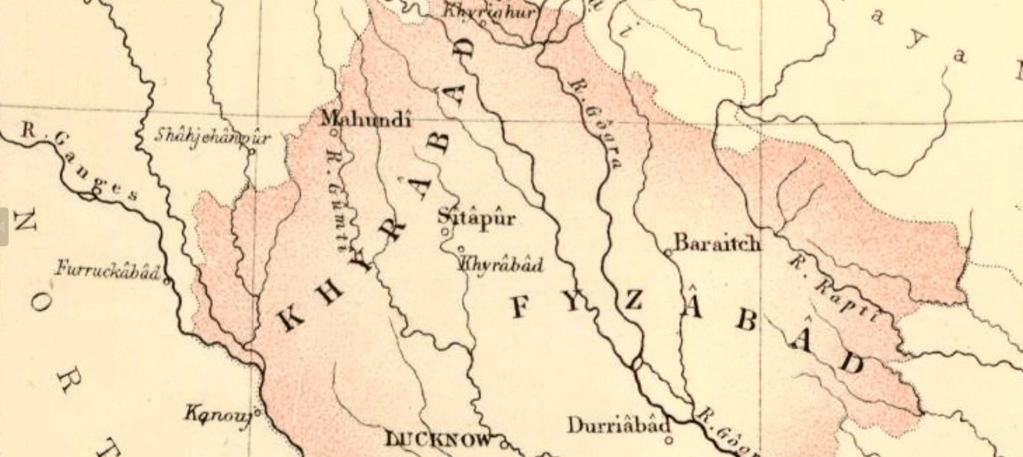
On the morning of 23 May, Brigadier Coke and his force joined Sir Colin Campbell. The rebels had long since decamped, and Sir Colin was faced with a baffling problem. To follow them up and raze Mohamdi to the ground was certainly what he intended to do, but on consideration, the rains had caused the Ganges to rise rapidly. If he stayed any longer on this side of the river, his return to Fatehgarh would be cut off. While the Moulvie was certainly a worry, Sir Colin had other issues to contend with, which included not only operations in Bihar but the continuing campaign in Central India. He could not continue coordinating operations from Shajahanpore for the entire wet season, and he was determined to return to Fatehgarh before the river became impassable. While Sir Colin Campbell would indeed return to Fatehgarh, Brigadier Jones was to advance on Mohamdi.
At 10 pm on 23 May, Sir Colin Campbell struck camp and, with only a small escort, with all the sick and wounded in tow, determined, by forced marches, to return to Fatehgarh. All troops who could be spared were to remain at Shajahanpore for on 24 May, Brigadier-General Jones was to march in the morning to Mohamdi.
For William Russell, it would be another two days of abject misery. To save time, elephants were now used to carry the charpoys of the sick. To his horror, Russell found the charpoy, which was slung across the elephant’s back and fastened with ropes, swung precariously, forcing Russell to sit up and hold on to the bed to prevent himself from succumbing to motion sickness. Leaving his charpoy to another man who “slept easily” Russell tried his luck in houdah on the back of another elephant. Instead of fighting sickness, he was now left holding on for dear life, as he expected, at any minute, to be pitched to the ground. At 2 in the morning, a halt was called that lasted until dawn. Russell, having had enough of elephants, hailed his sorely tried dooly bearers – the poor men, who had been walking along with the camp followers, would now carry him for the rest of the journey. At 10 in the morning, they reached Jallalabad Fort, after nearly 12 hours on the road.
Jones Marches
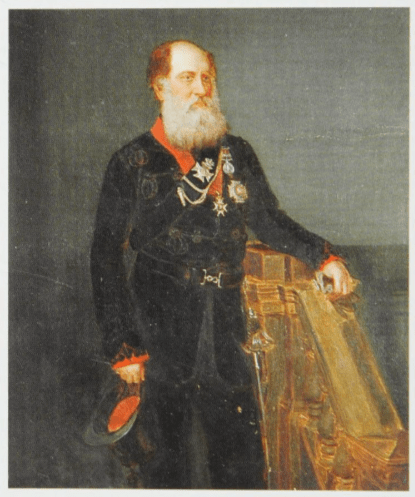
We will now leave Russell and his miserable march and turn our attention to Brigadier-General Jones and that formidable man, Brigadier Coke. True to their word and following Sir Colin Campbell’s instructions, they left Shajahanpore on the morning of the 24th. Leaving enough men to defend Shajahanpore, the force marched at 3 am. Shortly after dawn, on approaching the village of Bunai, the rebels, who happened to be occupying it, opened fire. Coke ordered the heavy guns to reply, discomfiting the rebel cavalry from charging while he advanced his cavalry and the field artillery – the rebels thought better of engaging and fell back. However, there would be a fight.
After allowing for the light guns to come up, the cavalry under Brigadier Hagart and Tombs’ troop of Horse Artillery formed up on the left while the main column continued its advance. The rebels, being particularly strong in cavalry, now tried to outflank Hagart at every turn – as soon as he halted to allow for Tombs to fire, they vanished from sight. Thus alternately halting and advancing, Hagart was unable to gain much ground, but this state of events could not continue. As they passed by a large grove of trees, Cureton, who formed the extreme left, suddenly received intelligence from his flankers that a body of rebel cavalry had suddenly taken the initiative and were charging the left flank of the Multanis.
Hurriedly wheeling up the left squadron, which, though taken by surprise, behaved with admirable steadiness, he had hardly completed the movement, when the enemy were upon them. The rebel chief, with about twenty followers -Ghazees -made such a furious onset that in an instant they had pierced the line. The regiment did not waver for an instant, and almost immediate death was the reward of their temerity. Not a man of the twenty -one escaped, but ere they fell, they had succeeded in killing and wounding several of the Mooltanees. The chief, who was commandant of the whole rebel cavalry, quitted this life tragically. A young Mooltanee made a stroke at him with his spear and missed. Determined that his prey should not escape, he dropped the faithless weapon and, clasping him round the waist, the two fell to the ground in mortal struggle. When the fight was over, both were found dead: the trooper with a pistol bullet through the body, and the rebel chief with a dagger in his chest. Meanwhile, the steadiness and imposing presence of the Mooltanees had prevented the remainder of the rebels from making any vigorous attack. These, amounting to between two and three hundred, had followed their leader with sufficient gallantry till their horses almost touched those of their adversaries. They then pulled short up and, allowing their leader and his brave followers to rush alone on the road to death and paradise, commenced firing their carbines and dashing their lances at the foe. No sign of confusion or fear gave them any encouragement to charge home, and in a few moments -the Ghazees having been disposed of-Cureton shouted ” Charge !” That word was the signal for the rebels to fly at the utmost speed of their horses. As they passed the mango grove, they were joined by another body of equal strength, which had remained concealed on the farther side. Scattering over the country, and better mounted than their pursuers, they managed to escape with the comparatively small loss in the whole affair of twenty – six killed, and about fifty wounded. The broken remnants of the rebel army were pursued for some distance, but without much effect, beyond their being prevented from rallying.
Having ensured that the small mud fort of Katchiana, which the force soon passed, was not only cleared of rebels but regularly levelled by the artillery, after a short halt for breakfast, the march continued towards Mohamdi. By the time they were just short of the town, the heat had already taken its toll; 110 men were struck down by the sun, and several died on the road. The 79th Highlanders buried two sergeants, one corporal and five privates, and Mohamdi had not even been reached. When they halted for the night, it would be found that nine men of the 82nd died in their tents before morning from apoplexy, several did not answer to roll call and were deemed missing, presumed dead, on the march and by midnight, the 82nd buried Sergeant Bridger and a further 8 men in a hastily dug grave. At 3 in the morning, “the march was resumed in pitchy darkness, a burning hot wind scorched and shrivelled the skin, blinding the eyes and torturing the body.”
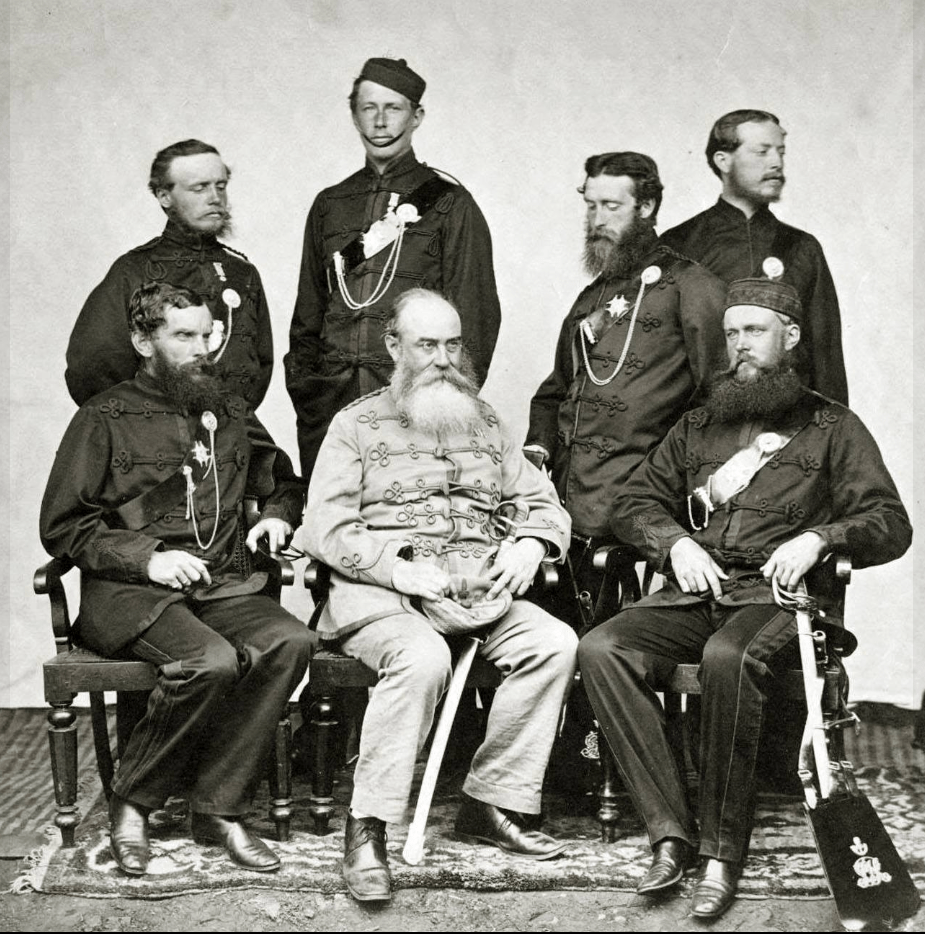
As For Sir Colin Campbell
We left Sir Colin Campbell at Jallalabad.
We hoped for a long rest, but at 3.30 p.m. general orders were brought round, and we were warned to get ready for the march in two hours more. The Headquarters’ bazaar had not arrived when we left our ground, so they will have a pleasant tramp of it. Horses and camels, elephants and men, are dead beat; but Sir Colin will it, and we must go. At 6.30 our little force left Jellalabad again. Strict orders were given to keep all doolys in the rear of the main body. We are smothered by the dust. One of us who made some remark to General Mansfield as to the straggling of the Belooches, and the danger to baggage and sick in case of an attack, is informed that “ it often happens on occasions of this sort that baggage and sick must be abandoned to the enemy!” And such an enemy!
William Russell’s doolie bearers were hardly able to keep pace with the Beluchis, who were marching as quickly as the cavalry. All around him, men panted in the terrible heat; the horse guns could scarcely pull their loads, and the Ganges was still many miles away. At one in the morning, everything ground to a halt. A doolie bearer told Russell that “some badmashes” were blocking the way, but an officer, riding past, called out, “This is our friend the Moulvie, and it is a nice state he finds us in! The infantry “have not a leg left, the cavalry can barely keep their horses off their knees, and the horse-guns are reduced to the state of guns position.” Russell loaded his revolver and waited. All the camp followers had stopped moving, and unusually, had fallen silent.
But it becomes a very lively time when I see the artillery slowly falling back, the horses staggering in the traces, and the Irregular Cavalry following their example. It is still more exciting when I observe that my dooly-bearers take me up and trudge towards the front as if to offer me as a sacrifice to the enemy! The enigma is soon solved. After some little suspense we discover that the body which we observed in our front is the convoy of “Europe provisions, under charge of some companies of H.M.’s 80th. The discovery must have been a considerable relief to. Sir Cohn. He decided, after some deliberation, to send on the convoy to Shahjehanpoor under the protection of our two guns, the Belooches and Irregular Cavalry, and to take back
the party of the 80th as an escort.
The soldiers of the 80th, who had already had a long march behind them, were soon as miserable as the rest of Campbell’s force, as they trudged on, mile upon mile over a sandy plain. Then, to make matters worse, the air, which had been still and stifling, suddenly whipped up into a fearful storm, – not one of rain or thunder, but of dust. The column halted at once as the dust, sharp, hot and blinding, “like the ashes of a furnace.” The doolie bearers quickly set their loads down on the ground and shrank down, windward side, while officers dismounted and their horses cowered to the ground, everyone tried, as best they could, to cover their faces from this, “burning breath of the Simoom,” and turn their backs to the wind. Within a quarter of an hour, the wind died down enough to allow for the column to reform and begin its march again, but an old soldier of the 80th, whom Russell had tried to cheer during the storm, now lay dead in his doolie, and several men were missing.
Just as dawn broke, they reached the Ganges. Sir Colin Campbell allowed for a brief halt; men and animals dashed to the water, some to bathe their legs, others their heads, as the animals drank their fill and the bhistees filled their mussacks.
Present, sitting over his horse’s shoulder, with an air of fatigue, as well he might, came Sir Colin himself, with a few of his Staff. His clothes and face were covered with dust, his eyes were half filled with sand, and, indeed, I scarcely recognised him for a moment when he drew up to speak to me.
“Futtehguhr is only four miles away,”‘ said he, “we’ll be there in an hour and a quarter.”
And after a minute or so more spent in talking of the night we had passed, he rode his horse, which had not lost its time in the water, across the stream, and went on. If any of the Senior United Service, or of “ the Rag ” Seniors, could have seen the dirty, jaded men who followed the General, they would have required much faith to believe they were Staff officers.
 Mutiny Reflections