Shahabad
Jones and Coke returned to Shajahanpore. The Moulvie had made his escape once again, and there was little point in keeping the force in Mohamdi. So they retraced their steps with their wounded and sick, and considered what to do next.
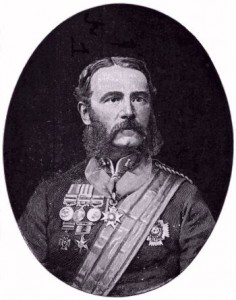
On the evening of 31 May, an expeditionary force under Lieutenant-Colonel W.M. Taylor was ordered to march to Shahabad with:
Colonel Tombs’ Troop, Horse Artillery
1 Squadron of Carabineers
Cureton’s Multani Horse
1 wing HM’s 60th Rifles
1 Wing HM’s 82nd Regiment
22nd Regiment Punjaub Native Infantry
a detail of Sappers and Miners
one 18-pounder gun, one 8-pounder howitzer, one 8-pounder mortar, and two cohorn mortars.
The question, of course, is why Shahabad? The town itself had once been a prosperous city; at one point, it was even counted as one of the largest cities in Oudh, a bustling hub of trade and commerce, but it was short-lived. Founded in 1677 by a Pathan officer in the service of the Mughals, by the late 1700s, with the decline of the Mughal power and the rise of the Nawabs of Oudh, by 1799, Shahabad was a mere shadow of its former self, described by travellers as being a considerable town but mostly in ruins.
The interest in Shahabad was limited, even during the mutiny. The Hardoi District, however, where the town was located, was certainly of more interest and a district of mixed loyalties. In 1858, the landlords were having second thoughts about the rebellion – it had proved costly, and above all, ruinous for their peasantry as mobs of rebels continued their plundering ways; with the exception of Narpat Singh, who would hold out until the very end, many landlords were turning away from the cause. One in particular, Hardeo Baksh of Katiari, had never wavered from his stance and had risked life and limb in protecting British fugitives in 1857, notably George Probyn and his family, whom he hid for three months. Baksh would then continue holding out against not only Nirpat Singh and Firoz Shah but also the other rebel leaders who chose to pass through his territories.
Following the abandonment of Mohamdi, the rebels made a beeline for Shahabad. The town, with its large buildings, though dilapidated, was still defensible, and there were still enough supplies available to feed them. So, while Shahabad would not feature again in the annals of the Indian mutiny, and hardly through history, for one brief moment, it was where the rebels made a stand. However, the Moulvie was no longer their leader – he had chosen a path quite different from what was indeed a scattered remnant of his army.
Taylor and his men marched on the evening of the 31st of May, arriving at their first halting point, eight miles down the road, just beyond Badshahnagar. After a brief rest, they moved on again at two in the morning, arriving at Shahabad shortly after dawn. Although still effective, the rebel cavalry had once again positioned themselves in a tope of trees just west of the town, some 200 strong and with two guns pointed directly at Taylor and his men. As the column advanced, the rebels opened fire, throwing several very precise shots, though discomfiting, that did little damage. Taylor quickly sent Tombs with half his troop to the right front. supported by the 6th Dragoons and a party of the Multanis. With daring abounding, Tombs advanced his guns to within 600 yards of the tope and opened fire. “Such was the precision of his fire that, after a very few rounds, one of the enemy’s guns was struck and dismounted, and, the cavalry beginning to show signs of confusion, Lieutenant-Colonel Tombs advanced rapidly, when all the horsemen took to flight, and 2 brass guns (were taken possession of by him.”
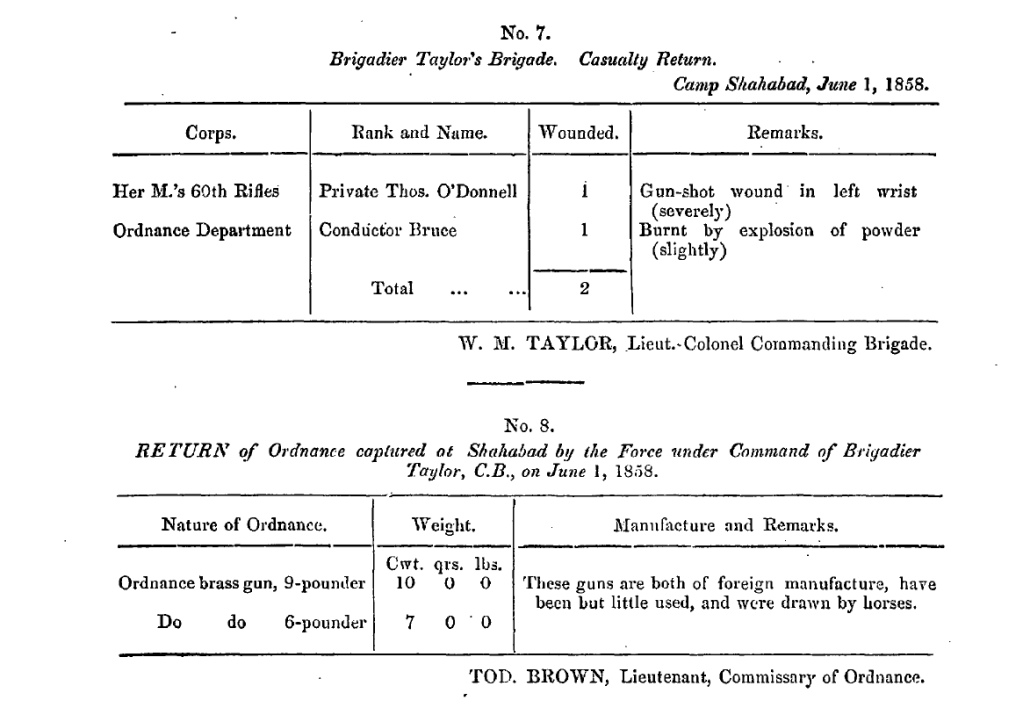
While Tombs’ guns played havoc, Taylor pushed forward three companies of the 60th Rifles and as many of the 82nd in skirmishing order, and entered Shahabad. He left his heavy guns outside the walls, with the 22nd Punjabis as their guard. He then ordered Tombs with a squadron of the Multanis and a troop of the Dragoons to work around the left of the town, while the remaining Multanis were to circle around to the right. If Taylor was expecting a grand battle, however, he was sorely mistaken. He passed straight through the town to the opposite side, clambered up a hill to find, from his vantage point, that there wasn’t a rebel in sight. Whoever they were or what their objective had been, he would never know, for once again, they had simply vanished. To his astonishment, Shahabad itself was completely deserted; every single inhabitant had left. He turned his force around, back through the town and sent a detachment of engineers, together with the 22nd Punjabis, to destroy the town. It was a harsh form of justice, however, one that Sir Colin Campbell deemed necessary; he was systematically razing every single bolt hole the rebels had left, and Shahabad would be no exception. By noon, twelve of the largest buildings were blown up, and the whole town was set on fire. Then, with the ruin of Shahabad behind him, Taylor returned to Shahjahanpore, where he arrived on 2 June. His casualties were slight – one man of the 60th wounded by musket shot and one conductor of the engineer park burned, albeit slightly, by exploding gunpowder. Of the rebels, their losses were limited to a few matchlock men and sowars killed by Cureton’s Multanis.
And what then of the Moulvie?
 Mutiny Reflections