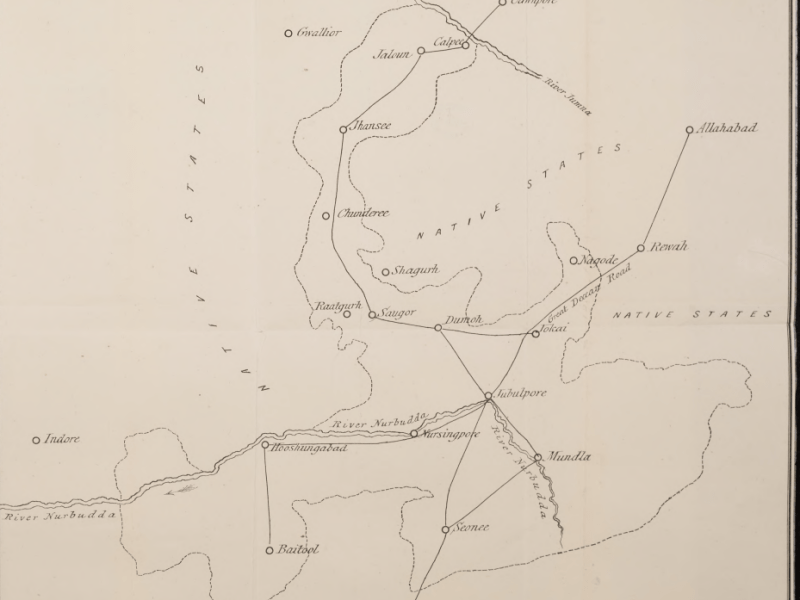
The plan for the campaign in Central India had been contrived in Calcutta by Sir Colin Campbell before he left for Oudh with Robert Hamilton, Political Agent to the Court of Indore. Hamilton had made the following plan: one column, with its base of operations at Mhow, was to sweep up the country between that place and Kalpi on the Jamuna, relieve Sagar and retake Jhansi; the other, coming from Madras, would make its base at Jabalpur, clear the line of communication with Allahabad and Mirzapore, then cross the Bundelkhand to Banda. A third force, under Major-General Roberts, would start operations in Rajputana. If all things went to plan, by May 1858, both Rose and Whitlock should have reached their objectives.
Sir Robert Hamilton then proceeded to Indore to free it from the wily machinations of Henry Marion Durand; he resumed his appointment as Governor-General’s Agent for Central India and all political functions regarding the chiefs in the Sagar and Narbada Territories. Almost simultaneously with the appointment of Sir Hugh Rose to command the Central India Field Force, Brigadier General Whitlock of the Madras Army was appointed to command a division for service in the Nagpur, Sagar and Narbada Territories. His force would act in parallel with Sir Hugh Rose in Central India. Whitlock took up his command in November 1857; in January 1858, Roberts would take command of the Rajputana Field Force.
When the Central India Campaign began in January 1858, little did the men know that it would turn into one of history’s most gruelling. Over the next five months, the Central India Field Force would march 1’085 miles (1’764 km), battling not just the heat, but rain and traversing rugged terrain from the confines of Western India to the waters of the Jamuna River. They would fight 16 actions, capture 20 forts and take not only Jhansi but the mighty fortress of Gwalior. They would not lose a single battle.
One of the finest military campaigns in mutiny history was fought by a man who had no experience in India and had never commanded Indian troops or their officers. His force was a colourful mixture of men from Bombay, Madras and Hyderabad; he had irregular infantry in the form of Bhils and a smattering of irregular cavalry. Their numbers were few, but under his leadership, the Central India Force would become one of the most cohesive military units ever seen.
On the rebel front, the Rani of Jhansi and Tantya Tope would be just two among the many recalcitrant rajas, stubborn zamindars, hardy sepoys, local levies and the very population of Central India itself, who were all up in arms and ready for a fight. Unlike in Oudh, there was no support for the British in Central India, and Sir Hugh Rose was very much on his own.
The campaign shall be followed in three stages, beginning with the march from Mhow to:
Rahatgarh to Madanpur Pass
After traversing the pass, the campaign continues to:
Betwa and Jhansi
With the taking of Jhansi, proceeds to:
Lohari to Kalpi
The campaign was over with victory at Kalpi. Sir Hugh Rose met his objectives, but no one reckoned the Scindia would embarrass himself. So it was back into the saddle to bring the campaign to its final close at Gwalior.
The Gwalior Campaign
 Mutiny Reflections