For the battle on 6 April 1858, two men of HM’s 13th were granted the Victoria Cross: Sergeant William Napier and Private Patrick Carlin. Their deeds exemplified the gallantry of British soldiers under fire; for HM’s 13th, they would also be the only VCs won by the regiment during the Indian Mutiny.
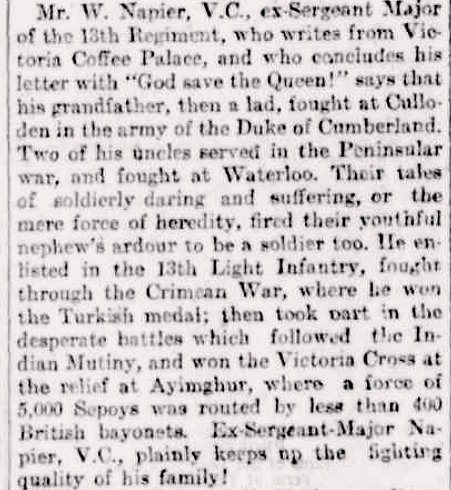
Sat 24 Jul 1897
Deeds That Won the Empire, “Of the Blood of Heroes,” by Vedette
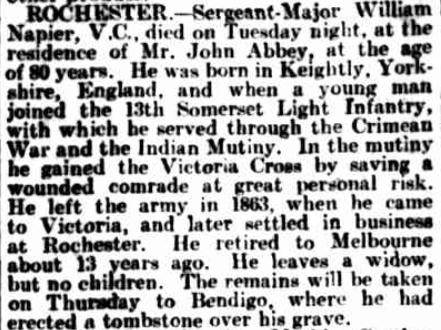
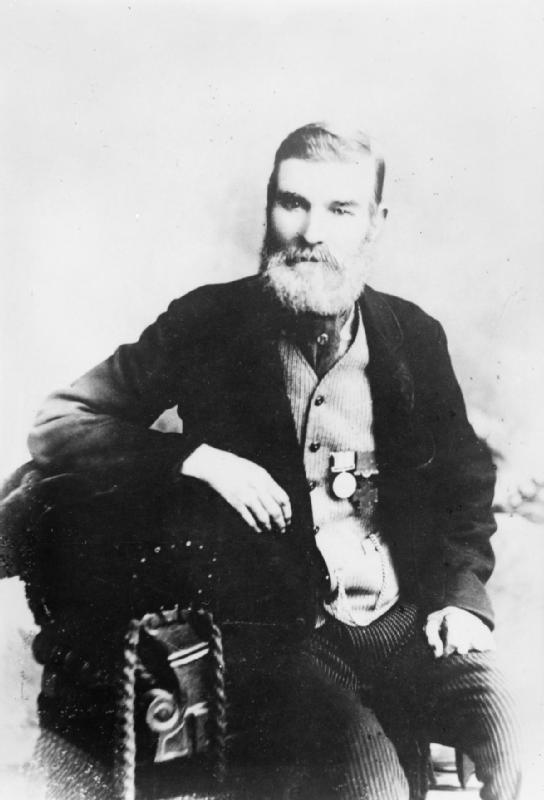
Sergeant William Napier
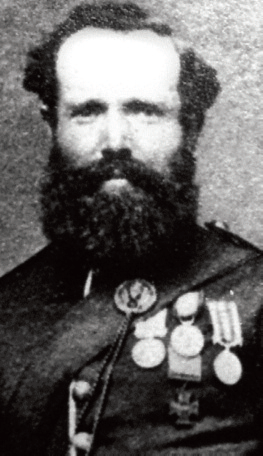
Born on 20 August 1828 at Keighley, in Yorkshire, the son of Samuel and Mary Slater, his boyhood was spent certainly in the shadows of a military family. His uncle William had fought at the Battle of Waterloo with the 2nd Battalion, Grenadier Guard, and as soon as he was old enough to leave school, the young man followed his uncle’s footsteps into the army, perhaps emboldened by the Waterloo Medal his uncle had gifted him. Although christened Samuel after his father, he changed his name to William Napier and on 10 December 1846, enlisted at Leeds in the 13th Light Infantry. He would soon leave England and join his regiment in Gibraltar. In 1850, Napier was promoted to corporal and on 1 March 1854, to sergeant.
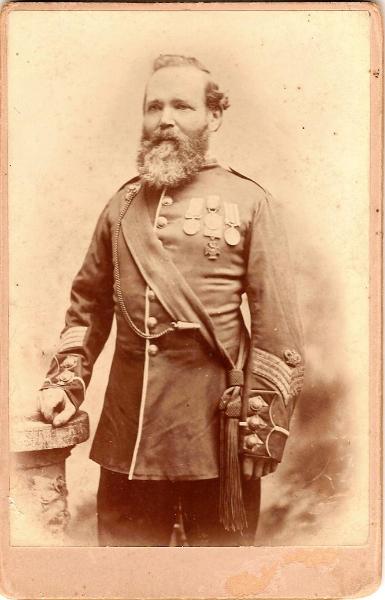
His first experience with war would be in the Crimea when, in 1855, he left England with the 1st Battalion under Lord Mark Kerr and arrived at Balaklava, by sea, on 29 June the same year. He would fight not only at the Battle of Chernaya, but in the trenches at Sevastopol, at the capture of the Redan and the fall of Sevastopol, leaving a rather hair-raising account of his experiences at Sevastopol in 1897:
“The mortality was fearful, but that the losses in battle were not more than one half of those caused by fever, and the hardships of camp life in that rigorous climate. Not long before the outbreak of the war, I saw a regiment of the Grenadier Guards paraded at Gibraltar, 900 strong. Afterwards, I saw them paraded in the Crimea, when only 82 of all ranks answered the roll call. Of the 800 odd who were absent, not more than 300 had fallen in battle.”
At the start of the mutiny in India, the 13th Regiment was in South Africa; however, Lord Mark argued hotly to have his regiment sent over. His words of persuasion certainly had the desired effect, for by October 1857, they were disembarking at Calcutta. We have already followed the rather unfortunate series of events that had the right wing relegated to Allahabad, so we shall now turn our attention to William’s VC.
With the battle before Azamgarh in full swing and casualties mounting, a young private named Benjamin Milnes found himself on the ground, desperately wounded. Surrounded by sepoys and his chances of survival decreasing by the minute, the timely appearance of Sergeant Napier ensured that Milnes would live out his life and not die on a grim battlefield. Napier quickly set about bandaging Milnes’ wounds, but as he was thus engaged, a shot struck the intrepid sergeant, leaving a gaping wound over his left eye. Instead of joining Milnes in his plight, Napier stood his ground and fought back. Then, with blood pouring down his face, he picked up Milnes and carried him to the rear. When Lord Mark heard of Napier’s gallantry, he offered him a commission, which Napier declined. So Kerr mentioned him specially in despatches and put him up personally for the VC.
For conspicuous gallantry near Azimghur, on the 6th of April, 1858, in having defended, and finally rescued, Private Benjamin Milnes, of the same Regiment, when severely wounded on the Baggage Guard. Serjeant Napier remained with him at the hazard of his life when surrounded by Sepoys, bandaged his wound under fire, and then carried him in safety to
the convoy.
Despatch from Colonel Lord Mark Kerr, C.B., dated 2nd August, 1858. (“No. 22212”. The London Gazette. 24 December 1858. p. 5517)
The mutiny continued for Napier and the 13th, and they would see action at a further nine battles; it would seem that by 1862, he had seen enough to last him a lifetime. Sergeant-Major Napier requested and received his discharge at Calcutta on 8 Dec 1862 and set sail, barely two weeks later, for Australia, where he arrived in 13 January 1863.
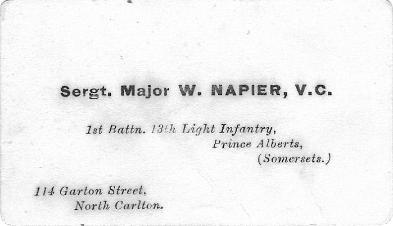
His fortunes, in a new land, were somewhat mixed, and he would first find work as a clerk and a miner in the Bendigo gold fields. He married Elizabeth Slater in September 1863, but their marriage was a short one; their two children died in infancy, and Elizabeth herself died on 25 April 1867, leaving behind a distraught William. In 1869, he married Ruth Ann Hirst (née Booth), the widow of Joseph Graham Hirst, and William himself settled down to a less wild life, founding a business manufacturing cordials and aerated waters in Rochester, Victoria. The business thrived, and his drinks were popular; in 1881, he joined the local Freemasons. Napier died on 2 June 1908 at the home of his friend, John Abbey and was buried at Bendigo Cemetery in Bendigo, Victoria. The wound he received at Azamgarh never quite healed, and it is believed its effects contributed to his death. His descendants continue to thrive in Western Australia. His Victoria Cross resides at the Somerset Light Infantry Museum, Taunton Castle, England.
Private Patrick Carlin
While we can fairly well trace the life and times of Sergeant Napier, very little can be written about Private Patrick Carlin, a young man born in 1832 in Shankhill Parish, Belfast, who listed his occupation as labourer when he joined Queen’s Royal (Antrim Rifles) Regiment of Militia on 5th December 1854. However, on 8 May 1855, we find Patrick had obtained his release from the militia to enlist with the 13th Regiment of Foot at Belfast. He served briefly in Malta, Gibraltar, Crimea and the Cape Colony before his regiment was sent to India.
His act of gallantry before Azamgarh was certainly no less admirable than that of Napier and equally astonishing – in the heat of battle, seeing a Naik of the Madras Rifles lying desperately wounded, Carlin rushed to his aid. In a moment of desperate courage to save the man’s life, Carlin slung the wounded man over his shoulders – at that moment, a rebel fired at Carlin. The shot went wide, but it was the last one the man would ever fire. Armed with the Naik’s sword and the wounded man still on his shoulders, Carlin cut down his assailant and carried the Naik to safety. The incident was mentioned in a General Order, issued on 29 June 1858, as issued by Sir Colin Campbell:
Head- Quarters, Allahabad, June 29, 1858.
The Commander-in-Chief in India directs that the undermentioned Soldier, of the 13th Foot, be presented, in the name of Her Most Gracious Majesty, with a Medal of the Victoria Cross, for valour and daring in the field, viz.: Private Patrick Carlin, No. 3611, of the 13th Foot, for rescuing, on the 6th of April, 1858, a wounded Naick of the 4th Madras Rifles, in the field of battle, after killing, with the Naick’s sword, a mutineer sepoy, who fired at him whilst bearing off his wounded comrade on his shoulders. (Signed) C. CAMPBELL, General, Commander-in-Chief, East Indies (“No, 22194,” The London Gazette. 26 October 1858, p. 4574)
He was presented his VC in India, by Sir Colin Campbell himself, at Gorakhpur, in February 1859.
The fate of Private Patrick Carlin, however, was not one of promotions or fortunes in a foreign land. In September 1871, following a severe fracture of the right femur, he was discharged as unfit for duty, after 16 years of service at Netley Military Hospital, and found his way back to Belfast. Carlin married Catherine Hagans in 1872, and here Patrick Carlin slips into obscurity. He reappeared on 11 May 1895, when he died in Belfast Union Infirmary; the Board of Guardians Minute Book recorded his death as being caused by exhaustion. It was reported that Carlin had suffered a series of seizures over a 24-hour period, of which there is nothing more known.
It is unclear where exactly Private Carlin, VC, was buried – some sources believe it was at Friar’s Bush Graveyard, but others contend he was laid to rest in the cemetery that was once adjacent to the present Belfast City Hospital. The cemetery no longer exists. To date, there are no memorials for Patrick Carlin, but his VC, like that of William Napier, resides in the regimental museum.
Sources:
https://trove.nla.gov.au/
https://www.keighleynews.co.uk/news/16377340.new-tribute-heroism-victoria-cross-winner-keighley/
https://historyhubulster.co.uk/tag/patrick-carlin/
https://www.memorialstovalour.co.uk/vc259.html
https://vcgca.org/
https://www.newsletter.co.uk/news/opinion/columnists/remembering-local-vc-heroes-from-the-indian-mutiny-of-1857-3011548
Everett, Henry. The History of the Somerset Light Infantry (Prince Albert’s) 1685–1914. London: Methuen & Co., 1934.
 Mutiny Reflections