…and the 29th of March 1857 — Mangal Pandey
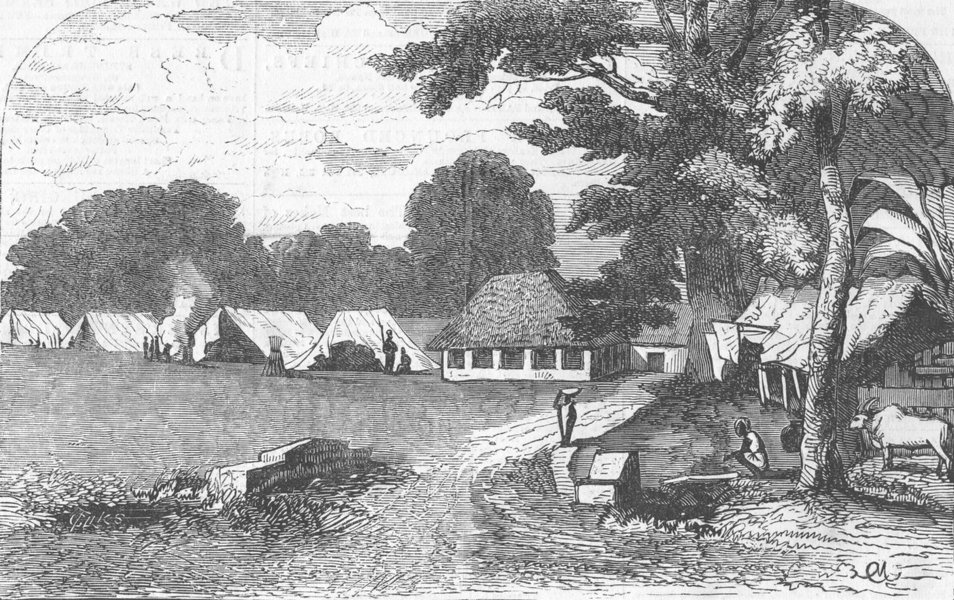
On the 29th of March, two days before the disbandment of the 19th BNI was due to take place, a young sepoy named Mangal Pandey of the 34th BNI set out on a rampage of his own. Coming out of his hut, he called out, “Come out, men, come out and join me – You sent me out here, why don’t you follow me?” Armed with his sword and musket, he traversed the lines, repeatedly calling to his comrades to join him and threatening to shoot any European whom he came across. He then proceeded to try to incite his comrades with taunts, “Come out, you…The Europeans are here. From biting these cartridges, we shall become infidels. Get ready, turn out all of you.”
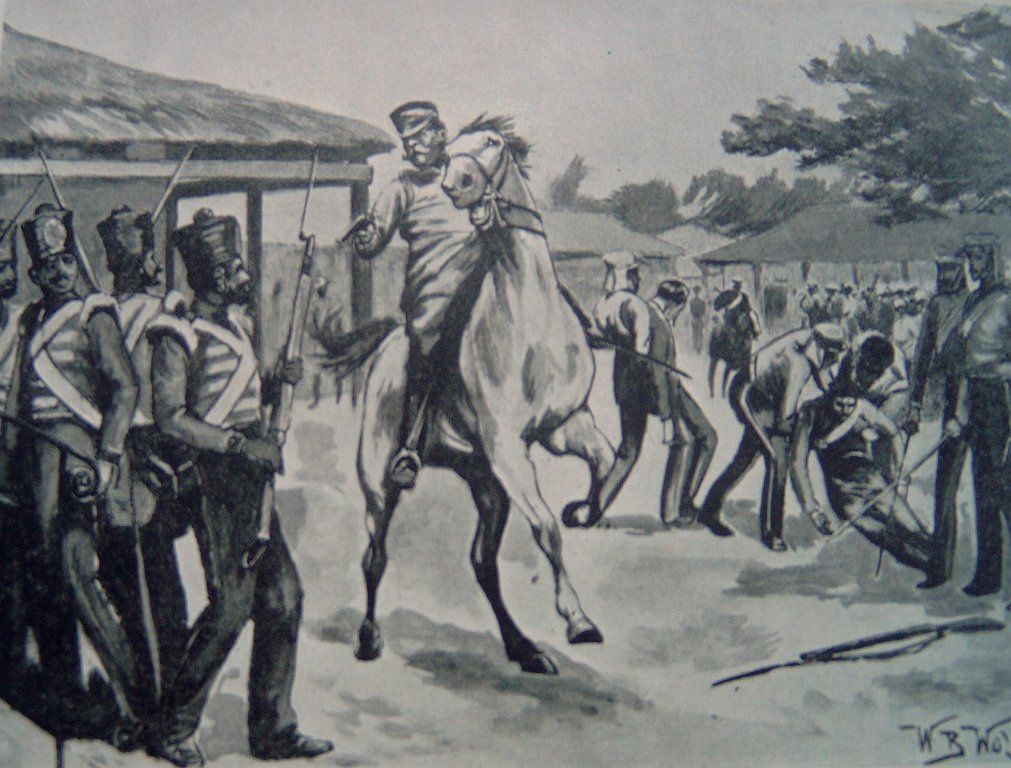
The first to hear of this was Lieutenant Baugh. Mounting his horse and with a pair of pistols in his holsters, he rode down to the parade ground. Mangal Pandey, hearing Baugh approaching, took aim and fired. The ball missed Baugh but wounded his horse, which sent Baugh to the ground. Unhurt, the officer disentangled himself from his horse and, taking one of his pistols from the holster, approached Pandey. Pandey, unable to load his musket a second time, discarded the weapon and advanced upon Baugh, his sword drawn. Baugh fired and missed. Before he could draw his own sword, Pandey was on him and struck him down. Orderly Shaik Phultoo, who had followed Baugh, described the scene,
“Mungul Pandy drew his sword and wounded him severely. By this time, the Sergeant Major (Hewson) came up; he also was wounded severely. I then came up and stretched out my hands to stop Mungul Pandy, who was following the Adjutant and said to him, take care, do not strike the Adjutant. He aimed a blow at the Adjutant’s neck which I received on my right hand; I then seized him round the waist with my left arm; the Adjutant and Sergeant-Major got away. I then called to the quarter-guard to come and make Mungal Pandy a prisoner, and told the Jemadar Isssurie Pandy of the 1st Company who commanded the guard to send four men and take him; that I had hold of him and would not allow him to hurt anyone; they did not come, but abused me as also did the Jemadar, who said that if I did not let Mungul Pandy go they would shoot me. Being wounded, I was obliged to let him go. While I was holding Mungul Pandy several men of the quarter-guard followed the Adjutant and the Sergeant-Major beating them with the butt-end of their muskets…”
Major-General Hearsey received news from Major Matthews of the 43rd that something was up in the lines. The other officers, Lieutenant-Colonel Wheler and Adjutant Drury, were on parade and were moving their men to the quarter guard of the 34th to stop Mangal Pandey. Hearsey sent Matthew off with orders for Wheler to shoot Pandy if he could not arrest him. With his sons, John and Andrew, Hearsey mounted his horse, and the three of them made their way to the lines.
The scene was chaotic.
“I saw the whole front of the bell of arms crowded with sepoys in their undress and unarmed, the native officers of the 43rd NI with them, and endeavouring to keep them in order. The men of the 34th NI had also turned out unarmed to the right and rear of their quarter-guard.”
Asking Major Ross what was the matter, Ross and the other officers assembled replied that a sepoy of the 34th had cut down Lieutenant Baugh and the sergeant-major and was now pacing up and down in front of the quarter guard, calling on men of the brigade to join him and die for their religion and caste. Pandey was also shouting that, “You have excited me to do this, and now you ban chutes, you will not join me!” Without hesitation, Hearsey, “On seeing this man, I immediately rode to the quarter guard of the 34th NI and saw the Jemadar Ishree Pandy and about ten or twelve men who had turned out and were standing before the quarter guardhouse. My two sons and Major Ross accompanied me, I heard an officer shout out to me his (the mutineer’s) musket is loaded; I replied, damn his musket.”
The Jemadar did not attack Hearsey but he didn’t jump to his orders either by delaying and ignoring anything Hearsey said. He told Hearsey that Pandey’s musket was loaded and he would undoubtedly shoot anyone who approached him. Hearsey, losing his patience, shook his revolver at the Jemadar and repeated his order to seize Pandey. The Jemadar, without any obvious interest in obeying, said the men of the guard were putting caps on the nipples. By now Hearsey had had enough. This time, in “a loud and peremptory voice,” Hearsey commanded the Jemadar to “be quick and follow me” as he rode out in front towards Mangal Pandey. “The guard followed my Aide-de-camp on horseback, close to the Jemadar, armed with his revolver, my other son also close to the native officer similarily armed, Major Ross in rear of myself; as we approached the mutineer, we quickened our pace. My son, Captain Hearsey, called to me, ‘ Father, he is taking aim at you, look out sharp!’ I replied,’ If I fall, John, rush upon him and put him to death.’ Immediately after the mutineer, Mangal Pandey, fired his musket, the whistle of the bullet was heard by the guard, for all but three men of it bent down, apparently to avoid being struck.”
Not that it mattered; Mangal Pandy was cornered, the other British officers were closing in, and although he aimed at Hearsey, he turned the gun on himself. The wound, though severe, was superficial, as he had touched the trigger with his toe, causing the muzzle to swerve. The shot tore the muscles of his chest, shoulder, and neck, and being at such close range, it caused his jacket to catch fire. Hearsey ordered the Jemadar to put it out, which he did. Pandey was then taken to the hospital of the 34th BNI. For Havildar Sheikh Phultoo, the only man to come to the rescue of the wounded officers that day, he received the Order of Merit, third class.
Not that Major-General Hearsey was quite finished:
“Before I quitted to go to my quarters, I rode amongst the sepoys of the 43rd NI and reassured them that no person should be permitted to interfere with their religious and caste prejudices whilst I commanded them. I then went, accompanied by Major Ross and my two sons amongst the crowd of sepoys of the 34th regiment NI and also reassured them, telling them they had not done their duty in allowing their fellow soldier Mungul Pandy, to behave in the murderous manner he had done. They answered in one voice, he is mad; he has taken bhang (an intoxicating drug) to excess. I replied could you not have secured him, or shot him or unarmed him? Would you not have done so to a mad dog or to a mad elephant and what difference was there in the dangerous madness of man, and the same in an elephant or a dog? They said he had a loaded musket. What! I replied, are you afraid of a loaded musket? They were silent. I bid them go quietly to their quarters and they did so, immediately obeying my orders.”
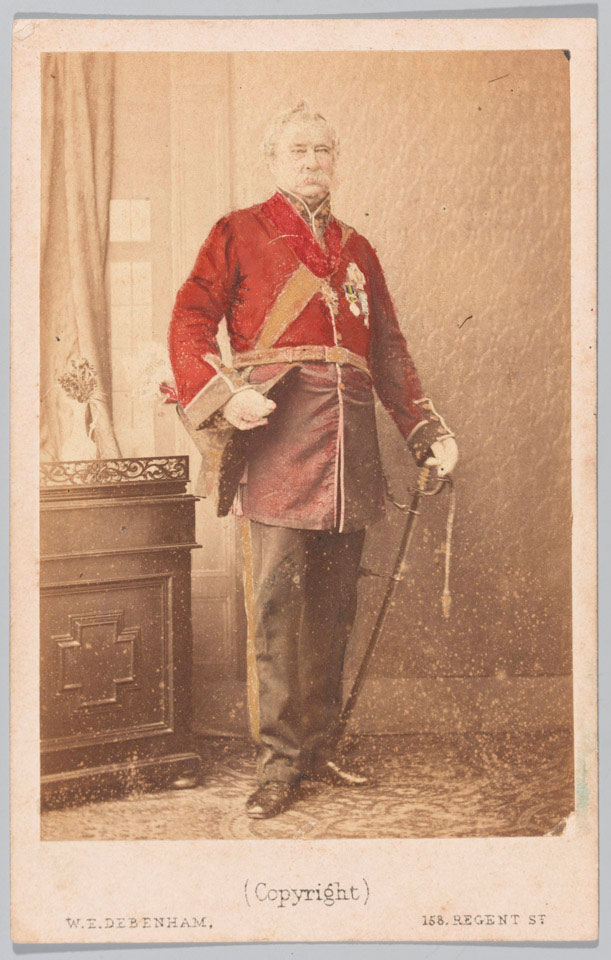
That the mutiny had come from a sepoy of the 34th Regiment was not particularly surprising – as it is the 34th had been an unsatisfactory regiment from the start and their history was, to use a term of the day, regrettable.
The 34th Regiment, Bengal Native Infantry (Bradshaw Ka Paltan)
- 1798 raised as 1st Btn 17th Regiment of Bengal Native Infantry following 1796 reorganisation when previous 17th became 2nd Btn 12th Regt. Raised by Major Samuel Bradshaw
- 1824 1st Battalion became 34th Regiment of Bengal Native Infantry under Major E F Waters
- 1844 -Disbanded for refusing to march to Sind due to the disallowance of batta. Their number was subsequently erased from the lists.
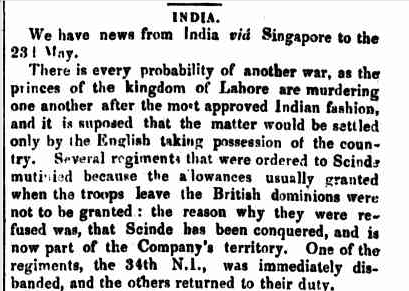
- 1846 Raised again as the 34th Regiment of Bengal Native Infantry
Following their behaviour in 1844 and subsequent disbandment, the 34th was raised again in 1846 to fill the gap, but as history showed, the results with the second raising were hardly any better. By 1857, they were positively sullen and insolent — a small escort of them, sent to Berhampore from Barrackpore in February 1857 had been so worked up already with stories of tainted cartridges and rumours of forcible conversions to Christianity, their talk inflamed the feelings of the 19th BNI; while it was obvious that the 34th were indeed up for mutiny, they were also unprepared for the actions of Mangal Panday on the 29th of March as not a single man stood with him.
So it remains unclear as to why Pandey did it in the first place. If Pandey was expecting support from anyone, he was sorely mistaken. It appears no one was ready as yet for the mutiny to begin, even if they had been planning to mutiny at all. No one stopped him from attacking the officers, and only a few stepped forward to hit Hewson and then quickly retreated. When asked to explain his conduct, Pandey admitted to having taken an inordinate amount of bhang (an infusion of hemp) and opium; he himself was not really aware of what he was doing. He would further state that he bore no ill will against the men he had injured, but he also stopped short of implicating anyone else. Mangal Pandey was court-martialled and sentenced to death. He was hanged on the 8th of April.
As for Jemadar Ishwari Prasad (to give him his correct name, however, in the trial transcripts, he is Issuree Pandy), his court-martial was somewhat different. Where it could only be ascertained that Mangal Pandey had acted out of provocation, probably by other men in his regiment, and that the drugs had indeed gone to his head, Ishwari Prasad knew exactly what he was doing. He had refused direct orders from his superiors, he had not used any means at all to stop Mangal Pandey, he had done nothing to help Baugh and Hewson and had actively discouraged his men from assisting the wounded officers. His punishment was death by hanging. On 21 April 1857, the sentence was carried out.
Although it is now common in history books to call Mangal Pandey a freedom fighter, it does not appear he was part of any greater conspiracy; there is no evidence he was a ringleader or had any ambitions to be one. He had been incited and excited into a rage by others; the rumours were obviously weighing heavily on his mind, and he dared to set off on a one-man rampage. An army he was not, and it would appear that caste was more on his mind than the freedom of the nation. He was not hanged because he was fighting for freedom; he was punished for disobeying the rules of the army he had chosen to serve in and for attacking his officers. Mangal Pandey did not start the mutiny of 1857, nor were his actions or those of the Jemadar Ishwari Prasad anything more than a symptom of a bigger problem at hand.
The Disbanding of the 34th Regiment, Bengal Native Infantry
Following the disbandment of the 19th Regiment BNI on the 31st of March, which passed by with hardly a note being made of their conduct in Berhampore, it was decided that, for their conduct or lack of it, seven companies of the 34th BNI were to be disbanded on the 6th of May. Exempted from the disbandment were all men who were not in Barrackpore, being on duty elsewhere; three companies of the 34th happened to be at Chittagong at the time and these approached their officers and petitioned the government, expressing their remorse and sorrow at the conduct of the Regiment, and disavowed any participation in the events of the 29th.
The disbandment itself was swift and was done in the presence of all available troops of the Presidency division to serve as a warning. At sunrise, the men of the 34th were marched from the parade grounds to the front of the line of European Infantry and guns. Here they were instructed as to the orders of the Governor-General by Major-General Hearsey, and it was explained why they were being dismissed from the Company’s service. The regiment was then broken into open columns and ordered to pile arms. They were then ordered to march to the rear to collect their salary from the pay sergeants. Meanwhile, Hearsey spoke to the remainder of the 34th that had been exempted from disbandment — it was a warning; they had witnessed what happened to men who disobeyed.
With the distribution of pay over, the men were once again ordered to fall in. Without their weapons or their red coats, the 34th presented themselves for the last time in their blue pantaloons and forage caps, before being marched off to the Fulta Ghat under two European officers of the 34th and an escort comprising the 84th and the Governor-General’s Body Guard. They were last seen crossing the river at Fulta Ghat Ferry but many would take up arms again in the army of the Nana Sahib and be found among the dead at Bithur in August 1857. For now the three companies at Chittagong in East Bengal were going about their duties mindfully and with all diligence. However, their time for mutiny would come.
Sources:
Gimlette, G. H. D. A Postscript to the Records of the Indian Mutiny. London: H. F. & G. Witherby, 1927.
Great Britain Parliament. Appendix to Papers Relative to the Mutinies in the East Indies (Inclosures 1-6 and Inclosures 7 to 19). London: Harrison and Sons, 1857.
Kaye, John William. A History of the Sepoy War in India, 1857-1858. Vol. I. London: Longmans, Green & Co., 1896.
Pearse, Hugh. The Hearseys: Five Generations of an Anglo-Indian Family. London: William Blackwood & Sons, 1905
 Mutiny Reflections