Miyanganj
Grant’s march now continued. On 23 February, he was before Miyanganj, an old town surrounded by a rectangular loopholed wall with bastions in the corners. The town was oblong in shape, with the old Cawnpore-Lucknow road running through its entire length. Some thought had gone into protecting the gates, for these were strongly fortified with a bank, a ditch and palisades before them.
Although it was not the Nana or indeed any of his force, the town was being held by men who appeared to be rebels, numbering around 2000, and these were loath to surrender. They proved their point by shooting down two Sowars who, with the advanced guard, had approached a little too close to the walls. As soon as Grant realised he could not take Miyanganj without a fight, he changed the direction of columns from the Rohilkhand road on which they had been marching, so they were now on the left and quickly searched for a spot where to place his guns. Some stealthy reconnoitring showed Grant he could, with little difficulty, breach the wall.
Turner’s troop and their 9-pounder were placed a little further to the rear to bombard the town and the wall, thus diverting the rebels’ attention from Anderson’s troop and their four guns. These, along with the 7th Hussars, were ordered to proceed along the Cawnpore road to keep in check a body of rebels who appeared to be trying to get around Grant’s flank. While this was going on, the remaining two guns, the 34th Regiment and a troop of cavalry were left to cover the baggage that had been deposited on the Rohilkhand road.
Meanwhile, the 18-pounder and 8-inch howitzer had succeeded in blasting a “practicable breach” in the wall after just an hour of firing. He ordered the 53rd to advance and take the town.
They marched to the plantation, where their light company was, ready to give the assault; meanwhile
Turner’s troop of artillery came up in the most splendid style and opened a heavy fire all along the face of the wall to clear it of the enemy. Soon (Augustus) Anson was sent to order the 53rd to the assault; the cannonade ceased, and they immediately debouched from the plantation, headed by their gallant colonel, and marched as steadily as if on parade towards the breach. When I saw them about half-way, I put spurs to my horse, and cantered up to them just as they came to a large sheet of water in front of the walls, and joined Anson, who, with his love of fighting, had gone on with the 53rd to the assault, and we, dashing through the water side by side, were in a minute through the breach, he beating me by a neck.” (Jones)
The rebels did not wait but turned and fled, for before them were the 53rd. Hopkins was first through the breach, and followed by Jones and Anson, he turned up the street, directly into a crowd of men, “chopping and sticking as hard as we could.” In a small square, where seven men were holding their own, Jones was injured on the hand from a sepoy whose skull he had intended to cleave open – an officer saved Jones the trouble and shot the man dead. The rest were left to the bayonets of the 53rd.
“We now advanced, headed by English, rapidly through the streets (Payn had meanwhile taken the left wing through the fort to the right of the breach), the enemy flying before us, but occasionally making a stand for a moment, and firing from some place of concealment, and we soon came to the Lucknow Gate, through which they were rapidly escaping. A great many also bolted into a large serai or khan, which, to their misfortune, they found to be a cul-de-sac, and where they were all killed to a man.”
Before any more could flee, Grant had seen to it that the gates were guarded by his cavalry -as soon as the men began to run out of Miyanganj, the cavalry was on them, but it was a harder fight than they had anticipated.
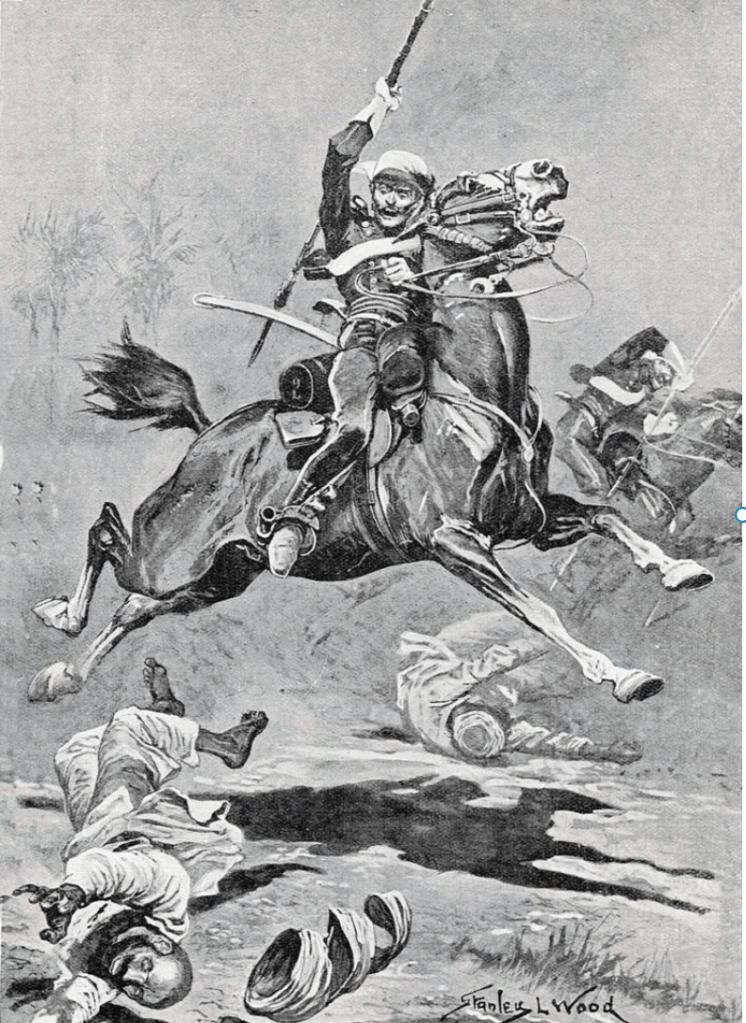
“The Cavalry and Horse Artillery, being handled by a man wholly without experience, were not as advantageously disposed as they might have been. The R.H.A., besides being dreadfully slow and red-tapish, did not dash on to the front, where the enemy were to be seen flying in numbers, with the same zeal and gallantry that so greatly distinguish our friends of the B.H.A. One or two griffs of subs allowed Fawcett’s troop and Gough’s Irregulars, under my command, to pursue an enemy six times our numbers without any support. We cantered about three-quarters of a mile, when, coming within range of their muskets, we gave a shout and charged with all our might. In a minute, we were in the middle of them.
I nearly tumbled off my horse in a vain attempt to cut down a man who dodged me and then deliberately proceeded to shoot me. However, I went at another, but he dodged me, too, and stood at bay with his drawn tulwar, inviting me to come on. I was just preparing for a rush when Gough came charging down and felled him with a powerful blow on his head. Fawcett’s horse tumbled in consequence of a man running right between his legs. F. got up, cut the man’s head open, and mounted again just in time to charge with me and nine or ten of the men through a patch of about five yards square of cotton-trees alive with the brutes hiding in it. There were fourteen men killed in it. Just at this time, we came up with Turner’s troop, and remained to protect it, Fawcett simply taking four or five men to kill three or four of the enemy whom he saw running across the plain. The 7th Hussars—a squadron of them—cut up about 200.” (Anson)
By saving Octavius Anson, Charles Gough had secured himself a final citation for his Victoria Cross.
Inside the town, the fighting resembled little more than slaughter.
“Some of them made a desperate resistance; a little knot of them got round a tree, with their backs to it,
and defended themselves long, until they were all slain. One brave fellow, seeing the Lancers after him, faced round with his sword and shield. Captain Coles, of the 9th Lancers, rode at him and sent his lance through shield, body, and all, but the fellow, in falling, made a swinging cut and hamstrung Coles’ horse, which was obliged to be shot. Cornet John Evans, of the 9th Lancers, killed no less than eleven men with his own hand. I saw one of these footmen standing at bay, surrounded by six or seven irregular cavalry, who were all , evidently, afraid of him, and in the twinkling of an eye he rushed at one of them, cut him off his horse, and then slashed him as he lay on the ground, so that he lost both hands; but while thus employed, another rode at him with a lance, and ran him through.” (Jones)
One house was found to be not only well-fortified but full of armed men. It was deemed imprudent to rush them, so the soldiers quickly lit a fire at the door and made a hole in the roof to smoke them out. One man rushed out, with his face and legs singed, straight into the waiting firing party, who swiftly put five bullets in his body. The remaining thirty either refused to come out or were denied an exit – it can only be hoped they suffocated to death before the house was set on fire. It was not the only outrage committed. Anson was horrified to find that several women were killed while trying to hide their husbands, and many were burnt alive in their houses, which they could not be induced to leave. Their fate, however, he felt was preferable over the “two unfortunates, who were ravished to death. What beasts men are when their passions are in a blaze.”
When it was all over, Grant found that no less than 500 had been killed and another 400 were now prisoners.
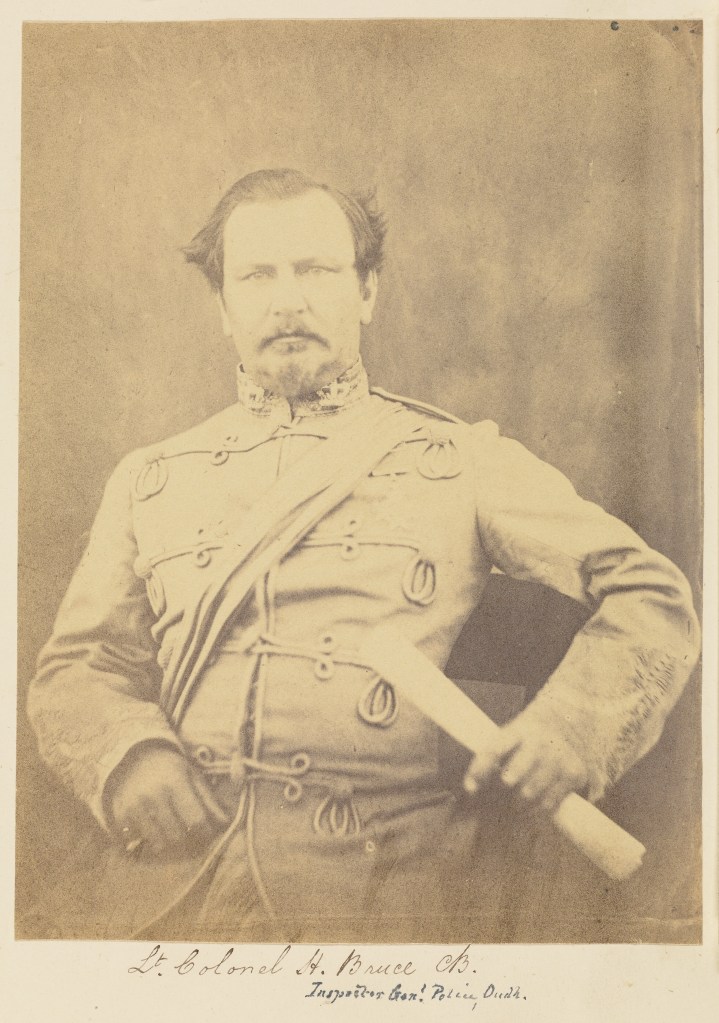
Major Bruce, who had accompanied Grant as his political agent, swiftly set about examining the prisoners. He found they had no information to give him, nor could they be “called rebels in the strictest sense.” They were mostly townspeople and levies of a disgruntled Zamindar, and Grant found it best to let them go, “…and the inexpressible surprise and delight evinced by these poor people, who expected to meet with an untimely end, was truly touching. They gave a shout of joy and started off through some trees, where I lost sight of them.”
However, Grant had another problem on his hands.
Presently, a sergeant came running up in breathless haste and reported that some of the soldiers were murdering these men. I started off as fast as possible, and saw three poor wretches strung up to trees, quite dead, and several scoundrels belonging to my force making off. I tried to ascertain their names, but failed, as they soon mixed with other men in the tents, who probably knew nothing of their evil deeds. It was a brutal and disgusting outrage.”
In the town, three officers, one of whom was Lieutenant Roberts, had entered the house of a poor man who had met them with tears in his eyes and his hands clasped in supplication. He begged them not to burn down his house, for it was all he had left. The three dead bodies which shared the room with him, he said, were his sons and had been killed in the attack. “On being asked why they had joined the rebels, ‘They had been forced to do so,’ he replied; ‘no one was allowed to go away.’ His other two sons had disappeared, and he did not know if they were alive or dead. Roberts promised to protect his dwelling, but it seems he was a little hasty with his mercy. Grant’s orders were clear – the gateways of Miyanganj were to be blown up, and the part of town where the old man lived was to be razed to the ground. Roberts, however, ascertains in his memoirs that the man and his house were left untouched.
Grant himself found a dead sepoy, still in his uniform, who had been standing outside his house protecting his family with the one musket he had. A soldier of the 53rd had shot him dead. He then learned that the sepoy’s wife had taken up the musket and levelled it at the soldier; she pulled the trigger, but the gun misfired. Without a second thought, the man had dashed her brains out with the butt of his rifle. In another, Grant found a poor woman who was tending her child, wounded by a shot in the side, while her nephew lay dead at her side.
“War is always fearful, but a civil war of this nature was most terrible even to think of…Elsewhere, a workman was sitting at his loom, dead, with his hand in the act of arranging the threads. He had been suddenly killed and remained in this attitude. In another room, a widow was found in bitter anguish leaning over the dead body of her husband, a sepoy, who had been killed.”
Orders now reached Grant; he was to leave off his expedition and march to Bantera – Sir Colin Campbell was waiting for him. Before the march commenced, Lieutenants Robert and Watson could not resist a little hunting. During their morning ride, Robert’s greyhound frightened a nilghai (a large horned Indian antelope – older males are bluish in colour, hence its name) that dashed at Watson. He tried to slash the animal with his sword, but to no avail, and only managed to gash it in the quarter. The lieutenants, roused to the chase, set off across country after the fleeing nilghai. After a few miles and with no hope of catching it, they suddenly realised they were hardly alone on the plain. Moving towards them, from the right, was a body of rebel cavalry.

Their position was, as Robert’s understates it, awkward. Their horses were tired after the fruitless pursuit, and the two men could hardly escape should the cavalry decide to charge. They pulled up, turned around and trotted back the way they came, hoping their horses would catch their breath before they would have to ride for their lives. Once in a while, they looked over their shoulders to see if the cavalry was gaining on them until it became clear they were opening out and making as if to charge.
Roberts and Watson shook hands and bid each other goodbye. They agreed that “each must do his best to escape and that neither was to wait for the other…” but just as suddenly as the mass of cavalry had appeared, they were gone and the plain was empty.
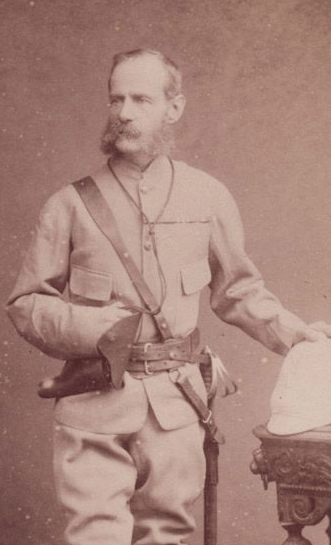
” We could hardly believe our eyes or comprehend at first that what we had seen was simply a mirage, but so like reality that anyone must have been deceived. Our relief on becoming convinced that we had been scared by a phantom enemy was considerable; but the apparition had the good effect of making us realise the folly of having allowed ourselves to be tempted so far away from our camp…we determined not to risk it again.”
However, they had not been deceived – throughout their march to Bantera, a body of rebel cavalry was seen at a distance, parallel to Grant’s troops, but never coming close enough to engage, weaving in and out of the grassy plain like tall spectres ahead of the sun.
Sir Colin Campbell stayed in Allahabad only a day, and his plans for the taking of Lucknow were thus far complete – there would be no direct assault as on previous occasions, but a gradual advance, each one calculated for maximum effect. The taking of Lucknow would be very much a scientific series of operations – if Campbell could pull it off, with the 10’000 men under his command, it would be a military genius. Although he would have proceeded with his plans even without showing them to Lord Canning, having his seal of approval was certainly no hindrance.
Sources:
Anson, O. H. St. G. With H.M. 9th Lancers During the Indian Mutiny. London: W. H. Allen & Co., Ltd., 1896.
Forrest, G. W. A History of the Indian Mutiny. Vol. 2. Edinburgh: William Blackwood & Sons Ltd., 1904.
Grant, Hope. Incidents in the Sepoy War 1857-58, Compiled from the Private Journals of General Sir Hope Grant, K.C.B.. Edited by Henry Knollys. Edinburgh & London: William Blackwood & Sons, 1873.
Jones, Oliver J. Recollections of a Winter’s Campaign in India in 1857-58. London: Saunders & Otley, 1859.
Roberts, Frederick Sleigh. Letters Written During the Indian Mutiny. Reprint. New Delhi: Lal Publishers, 1979.
 Mutiny Reflections