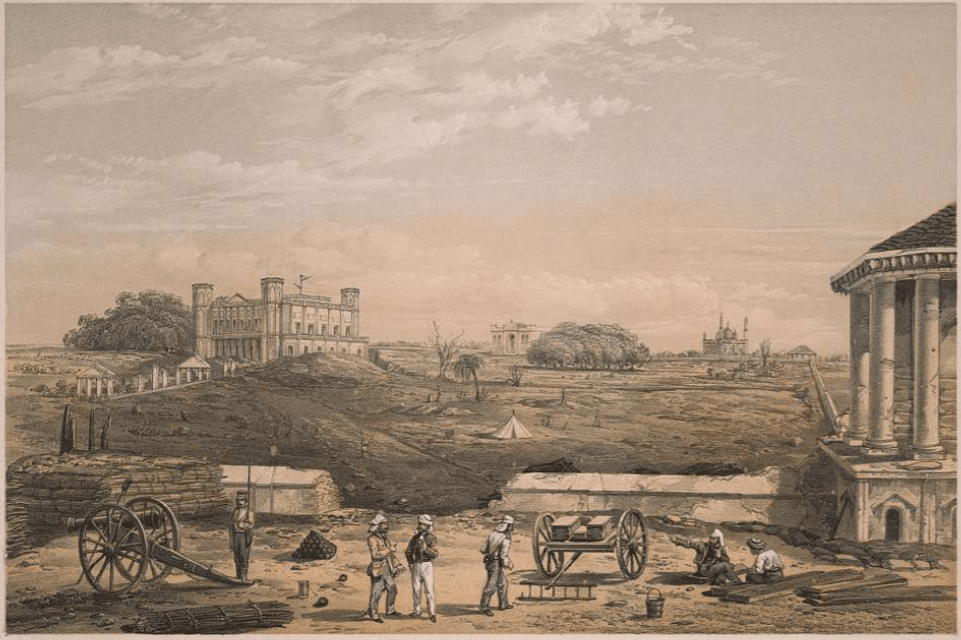
but as yet (Christmas Day) they have only succeeded in killing a horse, a very thin one, and wounding a single soldier.” – Clifford Henry Mecham
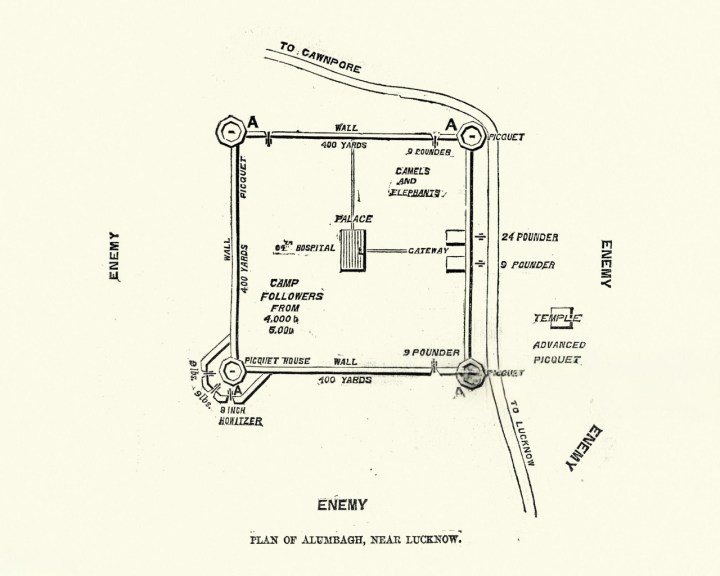
What the men of the Alambagh soon discovered, they were, in fact, little better off than they had been in the Residency. Anyone venturing more than 500 yards in front of the position was certain to be greeted by a hail of bullets, and while the rebels were wary of attacking the position itself outright, they amused themselves by cannonading it “nearly every day and all day, at long bowls…” When they did finally attack, it was half-hearted at best.
Moreover, they soon learned that Outram knew more about their movements than was comfortable. For this purpose, he had kept in his employ several able spies, among them the admirable Ungud and Anjoor Tewari, who continued, as they had done for months, to venture into the city to bring back the most reliable information about the rebel movements. The spies were so adept at their work that Outram was aware of any impending attack, sometimes hours before it came into fruition, allowing him enough time to reply accordingly and without haste.
It was, however, a harassing situation, nevertheless. As the rebels remained unpredictable, it was necessary to keep up a constant watch. The nights in the winter season in Oudh were cold and often windy; there was no winter clothing for the men, and many found themselves, instead of picket, ill in bed, yet Outram ordered the pickets to be manned unceasingly nevertheless and relied heavily on the officers to keep the men in check.
There was only a little time devoted to drill – just enough, said Dr. Home, to keep up the memory of it; yet he insisted the regimental bands, what was left of them at least, should continue to play when time allowed, to keep up the men’s spirits.
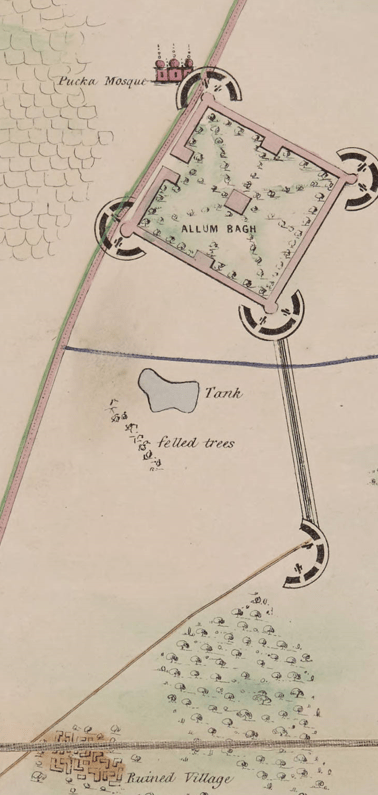
Like at Lucknow, the rebels concentrated their efforts on reducing the Alambagh palace to rubble with a constant cannonade, but with little result. On a single day, they managed to fire an impressive seventy-eight shots into the enclosure, yet most of them were either too high or too short; the butcher’s bill for the day was one man injured. Their aim was so notoriously terrible, it was more of an irritation than an actual threat.
They had also constructed an extensive work, complete with a circular bastion and stockade on the side of the camp that fronted the city; on this, they mounted four of their guns, but the firing was practically harmless. Standing on the roof of the Alambagh, and looking through a telescope, the officers could clearly see the men of the battery sitting about on the parapet, “very much at ease.” Occasionally, they would get up, dust themselves off and present the Alambagh with a cannonball, then they would revert to slouching about.
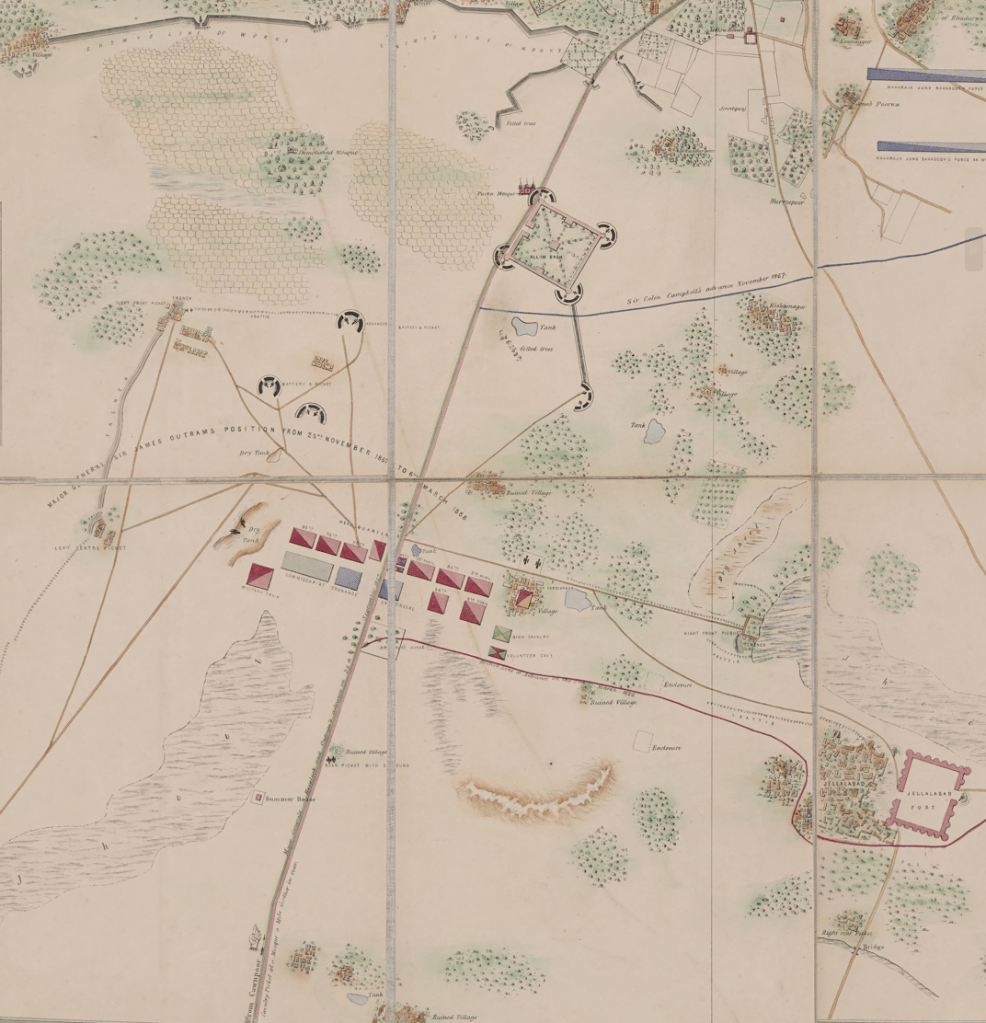
However, the British were impressed by just how well the officers of the mutinied regiments, who had last been seen before Delhi, continued to run their men. As their pickets were just opposite the British ones, they observed how, like clockwork, the field officer of the day made his rounds; startlingly, the routine words of command were still delivered up in English. The rebels also held grand reviews from time to time, which the British officers noted, with admiration, were a splendid sight – the regiments marched exceedingly well and their drilling was praiseworthy. Every evening, at tattoo, the old regimental bands enlivened the British camp with old, familiar tunes.
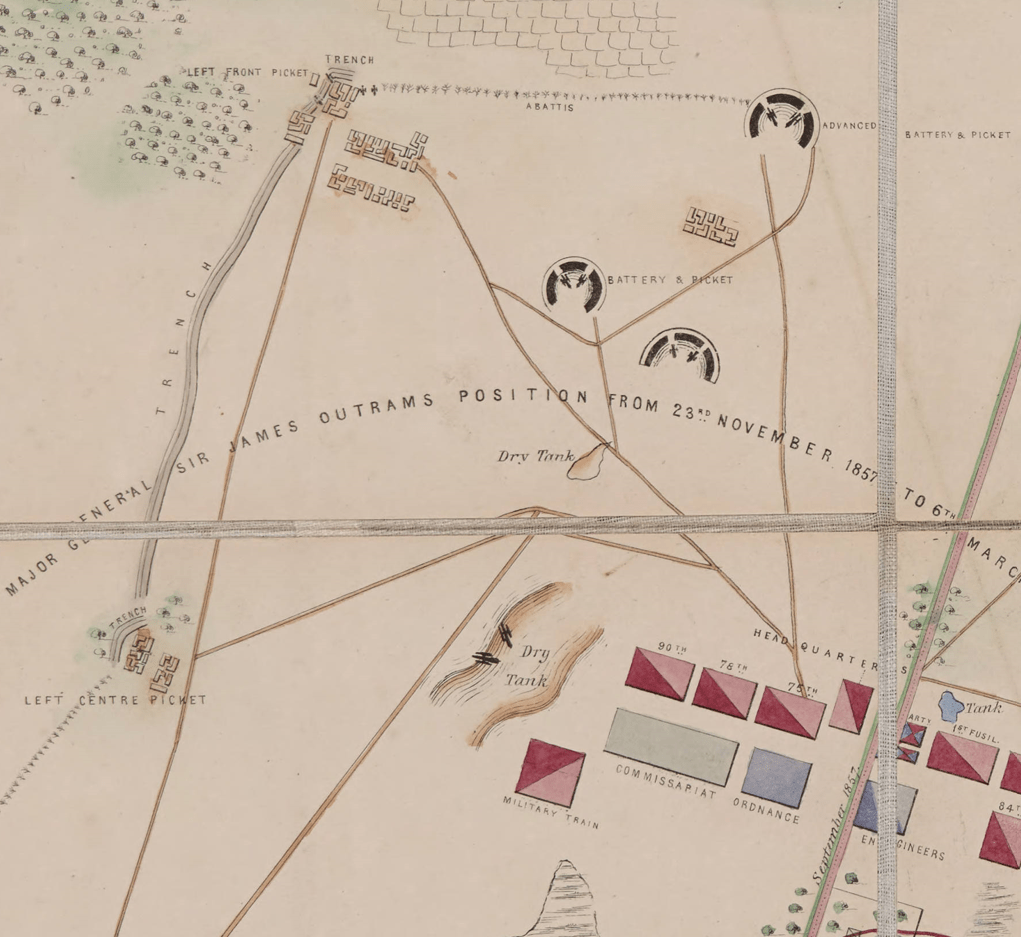
From time to time, the rebels entertained the camp by putting on a sham attack at night, waiting until the camp looked like it was well and truly asleep. On one particularly dark night, they ran up two of the horse-artillery guns with range of the camp, fired off two shots and then galloped back, well out of range. Startled awake, the entire camp leapt to its feet; officers dashed about, half-dressed, bugles rang out, sleeping camp followers rushed about looking for cover, men fell into line, others tried to find their line as they stumbled about in the dark, and Outram, cursing his spies, quickly came up with a plan, expecting that this was going to be the grand attack. It wasn’t. The men stood about uselessly for the rest of the night, waiting for an enemy that never appeared.
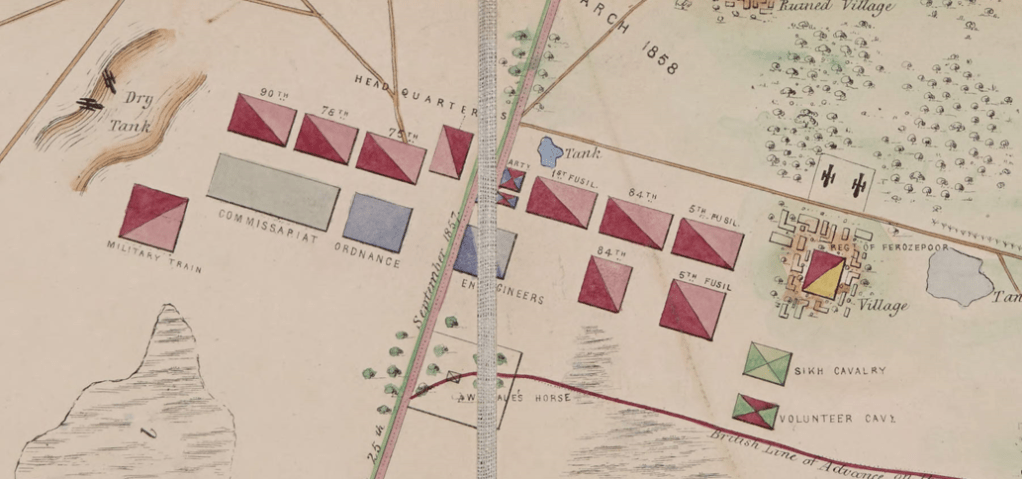
Yet it was due to Outram’s constant communication with the spies that he was able to preempt the rebels who had planned to burn down the tents on the open field. Shortly before 10 pm on the night before the attack, which was to occur at daybreak, Outram and his staff visited each Regiment and proceeded to give them rather unusual instructions. An hour before dawn, the whole Force was to be under arms and drawn up in front of the Brigade parade ground; the tent ropes, all but the two which held the poles upright, were to be loosened, and two men were to be left inside each tent. When the rebels approached, the idea was to allow them the illusion that no one knew a thing in Outram’s quarter. When the attack commenced, and Outram had moved his force to the front, the remaining men in the tents were to allow them to collapse. It was a perfect ruse; as planned, the rebels did make one of their half-hearted attacks and an attempt to fire the tents, but as soon as they saw them crashing down, they realised the jig was up. They never tried it again.
Outram, the Bayard of India
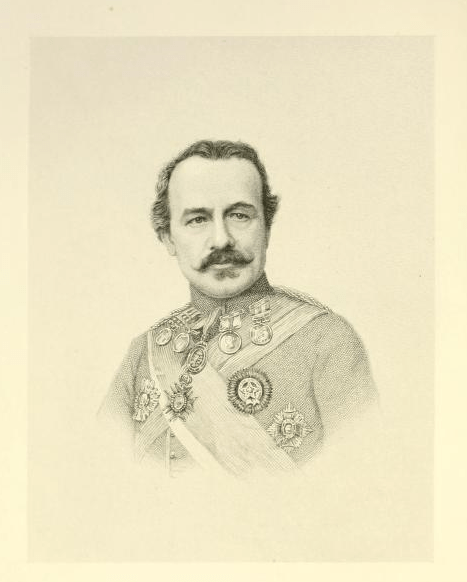
Outram was proving himself to be a very hands-on commander, a commendable trait that came with some drawbacks, as Maude soon proved.
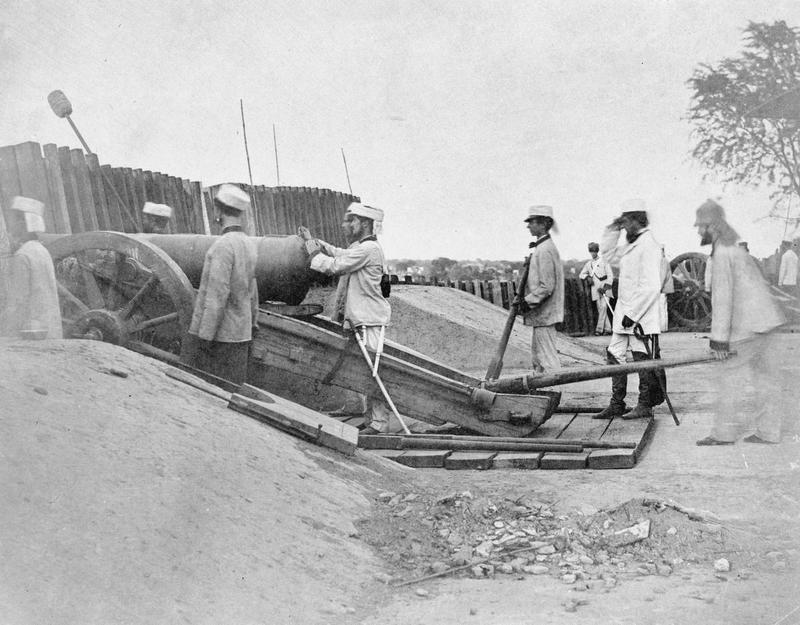
“On one of these so-called ‘attacks,’ I happened to have a couple of guns in our picquet on the left (or
North-West) front, where, it being the post of danger, of course, Outram was conspicuous. It was growing dusk, and the General was getting a little cross, as the enemy, while keeping up a provoking, desultory fire, showed no intention of coming to closer quarters. Besides, it was near dinner time and, although there were rarely any gastronomic delicacies in our camp, the fare was by no means of the despised proportions with which we had to pacify our stomachs in the preceding months. The earthwork had been constructed by the Engineers and neatly finished off, with fascines and gabions, in the most approved style. As the grim, but genial-hearted General sat on the parapet of the work, his legs dangled in the embrasure from which I had been firing. After some minutes had passed, he turned to me and said:
‘Why don’t you go on firing?’ ‘
If you wish it, Sir, I will,’ I replied.
‘Yes, do so,’ answered Outram, still perched up, cheroot in mouth, on the parapet.
I cut and fixed the fuse, and loaded, but, of course, I waited until he moved his legs out of the embrasure. Seeing this hesitation, he sung out:
‘Don’t mind me! Fire away!’
I saw that the embrasure had a wide mouth, and hoped he was clear of the recoil, but it was not without inward misgivings that I gave the word to ‘fire!’ When the usual cloud of smoke and dust cleared away, we had the satisfaction of seeing our good and beloved General descending, leisurely and unhurt, from the parapet; then, covered with dust and blackened with smoke, he mounted his great strawberry-roan ‘Waler,’ and jogged off slowly and silently back to his Camp. I never had the courage to ask him what his sensations were, but he must have had a tremendous shock; and he certainly never sat in an embrasure again, at least while the gun was being fired from it.”
However, everyone could agree, there was no commander more genial than Sir James Outram to serve under. He was a practical administrator who knew India well and understood the peculiarities of the Indian troops who served under him, making him quite the favourite with them; as for the European troops, they found him both generous and understanding. At the Alambagh, considering the strange nature of the position, Sir James Outram had done away with much formality, and the men were grateful for it. Although he insisted on discipline, if nothing else, to keep their tempers in check, he closed the distance between officers and men. Outram took his place among them – every morning, well before daybreak, cheroot firmly in his mouth, he walked to every picket, his horse led behind him, to greet the men with a “cheery Good Morning,” and took the time to speak to everyone he crossed paths with. The men appreciated him for it, and the officers, even those who never sat at his table, admired him, as Wolseley did, from a distance. Outram was both chivalrous and bold to the point of recklessness, but equally kind and sympathetic. Many had served with him through the blockade of Lucknow, and by now, if he had asked, would have run through fire for their commander.
Outram Meets the Maulavi – December 21-22, 1857
The Maulavi of Fyzabad, Ahmadullah Shah, now made his appearance before the Alambagh. He had taken note of Outram’s position with some deliberation and decided early on that attacking Jalalabad was a futile venture. Instead, he decided to try something new. He was not acting on the orders of the Begum Hazrat Mahal – indeed, he had refused to become a part of her administration and had taken himself off to the Badshah Bagh where he encamped with his soldiers and followers.
The Maulavi intended to cut off Outram’s communications with Cawnpore by taking the outpost at Bannu Bridge and sealing them in the Alambagh, all in one swoop. As such, at the beginning of December, he instructed the men to begin digging new batteries in front of the British left – with these complete, they then proceeded to extend them towards the left proper, opposite Outram’s right centre. To cover the workers, skirmishers were repeatedly sent out to within grapeshot distance of the British, always making their attack from the front. The occurrences were so frequent that the gunners of Outram’s force began looking forward to their daily repartee.
On December 21, the Maulavi was satisfied everything was in place, and, using the cover of darkness, he threw off all pretence by sending a detachment of 4000 infantry, four hundred cavalry and four guns, via the villages of Gaili and Badrup to Banni. They were to entrench themselves in the rear of the British force, thus severing all communications with Cawnpore. They reached Gaili with no mishaps; then, occupying a position between that village and Badrup, encamped for the night. So far, the plan was working.
However, Outram, as we have already seen, relied heavily on his spies, and these did not disappoint. He was well aware of what Maulavi was doing – while that erstwhile gentleman prepared to hem Outram in between two fires, Outram decided he would like to try and cut off the Maulavi from Lucknow. At Gaili, the rebels still had a route back to Lucknow, via the Dilkusha, which was only a half-mile distant and completely under their control. So, instead of following in their path the same night, Outram quietly put together his force – 1227 infantry, under Brigadier Stisted, 190 cavalry under Major Robertson and Captain Olpherts with six 9-pounders. They marched out of the Alambagh at 5 in the morning and came upon the rebel camp at daybreak, and Outram barely gave them a minute to recover from their surprise.
The right column, under the command of Lieutenant-Colonel Purnell (90th Regiment), with detachments of the 75th, the 78th, the 90th and Brayser’s Sikhs, dashed headlong at the rebel position, dismissive of the heavy fire the rebels tried to pour on their heads. The rush of the men was too much for the rebels to bear – they fired off another volley and set off at a run.
Colonel Guy, commanding the left column of 400 men of the 5th Fusiliers and the guidance of Lieutenant Moorsom, simultaneously attacked the village of Guili – here the rebels, after a short fight, turned as rapidly as they had started and left behind two of the guns.
Lousada Barrow and the Volunteer Cavalry now took up the chase across a wide plain, pursuing the fleeing rebels who made good their escape by hiding in a village, where they had previously secreted a gun loaded with grapeshot – this they now discharged while greeting Barrow with musketry. Barrow called up two of Olpherts’ guns, which quickly made the rebels change their line of retreat, and they now tried to return to Lucknow via the Dilkusha. However, Major Robertson and the Military Train, having been sent to make a flank movement, were on their heels so quickly that they not only dispersed the rebel cavalry but drove their guns into a ravine. Only the leading horses, whose traces were cut, escaped. The Madras Sappers quickly extricated the abandoned guns from the ravine. Meanwhile, at Badrup itself, Stisted chased out the remaining rebels at the point of the bayonet.
Outram now called off the pursuit as he had no intention of becoming embroiled in fighting at the Dilkusha. Instead, satisfied his men had done their duty well, he ordered the four captured guns and one elephant to be taken back to the Alambagh. Waiting for him was a pleasant surprise – Brigadiers Hamilton and Eyre, whom he had left in charge, reported they had made short work of the determined skirmishers the Maulavi had directed to attack the left flank – Outram’s return had put an end to the rebel aspirations on that front and the Maulavi, who insisted on being carried about in a rather conspicuous palanquin, rapidly retreated to Lucknow.
Somewhat demoralised, the rebels resumed their usual bombardment of the Alambagh and most judiciously kept out of sight of the British pickets – that is, until January 12, 1858.
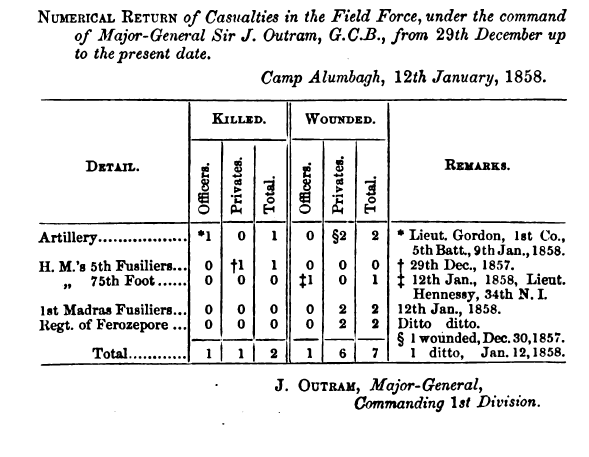
Mansab Ali Wants a Victory 12 January 1858 -Attacking the Convoys
A rebel partisan of some note, Mansab Ali, came up with a plan, which, had it been successful, would have made Outram’s life exceedingly difficult. Ali’s task, for some weeks, had been to hover about the British convoys proceeding every two weeks between Cawnpore and the Alambagh, and when possible, cut off small detachments and raid the convoys. Outram, once again, admirably served by his spies, knew perfectly well what Ali was up to. Having heard that Ali had received a strong reinforcement of troops from Lucknow, he decided to detach a large covering party with the empty waggons, proceeding then to Cawnpore.
The Lucknow rebels waited until they were absolutely sure the convoy was on its way back to the Alambagh and then, as a ruse, to facilitate Ali’s attack on the convoy, on the morning of the 12th, they made their attack on the Alambagh. They came out in considerable force – Orr estimated they were 30’000 strong – and amassed opposite the extreme left of Outram’s position and gradually extended to face his front and left flank, until they covered nearly six miles. They planned to threaten with their left, while their right centre and right would advance and commence the real attack.
Outram allowed them to extend and went so far as to permit them to round his left flank. Then, seeing they had completed their manoeuvre, Outram formed up his two brigades to face the front attack and ordered Olpherts to take four horse artillery guns with the support of a detachment from the Military Train to “dash over the overlapping right of the enemy. ”
“With the dash and energy eminently characteristic of the man, Olpherts took out his guns at a gallop,
and, pushing to the front, opened fire on the rebel masses just as they had begun the second overlapping movement, to gain the rear of the British position. The vigorous assault made by Olpherts completely disconcerted them. Renouncing their turning efforts, they fled in confusion and dismay.”
While Olpherts dismaying them on that front, the rebels opposing the British left centre would shortly be equally put out. They had advanced “with considerable spirit” into a grove of trees, heading straight for Captain Down and his picket of the 5th Fusiliers. Down allowed them the advance and then, satisfied they had come far enough, suddenly leapt at them, with his men following, bayonets front, and drove them off. It was not over yet.
“Whilst the enemy were thus being repulsed in their attacks on the left and the left centre, they had not been idle on the British right. This part of the British line was covered by the fort of Jalalabad, upon which some rough repairs had been executed, and it was considered comparatively unassailable. Knowing this, and deeming it probable that because the fort was considered strong it would be therefore weakly garrisoned, the rebel leader, whilst threatening, as we have seen, the left, and making on that side a noisy demonstration, had quietly massed a large body of infantry against the picket connecting the right with Jalalabad, and, bringing their three guns to the front, opened upon that picket a heavy fire. But here, too, Outram was equal to the occasion. Bringing to the front, from the left of the right brigade, detachments of the 5th Fusiliers and Brayser’s Sikhs, and two guns of Moir’s bullock battery, he took up a position which gave him the right flank of the enemy, and then opened upon that flank. The effect was instantaneous. The rebels abandoned the advanced position, evacuated the village they had occupied, and, though for a time they continued the fire from their guns, their practice was bad, and caused no damage.”
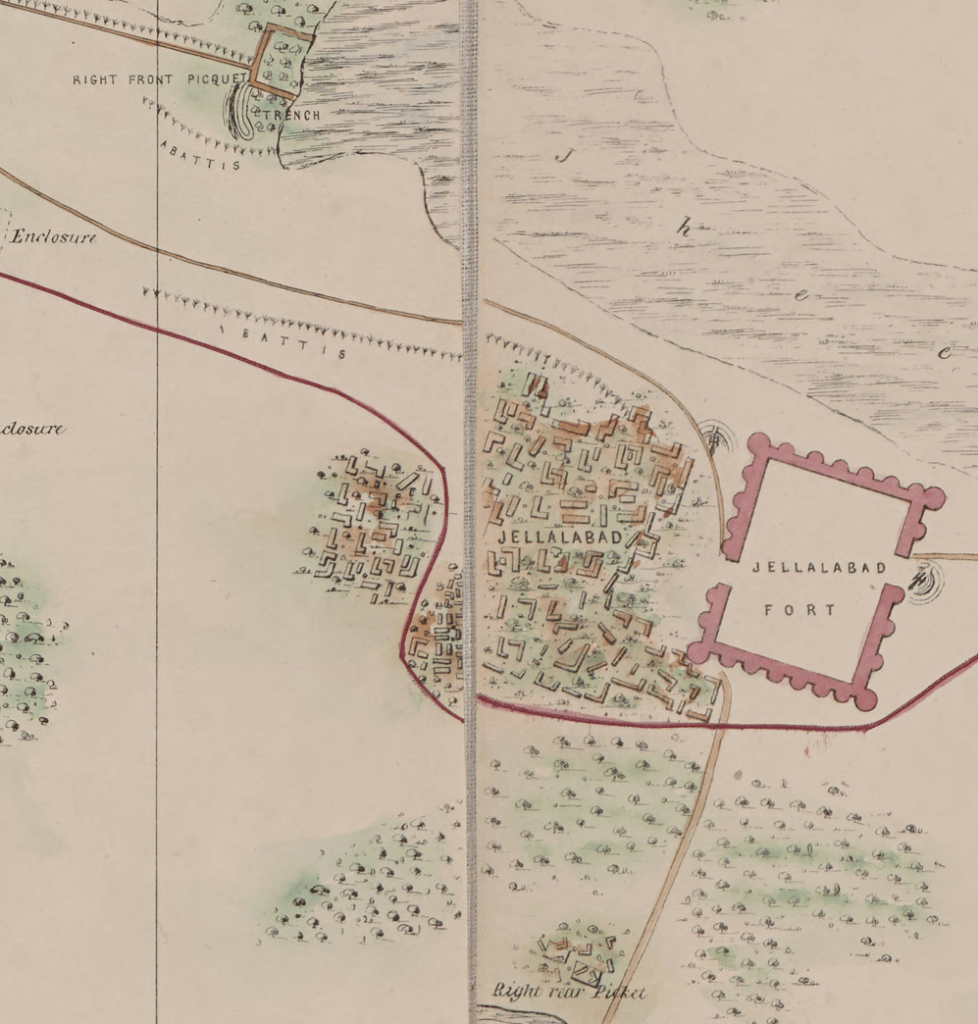
With all the movements and countermovements ongoing, the rebels felt, with everyone so busy, they decided it was high time to advance against the Alambagh; at first, they approached cautiously, using the cover close to the building to hide their movement, but suddenly at noon, they rushed out into the open and advanced with some rapidity. Maude was unfazed – he let his guns roar into action, and the riflemen stationed alongside him needed no invitation. Without waiting for an extra reminder, the rebels turned and fled. By 4pm, the action was over, and the rebels were running headlong back to Lucknow. They would find out, to their disappointment, that Ali had not attacked the convoy after all.
The Maulavi had had enough of these shenanigans and decided he would capture the convoy himself and parade it in front of Outram’s nose. Therefore, he left Lucknow with a considerable force and no baggage on the early morning of the 15th using the cover of a violent dust storm to hide his movements- little did he know that the wagging tongues in his camp had already given Outram’s spies another bounty of information, and he had planned another surprise for the wily Maulavi.
As the Maulavi moved with his body of horsemen towards Outram’s left rear, Outram sent two of Olpherts’ guns and a troop of the military train to keep an eye on him. As more troops were seen joining the Maulavi, Outram now ordered the rest of the battery and the remainder of the Military Train, a detachment of Wale’s Horse and H.M.’s 90th in support.
“I heard the galloping of horses near me, and upon looking round, saw it was Olphert’s battery going as fast as their wretched equipment would admit of. First came dear old Billy himself, clad in garments he had used in the Crimean War, a fez cap and a Turkish grègo, the latter tied round his waist with a piece of rope. About fifty yards behind came his well-known battery sergeant-major in a sort of shooting coat made from the green baize of a billiard table; then a gun, every driver flogging as hard as he could; then another at a long distance in rear. One broke down, to the unpractised eye, hopelessly, immediately in front of my company. Some of the spokes had gone; they all rattled. We were all highly amused and interested, for many men in the battery belonged to the 90th Light Infantry.” (Wolseley)
With a portion of the rebel infantry and cavalry well out in the open, “escorting a person in a palanquin,” Olpherts’ two guns and a troop of the Military Train dashed to the front and opened on them with grapeshot, wounding several and causing the rest to turn and run. The Maulavi was severely wounded for his pains. The convoy arrived at the Alambagh at 3 in the morning on the 16th, with no incidents to report. Outram now had the men of the convoy escort under his roof again, who would be most welcome for the proceedings of the day.
The Sikhs and Hanuman -16 January 1858
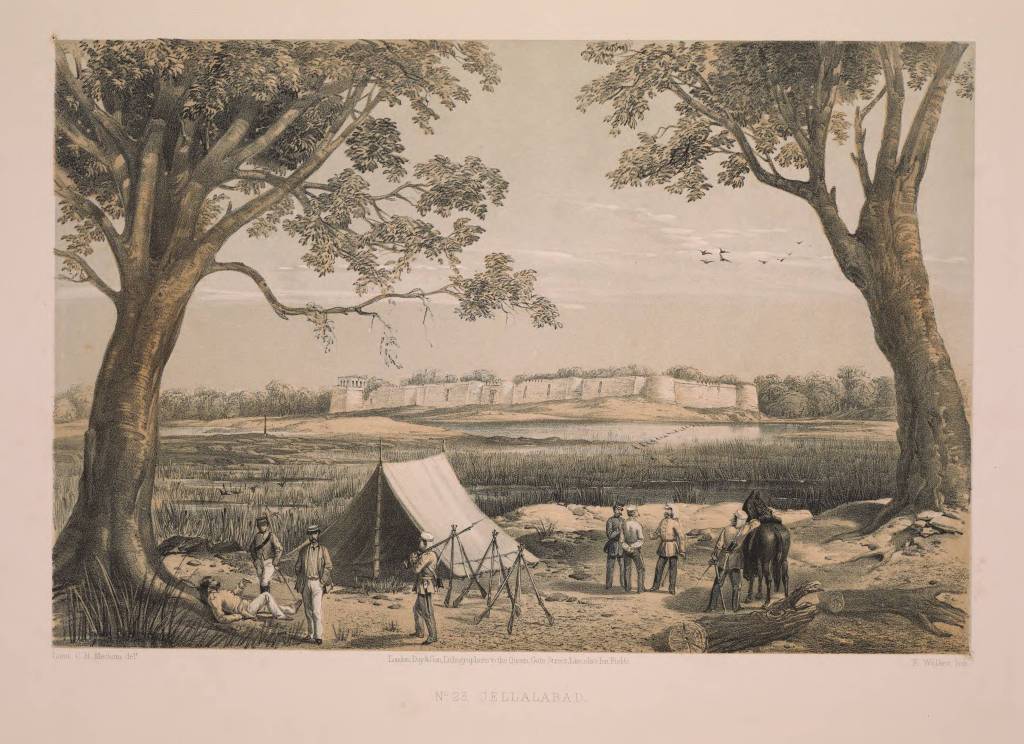
One of the most curious incidents at the Alambagh was left for the Brayser’s Sikhs to deal with. The rebels, while seemingly unwilling to attack the position outright, were more than capable of mounting almost theatrical sorties which, though dangerous, had they been followed through with any force, usually ended after a few shots from the pickets. One of these incidents, however, was firmly imprinted in the minds of no less than four writers, all of whom served at the Alambagh and, in varying degrees, were involved in it that day.
It began, as these attacks invariably did, with the amassing of men in front of a picket; this time, they had chosen to pick a fight with Brayser’s Sikhs, who were posted at the Jalalabad Fort. Warning had reached Outram what the rebels were planning, and according dispatched reinforcements to the fort. As it turned out, they hardly needed it, but they were rather surprised at first by what they were facing.
Leading the men was a man seated on a horse. He was dressed, not in any military fashion but in a costume that resembled a monkey or, as was quickly recognised, a representation of the Hindu God, Hanuman, who most closely resembles a large, warlike ape. Renowned for his strength, bravery and fearlessness, as a symbol to lead reticent men, the rebel leaders could not have chosen a better one. Unfortunately, his men would have needed a larger dose of courage that day than a symbolic God.
The man, with shouts and oaths, spurred his horse directly towards the Sikh picket and then, had they not raised their guns and shot him, showed every intention of storming it, sword in hand. A few of his followers scrambled forward behind him, but like their leader, they never set foot in the picket – the Sikhs quickly despatched them and then watched as the rest turned tail and fled back down the road.
There was no one forthcoming to collect the wounded Hanuman from the field, and as such, Dr. John Brown, surgeon to the regiment, strode forward to ascertain if there was enough left of the man to save. He had been shot no less than seven times, and one of the bullets had smashed his eye. And yet, the man was still alive.
Brown ordered him carried off the field and straight to the hospital tent. Here, with the assistance of Dr. Home, he proceeded to cut away the curious costume the man was wearing, which included a long and realistic tail. Throughout the whole procedure, the man, who Home noted was not even in shock, continued to answer questions with a defiant boldness that surprised the surgeons. Brown and Home patched the man up as best they could and then, satisfied there was nothing more at the time they could do for him, he was sent to the Sikh hospital to recover.
The Sikhs, who readily admired bravery, whether it came from a friend or a foe, showed a peculiar interest in this now ex-God. They reasoned, despite his very human injuries, that there must be something mystical about him and insisted on keeping him, not so much as a prisoner, but a charm or, as Wolseley noted, a Joss. Their commander, Jeremiah Brayser, who knew his men better than anyone ever would, understood that this was no mere superstition and allowed it. Some twenty-seven years later, Dr. Home, who had never quite got over the incident, set up a small inquiry, when on a trip to Lucknow, as to the fate of the man. He found out Hanuman was still alive and doing well, and he had secured for himself, most likely with the regiment’s assistance, a small government pension.
The attack, although unsuccessful at Jalalabad, certainly proved more vigorous on another front. On the left front and left, the rebels continued to advance skirmishers for the greater part of the day, always venturing forward to within range of the British guns before scarpering back again. They then reassembled and tried again. After dark, they “assembled in great strength” on the left at a village outpost – Major Gordon of the 75th, with an equally strong body of infantry, allowed the rebels to push forward to within 80 yards of his position; at this point, three guns opened fire with grapeshot and the infantry, rifles at the ready, followed up. The rebels thought better of the venture and retreated, Gordon tossing some shells from an eight-inch mortar to expedite their flight. Maude, at the Alambagh, kept his guns blasting away, ensuring no one with even the least sense would venture within sneezing distance of the walls, and Olpherts kept the bold rebel cavalry in check with his four horse battery guns and a detachment of the Military Train under Captain Clarke.
February
In February, the long arm of Sir Colin Campbell was making itself felt at the Alambagh, when he suddenly ordered H.M.’s 75th to march to Cawnpore. They were to be replaced by the 53rd. The officers and men of the 75th were mortified – they had after all, been in the fight since June; they had fought their way through Delhi and marched with the Column in September only to find, due to their numbers being weak and too many of their men on the sick list, they would not proceed to the Relief of Lucknow. Since then, they had been making the best of things at the Alambagh and had sincerely hoped they would at least be allowed to attend the imminent taking of Lucknow. Instead, Campbell poured on them one final insult for the sake of General Mansfield, who had risen with the 53rd and wanted “his” regiment to have the glory. Outram was powerless to intervene. He managed to postpone their march by one day as he waited for a reply to his strongly worded protest he had sent to Campbell. There was nothing for it, Campbell had made up his mind, and the 75th would have to go after all.
It left Richard Barter with a few choice words for Sir Colin Campbell that certainly rang more than true with many of the men under his command.
“Without a spark of noble generosity, he did not hesitate to let other Regiments do the work and then shove in ‘The Heeland Bonnets’ to reap honour. Witness Fatehgarh, only one case in many. He was utterly devoid of dash, the thing of all other necessary for complete success in Indian warfare; his whole thoughts were centred on the peerage, and he’d risk nothing for fear of losing it, nay more, he’d sacrifice all and anybody for its attainment. Witness his march to the Relief of Lucknow: a brave man undoubtedly, but too cautious for India and too selfish for any place.”
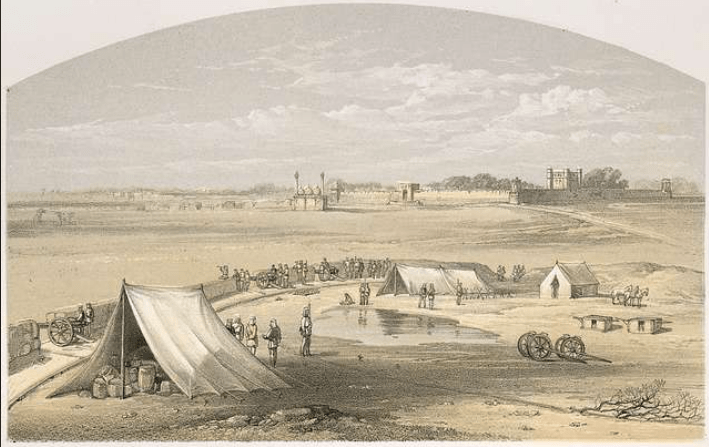
The Final Attacks – 21 and 25 February
By February, stores were coming into the Alambagh in greater numbers, and Sir Colin had sent in advance reinforcements for Outram, in anticipation of the retaking of Lucknow. The rebel leaders at Lucknow realised they were running out of time. They reckoned they had no more than a week to smash Outram and the Alambagh – if they did not succeed with one last grand attack, their futures would be bleak indeed.
This assault was better planned and on a scale they hoped Outram had not anticipated. Their spies in Outram’s camp had reported, correctly, that the General and a large portion of his staff would, as was their wont to do, attend a church parade early on Sunday morning on 21 February – it was ascertained, with the British busy with their God, it was the most opportune moment to bring them one step closer to meeting Him.
So, with as much stealth as could be expected, the rebels filled all of their trenches with as many men as they would hold, and placed large bodies of infantry in every tope of trees all along Outram’s front in support. Then, with one swift move, they commenced to move simultaneously around Outram’s flanks, while at the same time threatening the entire length of the Alambagh position; they attacked the north-east corner of the Alambagh itself, while the picket at Jalalabad was treated to the sudden fire of four of their guns.
Captain Gordon, one-time ADC to the late Brigadier General James Neill, had noticed the movements from his battery and quickly rode off the tell Outram. Without any hesitation, Outram reinforced the posts at the Alambagh and Jalalabad. He detached 250 cavalry and 2 field guns under Captain Barrow to the rear of the Jalalabad, where they surprised 2000 rebel cavalrymen. Barrow ordered the guns to open fire, which caused them to retreat towards their infantry that was attacking Jalalabad proper. Instead of assisting the infantry, the cavalry now held back and waited until enough grapeshot and musketry had given the rebel infantry time to reconsider their choices. They then retreated in a body back to Lucknow.
The attack on the left flank – formidable with a force of 8000 infantry and 500 cavalry – was broken by a handful of 120 men of the Military Train, the remaining four field guns. Keeping his own infantry in reserve, Outram let Robertson advance against the rebel cavalry, admirably supported by the guns, which quickly brought the whole proceeding to an end. It was a sobering day for the rebels.
“The reports from the city state the enemy to have lost 60 killed and 200 wounded in their attack on Alumbagh, and about 80 or 90 killed or wounded in front of Jellalabad. This was exclusive of their
loss on the left flank, and along our front, where our heavy artillery had constant opportunities of firing shell and shrapnel into the midst of their moving masses. I consider their loss to have been heavier
than on any of their previous attacks. ” (Outram’s despatch, 21 February)
The rebels decided they needed to try again – only this time, Outram was certainly more capable of meeting them in the open field; he had been reinforced by the arrival of Remmington’s troop of Horse Artillery, the 7th Hussars, Hodson’s Horse and the 1st Bengal Fusiliers. On 25 February, and taking matters into her own hands, Begum Hazrat Mahal and her ministers, mounted on elephants, took to the field.
The day’s proceedings began with a furious cannonade against the Alambagh at seven in the morning. After an hour, the cannons fell silent. For the next three hours, the British watched as the rebel army moved into place – the main body marched along the right front to the right, well out of range of the guns. It was an impressive sight, seeing a mass of men, no less than 20’000, pass the extreme right of the British position, make a sharp turn once again to the right and continue over and over again until all of them had reached the groves of trees at the right rear of the Jalalabad.
The other division, with the Begum at their head, halted at the turning angle to be able to support the attack and maintain communications with the main posts as needed. Meanwhile, the advanced portion began shelling Jalalabad.
“The principal attack was on our right, against which twenty-four regiments of regular infantry, six Nujeeb corps, 1,000 cavalry, and eight guns moved out from the enemy’s trenches; of this number, about one-half, with two guns, advanced towards our right rear, and having occupied the topes immediately to the east of Jellalabad, commenced shelling that post heavily, evidently in the hope of igniting the large quantity of combustible stores at present collected there, while the remainder held in support of the villages and ” topes ” directly in front of the enemy’s outworks. Large bodies of infantry and cavalry, with three guns, simultaneously menaced our left, and the trenches in front of our position were occupied in force.”
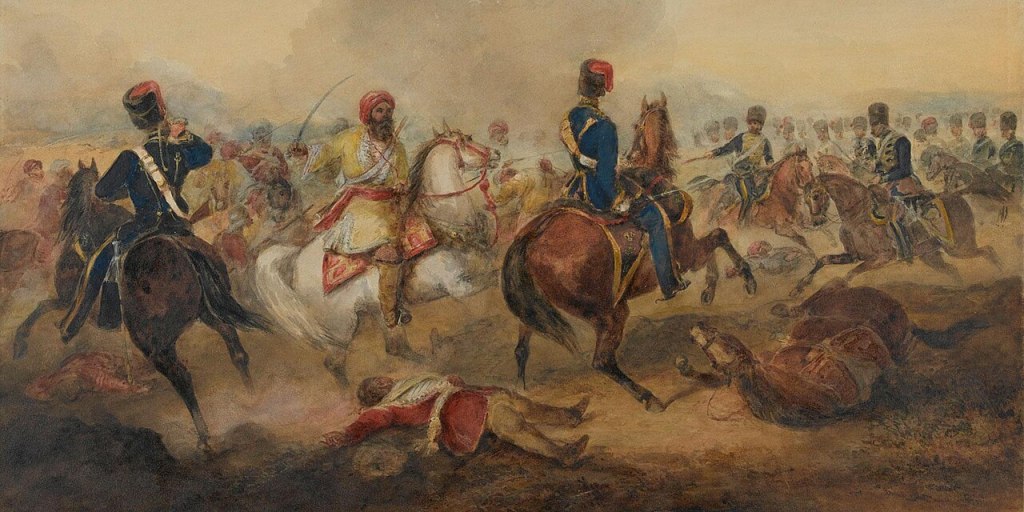
Shortly after 10 am, Outram moved out with a detachment of artillery, cavalry and infantry to intercept the column that was shelling Jalalabad – Wale’s Horse, Barrow’s Volunteer Horse were sent around to cooperate with the rear. He ordered Olphert’s guns, four of Remmington’s, a squadron of the 7th Hussars, a detachment of Hodson’s Horse and Graham’s Horse to support the advance of the infantry.
As Outram advanced, a part of the rebel reserve “made a demonstration” to the left, but Remmington with his four guns, a squadron of the 7th Hussars and Brayser’s Sikhs quickly put a stop to it.
The column now moved forward, flanked on the left by Brigadier Campbell and his native cavalry who enthusiastically pushed forward to cut off the rebel retreat, which was slowly turning into a rush. Taken aback by Remmington’s guns, they were reconsidering their options most strenuously. What they had not wanted was what happened next.
Brigadier Campbell’s detachment now assailed them from one side, while Barrow and Wale’s Horse appeared on the other; the Military Train dashed straight through the middle of the retreating rebels and, to add an insult to injury, captured two of the guns. To the left, Moir’s guns were proving most unpleasant and Brigadier Franklyn, who had been left in charge of the camp, determined to give them the hottest welcome they had ever witnessed. Not “liking the look of the arrangements prepared for them, ” the rebels turned and fled. The Begum left the field, and her ministers followed in quick suit. Olphert was not planning to allow her to leave without a few choice shots in her direction, followed quickly by Remmington, who now came up in full gallop and taking a position four hundred yards to the left just in advance of Olpherts, opened fire on the retreating rebels. The 7th Hussars and Brayser’s Sikhs advanced with them, keeping the rebel cavalry in check.
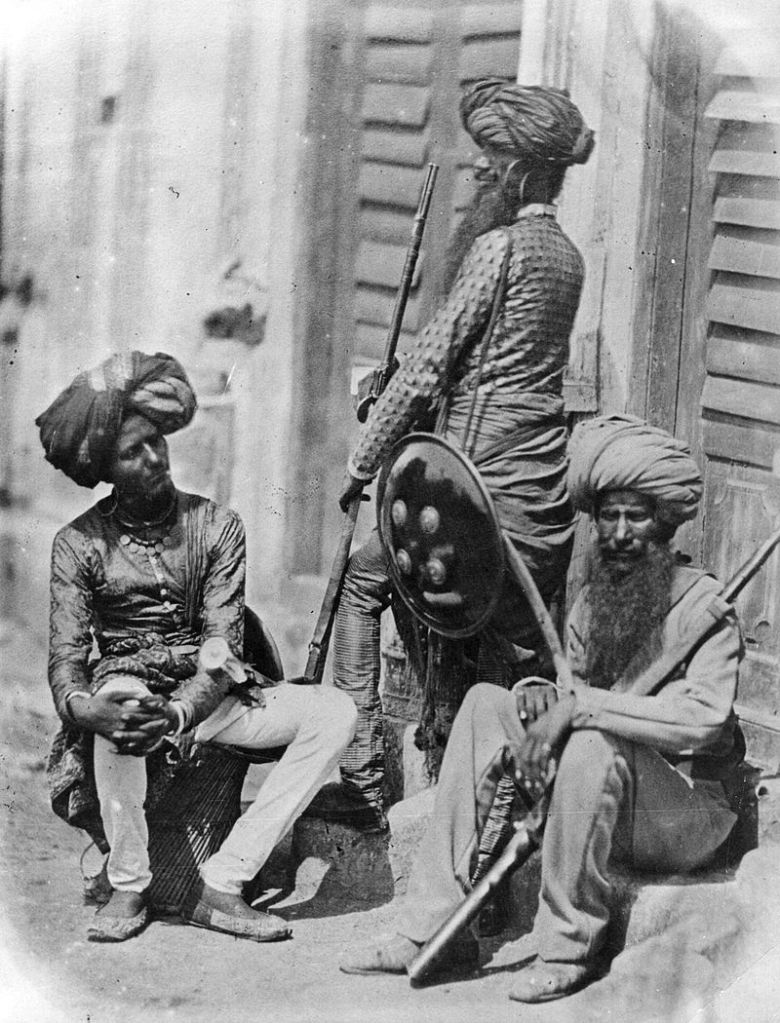
Others were even less fortunate in their choices, for encamped not too far from the Alambagh near the village of Jalalabad, was Hodson’s Horse. The regiment had but arrived – young Hugh Gough was still contemplating changing into a new pair of breeches when the order the “Turn Out” came. For him, it was curiously close to the spot where he had his last encounter with Lucknow rebels in November. However, as it turned out, it was not exactly the regiment’s finest moment.
“When we now came in view of the enemy, they were passing in rather a disorganised mass right across our front as we advanced. We could see they had a couple of field guns, one gun being about six hundred yards ahead of the other. The main body was almost entirely infantry, and all were mutineers, arrayed in uniform. Our rapid approach had a great effect upon them: they seemed to make no effort to rally and stand, and, as we advanced and charged, we got well into them, and the whole affair seemed over.
The rearmost gun was in our possession, and the enemy, as far as we had encountered them, in full flight; but somehow, owing to the ardour of the charge and the pursuit, our regiment got quite out of hand, lost all formation, and scattered; and they, seeing our condition, and probably having a leader with a good cool head, rallied round their remaining gun, regained their formation as we lost ours, and, pouring in volleys of musketry with discharges of grape from their gun, rendered our confusion worse confounded. Our men, gallant and forward in pursuit or a charge, could not stand being hammered at a disadvantage: there was a din of shouting and noise, officers doing their best to bring the men up, but all to no effect; and it looked sadly probable that ” Hodson’s Horse ” would in their turn retreat. Hodson, at this crisis, managed to get a few brave spirits together, not more than a dozen. Well, I remember him, with his arm in a sling from his wound at Shumshabad, shouting to the men to follow him as he made an attempt to charge. He and I were riding close together, and as we advanced with our small following, I saw his horse come down with him; and the next instant, my own charger, my beloved ” Tearaway,” reared straight up and fell dead.
The fire was most deadly: the range was short, and just suited to the point-blank fire from the smooth-bore musket under which we were exposed, so that nearly every one of our small party was killed or wounded. Fortunately I fell clear of my horse, and catching a sowar’s whose rider had just been killed, I speedily mounted, and, as good luck would have it, was able to rally our men to a certain extent, who, seeing our supports coming up (7th Hussars and Military Train), now came on with a will, and, charging the remaining gun, scattered the enemy in all directions….
It was no easy matter, as they (the enemy) had got amongst trees and low jungle, and were guarded by a village where cavalry was not of much use. In the ardour of pursuit, I had got ahead of my men when I came upon a couple of sepoys on their way to the village. They had their bayonets fixed, and seeing me unsupported, stood one in my direct front and the other on my right. I made for the former, but the one on the right took aim at me as I passed and shot me clean through the thigh, the bullet going through my saddle and my horse, killing her dead. Fortunately, I fell clear, though helpless. My opponent was just coming up to finish me off when he was sabred by a trooper of the Military Train.”
By noon, a portion of the rebel infantry had fallen back on a tope of trees and from the upper branches of the trees, proceeded to take potshots at Outram’s men. Their defence was so stout, it allowed the main body to fall back and recover their line of retreat. Then, feeling rather more invigorated, part of the rebel infantry tried again to attack Jalalabad, but Olpherts and Remmington swiftly informed them this was not going to happen. Scarcely two hours later, with the fight practically over, the last determined rebels decided to make one final effort.
“Strengthening their right with the troops who had fought in the morning, they made a desperate attack, about 5 o’clock, on the village forming the left front of the British position. Never had they fought with greater determination. They took possession of the tope of trees in front of the village, and then pressed on, encouraged by the fact that the British picket, just then short of ammunition, was falling back. But their triumph was short. A reinforcement came up, and forced them to retire. All that night, however, they continued their endeavours to take that village, threatening at the same time the entire left front of the position. Nor was it till the dawn of the following day that they gave up the task as hopeless.”
The rebel losses on this final day were estimated at 400 dead. What it cost them in morale was another thing altogether. The Begum and her promises no longer held sway with many of the sepoys, who, being men of Oudh, began departing her ranks. They threw off their uniforms and headed home to their villages, sadder, but perhaps wiser, men. The zamindars and talukdars were fast losing their enthusiasm for the cause, and many packed up their bags and moved off. Although a considerable army still awaited Sir Colin Campbell, it was not bristling for a fight. While his last advance to Lucknow would still be a hazardous affair, the spirit of the mutineers was on the wane.
Sir James Outram, for his part, had to give way to Sir Colin Campbell, who arrived on 1 March. Outram’s force was broken up, and although he continued operations with an equally fine and with his usual dash on the left bank of the Gomti, Lucknow was going to be Campbell’s win. In this respect, we shall allow Maude, who certainly had a clearer view of matters, to have the last word.
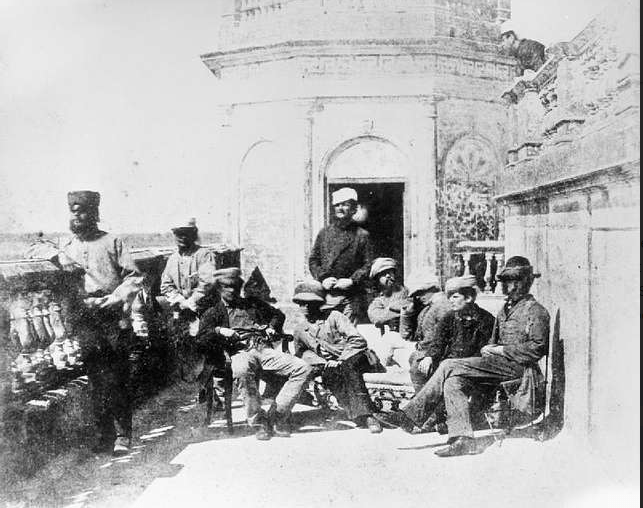
“But in the important particulars of daring and dash, Outram’s wings were sadly clipped by Colin Campbell, who, reversing Marshal Pelissier’s famous saying, absolutely forbade Outram to ‘break an egg in making his omelette.’ In other words, he was forbidden to execute a movement by which the rebel
army, already in retreat, would have been infallibly and entirely crushed, if, by doing so, he lost ‘the
life of a single British soldier.’ One is tempted to wonder whether Clyde deliberately wished to spill
out the campaign for private reasons of his own, or whether there was truth in the tale current at the time, that, not long previously, when in command on the North-Western Frontier, under the Government of Lord Dalhousie, the latter stern Satrap had good grounds for his alliterative despatch: ‘Colonel Colin Campbell has carried caution to the confines of cowardice.’ It is well known that Sir William Mansfield, afterwards Lord Sandhurst, shared the Fabian tactics of his chief, as historians have bitterly written regarding his action at Cawnpore. But that nothing succeeds like success, is at least an equally well-known and truthful dictum.”
Sources:
The Siege of Delhi – The Mutiny Memories of an Old Officer – Richard Barter (London Folio Society, 1884)
Kaye’s & Malleson’s History of the Indian Mutiny of 1857-58, Vol IV – edited by Col. Malleson (London: W.H. Allen & Co., 1889)
Lieutenant-General Sir James Outram’s Campaign in India, Comprising General Orders and Despatches – Printed for Private Circulation (London: Smith, Elder & Co., 1860)
Memories of the Mutiny, Vol II – Francis Cornwallis Maude (London & Sydney: Remington & Co., 1894)
The Story of a Soldier’s Life, Vol I – Field-Marshal Viscount Wolseley (New York: Charles Scribner’s Sons, 1903)
Service Memories – Sir Anthony Dickson Home (London: Edward Arnold, 1912)
 Mutiny Reflections