The Sad Demise of Lieutenant Gepp
Lieutenant Gepp and Lieutenant Miles had formed the two rear companies of the 66th the night before on the march to Charpura. “…we marched together; at daylight, we formed up in front of the enemies’ camp who at once opened fire on us with round shot from a battery of four guns (we had only two six-pounders); seeing these could not silence their battery (at any rate not under a long time), the three rear companies of our regiment, together with the Nepal contingent, were ordered to storm the guns on their right flank. We advanced some way before the enemy began to retreat, and when within a few yards, say one hundred to one hundred and fifty, we threw ourselves on them at the double. Gepp was on my right; many of the enemy were cut down at their guns, and many of them concealed themselves in the village. I saw Gepp with a man on the ground and in his power; this man, I believe, he killed, but was wounded slightly in the arm by him. I was pushing my men through the village and passed poor Gepp a little on his right, fancying he was all right and out of danger. On coming back after clearing the village, I was grieved to learn he had been shot by a villain concealed in a hut. I need not add that the man did not live to see the fruits of his villainy. When I came back, our supports had arrived, and I found Gepp being well taken care of by the officers who had come up with them. I supported him out of the village, and he then said, ” Write to my Father, ” and seemed perfectly conscious of his approaching end.” Lieutenant Miles, who wrote these words to his Gepp’s father, appears to have felt a measure of guilt at the young man’s fall.
“We all entertained great hopes of his recovery, though I do not think he ever thought of recovering, and the doctors had very little hope but did their best for him, as did all. We had no understanding about writing to one another’s friends, nor did Gepp make any other request to me or to any other officer that I know of. I have merely told you what I saw. Whether Gepp had pursued this man or not, I am not prepared to say, but I am inclined to believe my version is as correct a one as possible to be obtained considering the confusion in the enemies’ camp. It is very difficult to speak positively about anything, but as it struck me, I have related to you.”
Gepp had been cut in the left arm by a sword, and then shot, with the ball entering his left side, just under his heart. The ball then passed through his liver and was extracted by the doctor from just under the skin, on his right side. Unfortunately, the damage to his liver was so severe, that the doctor could do nothing but administer opiates and hope above hope, the young man would survive recover. Before he fell, Gepp had cut down three gunners and, along with Tytler, captured three guns.
Lieutenant Thomas Sydney Gepp lived long enough to return to Haldwani, but there was nothing anyone could do for him. He died on 12 February 1858 and was buried in Naini Tal cemetery. In writing to Gepp’s father, McCausland was quick to mention that Gepp’s gallantry had elicited the admiration of all his brother officers and he “was much and deservedly beloved by everyone and an ornament to his profession.” He assured his father that the officers intended to erect a monument over his son’s grave, and they further desired to place a memorial tablet in his parish church in Chelmsford. He then added, “Had he lived, I should have recommended him for the Victoria Cross.”
McCausland had been with Gepp to the last; he collected his watch, chain, ring, Bible and Pray-book, all of which he would send to his father, together with a few locks of his hair. He also took care of auctioning what little there was of Gepp’s property and assured his father his son had incurred neither debt nor any financial burdens. Sadly, McCausland would add,
“The enclosed letter arrived half an hour after he expired, I, therefore, return it. You have, my dear Sir, much to be thankful for that your poor son died a Soldier’s death and was not brutally murdered as many of our poor countrymen women and children have been. I have to deplore the loss of many near and dear relations, particularly a beloved son and daughter, in the horrible massacre at Cawnpore in July last. Once more expressing my heartfelt sympathy to yourself and family on the loss of so promising a Son.”
The following inscription at St Mary’s Parish Church (Chelmsford Cathedral), speaks for itself:
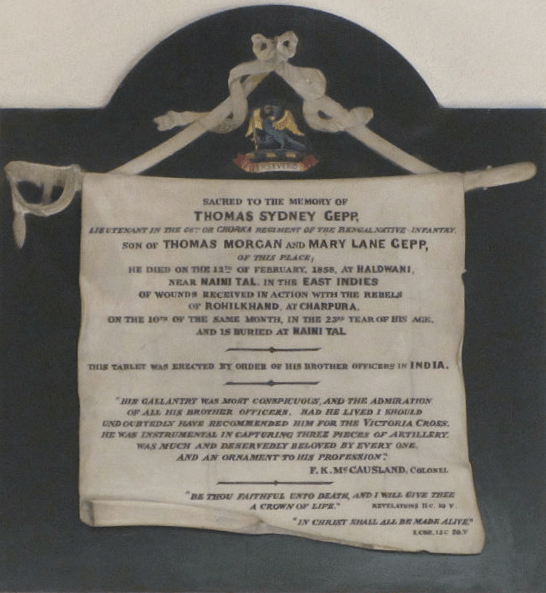
Sacred to the Memory of
THOMAS SYDNEY GEPP
Lieutenant in the 66th or Ghorka Regiment of the Bengal Native Infantry.
Son of Thomas Morgan and Mary Lane Gepp of this place.
He died on the 12th of February 1858 at HALDWANI,
near NAINI TAL, in the EAST INDIES
of wounds received in action with the rebels
of ROHILKHAND, at CHARPURA,
on the 10th of the same month, in the 23rd year of his age,
and is buried at NAINI TAL.
This Tablet was erected by order of his Brother Officers in INDIA.
“His gallantry was most conspicuous, and the admiration of all His Brother Officers.
Had he lived I should undoubtedly have recommended him for the Victoria Cross.
He was instrumental in capturing three pieces of artillery, was much and
deservedly beloved by every one, and an ornament to his profession.”
J. K. MCCAUSLAND, Colonel.
” Be thou faithful unto Death, and I will give thee a Crown of Life. “-Revelation 11. C. 10. V. “
In Christ shall all be made alive. “-1 Cor. 15. C. 20. V.
Thomas Sydney Gepp was the eldest of nine children born to the prominent Chelmsford solicitor, under sheriff and county treasurer, Thomas Morgan Gepp. Two of his brothers, Henry and Nicholas, joined the clergy, and Henry would become the longest-serving vicar of Adderbury, where the only disagreement he apparently had in his long career was with bell ringers. The remaining brothers, Charles and Walter, were firmly ensconced in the family business of ‘Gepp and Sons’ in Chelmsford. His nephew, Private Charles Edward Gepp, would die in World War I.
Sources:
Dodwell, Messrs., and Miles, Messrs. Alphabetical List of the Medical Officers of the Indian Army 1764-1838. London: Longman, Orme, Brown & Co., 1839.
Hodson, V. C. P. List of the Officers of the Bengal Army 1758-1834, Part III. London: Phillimore & Co., 1946.
Holmes, T. R. E. A History of the Indian Mutiny. London: W.H. Allen & Co., 1891.
Kaye, John William. A History of the Sepoy War in India 1857-1858. Vol. 3. London: Longmans, Green & Co., 1896.
Malleson, G. B. History of the Indian Mutiny 1857-1858, Commencing from the close of the Second Volume of Sir John Kaye’s History of the Sepoy War. Vol. 1. London: W.H. Allen & Co., 1878.
Petrie, Francis Loraine. The 1st King George’s Own Gurkha Rifles, the Malaun Regiment. London: Royal United Service Institution, 1925.
Great Britain. Parliament. Further Papers (No. 7), Relative to the Mutinies in the East Indies. London: Harrison & Sons, n.d.
 Mutiny Reflections